
BAR-222 · Lesson 3 of 12 · 19 min
Character and fitness and the MPRE
▶ Video coming soon A video version of this lesson is on the way.
Declan had one item on his petition that worried him. In 2022, after a dispute with a former landlord in Worcester over a security deposit and a broken lease, the landlord sued him in small claims court and won a judgment of a little over a thousand dollars, which Declan paid two months later. He wondered whether to mention it. Marchetti's answer was immediate. 'You mention it. You mention it accurately, with dates, and you attach the docket and the proof of payment. The judgment is not your problem. Leaving it out would be.'
This lesson covers the two requirements that test a candidate's ethics rather than knowledge of the law in general: the character and fitness review and the Multistate Professional Responsibility Examination.
The standard
Rule 3:01 requires that a petitioner be of good moral character and fit to practice law, and it places the burden on the petitioner to prove it. The Board of Bar Examiners does not need to find something wrong to deny admission; it needs to be satisfied that the petitioner has shown the qualities the public is entitled to expect of a lawyer. Those qualities include honesty, trustworthiness, diligence, respect for the law and the rights of others, and the ability to handle money, deadlines and confidential information responsibly.
The Supreme Judicial Court has described the inquiry as forward-looking. The question is not whether the petitioner has ever done anything wrong, but whether the record as a whole, including evidence of rehabilitation, shows that the petitioner can be trusted with clients' affairs now. In Matter of Prager, 422 Mass. 86 (1996), the court considered a petitioner who had led a large marijuana-smuggling operation, fled the country after his indictment and lived as a fugitive until he was extradited, and who then pleaded guilty, completed probation, graduated with honors from law school and clerked for a judge. The board recommended admission, but the court weighed the length and seriousness of the past conduct, including the flight from prosecution, against the evidence of reform and concluded that he had not yet carried his burden. It denied the application with leave to reapply after five years, over a dissent that would have admitted him. Cases like Prager teach that rehabilitation is possible but must be shown, not asserted, and that the more serious the conduct, the stronger the showing must be.
What the petition asks
The petition asks a long series of questions, and the board checks the answers against outside records. The main areas are these.
| Area | What the board looks for | Typical documents |
|---|---|---|
| Criminal history | Arrests, charges and convictions, including sealed, dismissed or continued matters the petition asks about | Court dockets, dispositions, police reports |
| Traffic matters | Citations and license suspensions as the petition defines them | Registry records, payment receipts |
| Civil litigation | Suits as party, judgments, small claims matters | Dockets, judgments, satisfactions |
| Academic record | Discipline at college or law school, academic dishonesty | Dean's certifications, hearing records |
| Employment | Terminations, discipline, gaps | Employer references, separation letters |
| Finances | Defaults, collections, tax problems, bankruptcy | Credit reports, payment plans, tax transcripts |
| Health and conduct | Conduct-based questions about anything affecting present ability to practice | Treatment or monitoring records only if a conduct question requires them |
| Bar admissions and discipline | Prior applications and any discipline elsewhere | Certificates of good standing |
The petition questions are precise, and the precise words matter. If a question asks about matters that were dismissed, continued without a finding or sealed, the petitioner must answer as asked, even if the matter would not appear on an ordinary background check. Continuance without a finding, a common Massachusetts disposition in which a criminal case is continued and later dismissed if the defendant complies with conditions, is a frequent source of mistaken answers. A candidate who believes that a dismissed case does not count should read the question again.
Candor is the test
The single most common reason for a serious character and fitness problem is not the underlying conduct but the failure to disclose it. Boards of bar examiners across the country, Massachusetts included, treat an omission or a misleading answer as evidence about present character, because it is: the petition is the first document a future lawyer files under the pains and penalties of perjury, and a lawyer's work depends on honest statements to courts and clients.
Marchetti gives every candidate three rules. Disclose when in doubt. Disclose completely, with dates, amounts and outcomes. Attach documents rather than describe them from memory. Declan's small claims judgment, disclosed with the docket and proof of payment, is an ordinary entry. The same judgment, left off the petition and found later by the board, would raise a question about whether he could be trusted to tell the truth when it was inconvenient.
Keeping the petition current
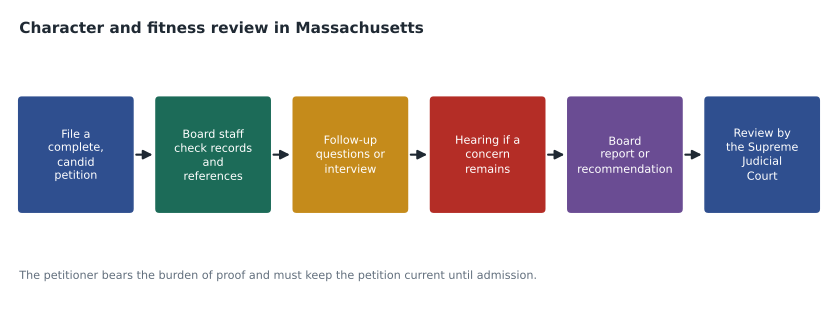
The duty to disclose does not end when the petition is filed. A petitioner must update the petition while it is pending if any answer changes: a new address, a new job, a traffic citation, a lawsuit, a change in finances. The duty runs until admission. Declan's move in October from his parents' house in Worcester to an apartment in Springfield went into the file within a week.
How the review proceeds
The board's staff review each petition, contact references and employers, and check court, motor vehicle and other records. Most petitions clear without any further step. When a question arises, the board may ask the petitioner for more information or documents, and it may invite the petitioner to an interview. If a concern remains, the board may hold a hearing at which the petitioner can present evidence and witnesses and be represented by counsel. If the board declines to recommend admission, the petitioner may seek review in the Supreme Judicial Court, which has the final word.
Financial responsibility
Debt is not disqualifying. Many candidates carry large student loans, and the board does not expect a new graduate to be debt-free. What matters is how the candidate handles obligations. A loan in repayment or in an approved deferment is ordinary. A string of defaults, unpaid judgments or ignored collection notices suggests the kind of neglect that could harm clients, whose money a lawyer will one day hold in trust. A candidate with financial problems should show a plan and evidence that it is being followed.
Mental health and substance use
Modern character and fitness questions focus on conduct rather than diagnosis. A candidate who sought counseling or treatment is not, for that reason alone, a problem for the board, and seeking help is generally viewed as a sign of responsibility. Where conduct has raised concerns, such as an arrest involving alcohol, the board looks at what the candidate has done since. Lawyers Concerned for Lawyers, the Massachusetts lawyer assistance program, offers confidential consultation to bar applicants who want advice before answering a question or who want support for its own sake.
The MPRE
The Multistate Professional Responsibility Examination is a national multiple-choice exam on the law governing lawyers. NCBE writes and administers it, usually three times a year, as a computer-based test. It has 60 questions, of which 50 are scored and 10 are unscored pretest questions, and the time allowed is two hours. Scores are reported on a scaled range from 50 to 150.
Massachusetts requires a scaled score of 85 or higher. That is at the high end of the range of required scores across American jurisdictions; most require between 75 and 86. A score earned for another jurisdiction counts in Massachusetts if it meets 85 and NCBE reports it to the board.
Massachusetts lets a candidate take the MPRE before or after the bar exam. What matters is that the qualifying score is on file before the board reports the petitioner to the court for admission. Many Massachusetts candidates take the MPRE during the second or third year of law school, which removes it from the bar-prep calendar entirely. A candidate who leaves it until after the bar exam should register for the first available administration, because a late MPRE can delay admission by months.
What the MPRE tests
The MPRE is based on the ABA Model Rules of Professional Conduct and the ABA Model Code of Judicial Conduct, together with generally accepted principles from leading cases and the law of lawyering. It does not test the Massachusetts Rules of Professional Conduct, which differ from the Model Rules in several places discussed in Lesson 11. A candidate studying for the MPRE should learn the Model Rules version and treat the Massachusetts differences as a separate topic for practice and for the Massachusetts Law Component, which includes legal ethics among its ten subject areas.
The heaviest topics on the MPRE are conflicts of interest, the client-lawyer relationship, client confidentiality, and litigation and other forms of advocacy. Questions often ask what a lawyer may do, as opposed to what a lawyer must do, and they reward precise reading. Marchetti's advice is to answer two or three hundred practice questions from NCBE's own materials and to keep a list of every rule that surprised you.
Declan's file
Declan's character and fitness file ended up thin, which is what most files look like. It contained the small claims matter with its docket and proof of payment, one speeding ticket from 2020, paid, the move to Springfield, and his two recommendation letters. His MPRE score of 98 was already on file. When the board's staff sent a routine request for a copy of the small claims judgment's satisfaction, he had it in his folder and returned it the same day.
Common mistakes
MistakeLeaving off a dismissed or continued case because it was not a conviction.
InsteadAnswer the question exactly as asked; continuances without a finding and dismissed matters are often covered.
MistakeDescribing a past matter from memory.
InsteadAttach dockets, dispositions and proof of payment.
MistakeTreating the petition as final once filed.
InsteadUpdate it for every changed answer until admission.
MistakeStudying the Massachusetts Rules for the MPRE.
InsteadThe MPRE tests the ABA Model Rules; learn the Massachusetts differences separately.
Practice problems
Work each problem on paper first, then reveal the answer to check.
Who bears the burden of proof in the Massachusetts character and fitness review?
Show answer
The petitioner.
What MPRE score does Massachusetts require?
Show answer
A scaled score of 85 or higher.
Must the MPRE be passed before the bar exam in Massachusetts?
Show answer
No; it may be taken before or after, but the score must be on file before the board reports the petitioner for admission.
What is a continuance without a finding, and why does it matter here?
Show answer
A Massachusetts criminal disposition that ends in dismissal if conditions are met; petition questions often require it to be disclosed.
A worked example
Worked problem
A late disclosure
Priya, a hypothetical petitioner, filed her Massachusetts petition in November and answered no to a question asking whether she had ever been charged with any offense. In January she remembered that, as a nineteen-year-old, she had been charged with possession of alcohol by a minor, and that the case had been continued without a finding and later dismissed. What should she do?
Show solution
- Read the petition question again. It asks about charges, not convictions, so the answer should have been yes.
- Amend the petition at once, explaining the original answer and correcting it.
- Obtain the court docket showing the charge, the continuance without a finding and the dismissal, and attach it.
- Write a short, factual statement of what happened, without minimizing it, and of what she has done since.
- Expect the board to ask about the original omission, and answer candidly.
Answer: Amend promptly and completely with documents. A prompt voluntary correction is far better than discovery by the board, and the underlying matter, by itself, is minor.
How the MPRE fits the study calendar
Because Massachusetts does not require the MPRE before the bar exam, candidates sometimes leave it to the end. Marchetti thinks that is a mistake for two reasons. First, the MPRE is offered only a few times a year, and registration closes weeks before each administration, so a candidate who waits can find that the next available date is months away. Second, preparing for the MPRE takes real time, typically two to four weeks of focused study, and that time is easiest to find before bar preparation begins. A candidate who takes it in law school, during or soon after a professional responsibility course, also benefits from having the material fresh.
A candidate who has already sat the MPRE for another jurisdiction should check that the score meets 85 and request that NCBE send it to Massachusetts. A score below 85 that satisfied another jurisdiction does not satisfy Massachusetts, and the candidate must sit again.
Character questions after admission
Character does not stop mattering at the oath. The Board of Bar Overseers handles complaints against Massachusetts lawyers, and misstatements in the admission process can themselves be grounds for discipline after admission. A lawyer who obtained admission by a materially false petition answer may face serious sanctions. The habit Marchetti teaches during the petition, full and accurate disclosure, is the same habit that protects a lawyer throughout a career.
Summary and key terms
- The petitioner must prove good moral character and fitness; the board looks forward, weighing past conduct against evidence of rehabilitation.
- Candor matters more than the underlying conduct; disclose completely and attach documents.
- The petition must be kept current until admission.
- Massachusetts requires an MPRE scaled score of 85, earned before or after the bar exam but on file before the report for admission.
- The MPRE tests the ABA Model Rules, not the Massachusetts Rules of Professional Conduct.
- Character and fitness
- The review of a petitioner's honesty, responsibility and fitness to practice.
- Rehabilitation
- Evidence that a petitioner has reformed since past misconduct.
- MPRE
- The Multistate Professional Responsibility Examination, a national ethics exam scored from 50 to 150.
- Continuance without a finding
- A Massachusetts disposition in which a criminal case is continued and later dismissed if conditions are met.
- Lawyers Concerned for Lawyers
- The Massachusetts lawyer assistance program, offering confidential help to lawyers and applicants.
Lesson quiz · 5 questions
Score 60% or more to complete this lesson.
Create a free account to save your progress, take quizzes and earn a certificate.