
BAR-222 · Lesson 6 of 12 · 17 min
The Massachusetts Law Component and how Massachusetts law appears
▶ Video coming soon A video version of this lesson is on the way.
Declan assumed the Massachusetts Law Component was a formality, something to click through on an afternoon after the bar exam. Then a lawyer at his firm who had been admitted in 2019 told him she had needed two tries. 'It's not hard,' she said, 'but it isn't the MBE. The answers are Massachusetts answers, and some of them are different from what you just spent ten weeks memorizing.' Declan brought the story to Marchetti, who agreed with both halves of it.
This lesson explains the Massachusetts Law Component, or MLC: who must take it, how it works, what it covers and how to prepare. It then maps the sources of Massachusetts law that the rest of this course draws on.
Why the MLC exists
When Massachusetts moved to the Uniform Bar Examination in 2018, it gave up its own essay questions on Massachusetts law. The Supreme Judicial Court wanted new lawyers to have some grounding in Massachusetts law all the same, so it made the MLC a condition of admission for petitioners filing on or after March 1, 2018. The MLC sits outside the bar exam: it is a separate requirement, taken online, with its own pass mark. Passing the UBE does not satisfy it, and failing it does not affect the UBE score.
The MLC applies on every route to admission. Petitioners for admission by examination, by UBE or NextGen score transfer and on motion must all pass it. It continues under NextGen.
How the MLC works
The MLC is a 50-question multiple-choice test taken online through the board's Applicant Portal. When a petitioner becomes eligible, the board sends an invitation email from its MLC address with a username and temporary password. Invitations for February examinees typically go out in early January, and for July examinees in early June. A petitioner who does not see the invitation should check a spam folder and then contact the board.
The questions are drawn from substantive outlines that the board provides at registration, and the MLC Outline is also available as a downloadable document. The passing score is 80 percent, which means 40 correct answers out of 50.
There is no fee. Once a petitioner starts the test, it must be completed within four days or it expires. A petitioner who does not pass may take it again as often as necessary, without penalty, but must wait 24 hours after an unsuccessful attempt before starting a new one. A repeat bar examinee who passed the MLC with an earlier petition does not need to take it again.
| Feature | Rule |
|---|---|
| Who | Every petitioner filing on or after March 1, 2018: examination, score transfer and motion |
| Format | 50 multiple-choice questions, online through the Applicant Portal |
| Pass mark | 80 percent: 40 of 50 |
| Fee | None |
| Time to finish | Four days from the start, or the attempt expires |
| Retakes | Unlimited, with a 24-hour wait after an unsuccessful attempt |
| Deadline, February exam | March 31 |
| Deadline, July exam | September 30 |
| Transfer and motion petitioners | As soon as invited; must be passed before the petition is reported to the court |
Deadlines and timing
For examinees, the board's deadline is March 31 for the February exam and September 30 for the July exam. Missing the deadline may delay admission. The board recommends taking the MLC after the bar exam rather than before, which matches the way most candidates plan their time: the weeks before the exam belong to the UBE, and the weeks after it are a natural time to turn to Massachusetts law.
For petitioners seeking admission by score transfer or on motion, the board asks for the MLC to be completed as soon as the invitation arrives. It must be passed, along with every other requirement, before the petition can be reported to the Supreme Judicial Court. Delay can postpone admission or even lead the board to close the petition.
The ten subject areas
The MLC covers ten areas of Massachusetts law. Each corresponds to a section of the MLC Outline, and each connects to the substantive lessons later in this course.
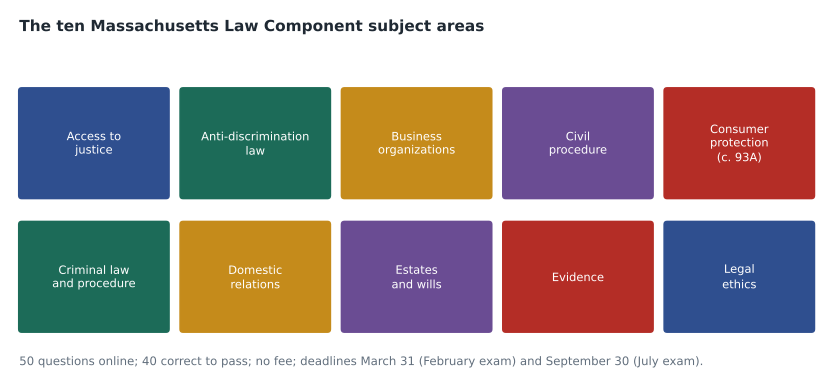
Access to justice covers the rules and programs that help people without lawyers or with limited means use the courts, such as limited assistance representation, in which a lawyer handles part of a matter, court service centers and the courts' language access rules.
Anti-discrimination law centers on General Laws chapter 151B, which prohibits discrimination in employment, housing and other areas, and on the Massachusetts Commission Against Discrimination, the state agency that investigates and adjudicates complaints. Chapter 151B reaches more employers than the federal statutes and has its own filing requirements.
Business organizations covers the Massachusetts Business Corporation Act, chapter 156D, the limited liability company statute, chapter 156C, and Massachusetts rules on partnerships and close corporations, including the heightened duties that Massachusetts courts have recognized among shareholders in close corporations.
Civil procedure covers the Massachusetts Rules of Civil Procedure and the structure of the Trial Court, discussed in Lesson 7.
Consumer protection covers chapter 93A, discussed in Lesson 9.
Criminal law and procedure covers distinctive Massachusetts rules, such as the continuance without a finding, the Massachusetts Rules of Criminal Procedure, and Massachusetts constitutional protections that in some areas exceed federal ones.
Domestic relations covers divorce, alimony, child support and custody under Massachusetts law, discussed in Lesson 10.
Estates and wills covers the Massachusetts Uniform Probate Code, chapter 190B, also discussed in Lesson 10.
Evidence covers Massachusetts evidence law as stated in the Massachusetts Guide to Evidence, which differs from the Federal Rules of Evidence on several points discussed in Lesson 7.
Legal ethics covers the Massachusetts Rules of Professional Conduct, discussed in Lesson 11.
How to prepare
The MLC is not designed to be difficult for a candidate who has read the outline. It is designed to make sure that new lawyers have read it. Marchetti's plan for Declan has three steps.
First, after the bar exam, download the MLC Outline and read it straight through once, without trying to memorize it. The aim is a map of the ten areas.
Second, read it again, this time marking every rule that differs from the general rule tested on the UBE. Those differences are where MLC questions are most likely to catch a candidate who answers from bar-prep memory. Examples include Massachusetts's modified comparative negligence rule, the Massachusetts approach to some evidence questions, and Massachusetts fee rules for lawyers.
Third, take the MLC within a few days of the second reading, with the outline at hand for review afterward. If the first attempt falls short of 40, review the areas where the misses fell, wait the required 24 hours and try again well before the deadline.
Where Massachusetts law comes from
Whether for the MLC or for practice, a Massachusetts lawyer needs to know where Massachusetts law is found and how the sources fit together.
The Constitution of the Commonwealth, drafted largely by John Adams and adopted in 1780, is the oldest written constitution still in effect anywhere in the world. Its Declaration of Rights protects individual rights, and the Supreme Judicial Court has interpreted several of its articles, notably Article 14 on searches and seizures and Article 12 on the rights of the accused, to give more protection than the federal constitution in some situations.
The General Laws are the Commonwealth's codified statutes, cited by chapter and section, as in G.L. c. 93A, section 9. Session laws, the acts as passed each year, appear in the Acts and Resolves. The Code of Massachusetts Regulations, cited as CMR, contains agency regulations, such as the Attorney General's consumer protection regulations under chapter 93A.
Court rules include the Massachusetts Rules of Civil Procedure, the Rules of Criminal Procedure, the Rules of Appellate Procedure, the Supreme Judicial Court Rules, including Rule 3:01 on admission and Rule 3:07, the Rules of Professional Conduct, and the rules of each Trial Court department, such as the Superior Court Rules.
Case law comes chiefly from the Supreme Judicial Court and the Appeals Court. Their published decisions appear in the Massachusetts Reports and the Massachusetts Appeals Court Reports. The Appeals Court also issues summary decisions in many cases; these are not binding precedent, though they may be cited for persuasive value under the court's rules.
The Massachusetts Guide to Evidence deserves special mention. Massachusetts has never adopted a code of evidence by statute or rule. Instead, a committee appointed by the Supreme Judicial Court publishes the Guide, which states Massachusetts evidence law as found in statutes, rules and cases, with commentary. The Guide is updated regularly, and courts cite it routinely, but its authority comes from the sources it collects.
How Massachusetts law appears in daily work
For Declan, the abstract list became concrete within weeks of starting at his firm. A consumer who bought a defective used car needed a chapter 93A demand letter. A slip-and-fall client needed an analysis of comparative negligence under chapter 231, section 85. A town's snowplow had damaged a client's fence, which meant a presentment letter under chapter 258. An elderly client wanted to know whether her house, held with her late husband as tenants by the entirety, would need to go through probate. Every one of those questions sits within an MLC area, and none of them is answered by the general rules the UBE tests.
Common mistakes
MistakeTreating the MLC as part of the bar exam.
InsteadIt is a separate admission requirement with its own pass mark, taken online.
MistakeAnswering MLC questions from MBE memory.
InsteadThe MLC tests Massachusetts law, which differs from the general rules on several points.
MistakeMissing the March 31 or September 30 deadline.
InsteadA late MLC can delay admission; take it soon after the exam.
MistakeCiting the Massachusetts Guide to Evidence as if it were a statute.
InsteadThe Guide collects and states the law; its authority comes from the underlying statutes, rules and cases.
Practice problems
Work each problem on paper first, then reveal the answer to check.
How many questions are on the MLC, and how many must be answered correctly?
Show answer
50 questions; 40 correct, which is 80 percent.
What is the MLC deadline for February examinees?
Show answer
March 31.
How long must a petitioner wait after an unsuccessful MLC attempt?
Show answer
24 hours.
Which chapter of the General Laws contains the main Massachusetts anti-discrimination statute?
Show answer
Chapter 151B.
Reading a Massachusetts citation
Massachusetts citations follow conventions that a new lawyer learns quickly. A statute is cited by chapter and section of the General Laws, as in G.L. c. 231, section 85, often written with the section symbol. A regulation is cited by title and section of the Code of Massachusetts Regulations, as in 940 CMR 3.00 for the Attorney General's general consumer protection regulations. A Supreme Judicial Court decision is cited to the Massachusetts Reports, as in 451 Mass. 623 (2008), and an Appeals Court decision to the Massachusetts Appeals Court Reports, abbreviated Mass. App. Ct., with the volume before the abbreviation and the first page after it. Both courts now also issue opinions with docket numbers and post them online before they appear in the printed reports.
Finding Massachusetts law
The official texts are free. The General Laws are published on the Legislature's website. The Supreme Judicial Court's rules, the Massachusetts Rules of Civil Procedure, the Rules of Professional Conduct and the Massachusetts Guide to Evidence are published on the Commonwealth's website. The Trial Court Law Libraries offer research help and access to commercial databases to the public and to lawyers. Recent decisions of both appellate courts are posted on the courts' websites and in free online case law collections.
Marchetti's research rule for the MLC and for practice is the same: start with the official text, then read the leading case or commentary, then check for recent amendments. A rule summarized in a bar-prep outline is a lead, not an authority.
A short sample of Massachusetts differences
To show Declan how the MLC areas differ from the UBE's general rules, Marchetti gave him a short list of contrasts to test himself on. Comparative negligence: Massachusetts bars a plaintiff whose negligence is greater than the defendants' combined negligence, rather than following pure comparative fault. Consumer claims: chapter 93A requires a demand letter at least 30 days before most consumer suits. Evidence: character for truthfulness is generally proved by reputation, not opinion. Probate: the Massachusetts Uniform Probate Code is in force for deaths on or after March 31, 2012, with informal and formal proceedings and a three-year limit on most original probate filings. Ethics: Massachusetts requires the scope and basis of a lawyer's fee to be communicated in writing in most matters. Each item is a likely MLC topic.
Marchetti added one practical note: because the MLC is taken online on the petitioner's own schedule, it is easy to postpone. She told Declan to put the date he would start the test on his calendar the day after the bar exam ended, and to treat it as an appointment.
Summary and key terms
- The MLC is a free, online, 50-question test of Massachusetts law required for every petitioner since March 1, 2018.
- The pass mark is 40 of 50; retakes are unlimited after a 24-hour wait; an attempt must be finished within four days.
- Deadlines are March 31 for February examinees and September 30 for July examinees; transfer and motion petitioners take it on invitation.
- The ten areas run from access to justice to legal ethics, including chapter 93A.
- Massachusetts law comes from the 1780 Constitution, the General Laws, the CMR, court rules and SJC and Appeals Court decisions, with evidence law collected in the Massachusetts Guide to Evidence.
- Massachusetts Law Component (MLC)
- The online test of Massachusetts law required for admission on every route.
- Applicant Portal
- The board's online system through which the MLC is taken.
- General Laws
- The codified statutes of Massachusetts, cited by chapter and section.
- CMR
- The Code of Massachusetts Regulations, containing agency regulations.
- Massachusetts Guide to Evidence
- A court-appointed committee's statement of Massachusetts evidence law, updated regularly.
- Chapter 151B
- The main Massachusetts anti-discrimination statute.
Lesson quiz · 5 questions
Score 60% or more to complete this lesson.
Create a free account to save your progress, take quizzes and earn a certificate.