
BAR-222 · Lesson 10 of 12 · 17 min
Massachusetts property, family and estates: tenancy by the entirety, alimony reform and the MUPC
▶ Video coming soon A video version of this lesson is on the way.
Three clients came to the Springfield firm in one November week with questions that sounded unrelated. A retired machinist wanted to know whether a creditor of her husband could force the sale of the house they owned together. A woman divorcing after twelve years of marriage wanted to know how long she might receive alimony. And a son whose father had died in September wanted to know how to get the father's car and bank account into his own name without, as he put it, a year in court. Declan handled the first interviews. Each answer depended on a Massachusetts statute that the UBE never tests in Massachusetts form.
This lesson covers three areas of Massachusetts law that a general practitioner meets constantly: how married couples hold property, how divorce divides property and sets alimony after the Alimony Reform Act of 2011, and how estates are administered under the Massachusetts Uniform Probate Code.
Tenancy by the entirety
Massachusetts recognizes three forms of concurrent ownership of real property: tenancy in common, joint tenancy with the right of survivorship, and tenancy by the entirety, which is available only to married couples. Like a joint tenancy, a tenancy by the entirety carries a right of survivorship: when one spouse dies, the survivor owns the whole property, and it passes outside probate.
The modern Massachusetts tenancy by the entirety is a creature of statute. Under the old common law, the husband controlled entireties property during the marriage. The Legislature changed that by amending G.L. c. 209, section 1, by chapter 727 of the Acts of 1979, effective February 11, 1980. For tenancies created on or after that date, both spouses have equal rights to possession, rents and profits. The amendment does not reach tenancies created before February 11, 1980, but section 1A of chapter 209 lets the owners of an earlier tenancy elect, by a notarized writing recorded at the registry of deeds, to bring it under the new rules.
The feature that makes the tenancy valuable to families is creditor protection. Under the statute, the interest of a debtor spouse in property held as tenants by the entirety is not subject to seizure or execution by a creditor of that spouse alone so long as the property is the principal residence of the nondebtor spouse. The protection does not apply to debts on which both spouses are liable, such as a mortgage both signed, and the statute contains other exceptions, including for debts for necessaries. A creditor of one spouse may take a security interest or lien on that spouse's interest, but in general cannot force a sale of the home while the nondebtor spouse lives there. If the debtor spouse dies first, the survivor takes the property free of that spouse's individual creditors. If the nondebtor spouse dies first, the creditor's position may change.
A tenancy by the entirety lasts only as long as the marriage. A divorce ordinarily converts it into a tenancy in common, unless the divorce judgment provides otherwise, which is why divorce judgments usually address the marital home expressly.
The Commonwealth's registry guidance confirms that a deed may create a tenancy by the entirety without reciting the marriage, and that registries do not require proof of marital status or of the spouses' sex.
Massachusetts also protects homes through the Homestead Act, G.L. c. 188, as rewritten effective in 2011. Every owner-occupied principal residence has an automatic homestead exemption against many creditors, and owners who record a declaration of homestead receive a larger exemption. The two protections, tenancy by the entirety and homestead, often work together.
| Form of ownership | Who may hold | Survivorship | Creditor of one owner |
|---|---|---|---|
| Tenancy in common | Anyone | No; each share passes by will or intestacy | May reach the debtor's share |
| Joint tenancy | Anyone | Yes | May reach the debtor's share, which can sever the joint tenancy |
| Tenancy by the entirety | Married couples only | Yes | Cannot force sale of the nondebtor spouse's principal residence for one spouse's separate debt |
The retired machinist's question had a clear answer. She and her husband had bought the house in 1994 and held title as tenants by the entirety. The creditor was a business lender to whom only her husband had given a personal guarantee. Because the house was her principal residence and the debt was his alone, the lender could not force a sale. Declan noted for Tobin that the lender might still record a lien on the husband's interest, which would matter if the house were sold or if she died first.
Divorce and property division
Massachusetts allows divorce on no-fault grounds, an irretrievable breakdown of the marriage, as well as on traditional fault grounds that are now rarely used. The Probate and Family Court decides property division, alimony, child support and custody.
Under G.L. c. 208, section 34, the court may assign to either spouse all or any part of the estate of the other. Massachusetts is an all-property state: the court may divide any property either spouse owns, however and whenever acquired, including property owned before the marriage and property received by gift or inheritance. The court does not start with a presumption of equal division. Instead, it weighs the statutory factors, which include the length of the marriage, the conduct of the parties, age, health, station, occupation, income, vocational skills, employability, estate, liabilities and needs of each party, the opportunity of each for future acquisition of assets and income, and the contributions of each to the acquisition, preservation or appreciation of the estates, including contributions as a homemaker.
The Alimony Reform Act of 2011
Before 2012, Massachusetts alimony was often open-ended. The Alimony Reform Act, chapter 124 of the Acts of 2011, effective March 1, 2012, rewrote the law in sections 48 to 55 of chapter 208. It created four types of alimony and attached time limits to the most common one.
General term alimony is periodic support for a spouse who is economically dependent. Rehabilitative alimony supports a spouse who is expected to become self-supporting by a predicted time, such as completion of training. Reimbursement alimony repays a spouse who contributed to the other's financial resources, such as by supporting the other through professional school, in a short marriage. Transitional alimony helps a spouse adjust to a change in lifestyle or location after a short marriage.
For general term alimony, the Act sets maximum durations based on the length of the marriage. If the marriage lasted five years or less, general term alimony may last no longer than half the number of months of the marriage. For marriages of more than five but not more than ten years, the limit is 60 percent of the number of months; more than ten but not more than fifteen years, 70 percent; and more than fifteen but not more than twenty years, 80 percent. For marriages longer than twenty years, the court may order general term alimony for an indefinite length of time. A court may deviate from the limits on written findings that deviation is required in the interests of justice.
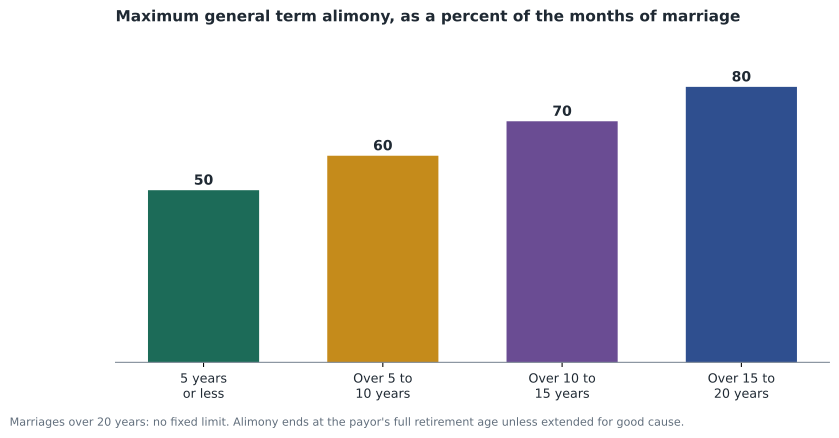
General term alimony also ends automatically when the paying spouse reaches full retirement age, the age at which the payor is eligible for the full Social Security retirement benefit, unless the court finds good cause to extend it when it makes the original order. And the payor may seek to suspend, reduce or terminate general term alimony if the recipient has maintained a common household with another person for a continuous period of at least three months.
The Act also guides the amount. In general, the amount of alimony should not exceed the recipient's need or 30 to 35 percent of the difference between the parties' gross incomes, a guideline that courts apply with the statutory factors and may depart from with findings.
The divorcing client had been married for twelve years, or 144 months. Under the Act, general term alimony could last no longer than 70 percent of 144 months, which is about 100 months, a little over eight years, unless the court found that deviation was required. Her husband was 58, so his full retirement age, likely 67, would arrive in about nine years, after the durational limit. Declan explained both limits and that the amount would depend on need and incomes.
The Massachusetts Uniform Probate Code
Massachusetts administers estates under the Massachusetts Uniform Probate Code, G.L. c. 190B, which took full effect on March 31, 2012, after its guardianship provisions took effect in 2009. The MUPC replaced most older probate statutes with a system based on the national Uniform Probate Code, adapted for Massachusetts. Estates of decedents who died before March 31, 2012 may still be governed by earlier rules on some points.
The MUPC offers several ways to administer an estate, depending on its size and whether anyone disputes it.
Informal probate is an administrative proceeding handled by a magistrate rather than a judge. A magistrate may admit a will to probate and appoint a personal representative with priority, but may not decide contested matters. Informal probate is not available where a guardian ad litem must be appointed.
Formal probate is a proceeding before a judge, required for contested matters, for creditor petitions and for some appointments.
Voluntary administration is a simplified procedure for small estates. A voluntary personal representative begins it by filing a voluntary administration statement, which lets the representative collect and distribute modest assets without a full appointment.
Whichever route is used, the personal representative receives letters of authority, the document that proves the representative's power to act for the estate, after appointment and approval of any required bond.
The MUPC sets a general time limit: informal probate or appointment, and formal testacy or appointment proceedings, must be filed within three years after the decedent's death, under section 3-108. Several proceedings are not subject to that limit, including voluntary administrations and determinations of heirs. For deaths on or after March 31, 2012, a formal late and limited proceeding may be brought after three years, but the personal representative appointed in it has limited authority.
Wills and the surviving spouse
A Massachusetts will must be in writing, signed by the testator, and signed by at least two witnesses. Massachusetts does not recognize unwitnessed handwritten wills. A will may be made self-proved by the testator's and witnesses' affidavits, which simplifies probate.
A surviving spouse who is dissatisfied with the will may, within a limited time, file a waiver of the will and claim a statutory share. Massachusetts kept its own elective share rules under chapter 191 rather than adopting the national code's augmented-estate system, and the size of the share depends on whether the decedent left descendants or other kin. The elective share is complex, and a new lawyer should research it carefully when it arises.
The son's question about his father's estate fit the MUPC's simplest route. The father had died in September 2026 leaving a car and a modest bank account, no real estate and no will. Declan explained that a voluntary administration would likely let the son, as an heir, collect and distribute the assets after the required waiting period, without a formal appointment and without anything like a year in court.
Common mistakes
MistakeAssuming one spouse's creditor can force sale of an entireties home.
InsteadFor tenancies created since February 11, 1980, a creditor of one spouse cannot reach the home while it is the nondebtor spouse's principal residence, subject to the statute's exceptions.
MistakeAssuming Massachusetts divides only marital property.
InsteadSection 34 lets the court assign any property of either spouse, however acquired.
MistakeAssuming alimony is open-ended.
InsteadGeneral term alimony has durational limits for marriages of twenty years or less and ends at the payor's full retirement age.
MistakeAssuming every estate needs formal probate.
InsteadThe MUPC offers voluntary administration and informal probate, with formal probate for contested matters.
MistakeMissing the three-year MUPC limit.
InsteadMost original probate and appointment proceedings must be filed within three years of death.
Practice problems
Work each problem on paper first, then reveal the answer to check.
When did the modern Massachusetts tenancy by the entirety take effect?
Show answer
February 11, 1980, under chapter 727 of the Acts of 1979 amending c. 209, section 1.
What is the maximum duration of general term alimony for a nine-year marriage?
Show answer
60 percent of the 108 months of the marriage, about 65 months.
When does general term alimony end automatically?
Show answer
When the payor reaches full retirement age, unless the court extends it for good cause in the original order.
Who may handle informal probate under the MUPC?
Show answer
A magistrate, who may not decide contested matters.
Marchetti's summary of the three interviews was short: in Massachusetts, how title is held, how long a marriage lasted and when a person died are facts that change legal answers, so a new lawyer should ask about all three early.
Summary and key terms
- Tenancy by the entirety, as amended effective February 11, 1980, gives spouses equal rights and shields the nondebtor spouse's principal residence from one spouse's separate creditors.
- Massachusetts is an all-property state: c. 208, section 34 lets the court divide any property of either spouse after weighing statutory factors.
- The Alimony Reform Act of 2011 created four alimony types and durational limits of 50, 60, 70 and 80 percent of the months of marriage, with indefinite awards after twenty years.
- General term alimony ends at the payor's full retirement age and may be modified for cohabitation of three months or more.
- The MUPC, in full effect since March 31, 2012, offers voluntary, informal and formal procedures, with a general three-year limit for original proceedings.
- Tenancy by the entirety
- Concurrent ownership by spouses with survivorship and statutory creditor protection.
- All-property state
- A state in which divorce courts may divide any property of either spouse.
- General term alimony
- Periodic support for an economically dependent spouse, subject to durational limits.
- Full retirement age
- The age at which the payor may receive full Social Security retirement benefits.
- MUPC
- The Massachusetts Uniform Probate Code, G.L. c. 190B.
- Letters of authority
- The court document proving a personal representative's power to act.
Lesson quiz · 5 questions
Score 60% or more to complete this lesson.
Create a free account to save your progress, take quizzes and earn a certificate.