
BAR-222 · Lesson 12 of 12 · 23 min
Capstone: Massachusetts practice questions and an exam-day plan
▶ Video coming soon A video version of this lesson is on the way.
On the last Tuesday before the holidays, Marchetti gave Declan a different kind of assignment. Instead of a practice essay from a national bank, she handed him an original fact pattern set entirely in Massachusetts and asked him to answer it the way a first-year associate would answer a partner: issue by issue, with the rule, the application and a conclusion. Then she asked him to write out his plan for February 23 and 24, 2027, hour by hour. 'The first part is for the job,' she said. 'The second part is for the exam. You need both.'
This lesson brings the course together. It offers an original Massachusetts problem with a model analysis, a set of short practice questions on Massachusetts law, a review of the admission timeline and a detailed exam-day plan. The problem and questions are original and written for this course; they are not drawn from any released bar exam.
The problem
The following facts are a hypothetical.
Rosalind and Walter Dunphy, married since 1998, own their home in Holyoke as tenants by the entirety under a deed recorded in 2001. In March 2025, Walter personally guaranteed a loan from a finance company to his brother's landscaping business, which later defaulted. Rosalind signed nothing.
In April 2026, the Dunphys hired Corbett Porchworks, a home improvement contractor, to replace their back porch for 24,000 dollars. Corbett's salesperson told them the company was registered as a home improvement contractor and that the work would be inspected. Neither statement was true. Corbett took a 12,000 dollar deposit, built a porch that a city building inspector later found unsafe, and refused to return calls.
In June 2026, while the porch dispute was pending, Rosalind was walking on a city sidewalk when a city maintenance truck backing out of a driveway struck her. The driver was looking at a clipboard. Rosalind was crossing behind the truck while reading a text message. She broke her wrist and incurred 30,000 dollars in medical expenses and lost wages; her lawyer values the claim at 150,000 dollars in total damages.
In October 2026, the finance company obtained a judgment against Walter on the guarantee and told him it would levy on the house. Walter wants to know whether it can. Rosalind wants to know what she can do about Corbett and about the city truck.
Model analysis
Issue one: can Walter's creditor levy on the house? Under G.L. c. 209, section 1, as amended effective February 11, 1980, the interest of a debtor spouse in property held as tenants by the entirety is not subject to seizure or execution by a creditor of that spouse alone so long as the property is the principal residence of the nondebtor spouse. The Dunphys' tenancy was created in 2001, after the amendment. The judgment debt arises from a guarantee Walter alone signed; it is not a joint debt and does not appear to be for necessaries. The house is Rosalind's principal residence. The creditor therefore cannot force a sale while those conditions hold. It may be able to record a lien that would attach to Walter's interest if the property were sold or if Rosalind died first. Walter should also consider whether a recorded declaration of homestead adds protection. Conclusion: no levy on the home at present.
Issue two: what claims do the Dunphys have against Corbett? Corbett is engaged in trade or commerce. Its salesperson's false statements about registration and inspection, and its taking of a deposit for unsafe work and refusal to respond, are likely unfair or deceptive acts under chapter 93A, section 2, and the Attorney General's home improvement regulations address misrepresentations of this kind. The Dunphys are consumers, so their claim arises under section 9. Before suing, they must send a written demand letter at least 30 days before filing, identifying themselves and describing the practices and injury, and demanding relief, such as a refund of the 12,000 dollar deposit plus the cost of removing the unsafe porch. If Corbett makes no tender or an unreasonable one, and the court finds the violation willful or knowing or the refusal to grant relief in bad faith, the court must award two to three times actual damages, plus reasonable attorney fees. The Dunphys also have breach of contract claims, and Massachusetts home improvement statutes may provide additional remedies. The four-year chapter 93A limitation period gives them ample time. Conclusion: send a demand letter now.
Issue three: what must Rosalind do about the city truck? The driver was a city employee acting within the scope of employment, so the Massachusetts Tort Claims Act, chapter 258, governs. The city, not the driver, is the proper defendant for negligence. Backing a truck while looking at a clipboard is ordinary operational negligence, not a discretionary function, and no section 10 exception appears to apply, although that should be researched. Before suing, Rosalind must present the claim in writing to the city's executive officer, typically the mayor in a city with a mayor, within two years after the June 2026 accident, that is, by June 2028. The city then has six months to respond; denial or silence for six months permits suit, which must be filed within three years of the accident.
Issue four: how will comparative negligence and the cap affect recovery? Under G.L. c. 231, section 85, Rosalind recovers if her negligence was not greater than the city's, reduced by her percentage. Crossing behind a backing truck while reading a text is negligence a jury may well find, but likely less than the driver's. If the jury found her 30 percent at fault on 150,000 dollars of damages, her damages would be reduced to 105,000 dollars. The chapter 258 cap of 100,000 dollars per plaintiff would then limit the city's liability to 100,000 dollars, with no prejudgment interest and no punitive damages. If she were found more than 50 percent at fault, she would recover nothing. Conclusion: present the claim promptly, document the driver's conduct, and value the case with both the comparative negligence reduction and the cap in mind.
Issue five: which court? A claim against the city with damages reasonably likely to exceed 50,000 dollars belongs in the Superior Court. The chapter 93A claim against Corbett, with treble damages potentially exceeding 50,000 dollars, might also go to the Superior Court; if the realistic recovery is lower, the District Court is available. Any Superior Court motions would follow Rule 9A.
How the answer is built
Marchetti pointed out the structure of the model analysis, because the same structure works on the MEE and in practice. Each issue starts with a question. The rule follows in a sentence or two, with the statute named. The application uses the facts, especially the specific facts: the 2001 deed, the guarantee Walter alone signed, the clipboard, the text message. The conclusion is stated plainly, with a practical next step. Nothing is left implied.
She also pointed out what the model analysis does not do. It does not recite every exception to chapter 258 or every element of chapter 93A. It identifies the rules the facts raise, applies them, and flags what needs research. On the bar exam, that is how answers earn points. In practice, that is how memos earn trust.
Short practice questions
These original questions test the Massachusetts law covered in Lessons 7 to 11. Answer each before reading the answer.
Practice problems
Work each problem on paper first, then reveal the answer to check.
A plaintiff sues two defendants for negligence. The jury finds the plaintiff 45 percent at fault and each defendant 27.5 percent at fault, with damages of 200,000 dollars. What does the plaintiff recover?
Show answer
110,000 dollars. The plaintiff's 45 percent is not greater than the defendants' combined 55 percent, so recovery is reduced by 45 percent.
A consumer sues a dealer under chapter 93A, section 9, without sending a demand letter. The dealer has a showroom in Worcester. What is the likely result?
Show answer
Dismissal or a stay; no exception applies, so the 30-day demand letter was required.
A business sues a supplier under chapter 93A, section 11, for willful deception. Must it send a demand letter first?
Show answer
No. Section 11 has no demand letter requirement.
A claimant presents a negligence claim against a town to the town's highway superintendent, not to the executive officer named in chapter 258. What is the risk?
Show answer
The presentment may be defective, and courts apply the requirement strictly; present to the correct executive officer within two years.
A twelve-year marriage ends in divorce. What is the maximum duration of general term alimony absent deviation?
Show answer
70 percent of 144 months, about 100 months.
A personal representative is needed for an estate of a decedent who died three and a half years ago. Can informal probate be used?
Show answer
Generally no; the three-year limit of section 3-108 applies, though a formal late and limited proceeding may be available.
A Superior Court defendant wants to move to dismiss. Should the motion be filed with the clerk immediately?
Show answer
No. Under Rule 9A, serve the motion; file the package after the opposition period.
A lawyer agrees orally to handle a single-session consultation for a 200 dollar fee. Must the fee be put in writing under Massachusetts Rule 1.5(b)?
Show answer
No; single-session consultations and fees expected to be under 500 dollars are exceptions.
A New Hampshire lawyer earned 272 on the UBE six years ago. Can the score be transferred?
Show answer
No; the score must have been earned within five years. The lawyer may qualify on motion if she meets the practice requirements, or may sit for the exam.
How many correct answers does a petitioner need on the MLC?
Show answer
40 of 50.
The admission timeline, one last time
Declan's path, now that his petition was on file, looked like this. Exam on February 23 and 24, 2027. Massachusetts Law Component after the exam, before March 31. Results in late April 2027. Character and fitness clearance, already well advanced. Report to the Supreme Judicial Court. Oath at an admission ceremony, which must occur within one year after the report. Registration with the Board of Bar Overseers. No mandatory CLE afterward, but a self-chosen first-year curriculum.
| Date | Step |
|---|---|
| November 9, 2026 | Petition filed for the February 2027 exam (done) |
| January 2027 | Laptop mock exam; MLC invitation expected |
| February 23, 2027 | Day one: MPT and MEE |
| February 24, 2027 | Day two: MBE |
| By March 31, 2027 | Pass the MLC |
| Late April 2027 | Results |
| After the board's report | Admission ceremony and oath within one year |
| After the oath | Register with the Board of Bar Overseers |
The exam-day plan
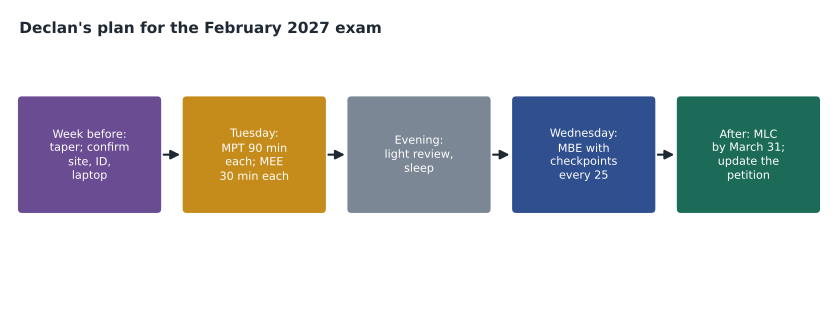
Marchetti's exam-day plans always have the same shape: the week before, each exam day, the evening between and the days after.
The week before. Taper study: review outlines and do light timed sets, but no new material and no full practice exams after the weekend before. Confirm the test site, travel time and parking, and do a trial run of the route if the site is unfamiliar. Pack the night before day one: admission ticket, required identification, approved items, laptop and charger if typing, a watch if permitted, and food and water as the rules allow. Check the board's instructions on what may and may not be brought into the room, and follow them exactly.
Day one, Tuesday. The morning holds the two MPT tasks. Spend the first part of each 90 minutes reading the task memo, the File and the Library; outline before writing; and stop at 90 minutes on the first task even if it feels unfinished, because the second task is worth the same. The afternoon holds six MEE questions at 30 minutes each. Read the call first, then the facts; organize by the call; state each rule in a sentence before applying it; and move on at 30 minutes. A complete answer to all six beats a perfect answer to five.
The evening between. Eat, walk and sleep. A short review of high-yield MBE rules is fine. Do not discuss the essays with other candidates; nothing useful comes of it.
Day two, Wednesday. The MBE runs in two sessions of 100 questions, three hours each. Pace at about 1.8 minutes per question, with checkpoints: about 45 minutes for every 25 questions. Answer every question, since there is no penalty for wrong answers. Mark hard questions and return if time allows, but bubble a best guess first so that nothing is left blank.
After the exam. Rest for a day or two. Then update the petition if anything has changed, take the MLC, and keep the folder current. Results arrive in late April.
Closing the course
Declan's last question of the session was whether any of the Massachusetts law would be on the exam. Marchetti answered honestly: almost none of it, because the UBE tests general principles. 'But on the MLC, all of it,' she said, 'and in Maureen Tobin's office, every bit of it, starting the day you are sworn in.' He wrote 'March 31' at the top of his calendar page, under the exam dates, and logged off to do twenty-five MBE questions before bed.
Common mistakes
MistakeWriting an essay that states rules without applying them to specific facts.
InsteadUse the facts, especially specific dates, signatures and conduct, in every application.
MistakeSpending extra time on the first MPT task.
InsteadStop at 90 minutes; the second task is worth the same.
MistakeLeaving MBE answers blank.
InsteadAnswer every question; there is no penalty for guessing.
MistakeForgetting the post-exam requirements.
InsteadTake the MLC by March 31 and keep the petition current.
Summary and key terms
- A Massachusetts problem often combines tenancy by the entirety, chapter 93A, chapter 258 and comparative negligence; analyze each issue with rule, application and conclusion.
- Chapter 258 presentment, the 100,000 dollar cap and section 85's 51 percent bar interact in public-employer injury cases.
- Chapter 93A demand letters come before suit in most consumer cases and often decide them.
- The exam-day plan covers the week before, two exam days, the evening between and the post-exam steps.
- After the exam come the MLC by March 31, results in late April, the board's report, the oath within one year and registration.
- IRAC
- Issue, rule, application, conclusion: the structure of a legal analysis.
- Issue map
- A diagram of the legal issues a fact pattern raises.
- Checkpoint
- A planned time check during the MBE, such as every 25 questions.
- Taper
- Reducing study volume in the final days before the exam.
- Original practice question
- A question written for study, not drawn from a released exam.
Lesson quiz · 5 questions
Score 60% or more to complete this lesson.
Create a free account to save your progress, take quizzes and earn a certificate.