
BAR-110 · Lesson 9 of 12 · 23 min
Contract formation and defenses
▶ Video coming soon A video version of this lesson is on the way.
Contracts week begins on November 7, and Dana Whitfield is relieved. 'Finally something that does not change every June,' she says. Marchetti agrees that contracts law is stable, but warns that the MBE makes up for it with detail: about a quarter of the questions turn on UCC Article 2, and the examiners love the points where the UCC and the common law part ways. Formation accounts, with performance and breach, for about half of the contracts questions. This lesson covers which law applies, offer and acceptance, consideration and its substitutes, and the defenses that make a contract unenforceable.
Which law applies
Article 2 of the Uniform Commercial Code governs contracts for the sale of goods, meaning things movable at the time of identification to the contract. The common law, as summarized in the Restatement (Second) of Contracts, governs everything else, including services, real estate, employment and intellectual property licenses. Some Article 2 rules apply to everyone, while others apply only to merchants, people who deal in goods of the kind or hold themselves out as having knowledge or skill about them.
For mixed contracts involving both goods and services, most courts apply the predominant purpose test: if the main purpose is the sale of goods, Article 2 governs the whole contract; if it is services, the common law does. On the MBE, the installation of a furnace in a house is typically a sale of goods with incidental services, while a portrait commission is mainly a service.
Offer
An offer is a manifestation of willingness to enter into a bargain, made so that the offeree is justified in understanding that assent is invited and will conclude it. Courts judge it objectively: what would a reasonable person in the offeree's position think? Advertisements, catalogs and price quotations are generally invitations to deal, not offers, unless they are specific about quantity and leave nothing open for negotiation, as in Lefkowitz v. Great Minneapolis Surplus Store (1957), where a store offering a fur stole 'first come, first served' made an offer. Statements made in obvious jest are not offers.
Under the common law, an offer must be reasonably definite in its essential terms, typically the parties, subject matter, price and quantity. The UCC is more forgiving: a contract for the sale of goods does not fail for indefiniteness if the parties intended to make a contract and there is a reasonably certain basis for giving a remedy. The UCC supplies missing terms such as a reasonable price, delivery at the seller's place of business and payment at delivery, but generally not quantity. Output and requirements contracts, in which quantity is measured by the seller's actual output or the buyer's good-faith requirements, are definite enough, though quantities may not be unreasonably disproportionate to any stated estimate or to normal prior amounts.
Termination of the offer
An offer can end in several ways. The offeror may revoke it at any time before acceptance by communicating revocation to the offeree, and indirect revocation occurs if the offeree learns from a reliable source that the offeror has taken action inconsistent with the offer, such as selling the item to someone else, Dickinson v. Dodds (1876). The offeree may reject it, and a counteroffer acts as a rejection under the common law. The offer lapses after the time stated, or a reasonable time if none is stated. It ends on the death or incapacity of either party before acceptance, except for option contracts.
Some offers are irrevocable. An option contract, in which the offeree gives consideration to keep the offer open, cannot be revoked during the option period. Under UCC 2-205, a firm offer by a merchant to buy or sell goods in a signed writing that gives assurance it will be held open is irrevocable for the time stated, or a reasonable time, but in no event more than three months, even without consideration. Under Restatement section 45, an offer for a unilateral contract becomes irrevocable once the offeree begins performance, and section 87(2) makes an offer binding to the extent necessary to avoid injustice if the offeror should reasonably expect it to induce substantial reliance before acceptance, as when a general contractor relies on a subcontractor's bid, Drennan v. Star Paving (1958).
Acceptance
An acceptance is a manifestation of assent to the terms of the offer in the manner invited or required by it. Only the person to whom the offer was made may accept, and the offeree must know of the offer. Under the mailbox rule, an acceptance sent in a reasonable manner is effective when dispatched, even if it is lost, unless the offer says otherwise. Rejections and revocations are effective only on receipt. If an offeree sends a rejection and then an acceptance, whichever arrives first controls. Acceptance under an option contract is effective on receipt.
Most offers invite acceptance by promise or performance, in any reasonable manner. An offer that clearly requires performance creates a unilateral contract, accepted only by full performance. Silence is generally not acceptance, unless the parties' prior dealings make it reasonable, or the offeree takes the benefit of offered services with reason to know they were offered with an expectation of payment.
The mirror image rule and UCC 2-207
At common law, an acceptance must mirror the offer exactly; a response that adds or changes terms is a rejection and a counteroffer. If the parties then perform, the last communication before performance usually supplies the terms, the last-shot rule.
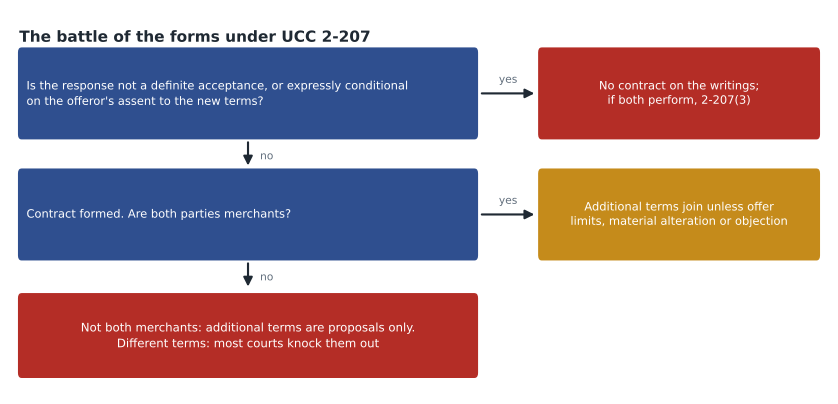
UCC 2-207 changes this for sales of goods, to resolve the battle of the forms. A definite and seasonable expression of acceptance operates as an acceptance even though it states additional or different terms, unless acceptance is expressly made conditional on assent to them. If either party is not a merchant, the additional terms are proposals that do not become part of the contract unless the offeror agrees. If both parties are merchants, additional terms become part of the contract automatically unless the offer expressly limits acceptance to its terms, the terms materially alter the contract, or the offeror objects within a reasonable time. Different terms are handled by most courts under the knockout rule: conflicting terms cancel out and the UCC gap fillers apply. If the writings do not form a contract but the parties act as if they have one, 2-207(3) recognizes a contract consisting of the terms on which the writings agree plus the UCC's gap fillers.
Consideration
A promise is enforceable as a contract only if supported by consideration, a bargained-for exchange of a promise or performance. Each party's promise or performance must be sought by the other in exchange for its own. The consideration may be a benefit to the promisor or a detriment to the promisee, such as giving up a legal right, Hamer v. Sidway (1891), where a nephew's giving up drinking and smoking until age 21 was consideration for his uncle's promise of money. Courts generally do not inquire into the adequacy of consideration, though a gross disparity may suggest fraud or unconscionability.
Several things are not consideration. A gift promise lacks bargain. Past consideration, a benefit already received when the promise is made, does not count, though Restatement section 86 enforces some promises made in recognition of a past benefit to prevent injustice. A preexisting legal duty is not consideration: a promise to pay more for what the other party is already obligated to do is unenforceable under the common law unless the duty is changed or unforeseen difficulties arise, Alaska Packers v. Domenico (1902). But under UCC 2-209(1), an agreement modifying a sale of goods needs no consideration, so long as it is made in good faith. An illusory promise, one that leaves performance entirely to the promisor's discretion, is not consideration, though courts often imply a duty of good faith or reasonable efforts to save a contract, Wood v. Lucy, Lady Duff-Gordon (1917).
Settling a disputed claim is consideration if the claim is asserted in good faith, even if it turns out to be invalid. A promise to pay part of an undisputed, liquidated debt in full satisfaction is not enforceable at common law, but an accord and satisfaction of a disputed or unliquidated claim is, including by a check conspicuously marked as full payment under UCC 3-311.
Substitutes for consideration
Promissory estoppel, Restatement section 90, enforces a promise that the promisor should reasonably expect to induce action or forbearance, that does induce it, if injustice can be avoided only by enforcement. The remedy may be limited as justice requires, often to reliance damages. Charitable subscriptions are binding under section 90(2) without proof of reliance. A promise to pay a debt barred by the statute of limitations, or a debt discharged in bankruptcy, made in writing, is enforceable without new consideration in most states.
Defenses to formation and enforcement
Even a bargained-for contract may be unenforceable.
Capacity. Minors, generally people under 18, may disaffirm contracts until a reasonable time after reaching majority, but they are liable for the reasonable value of necessaries actually furnished. A person who lacks mental capacity to understand the transaction, or who cannot act reasonably and the other party knows it, may avoid the contract. A person so intoxicated that the other party has reason to know he cannot understand the transaction may also avoid it.
Mistake. A mutual mistake of fact by both parties about a basic assumption, with a material effect on the exchange, makes the contract voidable by the adversely affected party unless that party bore the risk, as in Sherwood v. Walker (1887), where both parties believed a cow was barren. A party bears the risk if the contract allocates it, if the party knew it had only limited knowledge and treated it as sufficient (conscious ignorance), or if a court allocates it as reasonable. A unilateral mistake makes the contract voidable only if, in addition, enforcement would be unconscionable or the other party knew or had reason to know of the mistake or caused it.
Misrepresentation. A contract is voidable if a party's assent was induced by a fraudulent or material misrepresentation on which the party justifiably relied. Concealment and, in some cases, nondisclosure of a known fact, such as a basic fact the other party is mistaken about where good faith requires disclosure, are treated as misrepresentations.
Duress and undue influence. A contract is voidable if a party's assent was induced by an improper threat that left no reasonable alternative, including economic duress such as a wrongful threat to breach a contract when the victim has no adequate remedy. Undue influence is unfair persuasion of a party who is under the domination of, or in a relationship of trust with, the persuader.
Unconscionability. A court may refuse to enforce a contract or term that was unconscionable when made, UCC 2-302 and Restatement section 208. Most courts require both procedural unconscionability, such as unfair surprise, hidden terms, lack of meaningful choice or unequal bargaining power, and substantive unconscionability, terms unreasonably favorable to one side, Williams v. Walker-Thomas Furniture (1965).
Illegality and public policy. Contracts to commit crimes or torts, or contrary to public policy, are unenforceable. Covenants not to compete are enforced only if reasonable in scope, duration and area and necessary to protect a legitimate interest.
The statute of frauds. Some contracts must be evidenced by a writing signed by the party to be charged: marriage contracts (promises made in consideration of marriage), contracts that cannot be performed within one year of their making, contracts for the sale of an interest in land, executor promises to pay estate debts from personal funds, contracts for the sale of goods for 500 dollars or more, and suretyship promises to answer for another's debt, remembered by the mnemonic MY LEGS. The writing need only show the essential terms and be signed; under the UCC, it must state a quantity. Exceptions include full performance for one-year contracts; part performance for land, typically payment plus possession or improvements; and under UCC 2-201, a merchant's written confirmation that the recipient does not object to within ten days, specially manufactured goods, admissions in court, and goods paid for and accepted or received and accepted. The main purpose exception removes a surety's promise from the statute when the promisor's main purpose is its own benefit.
| Issue | Common law | UCC Article 2 |
|---|---|---|
| Missing terms | Essential terms required | Gaps filled if intent and remedy basis exist; quantity needed |
| Irrevocable offer without consideration | Not generally (but sections 45 and 87(2)) | Merchant's signed firm offer, up to three months |
| Acceptance with new terms | Mirror image rule: counteroffer | 2-207: acceptance; merchants' terms may join |
| Modification | Needs consideration (preexisting duty rule) | Good faith; no consideration needed |
| Statute of frauds | Five categories under MY LEGS | Goods 500 dollars or more; merchant confirmation exception |
Worked problem
A merchant's firm offer
On March 1, a hardware supplier sends a contractor a signed letter: "We offer 400 sheets of drywall at 12 dollars each. This offer will remain open until June 30." On April 15, before the contractor accepts, the supplier revokes. On April 20, the contractor accepts. Is there a contract?
Show solution
- Drywall is goods, so Article 2 governs, and the supplier is a merchant.
- A merchant's signed written offer giving assurance it will be held open is irrevocable without consideration for the stated time, but not more than three months.
- Three months from March 1 runs to June 1, so the offer was irrevocable on April 15.
Answer: Yes. The attempted revocation was ineffective and the April 20 acceptance formed a contract.
Practice problems
Work each problem on paper first, then reveal the answer to check.
Which law governs a contract to install a new furnace, where the furnace is most of the price?
Show answer
UCC Article 2, under the predominant purpose test.
When is an acceptance by mail effective?
Show answer
When dispatched, under the mailbox rule, unless the offer says otherwise or it is an option.
Between merchants, does an additional term in an acceptance become part of the contract?
Show answer
Yes, unless the offer limits acceptance, it materially alters the contract, or the offeror objects.
Is a promise to pay for a past favor enforceable?
Show answer
Generally no, because past consideration is not bargained for, though section 86 may apply.
Does a modification of a sale of goods require consideration?
Show answer
No, only good faith, under UCC 2-209.
Which contracts fall within the statute of frauds?
Show answer
Marriage, more than one year, land, executor, goods of 500 dollars or more and suretyship.
Common mistakes
MistakeAn advertisement is an offer.
InsteadUsually it is an invitation to deal, unless specific and leaving nothing open.
MistakeA rejection is effective when mailed.
InsteadRejections and revocations are effective on receipt; only acceptances use the mailbox rule.
MistakeA firm offer can last as long as stated.
InsteadWithout consideration, no more than three months.
MistakeA unilateral mistake lets a party out of a contract.
InsteadOnly if enforcement would be unconscionable or the other party knew or caused the mistake.
Summary and key terms
- Article 2 governs sales of goods; mixed contracts use the predominant purpose test; some rules apply only to merchants.
- Offers are judged objectively; know revocation, rejection, lapse and death, and irrevocable offers: options, firm offers, section 45 and section 87(2).
- Acceptance by mail is effective on dispatch; the common law requires a mirror image; UCC 2-207 forms contracts despite new terms.
- Consideration is a bargained-for exchange; past consideration and preexisting duties fail at common law; UCC modifications need only good faith; promissory estoppel substitutes for consideration.
- Defenses: capacity, mistake, misrepresentation, duress, undue influence, unconscionability, illegality and the statute of frauds (MY LEGS) with its exceptions.
- Merchant
- A person who deals in goods of the kind or holds itself out as having knowledge or skill about them.
- Firm offer
- A merchant's signed written offer to buy or sell goods that is irrevocable without consideration for up to three months.
- Mailbox rule
- An acceptance is effective when properly dispatched.
- Consideration
- A bargained-for exchange of promises or performances.
- Promissory estoppel
- Enforcement of a promise reasonably relied on, to avoid injustice.
Lesson quiz · 5 questions
Score 60% or more to complete this lesson.
Create a free account to save your progress, take quizzes and earn a certificate.