
BAR-110 · Lesson 5 of 12 · 22 min
Judicial power and federalism
▶ Video coming soon A video version of this lesson is on the way.
Constitutional law begins on October 10, and Eddie Boudreaux and Camila Ortiz Rivera log on for the first time in the Saturday series. Camila explains why: Puerto Rico is a territory, and questions about Congress's power over it, and about which constitutional provisions apply there, run through her own bar subjects. Marchetti starts with the two foundations of constitutional law questions: when federal courts can decide a case at all, and how power is divided between the national government and the states. Half the constitutional law questions on the MBE come from these structural areas and separation of powers; the other half come from individual rights.
Judicial review and Article III
Marbury v. Madison (1803) established that federal courts may review the constitutionality of acts of Congress, and later cases extended review to state laws and state court decisions on federal questions. Article III gives the Supreme Court original jurisdiction in cases affecting ambassadors and those in which a state is a party; Congress cannot expand that original jurisdiction. Everything else comes to the Court through appellate jurisdiction, which exists 'with such Exceptions, and under such Regulations as the Congress shall make.' Today nearly all of the Court's appellate jurisdiction is discretionary, by writ of certiorari.
The Supreme Court will not review a state court decision that rests on an adequate and independent state ground, because its decision on the federal question would not change the outcome. If the state court relied on both state and federal law and the state ground is not clearly independent, Michigan v. Long (1983) lets the Court presume the decision rests on federal law.
Justiciability
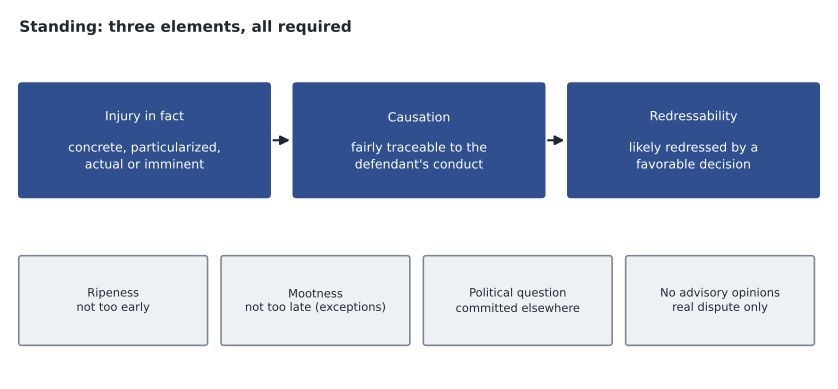
Article III limits federal courts to cases and controversies. Several doctrines enforce that limit, and they are favorite MBE topics because each has crisp elements.
Standing requires the plaintiff to show injury in fact, causation and redressability. The injury must be concrete and particularized and actual or imminent, not conjectural; TransUnion v. Ramirez (2021) held that a bare statutory violation without concrete harm does not suffice. The injury must be fairly traceable to the defendant's conduct, and a favorable decision must be likely to redress it. Murthy v. Missouri (2024) found no standing for plaintiffs who could not trace their content moderation injuries to the government's communications with platforms or show a substantial risk of future injury, and FDA v. Alliance for Hippocratic Medicine (2024) held that doctors who did not prescribe or use mifepristone lacked standing to challenge its regulation.
Special standing rules are tested often. Taxpayers generally lack standing to challenge government spending, except for Establishment Clause challenges to specific congressional appropriations under Flast v. Cohen (1968), which later cases have narrowed. An organization may sue on behalf of its members if its members would have standing individually, the interests are germane to its purpose, and the claim does not require individual members' participation. Third-party standing is allowed only when the plaintiff has its own injury, a close relationship with the third party, and the third party faces some obstacle to suing. A plaintiff seeking an injunction must show a real and immediate threat of future injury, City of Los Angeles v. Lyons (1983). States suing to protect their own sovereign or proprietary interests have standing, but a state generally cannot sue the federal government as parens patriae for its citizens.
Ripeness bars claims brought too early, before a real dispute has developed; courts weigh the fitness of the issues for decision and the hardship to the parties of withholding review. A plaintiff who faces a credible threat of enforcement need not violate a law to challenge it. Mootness bars claims that end too late, after the dispute is resolved, with exceptions for wrongs capable of repetition yet evading review, as in Roe v. Wade and election cases; voluntary cessation by a defendant that could resume the conduct; and class actions where the named plaintiff's claim becomes moot after certification.
The political question doctrine leaves some issues to the elected branches when there is a textually demonstrable commitment of the issue to another branch or a lack of judicially manageable standards. Examples include the Guarantee Clause, the conduct of foreign affairs, impeachment procedures, as in Nixon v. United States (1993), and partisan gerrymandering claims under Rucho v. Common Cause (2019). Racial gerrymandering and one-person, one-vote claims remain justiciable.
Federal courts also may not give advisory opinions, and the Eleventh Amendment, with the broader principle of state sovereign immunity, bars private suits for damages against states in federal court without the state's consent, Hans v. Louisiana (1890). Congress may abrogate state immunity when acting under section 5 of the Fourteenth Amendment, but not under its Article I powers, Seminole Tribe v. Florida (1996). Immunity does not protect local governments, and under Ex parte Young (1908) a plaintiff may sue a state officer for prospective injunctive relief against an ongoing violation of federal law.
Congress's powers
Congress has only the powers the Constitution enumerates, together with the Necessary and Proper Clause, which lets it choose any means rationally related to an enumerated end, McCulloch v. Maryland (1819). The Tenth Amendment reserves the remaining powers to the states or the people. There is no general federal police power to legislate for health, safety and welfare.
The Commerce Clause is the broadest power. Congress may regulate the channels of interstate commerce, the instrumentalities of interstate commerce and persons or things in it, and activities that substantially affect interstate commerce. For economic activity, Congress may aggregate the effects of many small activities, as in Wickard v. Filburn (1942) and Gonzales v. Raich (2005), which upheld federal regulation of home-grown marijuana. For noneconomic activity, such as gun possession near schools in United States v. Lopez (1995) or gender-motivated violence in United States v. Morrison (2000), aggregation is not allowed and the link to commerce must be more than attenuated. In NFIB v. Sebelius (2012), a majority of justices concluded that the Commerce Clause does not allow Congress to compel people to buy health insurance, though the mandate was upheld as a tax.
The taxing power lets Congress tax for the general welfare, and a measure is a tax if it raises revenue and is not a penalty in disguise. The spending power lets Congress spend for the general welfare and attach conditions to federal funds, under South Dakota v. Dole (1987), if the conditions are unambiguous, related to the federal interest in the program, do not require states to violate the Constitution, and are not so coercive as to turn pressure into compulsion. NFIB v. Sebelius held that threatening states with the loss of all existing Medicaid funding to force Medicaid expansion was unconstitutionally coercive.
Section 5 of the Fourteenth Amendment empowers Congress to enforce the amendment's guarantees, but under City of Boerne v. Flores (1997) its legislation must show congruence and proportionality between the injury to be prevented and the means adopted; Congress cannot redefine the substance of the rights. Section 2 of the Thirteenth Amendment lets Congress reach private racial discrimination as a badge of slavery, and section 2 of the Fifteenth Amendment protects voting against racial discrimination. Congress also has power over war, immigration and naturalization, bankruptcy, the postal system, intellectual property and the property and territories of the United States.
Limits protecting states
Under the anti-commandeering principle, Congress may not compel state legislatures to enact or enforce federal programs, New York v. United States (1992), or command state officers to administer federal law, Printz v. United States (1997). Murphy v. NCAA (2018) struck down a federal law forbidding states to authorize sports gambling, because a ban on state legislation is still a command to the states. Congress may regulate states when they act as participants in the market, under generally applicable laws, Reno v. Condon (2000), and it can encourage states with funding conditions or by offering them a choice between regulating to federal standards and having federal law preempt theirs.
Preemption and intergovernmental immunity
Under the Supremacy Clause, valid federal law preempts conflicting state law. Express preemption occurs when a federal statute says so. Implied preemption includes conflict preemption, where it is impossible to comply with both laws or state law stands as an obstacle to federal objectives, and field preemption, where federal regulation is so pervasive that Congress left no room for states, as with immigration registration in Arizona v. United States (2012). States may not tax or regulate the federal government directly, or discriminate against it or those it deals with, but federal contractors and employees may be subject to nondiscriminatory state taxes. The federal government may tax and regulate states under generally applicable laws, subject to the anti-commandeering limits.
The dormant Commerce Clause
Even when Congress has not acted, the Commerce Clause limits state laws that burden interstate commerce. A state law that discriminates against interstate commerce on its face, in purpose or in effect is virtually invalid unless it serves a legitimate local purpose that cannot be served by reasonable nondiscriminatory alternatives, as in Maine v. Taylor (1986), which upheld a ban on importing baitfish to protect local fisheries from parasites. A nondiscriminatory law is evaluated under Pike v. Bruce Church (1970) and struck down only if its burden on commerce is clearly excessive in relation to its local benefits. In National Pork Producers Council v. Ross (2023), the Court rejected a dormant Commerce Clause challenge to a California law setting animal-housing standards for pork sold in the state, refusing to adopt a rule against laws with extraterritorial effects and finding no discrimination.
Two exceptions matter. When Congress authorizes the state discrimination, it is valid. When the state acts as a market participant, buying or selling goods or services itself, it may favor its own citizens, as in Reeves v. Stake (1980); United Haulers (2007) also upheld laws favoring government-owned facilities over private businesses. State taxes on interstate commerce are valid under Complete Auto Transit (1977) if they apply to an activity with a substantial nexus to the state, are fairly apportioned, do not discriminate and are fairly related to services the state provides. South Dakota v. Wayfair (2018) held that physical presence is not required for the nexus.
Privileges and immunities and full faith and credit
The Privileges and Immunities Clause of Article IV bars states from discriminating against citizens of other states in fundamental rights, such as pursuing a livelihood, unless the state has a substantial reason and the discrimination bears a substantial relationship to it. It protects only individual citizens, not corporations or aliens. The Fourteenth Amendment's Privileges or Immunities Clause protects rights of national citizenship, such as the right to travel to and settle in a new state, as in Saenz v. Roe (1999). The Full Faith and Credit Clause requires states to recognize the judgments of other states' courts if the rendering court had jurisdiction and the judgment was on the merits and final.
| Doctrine | Protects | Key test |
|---|---|---|
| Dormant Commerce Clause | Interstate commerce (including corporations) | Discrimination nearly always invalid; otherwise Pike balancing; market-participant exception |
| Article IV Privileges and Immunities | Citizens of other states only | Fundamental rights; substantial reason and substantial relationship |
| Anti-commandeering | State legislatures and officers | Congress may not compel states to legislate or enforce federal law |
Worked problem
A discriminatory state law
State X requires all milk sold in the state to be processed at plants located in State X, citing food safety. Out-of-state dairies sue. Is the law constitutional?
Show solution
- The law discriminates against interstate commerce in its effect and on its face by favoring in-state processing.
- Discrimination is virtually invalid unless the state shows a legitimate purpose that cannot be served by nondiscriminatory alternatives.
- Food safety could be served by inspections and standards applied to all plants, wherever located.
- The state is regulating, not acting as a market participant, and Congress has not authorized the discrimination.
Answer: No. It violates the dormant Commerce Clause.
Practice problems
Work each problem on paper first, then reveal the answer to check.
What are the three elements of standing?
Show answer
Injury in fact, causation and redressability.
What exception to mootness applies to short-lived disputes like pregnancies and elections?
Show answer
Capable of repetition yet evading review.
May Congress aggregate the effects of noneconomic activity under the Commerce Clause?
Show answer
No. Lopez and Morrison limit aggregation to economic activity.
May Congress order state officials to run background checks?
Show answer
No. Printz bars commandeering state officers.
Does the Article IV Privileges and Immunities Clause protect corporations?
Show answer
No. It protects individual citizens only.
When may a state favor its own residents in selling its own products?
Show answer
When it acts as a market participant.
Common mistakes
MistakeTaxpayers have standing to challenge any federal spending.
InsteadTaxpayer standing is limited to Establishment Clause challenges to specific congressional appropriations.
MistakeThe Tenth Amendment lets states ignore federal laws they dislike.
InsteadValid federal laws are supreme; the Tenth Amendment limits commandeering, not federal regulation of private conduct.
MistakeAny state law burdening interstate commerce is invalid.
InsteadOnly discrimination is nearly always invalid; neutral laws fail only if burdens clearly exceed benefits.
MistakeThe Eleventh Amendment protects cities and counties.
InsteadIt protects states and arms of the state, not local governments.
A quick checklist for federalism questions
When a question asks whether a federal law is valid, Marchetti tells the group to ask three questions in order. Does Congress have an enumerated power, read with the Necessary and Proper Clause, to pass it? Does the law violate an external limit, such as the anti-commandeering principle or an individual right? And if the question involves a state law, is it preempted or does it violate the dormant Commerce Clause or Article IV? Most wrong answers on the MBE skip the first question and argue about the Tenth Amendment, which on its own rarely invalidates a federal law regulating private conduct.
Summary and key terms
- Article III limits federal courts to cases and controversies: standing, ripeness, mootness, no political questions and no advisory opinions; state sovereign immunity has exceptions for section 5 abrogation and Ex parte Young suits.
- Congress needs an enumerated power: commerce (channels, instrumentalities, substantial effects with aggregation only for economic activity), taxing and spending with Dole conditions, and section 5 with congruence and proportionality.
- Congress may not commandeer state legislatures or officers; federal law preempts expressly or by conflict or field.
- The dormant Commerce Clause forbids discrimination against interstate commerce and clearly excessive burdens, with market-participant and congressional-authorization exceptions.
- Article IV protects citizens' fundamental rights against discrimination by other states; full faith and credit requires respect for valid judgments.
- Standing
- A plaintiff's personal stake: injury in fact, causation and redressability.
- Political question
- An issue committed to another branch or lacking judicially manageable standards.
- Anti-commandeering
- The rule that Congress may not compel states to legislate or enforce federal programs.
- Dormant Commerce Clause
- The implied limit on state laws that discriminate against or unduly burden interstate commerce.
- Market participant
- A state acting as buyer or seller, which may favor its own residents.
Lesson quiz · 5 questions
Score 60% or more to complete this lesson.
Create a free account to save your progress, take quizzes and earn a certificate.