
BAR-110 · Lesson 4 of 12 · 24 min
Trial, judgment and preclusion
▶ Video coming soon A video version of this lesson is on the way.
On October 3, Dana Whitfield reports that she has started noticing a pattern in her mistakes. 'Every time a question says renewed motion, I panic,' she says. Marchetti decides to spend the morning on the back half of a lawsuit: the motions that end cases before or during trial, the right to a jury, verdicts and judgments, appeals, and the preclusion doctrines that decide what can be litigated again. Motions are one of the three heaviest civil procedure areas, and the others in this lesson make up much of the rest.
Default and dismissal
If a defendant fails to plead or otherwise defend, the clerk enters default under Rule 55(a). Default judgment follows: the clerk may enter it if the claim is for a sum certain and the defendant has not appeared and is not a minor or incompetent person; otherwise the court must enter it, and a defendant who has appeared must receive written notice at least seven days before the hearing. A court may set aside an entry of default for good cause and a default judgment under Rule 60(b).
A plaintiff may voluntarily dismiss without a court order by filing a notice before the opposing party serves an answer or a motion for summary judgment, or by a stipulation signed by all parties who have appeared. The first such dismissal is without prejudice, but under the two-dismissal rule, a notice of dismissal operates as an adjudication on the merits if the plaintiff previously dismissed a federal or state action based on the same claim. Otherwise, dismissal requires a court order on terms the court considers proper. Involuntary dismissal under Rule 41(b) for failure to prosecute or to comply with the rules or an order operates as an adjudication on the merits unless the order says otherwise, though dismissals for lack of jurisdiction, improper venue or failure to join a Rule 19 party do not.
Summary judgment
Rule 56 requires the court to grant summary judgment if the movant shows there is no genuine dispute as to any material fact and the movant is entitled to judgment as a matter of law. A fact is material if it might affect the outcome under the governing law; a dispute is genuine if a reasonable jury could return a verdict for the nonmoving party. The court views the evidence in the light most favorable to the nonmovant and does not weigh credibility.
The 1986 trilogy defines the burdens. Celotex Corp. v. Catrett held that a movant who will not bear the burden of proof at trial can meet its initial burden by pointing out the absence of evidence supporting the nonmovant's case. Anderson v. Liberty Lobby held that the court must apply the substantive evidentiary standard, such as clear and convincing evidence, that will apply at trial. Matsushita v. Zenith held that a nonmovant must show more than metaphysical doubt. A nonmovant cannot rest on its pleadings; it must cite materials in the record, such as depositions, documents, affidavits or declarations based on personal knowledge, showing a genuine dispute. A party may move for summary judgment at any time until 30 days after the close of all discovery, unless a local rule or order says otherwise, and the court may defer ruling if the nonmovant shows by affidavit that it cannot yet present essential facts.
The right to a jury
The Seventh Amendment preserves the right to a jury trial in suits at common law where the amount in controversy exceeds twenty dollars. It applies in federal court but has not been incorporated against the states. The historical test asks whether the claim is legal or equitable. Claims for money damages are generally legal and carry a jury right; claims for injunctions, specific performance, rescission and other equitable relief generally do not. For statutory claims, the court compares the claim to eighteenth-century actions and, more importantly, examines the remedy sought, under Tull v. United States (1987). In SEC v. Jarkesy (2024), the Court held that when the SEC seeks civil penalties for securities fraud, the Seventh Amendment entitles the defendant to a jury, so the agency could not impose the penalties in an in-house proceeding.
When legal and equitable claims are joined, Beacon Theaters v. Westover (1959) and Dairy Queen v. Wood (1962) require that common factual issues be tried to the jury first, so the jury's findings bind the judge on the equitable claims. A party must demand a jury in writing no later than 14 days after service of the last pleading directed to the issue; failure to demand waives the right, though the court may still order a jury trial on motion.
Jury mechanics are also testable. A civil jury has at least six and no more than twelve members; all must participate unless excused for good cause. The verdict must be unanimous and from a jury of at least six unless the parties stipulate otherwise. Each side has three peremptory challenges under 28 U.S.C. section 1870, which may not be used to exclude jurors because of race or sex under Edmonson v. Leesville Concrete (1991) and J.E.B. v. Alabama (1994). Challenges for cause are unlimited.
Judgment as a matter of law and new trial
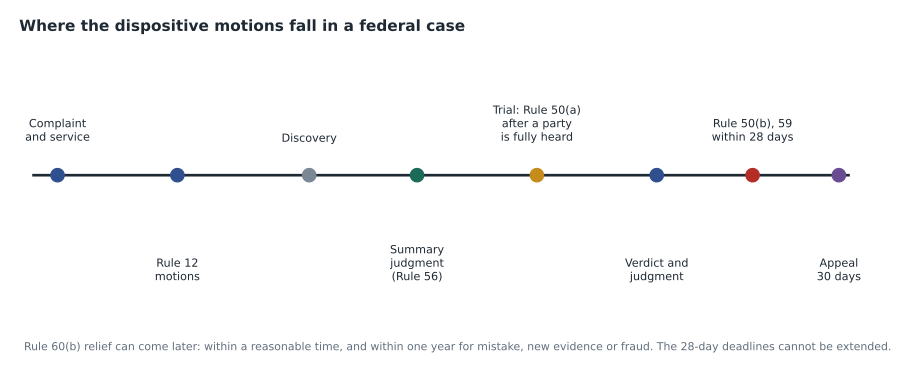
Rule 50(a) allows a motion for judgment as a matter of law, once called a directed verdict, after a party has been fully heard on an issue during a jury trial, if a reasonable jury would not have a legally sufficient evidentiary basis to find for that party. The motion must be made before the case is submitted to the jury and must specify the judgment sought and the law and facts that justify it.
Rule 50(b) allows a renewed motion for judgment as a matter of law, once called judgment notwithstanding the verdict, no later than 28 days after entry of judgment. A party cannot make a renewed motion on a ground it did not raise in a Rule 50(a) motion before submission. And under Unitherm Food Systems v. Swift-Eckrich (2006), a party that fails to renew its motion after the verdict cannot ask the court of appeals to review the sufficiency of the evidence. This sequence, motion during trial and renewed motion after verdict, is a favorite MBE trap.
Rule 59 allows a motion for a new trial, also within 28 days after entry of judgment, for any reason for which new trials have traditionally been granted: the verdict is against the clear weight of the evidence, damages are excessive or inadequate, prejudicial error occurred in admitting evidence or instructing the jury, misconduct by jurors or lawyers, or newly discovered evidence. A court weighing the evidence on a new trial motion may consider credibility, unlike on a judgment as a matter of law. For excessive damages, a court may order remittitur, giving the plaintiff a choice between accepting a reduced award and a new trial; additur, increasing a verdict, violates the Seventh Amendment in federal court under Dimick v. Schiedt (1935). A party may combine a renewed Rule 50(b) motion with an alternative Rule 59 motion, and the court should rule conditionally on the new trial motion if it grants judgment as a matter of law. The court cannot extend the 28-day deadlines.
Rule 60 permits relief from a final judgment. Clerical mistakes can be corrected any time under Rule 60(a). Under Rule 60(b), the court may relieve a party for mistake, inadvertence, surprise or excusable neglect; newly discovered evidence that could not have been discovered in time for a new trial motion; or fraud, misrepresentation or misconduct by an opposing party. Motions on those three grounds must be made within a reasonable time and no more than one year after judgment. Motions because the judgment is void, has been satisfied, or for any other reason justifying relief must be made within a reasonable time. In Coney Island Auto Parts v. Burton (2026), the Court confirmed that even a motion to vacate a void judgment is subject to the reasonable-time requirement.
Verdicts and judgments
A general verdict simply declares the winner and any damages. A special verdict, under Rule 49(a), asks the jury to make specific written findings on each factual issue, and the court then applies the law. A general verdict with answers to written questions combines them; if the answers are consistent with each other but one or more is inconsistent with the general verdict, the court may enter judgment on the answers, return the matter to the jury or order a new trial. In a bench trial, Rule 52 requires the court to find the facts specially and state its conclusions of law separately; findings of fact may be set aside only if clearly erroneous, with due regard for the trial court's opportunity to judge credibility.
Appeals
The courts of appeals have jurisdiction over final decisions of the district courts under 28 U.S.C. section 1291. A final decision ends the litigation on the merits and leaves nothing for the court to do but execute the judgment. A notice of appeal must be filed within 30 days after entry of judgment, or 60 days if the United States is a party. Timely Rule 50(b), 52(b) or 59 motions suspend the time to appeal until the motion is decided.
There are exceptions to the final judgment rule. Section 1292(a) allows appeals from interlocutory orders granting, denying or modifying injunctions. Section 1292(b) allows a discretionary appeal if the district judge certifies that the order involves a controlling question of law as to which there is substantial ground for difference of opinion and an immediate appeal may materially advance the end of the litigation, and the court of appeals agrees to hear it within ten days' petition time. Rule 54(b) lets the court enter final judgment on fewer than all claims or parties if it expressly determines there is no just reason for delay. The collateral order doctrine, from Cohen v. Beneficial Industrial Loan (1949), allows appeal of orders that conclusively determine an important issue completely separate from the merits and that would be effectively unreviewable after final judgment, such as orders denying qualified or sovereign immunity. Rule 23(f) permits a discretionary appeal from a class certification order, and mandamus is available in extraordinary cases.
Standards of review differ by type of ruling. Questions of law are reviewed de novo. Findings of fact by a judge are reviewed for clear error, and jury findings stand if supported by substantial evidence. Discretionary rulings, such as most discovery and evidentiary rulings and the grant or denial of a new trial, are reviewed for abuse of discretion.
Claim preclusion
Claim preclusion, also called res judicata, bars a party from relitigating a claim that was or could have been brought in an earlier action. It requires a final judgment on the merits, the same claim, and the same parties or their privies. Most courts and the Restatement (Second) of Judgments define the same claim transactionally: all rights to relief arising from the same transaction or series of connected transactions, regardless of the legal theory. So a plaintiff who sues for property damage from a car accident and loses cannot later sue for personal injuries from the same accident. Judgments on the merits include judgments after trial, summary judgments and dismissals for failure to state a claim, but not dismissals for lack of jurisdiction, improper venue or failure to join a party.
Issue preclusion
Issue preclusion, also called collateral estoppel, bars relitigation of an issue actually litigated and determined in a prior action by a valid and final judgment, when the determination was essential to the judgment. It can apply even in a different claim. Due process forbids using it against someone who was not a party or in privity, Taylor v. Sturgell (2008) listing narrow exceptions such as successors in interest and adequate representation in a class action.
Courts once required mutuality, meaning both parties had to have been parties to the first case. Federal courts now allow nonmutual issue preclusion in many cases. Defensive nonmutual use, where a new defendant stops a plaintiff from relitigating an issue the plaintiff lost against someone else, was approved in Blonder-Tongue Laboratories v. University of Illinois Foundation (1971). Offensive nonmutual use, where a new plaintiff uses a judgment a defendant lost against someone else, is allowed in the court's discretion under Parklane Hosiery v. Shore (1979), considering whether the plaintiff could easily have joined the earlier action, whether the defendant had incentive to litigate fully, whether there are inconsistent prior judgments, and whether the second action offers procedural opportunities unavailable in the first.
Federal courts give state judgments the same preclusive effect the state's own courts would, under the Full Faith and Credit Act, 28 U.S.C. section 1738. The preclusive effect of a federal diversity judgment is governed by the law of the state where the rendering federal court sat, under Semtek International v. Lockheed Martin (2001).
| Claim preclusion | Issue preclusion | |
|---|---|---|
| What is barred | Claims that were or could have been brought | Issues actually litigated and decided |
| Requirements | Final judgment on the merits; same claim (same transaction); same parties or privies | Same issue; actually litigated; determined; essential to the judgment; final judgment |
| Against whom | Parties and privies | Only someone who was a party or in privity |
| Who may use it | Parties and privies | Often anyone, subject to Parklane factors for offensive nonmutual use |
Worked problem
Offensive issue preclusion
A train derails, injuring 40 passengers. Passenger 1 sues the railroad in federal court and the jury, after a full trial, finds the railroad negligent. Passenger 2, who knew of the first suit and chose to wait for its outcome, now sues and moves for partial summary judgment on negligence based on the first verdict. Should the court grant the motion?
Show solution
- This is offensive nonmutual issue preclusion: a new plaintiff using a finding against the defendant.
- Parklane lets the court decide. Negligence was actually litigated, determined and essential, and the railroad had every incentive to fight.
- But Passenger 2 could easily have joined and deliberately waited; that factor weighs against preclusion. Any inconsistent prior judgments would also weigh against it.
Answer: The court has discretion, and a wait-and-see plaintiff is the classic case in which a court may refuse offensive preclusion.
Practice problems
Work each problem on paper first, then reveal the answer to check.
What is the standard for summary judgment?
Show answer
No genuine dispute as to any material fact and the movant is entitled to judgment as a matter of law.
Can a party file a renewed Rule 50(b) motion on a ground not raised before the case went to the jury?
Show answer
No. The renewed motion is limited to grounds raised in the Rule 50(a) motion.
How long does a party have to file a motion for a new trial?
Show answer
28 days after entry of judgment; the court cannot extend it.
Is there a jury right for a claim seeking only an injunction?
Show answer
No. Injunctions are equitable.
What is the time to file a notice of appeal in an ordinary civil case?
Show answer
30 days after entry of judgment, or 60 if the United States is a party.
Can issue preclusion be used against someone who was not a party to the first case?
Show answer
Generally no; due process requires that the person have been a party or in privity.
Common mistakes
MistakeA party can raise sufficiency of the evidence on appeal without any post-verdict motion.
InsteadIt must renew its Rule 50 motion after the verdict.
MistakeAdditur is available like remittitur.
InsteadAdditur violates the Seventh Amendment in federal court.
MistakeClaim preclusion bars only theories actually argued.
InsteadIt bars all claims from the same transaction that could have been brought.
MistakeAny dismissal has preclusive effect.
InsteadDismissals for lack of jurisdiction, improper venue or failure to join a party are not on the merits.
Summary and key terms
- Know default, voluntary dismissal and the two-dismissal rule, and involuntary dismissal under Rule 41(b).
- Summary judgment: no genuine dispute of material fact; Celotex lets a movant point to the absence of evidence; the nonmovant must cite record materials.
- The Seventh Amendment jury right turns on legal versus equitable relief; demand within 14 days; Jarkesy requires a jury for SEC fraud penalties.
- Rule 50(a) during trial, Rule 50(b) and Rule 59 within 28 days after judgment; Rule 60(b) one-year limit for mistake, new evidence and fraud.
- Appeals need a final decision, with exceptions for injunctions, 1292(b), Rule 54(b) and collateral orders; claim and issue preclusion have distinct elements, with Parklane governing offensive nonmutual use.
- Summary judgment
- Judgment without trial when no genuine dispute of material fact exists.
- Judgment as a matter of law
- Judgment entered because no reasonable jury could find for the opposing party.
- Remittitur
- An order giving the plaintiff a choice between a reduced award and a new trial.
- Collateral order doctrine
- Allows immediate appeal of separable, important, effectively unreviewable orders.
- Nonmutual issue preclusion
- Use of issue preclusion by someone who was not a party to the first case.
Lesson quiz · 5 questions
Score 60% or more to complete this lesson.
Create a free account to save your progress, take quizzes and earn a certificate.