
BAR-110 · Lesson 6 of 12 · 25 min
Separation of powers and state action
▶ Video coming soon A video version of this lesson is on the way.
On October 17, Marchetti opens with a warning she will repeat several times in the constitutional law weeks. 'This area has changed more in the last five years than in the thirty before,' she says. 'The MBE tests settled law, and examiners avoid points the Court has just thrown into doubt. So learn the stable structure first, know the recent landmark holdings, and do not invent answers from the news.' This lesson covers the separation of powers among Congress, the President and the courts, and the state action requirement that decides when the Constitution applies at all.
The structure
The Constitution vests legislative power in Congress, executive power in the President and judicial power in the federal courts. Each branch has checks on the others: the veto and its override, Senate confirmation of appointments and ratification of treaties, impeachment and removal, judicial review, and Congress's control over the courts' structure and appellate jurisdiction. MBE questions usually ask whether one branch has taken power that belongs to another, or has interfered with another's core functions.
Congress's legislative process
A bill becomes law only through bicameralism and presentment: passage by both houses in identical form and presentment to the President for signature or veto. INS v. Chadha (1983) struck down a one-house legislative veto of executive action, because an action that changes legal rights is legislative and must follow the full process. Clinton v. City of New York (1998) struck down the line-item veto, because canceling parts of a signed statute amounts to amending it without bicameralism and presentment.
Congress may delegate authority to agencies if it provides an intelligible principle to guide them, a standard that has invalidated statutes only twice, both in 1935. In FCC v. Consumers' Research (2025), the Court upheld the universal service fund system under that test. Separately, the major questions doctrine, applied in West Virginia v. EPA (2022) and Biden v. Nebraska (2023), requires clear congressional authorization before an agency may decide issues of vast economic and political significance. In Learning Resources v. Trump (2026), the Court held that the International Emergency Economic Powers Act does not authorize the President to impose tariffs. These are statutory interpretation holdings, but they rest on separation of powers concerns.
Congress has broad investigative power as an adjunct to legislating, enforced by subpoena and contempt, but an inquiry must have a valid legislative purpose. Trump v. Mazars (2020) set out factors for congressional subpoenas of a President's personal records. Members of Congress have Speech or Debate Clause immunity for legislative acts, but not for political or personal conduct outside the legislative process.
The President's powers
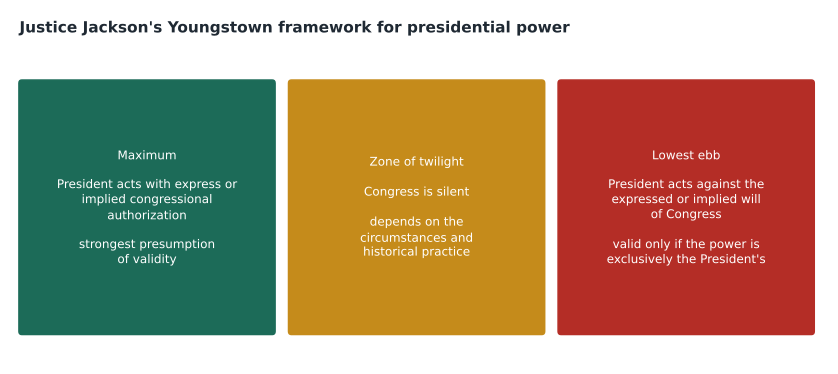
The President executes the laws, commands the armed forces, conducts foreign relations, makes treaties with the advice and consent of two thirds of the Senate, appoints officers and grants pardons for federal offenses except in cases of impeachment. Justice Jackson's concurrence in Youngstown Sheet & Tube v. Sawyer (1952) supplies the framework MBE questions use. When the President acts with express or implied authorization of Congress, his power is at its maximum. When Congress is silent, he acts in a zone of twilight where the outcome depends on circumstances. When he acts against the expressed or implied will of Congress, his power is at its lowest, and he can rely only on his own constitutional powers minus Congress's. In Youngstown itself, President Truman's seizure of steel mills during the Korean War failed because Congress had considered and rejected seizure power.
Executive agreements with foreign nations do not need Senate approval and are valid as domestic law if they do not conflict with federal statutes. Treaties take precedence over conflicting state law, and a treaty and a federal statute are equal, so the later in time controls. A treaty cannot violate the Constitution, Reid v. Covert (1957). In foreign affairs, the President has broad power and is the nation's sole organ, and Zivotofsky v. Kerry (2015) held that the power to recognize foreign governments belongs exclusively to the President. Congress declares war and funds the military; the President may respond to sudden attacks without a declaration.
The pardon power covers only federal crimes and does not reach impeachment or state offenses. It may be exercised before or after conviction and with or without conditions.
Appointment and removal
Under the Appointments Clause, principal officers are appointed by the President with the advice and consent of the Senate. Congress may vest the appointment of inferior officers in the President alone, the courts of law or the heads of departments. Congress cannot appoint executive officers itself. Lucia v. SEC (2018) held that SEC administrative law judges are officers who must be properly appointed, and United States v. Arthrex (2021) held that administrative patent judges could not issue final decisions unreviewable by a principal officer.
Removal is where doctrine has moved most. The President may remove executive officers at will, and Congress may not reserve a role for itself in removal, Bowsher v. Synar (1986). Morrison v. Olson (1988) upheld good-cause limits on removing an independent counsel, an inferior officer. Seila Law v. CFPB (2020) struck down for-cause protection for a single director heading an agency with significant executive power, and Collins v. Yellen (2021) did the same for the Federal Housing Finance Agency. In Trump v. Slaughter (2026), the Court overruled Humphrey's Executor v. United States (1935) and upheld the President's removal of a Federal Trade Commission commissioner, rejecting statutory for-cause protection for the multimember commission. The Court separately left in place a lower-court order temporarily blocking the President's removal of a Federal Reserve governor while that litigation continues. Because these holdings are new, a bar question is more likely to test the stable propositions: the President may remove purely executive officers at will, and Congress may not keep removal power for itself.
Executive privilege and immunity
The President has a qualified privilege for confidential communications, which yields to a demonstrated, specific need for evidence in a criminal trial, United States v. Nixon (1974). The President has absolute immunity from civil damages for official acts, Nixon v. Fitzgerald (1982), but no immunity from civil suits for conduct before taking office, Clinton v. Jones (1997), and no absolute immunity from state criminal subpoenas for personal records, Trump v. Vance (2020). In Trump v. United States (2024), the Court held that a former President has absolute immunity from criminal prosecution for actions within his conclusive and preclusive constitutional authority, at least presumptive immunity for other official acts, and no immunity for unofficial acts.
Impeachment
The House impeaches by majority vote, and the Senate tries the case, with conviction requiring two thirds of the members present. The President, Vice President and all civil officers of the United States may be impeached for treason, bribery, or other high crimes and misdemeanors. Removal from office follows conviction, and the Senate may also disqualify the person from future federal office. Federal judges hold office during good behavior and can be removed only by impeachment.
The courts and non-Article III adjudication
Article III judges have life tenure and protected salaries. Congress may create legislative courts and agencies that decide some matters without Article III judges, chiefly cases involving public rights, such as federal benefits and many regulatory matters. But Congress cannot remove private-rights cases traditionally tried at common law from Article III courts, Stern v. Marshall (2011), and SEC v. Jarkesy (2024) held that a securities fraud claim for civil penalties is a suit at common law that must go to a jury in an Article III court rather than an agency proceeding. Congress may also not reopen final judgments of Article III courts, Plaut v. Spendthrift Farm (1995), though it may change the law that governs pending cases. Loper Bright Enterprises v. Raimondo (2024) overruled Chevron deference: courts must exercise independent judgment in deciding whether an agency acted within its statutory authority, though they may respect an agency's interpretation for its persuasiveness.
State action
Most constitutional rights, including due process, equal protection and free speech, restrict only government action. A private employer that fires a worker for her speech does not violate the First Amendment. The Thirteenth Amendment, banning slavery and involuntary servitude, is the main exception that applies to private conduct directly.
Private conduct counts as state action in a few situations. When a private party performs a function traditionally and exclusively performed by government, such as running a company town in Marsh v. Alabama (1946) or conducting elections, it is a state actor. Manhattan Community Access Corp. v. Halleck (2019) held that operating public access television channels is not such a function. When the government is significantly entangled with private conduct, by commanding or encouraging it, the conduct is state action. Examples include judicial enforcement of racially restrictive covenants in Shelley v. Kraemer (1948), a private restaurant leasing space in a public parking building and sharing benefits with the state in Burton v. Wilmington Parking Authority (1961), and a private athletic association dominated by public schools in Brentwood Academy (2001). Mere licensing, regulation or funding is not enough, as with a privately owned utility in Jackson v. Metropolitan Edison (1974) or a heavily funded private school in Rendell-Baker v. Kohn (1982).
Public officials using social media raise a related question. Lindke v. Freed (2024) held that an official's speech on social media is state action only if the official possessed actual authority to speak on the government's behalf on the subject and purported to exercise that authority in the posts.
| State action found | No state action |
|---|---|
| Public function: company town, elections | Public access TV channel; nursing home; private utility |
| Court enforcement of racially restrictive covenants | Mere licensing or regulation |
| Joint benefit and interdependence (Burton) | Government funding alone (Rendell-Baker) |
| Association dominated by public officials (Brentwood) | Private employer firing for speech |
Worked problem
A presidential order and congressional silence
Congress has passed no statute on whether federal agencies may hire contractors who use certain foreign software. The President issues an executive order barring agencies from hiring such contractors, citing national security. A contractor challenges the order. How should a court analyze it?
Show solution
- Identify the Youngstown category: Congress has not authorized or forbidden the action, so the President is in the zone of twilight.
- The order directs executive agencies in their contracting, a matter within the President's supervision of the executive branch, and cites national security.
- No statute conflicts with it.
Answer: The order is likely valid. Presidents may direct how executive agencies carry out their functions absent a conflicting statute, and the twilight-zone analysis favors the President where Congress is silent and the action concerns executive management.
Practice problems
Work each problem on paper first, then reveal the answer to check.
What did INS v. Chadha hold?
Show answer
A one-house legislative veto is unconstitutional because legislative acts require bicameralism and presentment.
Under Youngstown, when is presidential power at its lowest?
Show answer
When the President acts against the expressed or implied will of Congress.
May Congress appoint members of an agency that enforces federal law?
Show answer
No. Congress cannot appoint executive officers.
Does the pardon power cover state crimes?
Show answer
No. It covers only federal offenses and not impeachment.
What did Loper Bright overrule?
Show answer
Chevron deference; courts must independently decide whether an agency acted within its statutory authority.
Is a private company that runs a town a state actor?
Show answer
Yes, because running a town is a traditional, exclusive public function.
Common mistakes
MistakeA treaty always beats a federal statute.
InsteadThey are equal; the later in time controls, and neither may violate the Constitution.
MistakeThe President may refuse to spend appropriated funds at will.
InsteadImpoundment disputes are governed by statute; the President must faithfully execute appropriations laws.
MistakeGovernment regulation or funding makes a private actor a state actor.
InsteadSignificant entanglement or a traditional exclusive public function is required.
MistakeExecutive privilege is absolute.
InsteadIt is qualified and yields to specific need in a criminal trial.
Separation of powers on the MBE: how questions are built
Separation of powers questions usually follow one of four patterns, and recognizing the pattern is half the work. The first is aggrandizement: one branch takes for itself a power that belongs to another, as when Congress keeps a role in removing executive officers or appoints them itself, or when the President tries to legislate by canceling parts of statutes. The second is encroachment: one branch interferes with another's core function, as when Congress reopens final judgments of Article III courts. The third is a delegation question: Congress hands power to an agency or the President, and the question is whether it supplied an intelligible principle or, for issues of vast significance, clear authorization. The fourth is a question about the President acting alone, where Jackson's Youngstown categories decide the case.
In each pattern, the right answer usually names the specific structural rule rather than a general principle. An answer saying 'No, because it violates the separation of powers' is less likely to be best than one saying 'No, because legislative action requires passage by both houses and presentment to the President.' When two answers both reach the right conclusion, prefer the one that states the controlling clause or doctrine.
Questions about state action follow a similar pattern. The facts describe a private actor and some government connection: a license, a lease, funding, regulation or a delegated task. The answer turns on whether the connection amounts to a traditional exclusive public function or significant entanglement. Licensing, regulation and funding alone are the classic wrong answers. Watch also for the Thirteenth Amendment exception and for federal civil rights statutes, such as Title II of the Civil Rights Act of 1964 or 42 U.S.C. section 1981, which reach private discrimination directly; if a question cites a statute, the state action requirement may not apply.
Worked problem
A state action question
A city leases space in a city-owned stadium to a private restaurant. The restaurant's lease requires it to follow the city's health code, and the city receives a share of its profits, which help pay for stadium upkeep. The restaurant refuses to serve customers of one race. Is its refusal state action?
Show solution
- The restaurant is private, so ask whether the city is significantly entangled with its conduct.
- The city owns the building, leases space to the restaurant, shares its profits and benefits financially from its operation, a symbiotic relationship like Burton v. Wilmington Parking Authority.
- Health code compliance alone would not be enough, but the combination of public ownership and mutual benefit is.
Answer: Yes. The relationship is close enough that the restaurant's discrimination is attributable to the city and violates equal protection.
Summary and key terms
- Legislation requires bicameralism and presentment (Chadha, Clinton); delegation needs an intelligible principle, and major questions need clear authorization.
- Use Jackson's Youngstown categories for presidential power; treaties and statutes are equal; recognition belongs to the President; pardons cover only federal crimes.
- Principal officers need Senate confirmation; Congress cannot appoint or remove executive officers; removal protection has narrowed sharply (Seila Law, Collins, and Slaughter overruling Humphrey's Executor in 2026).
- Know executive privilege (Nixon), civil immunity (Fitzgerald, Jones), criminal immunity (Trump v. United States), Jarkesy on jury rights, and Loper Bright ending Chevron.
- Constitutional rights restrict government; private conduct is state action only through a public function or significant entanglement.
- Bicameralism and presentment
- Passage by both houses and presentment to the President, required for legislation.
- Intelligible principle
- The standard Congress must provide when delegating power to an agency.
- Youngstown framework
- Justice Jackson's three categories for evaluating presidential action against congressional will.
- Principal officer
- An officer who must be appointed by the President with Senate confirmation.
- State action
- Conduct attributable to government, required for most constitutional claims.
Lesson quiz · 5 questions
Score 60% or more to complete this lesson.
Create a free account to save your progress, take quizzes and earn a certificate.