
BAR-110 · Lesson 2 of 12 · 24 min
Jurisdiction and venue
▶ Video coming soon A video version of this lesson is on the way.
On September 19, Marchetti writes three words on the shared screen: power, place, notice. 'Every civil procedure question about where a case can be heard comes back to these,' she says. 'Does the court have power over the kind of case? Does it have power over the defendant? Is it the right place within the system? And was the defendant properly told?' Jurisdiction and venue are the largest single block of the civil procedure outline, and with pretrial procedures and motions they produce about two thirds of the civil procedure questions.
Subject-matter jurisdiction: the basics
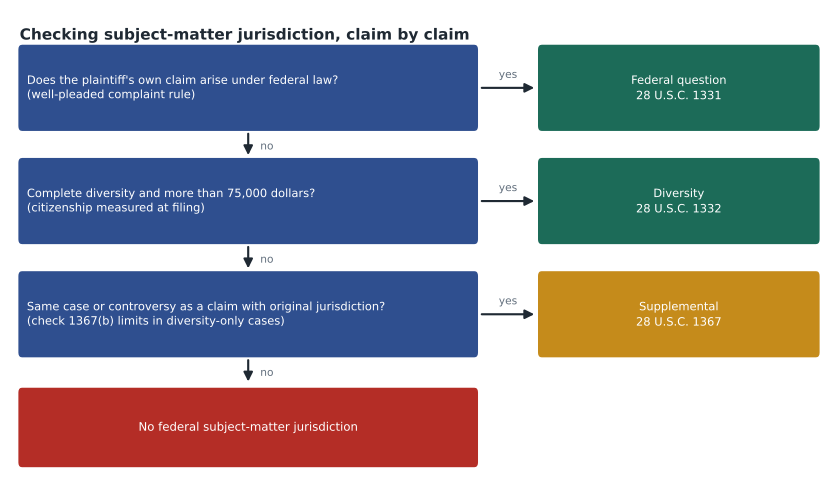
Federal courts are courts of limited jurisdiction. They can hear only cases that the Constitution permits and Congress has authorized by statute. Subject-matter jurisdiction cannot be waived or created by consent, and a court must dismiss whenever it finds jurisdiction lacking, even on appeal and even if no party raises it. Rule 12(h)(3) says so expressly. That is why the MBE likes questions in which a party loses at trial and then, for the first time, challenges subject-matter jurisdiction: the challenge is timely.
The two main bases are federal question jurisdiction under 28 U.S.C. section 1331 and diversity jurisdiction under section 1332. Supplemental jurisdiction under section 1367 lets a court hear related claims that lack an independent basis. Removal under sections 1441 to 1447 lets defendants move cases from state court to federal court.
Federal question jurisdiction
Section 1331 gives district courts jurisdiction over civil actions arising under the Constitution, laws or treaties of the United States. Under the well-pleaded complaint rule from Louisville & Nashville Railroad v. Mottley (1908), the federal issue must appear in the plaintiff's own claim, not in an anticipated defense or in the defendant's answer. In Mottley itself, the plaintiffs alleged that a federal statute would not excuse the railroad's breach of contract; because the federal statute was only an expected defense, there was no federal question jurisdiction.
A claim usually arises under federal law because federal law creates the cause of action, such as a claim under 42 U.S.C. section 1983 or a federal copyright claim. In a small set of cases, a state-law claim arises under federal law if it necessarily raises a federal issue that is actually disputed and substantial and that a federal court can resolve without disrupting the balance between state and federal courts, the test from Grable & Sons (2005) as restated in Gunn v. Minton (2013). On the MBE, assume a state-law claim does not arise under federal law unless the facts make the federal issue central and substantial.
There is no amount-in-controversy requirement for federal question cases, and the parties' citizenship is irrelevant.
Diversity jurisdiction
Section 1332(a) requires two things: complete diversity of citizenship and an amount in controversy that exceeds 75,000 dollars, exclusive of interest and costs. Complete diversity, from Strawbridge v. Curtiss (1806), means no plaintiff may be a citizen of the same state as any defendant. Diversity is measured when the action is filed; later moves do not destroy it.
Citizenship rules are favorite test points. A natural person who is a US citizen is a citizen of the state where the person is domiciled, meaning where the person resides with the intent to remain indefinitely. A person has only one domicile at a time and keeps it until establishing a new one. A corporation is a citizen of every state where it is incorporated and of the state where it has its principal place of business, which Hertz Corp. v. Friend (2010) defines as the nerve center, usually the headquarters where officers direct and control the business. Unincorporated associations, such as partnerships and limited liability companies, take the citizenship of every one of their members. A legal representative of a decedent, infant or incompetent takes the citizenship of the person represented.
Aliens add another layer. Section 1332(a)(2) allows suits between citizens of a state and citizens or subjects of a foreign state, but not if the alien is a permanent resident domiciled in the same state as the opposing party. Suits between two aliens alone, with no US citizen party, do not qualify. A US citizen domiciled abroad is 'stateless' for diversity purposes and cannot sue or be sued under diversity.
For the amount in controversy, the plaintiff's good-faith claim controls unless it appears to a legal certainty that the plaintiff cannot recover more than 75,000 dollars. One plaintiff may aggregate all claims against a single defendant, related or not. But multiple plaintiffs cannot add their claims together, and claims against multiple defendants cannot be combined unless the defendants are jointly liable. Exactly 75,000 dollars is not enough; the amount must exceed it.
Two judge-made exceptions remove certain cases even when diversity exists: federal courts do not grant divorces, alimony or child custody decrees, and they do not probate wills or administer estates. The Class Action Fairness Act, section 1332(d), creates a separate diversity basis for large class actions, requiring minimal diversity, at least 100 class members and more than 5 million dollars in total.
| Party | Citizenship for diversity |
|---|---|
| Individual (US citizen) | State of domicile: residence plus intent to remain indefinitely |
| Corporation | Every state of incorporation and the state of its principal place of business (nerve center) |
| Partnership, LLC, union | Every state of which any member is a citizen |
| Representative of a decedent, minor or incompetent | The state of the person represented |
| US citizen domiciled abroad | No state; cannot be a diversity party |
Supplemental jurisdiction
Section 1367(a) allows a federal court with jurisdiction over one claim to hear other claims that are so related that they form part of the same case or controversy, meaning they arise from a common nucleus of operative fact. This lets a plaintiff with a federal claim add a related state-law claim against the same defendant, and it lets defendants bring compulsory counterclaims and crossclaims.
Section 1367(b) limits supplemental jurisdiction in cases based only on diversity. In such cases, the court may not exercise supplemental jurisdiction over claims by plaintiffs against persons made parties under Rules 14, 19, 20 or 24, or over claims by persons joined as plaintiffs under Rule 19 or intervening as plaintiffs under Rule 24, when doing so would be inconsistent with the diversity requirements. The point is to stop plaintiffs from getting around complete diversity by suing a diverse defendant and then adding a non-diverse one. The Supreme Court held in Exxon Mobil Corp. v. Allapattah Services (2005) that a plaintiff with a claim under the amount can join with a plaintiff whose claim exceeds it, under Rule 20 or in a Rule 23 class, as long as complete diversity exists.
Section 1367(c) gives the court discretion to decline supplemental jurisdiction if the claim raises a novel or complex issue of state law, if it substantially predominates, if the court has dismissed all the claims within its original jurisdiction, or in other exceptional circumstances.
Removal
Under section 1441(a), a defendant may remove a civil action from state court to the federal district court for the district and division embracing the place where the state action is pending, if the case could originally have been brought in federal court. Only defendants may remove, and all defendants who have been properly joined and served must consent. Notice of removal must be filed within 30 days after the defendant receives the initial pleading or is served. If a case becomes removable later, the 30 days run from when the defendant receives a paper showing removability, but a case cannot be removed on diversity grounds more than one year after it began unless the plaintiff acted in bad faith to prevent removal.
The forum-defendant rule in section 1441(b)(2) bars removal of a diversity case if any properly joined and served defendant is a citizen of the forum state; that defendant could not have been surprised by a home-state court. The rule does not apply to federal question cases. A plaintiff may move to remand for procedural defects within 30 days of removal; lack of subject-matter jurisdiction can be raised at any time. And if the federal claims are dropped after removal, Royal Canin U.S.A. v. Wullschleger (2025) held that a plaintiff's amendment eliminating all federal claims deprives the court of supplemental jurisdiction over the remaining state claims, so the case goes back to state court.
Personal jurisdiction
A court must also have power over the defendant. Under Rule 4(k)(1)(A), a federal court generally has the same reach as the courts of the state where it sits, so the analysis has two steps: does the state's long-arm statute reach the defendant, and does exercising jurisdiction satisfy the Due Process Clause of the Fourteenth Amendment? On the MBE, if no statute is given, assume the long-arm statute extends to the limits of due process, so the constitutional question decides the case.
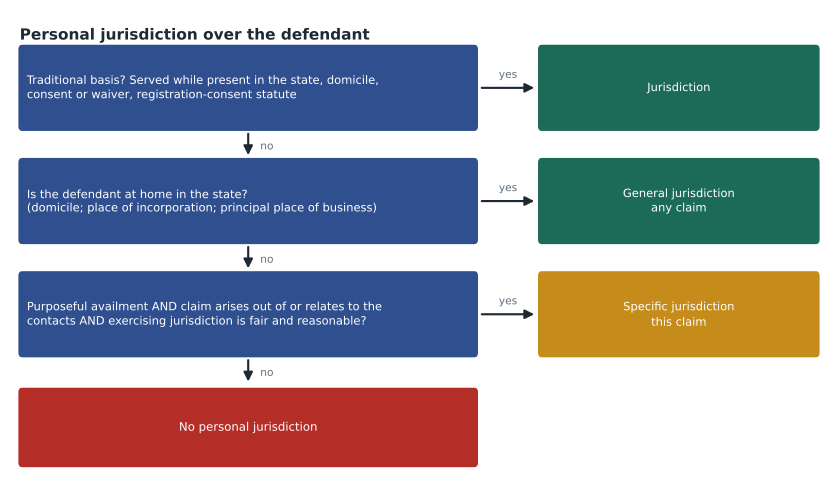
The traditional bases still work. A defendant served while physically present in the state is subject to general jurisdiction there, under Burnham v. Superior Court (1990). A defendant can consent, including by failing to object in the first Rule 12 response; personal jurisdiction, unlike subject-matter jurisdiction, can be waived. And domicile in the state supports jurisdiction over an individual. In Mallory v. Norfolk Southern Railway (2023), the Court upheld a Pennsylvania statute treating a corporation's registration to do business in the state as consent to general jurisdiction there, though the dormant Commerce Clause challenge was left open.
Otherwise, International Shoe Co. v. Washington (1945) requires that the defendant have minimum contacts with the forum such that maintaining the suit does not offend traditional notions of fair play and substantial justice. Courts divide this into general and specific jurisdiction.
General jurisdiction allows a court to hear any claim against the defendant, even one unrelated to the forum. Goodyear (2011) and Daimler AG v. Bauman (2014) limit it to places where the defendant is essentially at home: for an individual, the domicile; for a corporation, its place of incorporation and principal place of business, except in a truly exceptional case.
Specific jurisdiction allows a court to hear claims that arise out of or relate to the defendant's contacts with the forum. The defendant must have purposefully availed itself of the privilege of conducting activities in the state, as in Hanson v. Denckla (1958) and World-Wide Volkswagen Corp. v. Woodson (1980), where a New York car dealer that did no business in Oklahoma could not be sued there simply because a customer drove a car into the state. The claim must arise out of or relate to those contacts; Ford Motor Co. v. Montana Eighth Judicial District Court (2021) held that a strict causal link is not required where a company systematically served a market for the very product that caused the injury. Bristol-Myers Squibb v. Superior Court (2017) held that nonresidents' claims with no connection to California could not be heard there. Finally, jurisdiction must be reasonable, considering the burden on the defendant, the forum state's interest, the plaintiff's interest and efficiency, as in Burger King v. Rudzewicz (1985) and Asahi Metal Industry v. Superior Court (1987).
Notice and service
Due process also requires notice reasonably calculated, under all the circumstances, to inform interested parties of the action and give them an opportunity to object, from Mullane v. Central Hanover Bank (1950). Rule 4 governs service of the summons and complaint. An individual may be served by personal delivery, by leaving copies at the person's dwelling with someone of suitable age and discretion who resides there, by delivery to an authorized agent, or by any method allowed by the law of the state where the federal court sits or where service is made. Corporations may be served through an officer or a managing or general agent. Service must be made within 90 days after the complaint is filed, or the court must dismiss without prejudice or order service within a specified time, unless the plaintiff shows good cause. Any nonparty who is at least 18 may serve; the plaintiff may not personally serve. Under Rule 4(d), a plaintiff may ask the defendant to waive service, and a defendant who agrees gets 60 days to answer instead of 21.
Venue and transfer
Venue decides which federal district hears the case. Under section 1391(b), venue is proper in a district where any defendant resides, if all defendants reside in the same state; in a district where a substantial part of the events or omissions giving rise to the claim occurred or where a substantial part of the property at issue is located; or, only if neither works, in a district where any defendant is subject to personal jurisdiction. For venue, an individual resides where domiciled, and an entity defendant resides in any district where it is subject to personal jurisdiction for the claim. Unlike subject-matter jurisdiction, improper venue is waived if not raised in the first Rule 12 response.
Section 1404(a) lets a court transfer a case to any other district where it might have been brought, or to which all parties consent, for the convenience of parties and witnesses and in the interest of justice. The transferee court applies the law the transferor court would have applied, including its choice-of-law rules. If venue was improper in the original court, section 1406 lets the court dismiss or transfer, and the transferee applies its own choice-of-law rules. A valid forum-selection clause pointing to another federal court should ordinarily be enforced through a 1404(a) transfer, and the plaintiff's choice of forum then gets no weight, under Atlantic Marine Construction v. US District Court (2013). Forum non conveniens permits dismissal when the better forum is in another country or a state court system.
Worked problem
Diversity and the forum defendant
A Florida citizen sues two defendants in Georgia state court for 200,000 dollars on a state-law fraud claim. One defendant is a corporation incorporated in Delaware with its headquarters in Georgia. The other is an Alabama citizen. Both are served. They file a timely notice of removal to the federal court in Georgia. Should the court remand if the plaintiff moves promptly?
Show solution
- Diversity: Florida plaintiff versus defendants who are citizens of Delaware, Georgia and Alabama. Complete diversity exists and the amount exceeds 75,000 dollars.
- But the corporation is a citizen of Georgia, the forum state, and was properly joined and served.
- Section 1441(b)(2) bars removal of a diversity case in that situation; the defect is procedural and the plaintiff moved within 30 days.
Answer: Yes. The forum-defendant rule makes removal improper, so the court should remand.
Practice problems
Work each problem on paper first, then reveal the answer to check.
Can parties consent to federal subject-matter jurisdiction?
Show answer
No. It cannot be waived or conferred by consent and can be raised at any time.
A corporation is incorporated in Delaware and has its headquarters in Texas. Of which states is it a citizen?
Show answer
Delaware and Texas.
Two plaintiffs each claim 50,000 dollars against one defendant on the same accident. Can they aggregate?
Show answer
No. Separate plaintiffs cannot aggregate; diversity jurisdiction fails unless another basis exists.
Within how many days must a defendant remove?
Show answer
30 days after receiving the initial pleading or service, and diversity cases cannot be removed more than one year after commencement absent bad faith.
Where is a corporation subject to general jurisdiction?
Show answer
Where it is at home: its state of incorporation and principal place of business, except in an exceptional case.
Is improper venue waivable?
Show answer
Yes, if not raised in the first Rule 12 motion or answer.
Common mistakes
MistakeA federal defense creates federal question jurisdiction.
InsteadUnder the well-pleaded complaint rule, only the plaintiff's claim counts.
MistakeAn LLC is a citizen of its state of organization and principal place of business.
InsteadThat is the corporate rule. An LLC takes the citizenship of each member.
MistakeExactly 75,000 dollars satisfies diversity.
InsteadThe amount must exceed 75,000 dollars, exclusive of interest and costs.
MistakeThe forum-defendant rule applies to all removals.
InsteadIt applies only to cases removed on the basis of diversity.
Summary and key terms
- Subject-matter jurisdiction cannot be waived; check each claim for federal question, diversity or supplemental jurisdiction.
- Diversity needs complete diversity and more than 75,000 dollars; know the citizenship rules for people, corporations and unincorporated associations.
- Section 1367(b) blocks plaintiffs from using supplemental jurisdiction to evade complete diversity; removal is for defendants only, within 30 days, subject to the forum-defendant and one-year rules.
- Personal jurisdiction rests on traditional bases, general jurisdiction where the defendant is at home, or specific jurisdiction from purposeful contacts, relatedness and fairness.
- Venue lies where defendants reside or where substantial events occurred; transfer under 1404(a) keeps the transferor's law.
- Well-pleaded complaint rule
- The federal issue must appear in the plaintiff's own claim, not in a defense.
- Complete diversity
- No plaintiff shares state citizenship with any defendant.
- Nerve center
- A corporation's principal place of business, where officers direct and control it.
- Supplemental jurisdiction
- Jurisdiction over related claims that form part of the same case or controversy.
- Purposeful availment
- A defendant's deliberate choice to conduct activities in or direct them at the forum state.
Lesson quiz · 5 questions
Score 60% or more to complete this lesson.
Create a free account to save your progress, take quizzes and earn a certificate.