
BAR-110 · Lesson 11 of 12 · 22 min
Breach, remedies and third parties
▶ Video coming soon A video version of this lesson is on the way.
The last content drill of the series is on Saturday, November 21, and Sofia Reyes arrives with a spreadsheet. 'I finally get damages,' she says, 'because I started doing the arithmetic instead of reading about it.' Marchetti approves: MBE remedies questions often hide a calculation inside the facts, and the right answer is the one that puts the injured party in the position it would have occupied had the contract been performed. This lesson covers money damages and their limits, UCC remedies for buyers and sellers, equitable remedies and restitution, and the rights of third parties: beneficiaries, assignees and delegates.
The goal of contract damages
Contract remedies protect three interests. The expectation interest is the benefit of the bargain: the position the plaintiff would have been in had the contract been performed. The reliance interest is the position the plaintiff would have been in had the contract never been made, measured by expenditures made in reliance. The restitution interest is the value of any benefit the plaintiff conferred on the defendant. Expectation is the usual measure; reliance is an alternative when expectation is too speculative to prove, and restitution prevents unjust enrichment.
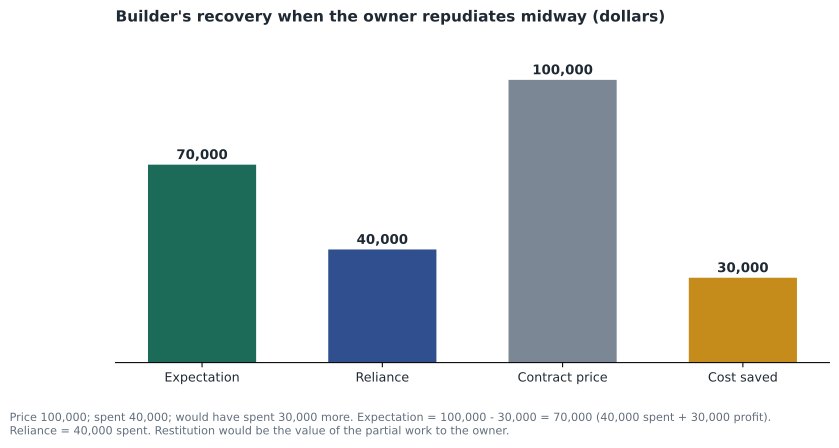
Expectation damages generally equal the loss in value of the other party's performance, plus incidental and consequential damages, minus any costs or losses the plaintiff avoided by not having to perform. In construction cases, if the builder breaches, the owner usually recovers the reasonable cost of completion, unless that cost is clearly disproportionate to the difference in value, as in Jacob & Youngs v. Kent and Peevyhouse v. Garland Coal (1962), where the cost of restoring farmland would have been many times the value it added. If the owner breaches, the builder recovers the contract price minus the cost of completion it saved, or its expenditures plus the profit it would have made.
Limits on damages
Four limits apply. First, foreseeability: consequential damages are recoverable only if they were foreseeable at the time of contracting as a probable result of breach, either because they arise naturally from the breach or because the defendant had reason to know of the special circumstances, Hadley v. Baxendale (1854), where a carrier's delay in delivering a broken mill shaft did not make it liable for the mill's lost profits because it did not know the mill would sit idle. Second, certainty: damages must be proven with reasonable certainty, which can bar lost profits for a new business, though modern courts are more flexible. Third, mitigation: the plaintiff cannot recover damages it could have avoided by reasonable efforts, such as a fired employee's failure to seek comparable work, Parker v. Twentieth Century-Fox (1970), or a builder continuing work after the owner repudiates, Rockingham County v. Luten Bridge (1929). Reasonable mitigation costs are recoverable. Fourth, punitive damages are not available for breach of contract unless the conduct is also an independent tort, and damages for emotional distress are generally unavailable unless the breach also caused bodily harm or serious emotional disturbance was a particularly likely result.
Liquidated damages clauses are enforceable if the amount is reasonable in light of the anticipated or actual loss and the difficulty of proof of loss; a clause setting an unreasonably large amount is an unenforceable penalty, Restatement section 356 and UCC 2-718. Nominal damages, a small sum, are available when a breach caused no provable loss.
Seller's remedies under Article 2
When the buyer wrongfully rejects, revokes acceptance, fails to pay or repudiates, the seller may withhold delivery, stop goods in transit in some cases, and recover damages. If the seller resells the goods in a commercially reasonable manner, it may recover the contract price minus the resale price, plus incidental damages, minus expenses saved, UCC 2-706. Alternatively, it may recover the contract price minus the market price at the time and place for tender, plus incidental damages, 2-708(1). If neither measure puts the seller in as good a position as performance would have, as for a lost-volume seller who could have made both sales, the seller recovers its lost profit, 2-708(2). The seller may recover the full price only if the buyer accepted the goods, the goods were lost or damaged after risk passed to the buyer, or the goods were identified to the contract and the seller cannot reasonably resell them, 2-709.
Buyer's remedies under Article 2
When the seller fails to deliver or the buyer rightfully rejects or revokes, the buyer may cancel and recover any price paid, and then either cover or recover market damages. Cover means buying substitute goods in good faith and without unreasonable delay; the buyer recovers the cover price minus the contract price, plus incidental and consequential damages, minus expenses saved, 2-712. Instead, the buyer may recover the market price at the time the buyer learned of the breach minus the contract price, with incidentals and consequentials, 2-713. A buyer who fails to cover when it reasonably could cannot recover consequential damages that cover would have prevented. A buyer who accepts nonconforming goods and gives notice recovers the difference between the value of the goods as warranted and as accepted, plus incidental and consequential damages, 2-714, and may deduct damages from the price still due after notifying the seller. The buyer may obtain specific performance when the goods are unique or in other proper circumstances, and may replevy identified goods it cannot cover.
| Party | Main money remedies |
|---|---|
| Seller (buyer breaches) | Resale minus contract price (2-706); market differential (2-708(1)); lost profit for lost-volume seller (2-708(2)); full price in limited cases (2-709) |
| Buyer (seller breaches, no acceptance) | Cover minus contract price (2-712) or market minus contract price (2-713), plus incidental and consequential damages |
| Buyer (accepted nonconforming goods) | Value as warranted minus value as accepted (2-714), plus incidental and consequential damages |
Equitable remedies
Specific performance and injunctions are available only when money damages are inadequate. Land is always treated as unique, so buyers and, in most courts, sellers of real estate can get specific performance. Unique goods, such as art, heirlooms or goods in short supply, qualify too. Courts will not order specific performance of personal service contracts, because it would amount to involuntary servitude and be hard to supervise, but they may enjoin a performer from working for a competitor during the contract term if the services are unique and the restriction reasonable, Lumley v. Wagner (1852). Equitable defenses such as unclean hands, laches and undue hardship can bar relief. Rescission and reformation are equitable remedies for mistake and misrepresentation; reformation rewrites a writing to reflect the parties' actual agreement.
Restitution
Restitution recovers the value of a benefit conferred to prevent unjust enrichment. It is available to a party who rescinds a contract for the other's breach or misrepresentation; to a party whose contract is unenforceable, such as under the statute of frauds or for mistake or impracticability; to a party in breach, in many states, for the net benefit conferred beyond the other party's damages; and in quasi-contract where no contract exists, as for emergency medical services to an unconscious person. The measure is usually the reasonable value of the benefit, or the increase in the defendant's wealth, and courts often cap a breaching plaintiff's recovery at the contract rate.
Third-party beneficiaries
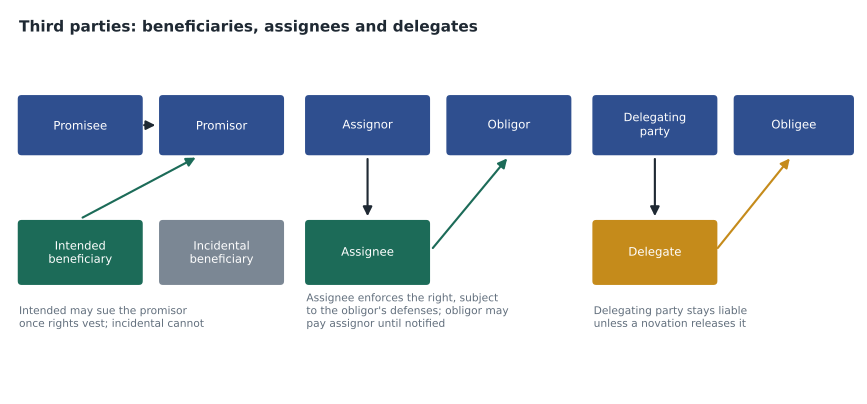
A third party can enforce a contract only if it is an intended beneficiary, not an incidental one. Under Restatement section 302, a beneficiary is intended if recognizing its right is appropriate to carry out the parties' intention and either performance will satisfy a promisee's obligation to the beneficiary, once called a creditor beneficiary, or the circumstances show that the promisee intends to give the beneficiary the benefit, once called a donee beneficiary. Signs of intent include naming the beneficiary in the contract and performance running directly to it. A neighbor whose property value would rise if a contract to build a mansion next door were performed is incidental and cannot sue.
The intended beneficiary's rights vest, and the original parties can no longer modify or rescind the contract without its consent, when the beneficiary manifests assent at the request of a party, sues to enforce, or materially changes position in justifiable reliance, unless the contract reserves the power to modify. The beneficiary can sue the promisor, and a creditor beneficiary can also sue the promisee on the original obligation. The promisor may raise against the beneficiary any defense it has against the promisee arising from the contract, such as fraud or failure of consideration.
Assignment of rights
An assignment transfers a contract right to a third party, the assignee, who can then enforce it against the obligor. Most rights are assignable, except when assignment would materially change the obligor's duty or risk, such as assignment of a personal services right or a requirements contract to a buyer with very different needs; when a statute or public policy forbids it; or when the contract validly prohibits it. Courts read a clause forbidding assignment of 'the contract' as barring only delegation of duties, and a prohibition generally gives the obligor a damages claim rather than voiding the assignment unless the clause says so; under the UCC, rights to payment generally may be assigned despite a prohibition.
No particular form is required, though some assignments must be in writing under the statute of frauds or Article 9. A gratuitous assignment is revocable until the assignee receives performance, gets a judgment, or relies to its detriment, or the assignor delivers a symbolic document. The obligor may pay the assignor until it receives notice of the assignment, and the assignee takes subject to the obligor's defenses arising from the contract, and to other defenses that accrued before notice. If the assignor assigns the same right twice, under the majority rule the first assignee to take for value prevails, unless a later assignee for value without notice first obtains payment, a judgment or a symbolic writing.
Delegation of duties
A party may delegate performance of its duties unless the obligee has a substantial interest in having the original party perform, as with personal services requiring special skill or judgment, or the contract prohibits delegation. Delegation does not release the delegating party: it remains liable if the delegate fails to perform, unless the obligee agrees to a novation substituting the delegate. The delegate who promises to perform, called an assumption, becomes liable to the obligee as well, because the obligee is an intended beneficiary of the delegate's promise. Under the UCC, an assignment of 'the contract' or of 'all my rights under the contract' generally includes a delegation of duties and the assignee's promise to perform them, and the other party may treat it as creating reasonable grounds for insecurity.
Worked problem
Cover damages
A bakery contracts to buy 1,000 pounds of flour at 50 cents a pound, delivery June 1. On June 1, the mill fails to deliver. The bakery promptly buys substitute flour at 70 cents a pound, spending 40 dollars on extra delivery. The market price on June 1 was 65 cents. What can the bakery recover?
Show solution
- The bakery covered in good faith and without unreasonable delay.
- Cover damages are the cover price minus the contract price: 700 dollars minus 500 dollars equals 200 dollars.
- Add incidental damages of 40 dollars for the extra delivery.
- The market price is irrelevant when the buyer reasonably covers.
Answer: 240 dollars.
Practice problems
Work each problem on paper first, then reveal the answer to check.
What does Hadley v. Baxendale limit?
Show answer
Consequential damages to losses foreseeable at contracting as a probable result of breach.
When is a liquidated damages clause enforceable?
Show answer
When the amount is reasonable in light of anticipated or actual loss and the difficulty of proof; otherwise it is a penalty.
What does a lost-volume seller recover?
Show answer
Its lost profit under UCC 2-708(2).
Can a court order a singer to perform her contract?
Show answer
No, but it may enjoin her from performing for a competitor during the term if her services are unique.
When do an intended beneficiary's rights vest?
Show answer
When it assents at a party's request, sues, or materially relies.
Does delegating a duty release the delegating party?
Show answer
No, unless the obligee agrees to a novation.
Common mistakes
MistakePunitive damages punish willful breaches.
InsteadThey are not available for breach of contract unless an independent tort occurs.
MistakeA buyer who covers recovers market minus contract price.
InsteadA buyer who reasonably covers recovers cover minus contract price.
MistakeAnyone who benefits from a contract can sue on it.
InsteadOnly intended beneficiaries can.
MistakeAn anti-assignment clause voids any assignment.
InsteadUsually it bars delegation or gives a damages claim, unless it clearly says assignments are void; payment rights are generally assignable.
Doing the arithmetic
Sofia's spreadsheet method works for most damages questions. Start with what the plaintiff was promised, subtract what the plaintiff actually received or could have obtained by reasonable mitigation, add incidental and foreseeable consequential losses, and subtract any costs the plaintiff saved because it did not have to perform. Then check the limits: was each item foreseeable when the contract was made, provable with reasonable certainty and unavoidable? Finally, check whether a liquidated damages clause controls and whether it is a reasonable estimate or a penalty.
Answer choices in remedies questions often include the right number reached by the wrong formula, such as market damages when the buyer actually covered, or the full contract price for a seller who resold. When two choices give the same figure, pick the one whose reason states the correct measure. When the choices give different figures, do the calculation before reading them, so the closest-sounding distractor does not tempt you.
Summary and key terms
- Expectation damages put the plaintiff in the position of full performance; reliance and restitution are alternatives.
- Limits: foreseeability (Hadley), certainty, mitigation, no punitive damages for breach; liquidated damages must be reasonable, not penalties.
- UCC seller remedies: resale, market differential, lost profit, price in limited cases; buyer remedies: cover, market differential, warranty damages for accepted goods.
- Specific performance requires inadequate damages, as for land and unique goods; no specific performance of personal services; restitution prevents unjust enrichment.
- Intended beneficiaries can enforce once rights vest; most rights are assignable; delegation leaves the delegating party liable absent a novation.
- Expectation interest
- The benefit of the bargain, measured as the position of full performance.
- Consequential damages
- Losses beyond the value of the performance, recoverable only if foreseeable.
- Cover
- A buyer's good-faith purchase of substitute goods after the seller's breach.
- Intended beneficiary
- A third party the contracting parties meant to benefit, who may enforce the contract.
- Novation
- An agreement substituting a new party and releasing the original obligor.
Lesson quiz · 5 questions
Score 60% or more to complete this lesson.
Create a free account to save your progress, take quizzes and earn a certificate.