
BAR-110 · Lesson 7 of 12 · 22 min
Individual rights: due process and equal protection
▶ Video coming soon A video version of this lesson is on the way.
On October 24, Sofia Reyes admits that standards of review are her weak spot. 'I know there are three tiers,' she says, 'but in the moment I pick strict scrutiny for everything that sounds important.' Marchetti tells her she is not alone and that individual rights produce about half of all constitutional law questions, so this lesson and the next carry the most weight in the subject. Today's subject is the Fifth and Fourteenth Amendments: procedural due process, substantive due process and equal protection, along with the Takings Clause and a few other rights that turn on the same tiers.
Where the rights come from
The Fourteenth Amendment's Due Process and Equal Protection Clauses limit the states. The Fifth Amendment's Due Process Clause limits the federal government, and Bolling v. Sharpe (1954) read an equal protection component into it, so the same equal protection analysis applies to federal action. Most of the Bill of Rights has been incorporated against the states through the Fourteenth Amendment's Due Process Clause, including the Second Amendment in McDonald v. Chicago (2010) and the Excessive Fines Clause in Timbs v. Indiana (2019). The main exceptions are the Third Amendment, the Fifth Amendment's grand jury requirement and the Seventh Amendment's civil jury right.
The three tiers
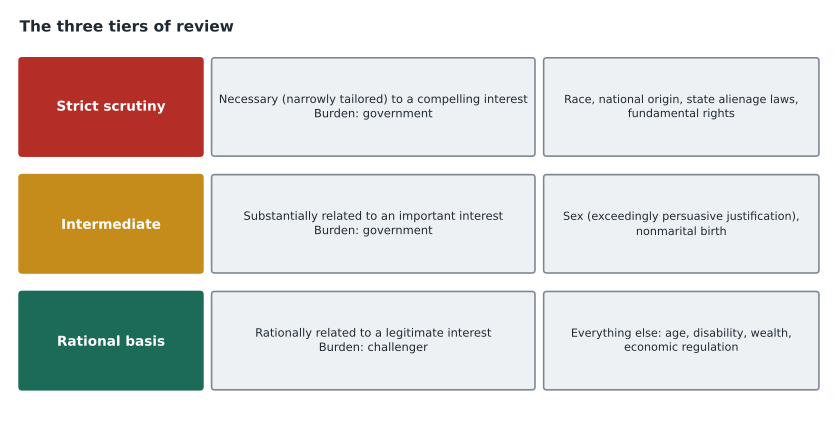
Courts use three standards of review, and choosing the right one decides most cases.
Strict scrutiny requires the government to prove that the law is necessary, meaning narrowly tailored and the least restrictive means, to achieve a compelling government interest. It applies to classifications based on race, national origin and, for state laws, alienage, and to laws burdening fundamental rights. Laws rarely survive it.
Intermediate scrutiny requires the government to show that the law is substantially related to an important government interest. It applies to classifications based on sex and on nonmarital birth. For sex, United States v. Virginia (1996) requires an exceedingly persuasive justification, and the justification must be genuine, not invented after the fact or based on overbroad generalizations about men and women.
Rational basis review requires the challenger to prove that the law is not rationally related to any legitimate government interest. It applies to everything else, including classifications based on age, disability, wealth and economic regulation. Courts will imagine any conceivable legitimate purpose. Laws almost always survive, though a few cases struck down laws motivated by animus against a politically unpopular group, such as City of Cleburne v. Cleburne Living Center (1985), Romer v. Evans (1996) and United States v. Windsor (2013).
Procedural due process
Procedural due process asks whether the government followed fair procedures before depriving a person of life, liberty or property. First, is there a protected interest? Property includes entitlements created by statute, contract or clear practice, such as continued public employment where a person may be fired only for cause, Cleveland Board of Education v. Loudermill (1985), or welfare benefits, Goldberg v. Kelly (1970). A unilateral expectation is not enough; an at-will or probationary public employee has no property interest, Board of Regents v. Roth (1972). Liberty includes physical freedom, many family rights and the freedom to pursue an occupation, though injury to reputation alone is not enough.
Second, what process is due? Mathews v. Eldridge (1976) balances the private interest affected, the risk of erroneous deprivation under current procedures and the value of additional safeguards, and the government's interest, including administrative burden. Usually notice and an opportunity to be heard before the deprivation are required, but in emergencies, or when a post-deprivation hearing is adequate, a later hearing may suffice. A tenured public employee is entitled to notice of the charges, an explanation of the evidence and an opportunity to respond before termination, followed by a fuller post-termination hearing. Termination of welfare benefits requires a pre-termination evidentiary hearing; termination of disability benefits does not. Negligent government conduct does not deprive anyone of due process, Daniels v. Williams (1986).
Substantive due process
Substantive due process protects certain rights against government interference regardless of procedure. Fundamental rights trigger strict scrutiny. Rights the Court has recognized as fundamental include the right to marry, Loving v. Virginia (1967) and Obergefell v. Hodges (2015); to procreate; to use contraception, Griswold v. Connecticut (1965) and Eisenstadt v. Baird (1972); to make decisions about the care, custody and control of one's children, Troxel v. Granville (2000); to keep the family together, including extended family, Moore v. East Cleveland (1977); to engage in private intimate conduct, Lawrence v. Texas (2003); and to refuse unwanted medical treatment. The right to travel interstate is also fundamental, though it is usually analyzed under equal protection or privileges or immunities.
Dobbs v. Jackson Women's Health Organization (2022) overruled Roe v. Wade and Planned Parenthood v. Casey, holding that the Constitution does not confer a right to abortion and returning regulation to the people and their elected representatives. State abortion laws are now reviewed under rational basis. Dobbs reaffirmed that, to qualify as fundamental, an unenumerated right must be deeply rooted in the nation's history and tradition and implicit in the concept of ordered liberty, Washington v. Glucksberg (1997), which rejected a right to physician-assisted suicide. The majority said its decision did not cast doubt on precedents not concerning abortion.
Economic and social legislation that does not burden a fundamental right gets rational basis review, the approach the Court adopted after the Lochner era in cases such as West Coast Hotel v. Parrish (1937). Excessive punitive damages, grossly out of proportion to the harm, can violate substantive due process, BMW v. Gore (1996) and State Farm v. Campbell (2003).
Equal protection
Equal protection analysis starts by identifying the classification. A law can classify on its face, or a facially neutral law can be applied in a discriminatory way, as in Yick Wo v. Hopkins (1886). A facially neutral law with a disproportionate impact on a group triggers heightened scrutiny only if it was adopted with a discriminatory purpose, Washington v. Davis (1976) and Personnel Administrator v. Feeney (1979); impact alone is evidence of purpose but not enough. Village of Arlington Heights (1977) lists the evidence courts consider.
Race and national origin classifications receive strict scrutiny even when they are meant to benefit minority groups, Adarand Constructors v. Peña (1995). Remedying identified past discrimination by the governmental unit itself can be compelling, but general societal discrimination is not enough, City of Richmond v. J.A. Croson (1989). In Students for Fair Admissions v. President and Fellows of Harvard College (2023), the Court held that race-conscious admissions programs at Harvard and the University of North Carolina violated equal protection, because their interests were not sufficiently measurable to permit strict scrutiny review, they used race negatively and as a stereotype, and they lacked a logical end point. An applicant may still discuss how race affected his or her life, as long as the university treats the applicant as an individual. Racial gerrymandering, drawing districts predominantly on the basis of race, triggers strict scrutiny, Shaw v. Reno (1993).
Alienage is a special case. State laws discriminating against lawfully present aliens get strict scrutiny, Graham v. Richardson (1971), except for laws excluding aliens from participation in government functions, such as police officers, public school teachers and probation officers, which get rational basis under the political function exception. Federal alienage classifications get rational basis because of Congress's plenary power over immigration. State laws affecting undocumented aliens generally get rational basis, but Plyler v. Doe (1982) struck down denial of free public education to undocumented children as irrational.
Sex classifications receive intermediate scrutiny, whether they disadvantage women or men, Craig v. Boren (1976) and Mississippi University for Women v. Hogan (1982). Laws based on real biological differences, such as statutory rape laws in Michael M. (1981) or rules on proving parentage in Nguyen v. INS (2001), have been upheld, while laws based on stereotypes have not. Sessions v. Morales-Santana (2017) struck down a citizenship rule treating unwed fathers and mothers differently. In United States v. Skrmetti (2025), the Court applied rational basis review to and upheld a Tennessee law banning certain medical treatments for transgender minors, reasoning that the law classified based on age and medical use rather than sex. In West Virginia v. B.P.J. and Little v. Hecox (2026), the Court upheld state laws limiting participation in girls' school sports teams on the basis of sex at birth.
Nonmarital birth classifications receive intermediate scrutiny, so a state cannot deny benefits to children because their parents were not married. Age, disability, wealth and sexual orientation classifications have not been given heightened scrutiny, though animus-based laws fail even rational basis.
Fundamental rights under equal protection include voting, where one person, one vote applies to state and local legislative districts, Reynolds v. Sims (1964), though some flexibility is allowed for state legislatures; access to courts for certain cases, such as divorce filing fees for the indigent; and interstate travel, which bars durational residency requirements for benefits like welfare, Saenz v. Roe (1999), though reasonable requirements for things like in-state tuition, voting registration and divorce are allowed. Education is not a fundamental right, San Antonio Independent School District v. Rodriguez (1973).
| Classification | Standard | Leading cases |
|---|---|---|
| Race, national origin | Strict | Adarand; Croson; SFFA (2023) |
| State alienage law (lawful residents) | Strict, except political functions | Graham v. Richardson |
| Sex | Intermediate (exceedingly persuasive justification) | Craig v. Boren; United States v. Virginia |
| Nonmarital birth | Intermediate | Clark v. Jeter |
| Age, disability, wealth, economic regulation | Rational basis | Cleburne; Rodriguez |
Takings
The Fifth Amendment's Takings Clause, incorporated against the states, bars taking private property for public use without just compensation. Public use is read broadly to mean a public purpose, including economic development, Kelo v. City of New London (2005). Just compensation is the fair market value of the property at the time of the taking. A physical occupation authorized by government is a per se taking however small, Loretto v. Teleprompter (1982), and Cedar Point Nursery v. Hassid (2021) held that a regulation giving union organizers a right to enter farms was a per se physical taking. A regulation that deprives an owner of all economically beneficial use is a per se taking unless background principles of nuisance or property law already prohibited the use, Lucas v. South Carolina Coastal Council (1992). Other regulations are judged under the Penn Central (1978) factors: economic impact, interference with distinct investment-backed expectations and the character of the government action. Land-use exactions must have an essential nexus to a legitimate interest and rough proportionality to the impact of the development, Nollan (1987) and Dolan (1994), and Sheetz v. County of El Dorado (2024) held those tests apply to legislatively imposed fees too. Since Knick v. Township of Scott (2019), a property owner may sue in federal court as soon as the government takes property without paying.
Contracts Clause and other limits
The Contracts Clause bars states from passing laws impairing the obligation of existing contracts. A substantial impairment of a private contract is valid only if it serves a significant and legitimate public purpose and is reasonable and appropriate, Energy Reserves Group (1983); impairments of the government's own contracts get closer scrutiny. The clause does not apply to the federal government or to future contracts. Bills of attainder, legislative punishment of named or identifiable individuals without trial, and ex post facto laws, which retroactively criminalize conduct or increase punishment, are forbidden to both federal and state governments; the ex post facto prohibition applies only to criminal laws.
Worked problem
Choosing the tier
A city ordinance gives a ten-point hiring preference for firefighter jobs to applicants who live in the city. A nonresident challenges it under equal protection. What standard applies, and how will the court likely rule?
Show solution
- Residence within a city is not a suspect or quasi-suspect classification.
- Public employment is not a fundamental right, and the preference does not penalize interstate travel by new residents of the state.
- Rational basis applies: the challenger must show no rational relation to any legitimate interest.
- Faster emergency response and community ties are conceivable legitimate interests.
Answer: Rational basis; the ordinance is likely valid under equal protection. (A preference against out-of-state residents in private employment could raise Article IV privileges and immunities issues, a separate question.)
Practice problems
Work each problem on paper first, then reveal the answer to check.
Which level of scrutiny applies to a state law excluding lawful permanent residents from practicing law?
Show answer
Strict scrutiny; practicing law is not a political function.
What did Dobbs hold?
Show answer
The Constitution does not confer a right to abortion; Roe and Casey were overruled.
Does a facially neutral law with a disparate racial impact trigger strict scrutiny?
Show answer
Only if adopted with a discriminatory purpose.
What process is due before firing a tenured public employee?
Show answer
Notice of the charges, an explanation of the evidence and an opportunity to respond, followed by a fuller post-termination hearing.
Is a regulation permitting third parties to enter private property a taking?
Show answer
Yes, a per se physical taking under Cedar Point Nursery.
Does the Contracts Clause limit the federal government?
Show answer
No. It applies only to the states.
Common mistakes
MistakeBenign racial classifications get intermediate scrutiny.
InsteadAll racial classifications get strict scrutiny.
MistakeEducation is a fundamental right.
InsteadRodriguez held it is not, though Plyler struck down a total denial to undocumented children.
MistakeEvery interest that sounds important is fundamental.
InsteadFundamental rights are a defined list; new ones must be deeply rooted in history and tradition.
MistakeDisparate impact proves discrimination.
InsteadDiscriminatory purpose is required.
Summary and key terms
- Pick the tier: strict for race, national origin, state alienage and fundamental rights; intermediate for sex and nonmarital birth; rational basis for everything else.
- Procedural due process: identify a protected property or liberty interest, then apply Mathews v. Eldridge balancing.
- Substantive due process protects marriage, procreation, contraception, parental rights, family living and intimate conduct; Dobbs removed abortion from that list.
- Equal protection requires discriminatory purpose for facially neutral laws; SFFA ended race-conscious admissions; Skrmetti and B.P.J. are recent sex-classification cases.
- Takings: physical occupations and total wipeouts are per se; otherwise Penn Central; exactions need nexus and rough proportionality. Contracts Clause, bills of attainder and ex post facto laws add further limits.
- Strict scrutiny
- The law must be necessary to achieve a compelling interest; the government bears the burden.
- Intermediate scrutiny
- The law must be substantially related to an important interest.
- Rational basis
- The law must be rationally related to a legitimate interest; the challenger bears the burden.
- Incorporation
- Applying Bill of Rights guarantees to the states through the Fourteenth Amendment.
- Per se taking
- A physical occupation or total deprivation of economic use, requiring compensation without balancing.
Lesson quiz · 5 questions
Score 60% or more to complete this lesson.
Create a free account to save your progress, take quizzes and earn a certificate.