
BAR-110 · Lesson 1 of 12 · 22 min
How the MBE works and how to attack a question
▶ Video coming soon A video version of this lesson is on the way.
On Saturday, September 12, 2026, Hollis Marchetti opens a new series for the study group: a Saturday morning drill on the Multistate Bar Examination, which everyone calls the MBE. Three members will sit it in February 2027. Dana Whitfield takes it as part of Texas's legacy Uniform Bar Exam, Ngozi Adeyemi as part of New York's, and Sofia Reyes as part of the California exam, which went back to the MBE in 2025. Marcus Bell, who passed Missouri's first NextGen exam in July, joins as a volunteer drill partner. Eddie Boudreaux and Camila Ortiz Rivera, whose Louisiana and Puerto Rico exams do not use the MBE, say they will sit in on the constitutional law weeks because federal law follows them everywhere.
Marchetti starts with a confession. 'I failed my first practice MBE,' she says. 'I knew the law. I lost points because I read too fast, answered the question I expected instead of the one in front of me, and changed right answers to wrong ones. This course reviews three of the seven MBE subjects: civil procedure, constitutional law and contracts. But today is about the test itself, because method is worth as many points as memorization.'
The format
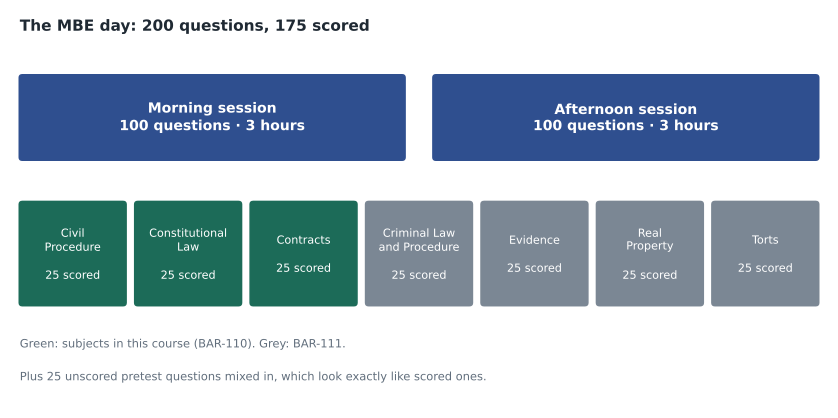
The MBE is a six-hour, 200-question multiple-choice test, given in two three-hour sessions of 100 questions each, one in the morning and one in the afternoon, with no scheduled breaks inside a session. Only 175 questions are scored. The other 25 are unscored pretest questions that NCBE is trying out for future exams, and they look exactly like the scored ones, so you must treat every question as if it counts.
The 175 scored questions are split evenly: 25 each in Civil Procedure, Constitutional Law, Contracts, Criminal Law and Procedure, Evidence, Real Property and Torts. This course covers the first three; BAR-111 covers the rest. That even split matters for planning: no subject is optional, and three hours for 100 questions means an average of 1.8 minutes per question, or about 108 seconds.
Your raw score, the number of scored questions you answered correctly, is converted to a scaled score through a statistical process called equating, which adjusts for small differences in difficulty between test forms so that a score means the same thing from one administration to the next. There is no penalty for wrong answers, so you must answer every question. A blank is always wrong; a guess is right a quarter of the time, and an educated guess after eliminating two answers is right half the time.
In UBE jurisdictions the MBE is 50 percent of the total score, with the Multistate Essay Examination at 30 percent and the Multistate Performance Test at 20 percent. Several non-UBE jurisdictions also use it. Because most jurisdictions are moving to the NextGen bar exam between July 2026 and July 2028, NCBE has announced that the legacy exam, including the MBE, will be given through February 2028. Anyone taking a legacy exam before then still needs the MBE.
What law the MBE tests
NCBE's MBE Subject Matter Outline tells examinees what to assume. For civil procedure, assume the Federal Rules of Civil Procedure as currently in effect and the sections of Title 28 of the United States Code on trial and appellate jurisdiction, venue and transfer. For constitutional law, 'the Constitution' means the federal Constitution. For contracts, assume the official text of Articles 1 and 2 of the Uniform Commercial Code has been adopted; about one quarter of the contracts questions are based on those articles. Beyond those instructions, questions are to be answered under generally accepted fundamental legal principles unless the question says otherwise.
That phrase is the key to MBE law. The test is national, so it asks for the majority rule or the rule of the Restatement or the uniform code, not your state's rule. When a question wants a minority rule or a statute, it gives it to you in the facts. Marchetti tells Dana, whose Texas clerkship has trained her in Texas practice, that her daily instincts may sometimes mislead her. 'On Saturday mornings, you live in the State of Majority Rule,' she says.
The outline also tells you where the questions cluster. In civil procedure, about two thirds of the questions come from three areas: jurisdiction and venue, pretrial procedures, and motions. In constitutional law, about half come from individual rights, and the other half from judicial review, separation of powers and federalism. In contracts, about half come from formation and from performance, breach and discharge.
| Subject | Heaviest areas (about half or more) | Remaining areas |
|---|---|---|
| Civil Procedure | Jurisdiction and venue; pretrial procedures; motions (about two thirds) | Law applied by federal courts; jury trials; verdicts and judgments; appealability |
| Constitutional Law | Individual rights (about half) | Judicial review; separation of powers; nation and states |
| Contracts | Formation; performance, breach and discharge (about half) | Defenses; content and meaning; remedies; third-party rights |
Anatomy of a question
Every MBE question has three parts. The fact pattern is a short story, usually four to ten sentences. The call of the question, the last sentence before the answers, tells you what to decide: whether a motion should be granted, whether a statute is constitutional, whether a party is likely to prevail. Then come four answer choices, labeled A through D, one of which is the best answer. Notice the word best. NCBE instructs examinees to choose the best answer, and sometimes two choices are partly correct; your job is to pick the one that most completely and accurately resolves the call.
Answer choices often have two parts: a conclusion, such as 'Yes' or 'Grant the motion', and a reason, introduced by 'because', 'if' or 'unless'. A choice with the right conclusion and the wrong reason is wrong. 'Because' means the reason must be true and must actually support the conclusion. 'If' means the condition must be one that, if met, produces the conclusion, and it must be plausibly raised by the facts. 'Unless' means the conclusion follows in every case except the stated one.
A five-step method
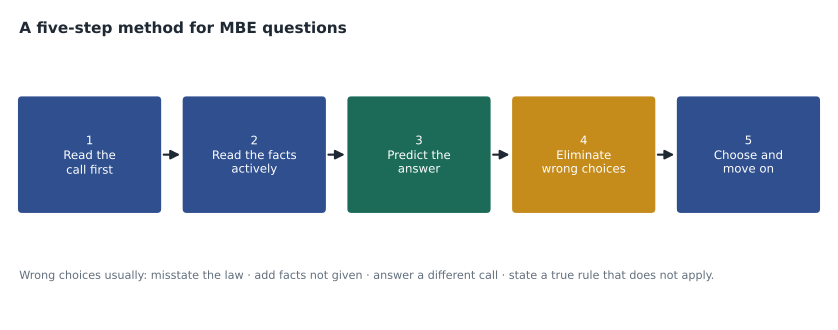
Marchetti's method has five steps, and she makes the group practice it slowly before they practice it fast.
First, read the call of the question first. It tells you the subject and what kind of answer to look for before you read the facts, so you read them with a purpose. A call asking 'Should the court grant the motion to dismiss for lack of subject-matter jurisdiction?' sends you looking for citizenship, amounts and federal claims.
Second, read the facts actively. Note each party, its role and its state of citizenship; dates and amounts; who did what; and any odd detail, because the examiners rarely include a fact for no reason. A defendant described as 'a citizen of Ohio with its principal place of business in Indiana' is telling you to think about diversity.
Third, predict the answer before you look at the choices. State the rule in your head and apply it. If you have an answer in mind, the choices become a check rather than a menu of temptations. The examiners write wrong answers that sound plausible to someone without a prediction.
Fourth, read every choice and eliminate. Strike choices that misstate the law, that rely on facts not in the question, that answer a different call, or that state a true rule that does not apply. Be suspicious of absolute words like always and never, though they are sometimes correct.
Fifth, choose and move on. If two choices remain, ask which more precisely fits the facts and the call. Mark the question if you are unsure and come back only if time allows. Research on test-taking shows that answer changes made for a clear reason, such as noticing a fact you missed, tend to help, while changes made from vague unease tend to hurt; Marchetti's rule is to change an answer only when you can name the fact or rule that changed your mind.
Timing
With 100 questions in 180 minutes, Marchetti recommends checkpoints rather than watching every question's clock. Aim to finish question 34 at about one hour, question 67 at about two hours, and question 100 with ten minutes to spare to fill in any blanks. Long questions and short ones average out. If you find yourself reading a fact pattern for the third time, pick your best answer, mark it and move on; one stubborn question can cost you three easy ones at the end of the session.
Bubbling matters too. Whether your jurisdiction uses paper answer sheets or a computer, a mismatch between question number and answer slot can cost many points. On paper, check alignment every ten questions. On a computer, use the flag feature rather than skipping without a mark.
Worked problem
Applying the method
Call: Is the court likely to grant the defendant's motion to dismiss for lack of subject-matter jurisdiction? Facts: A patient who is a citizen of Kansas sues a surgeon who is a citizen of Missouri in federal court in Kansas, alleging negligence and seeking 90,000 dollars in damages. Choices: (A) Yes, because negligence is a state-law claim. (B) Yes, because the surgeon is not a citizen of Kansas. (C) No, because the parties are diverse and the amount in controversy exceeds 75,000 dollars. (D) No, because federal courts have jurisdiction over all claims between citizens of different states.
Show solution
- Read the call: subject-matter jurisdiction in federal court.
- Facts: Kansas plaintiff, Missouri defendant, 90,000 dollars, state-law claim.
- Predict: diversity jurisdiction exists under 28 U.S.C. 1332, because the parties are completely diverse and the amount exceeds 75,000 dollars, so the motion should be denied.
- Eliminate: (A) is wrong because state-law claims can come in under diversity. (B) is irrelevant. (D) states the conclusion but a false rule: diversity also requires the amount in controversy.
Answer: (C). It has the right conclusion and the complete, correct reason.
How to review practice questions
The group will do many practice questions, all of them written for the course rather than taken from real exams. Marchetti insists that reviewing is where the learning happens. For every question you missed or guessed, write down why the right answer is right, why your answer was wrong, and which of four categories the error belongs to: did not know the rule, knew the rule but misapplied it, misread the facts or call, or fell for a trap answer. After a few hundred questions, patterns appear. Sofia discovers in the first week that most of her contracts errors are misreads of the call, not gaps in knowledge, which tells her to slow down at step one rather than to reread her outline.
Volume matters, but quality matters more. A typical plan for a February exam starts content review in late fall and builds to timed mixed sets in January. Marchetti suggests between 1,500 and 2,500 practice questions over a full bar-prep period, with every one reviewed. She also recommends doing official NCBE practice exams, which are licensed by NCBE and contain retired real questions, under timed conditions near the end, because they are the best guide to the style of the real test.
The three subjects in this course
Civil Procedure questions test the Federal Rules and federal jurisdiction statutes. Expect subject-matter and personal jurisdiction, venue, the Erie doctrine, pleadings, joinder, discovery, summary judgment, jury trial rights, judgments and preclusion. Lessons 2 to 4 cover them.
Constitutional Law questions test the federal Constitution as the Supreme Court has interpreted it. Expect justiciability, congressional and presidential powers, federalism, state action, due process, equal protection and the First Amendment. Lessons 5 to 8 cover them. Because the Supreme Court changes doctrine from time to time, the course flags recent decisions, but the MBE tests settled law, and examiners avoid questions on points the Court has just unsettled until the law is clear.
Contracts questions test common law contracts, mostly as reflected in the Restatement (Second) of Contracts, and sales of goods under UCC Article 2. Expect formation, consideration, defenses, interpretation, conditions, breach, remedies and third-party rights. Lessons 9 to 11 cover them. Lesson 12 is a mixed timed set across all three.
Practice problems
Work each problem on paper first, then reveal the answer to check.
How many MBE questions are scored, and how are they divided?
Show answer
175, with 25 in each of seven subjects. The other 25 are unscored pretest questions mixed in.
What does "best answer" mean on the MBE?
Show answer
More than one choice may be partly correct; choose the one that most completely and accurately resolves the call.
What does "because" require in an answer choice?
Show answer
The reason must be true and must actually support the conclusion.
What civil procedure law does the MBE assume?
Show answer
The Federal Rules of Civil Procedure as currently in effect and the Title 28 sections on jurisdiction, venue and transfer.
About what share of contracts questions involve UCC Articles 1 and 2?
Show answer
About one quarter.
Should you ever leave an MBE question blank?
Show answer
No. There is no penalty for wrong answers, so a guess can only help.
Common mistakes
MistakePretest questions can be spotted and skipped.
InsteadThey look identical to scored questions; answer everything carefully.
MistakeAn answer with the right "Yes" or "No" is right.
InsteadThe reason must also be correct and must support the conclusion.
MistakeUse your own state's rules.
InsteadThe MBE tests majority rules, the Federal Rules and the UCC, unless the question gives you a different rule.
MistakeChange answers whenever in doubt.
InsteadChange an answer only when you can identify the fact or rule that proves your first choice wrong.
Summary and key terms
- The MBE has 200 questions in two three-hour sessions; 175 are scored, 25 in each of seven subjects, and 25 are unscored pretest questions.
- Scores are scaled by equating; there is no wrong-answer penalty, and the MBE is half of the UBE score. The legacy MBE runs through February 2028.
- Assume the Federal Rules of Civil Procedure and Title 28 for civil procedure, the federal Constitution, and UCC Articles 1 and 2 for sales; otherwise, generally accepted principles.
- Use the five steps: call, facts, predict, eliminate, choose. Two-part answers need a correct conclusion and a correct reason.
- Pace by checkpoints, review every missed or guessed question by error type, and finish with timed official practice.
- MBE
- The Multistate Bar Examination, NCBE's 200-question multiple-choice test.
- Pretest question
- An unscored question being tried out for future use; it looks identical to scored questions.
- Equating
- The statistical process that adjusts for difficulty differences between test forms.
- Scaled score
- A score converted from the raw score through equating so it means the same thing across administrations.
- Call of the question
- The sentence just before the answer choices that states what must be decided.
Lesson quiz · 5 questions
Score 60% or more to complete this lesson.
Create a free account to save your progress, take quizzes and earn a certificate.