
BAR-110 · Lesson 10 of 12 · 23 min
Terms, performance and conditions
▶ Video coming soon A video version of this lesson is on the way.
On November 14, Ngozi Adeyemi brings the group a contracts question that made her laugh. A seller delivered 1,000 widgets, one of them scratched, and the buyer rejected the whole shipment. 'In Nigeria we would call that petty,' she says. 'Is it allowed?' Marchetti says that under the UCC's perfect tender rule it often is, subject to some important limits, and that this is exactly the kind of difference between Article 2 and the common law the MBE tests. This lesson covers what the contract means, what terms are implied into it, the conditions that control when performance is due, and the excuses that release a party.
The parol evidence rule
When the parties put their agreement in a writing intended as the final expression of their terms, an integrated agreement, the parol evidence rule limits evidence of earlier or contemporaneous agreements. If the writing is completely integrated, meaning a complete and exclusive statement of the terms, evidence of prior or contemporaneous agreements cannot add to or contradict it. If it is partially integrated, final but not complete, such evidence may supplement it with consistent additional terms but may not contradict it. A merger clause stating that the writing is the entire agreement is strong evidence of complete integration. Under UCC 2-202, a final writing may be explained or supplemented by course of dealing, usage of trade and course of performance, and by consistent additional terms unless the court finds the writing was intended as complete and exclusive.
The rule does not bar evidence offered for other purposes. Parol evidence is admissible to show that the agreement is void or voidable because of fraud, duress, mistake or illegality; to show that a condition precedent to the agreement's effectiveness was not met; to interpret ambiguous terms; to prove a separate agreement supported by separate consideration; and to prove later modifications, which the rule does not cover at all. A no-oral-modification clause is generally effective under UCC 2-209(2) between merchants, though a party may waive it by conduct.
Interpretation
Courts interpret contracts to carry out the parties' intent, read as a whole. Specific terms control general ones, handwritten terms control typed ones, and typed terms control printed ones. Ambiguities are construed against the drafter, the rule of contra proferentem. Under the Restatement and the UCC, express terms control course of performance, which controls course of dealing, which controls usage of trade. When parties attach materially different meanings to a term, there is no contract if neither knows or has reason to know of the other's meaning, as in Raffles v. Wichelhaus (1864), where the parties meant different ships named Peerless; if one knows the other's meaning, that meaning controls.
Implied terms and good faith
Every contract carries an implied duty of good faith and fair dealing in its performance and enforcement, Restatement section 205 and UCC 1-304. It does not create independent obligations, but it prevents a party from frustrating the other's reasonable expectations, such as by exercising discretion arbitrarily. Courts also imply terms needed to make a contract work, such as reasonable efforts in an exclusive dealing arrangement.
Warranties under Article 2
Express warranties arise from affirmations of fact or promises relating to the goods, descriptions of the goods and samples or models that become part of the basis of the bargain, UCC 2-313. No special words are needed, but mere opinion or sales talk, such as calling a car 'a great deal', creates none. The implied warranty of merchantability, UCC 2-314, arises in every sale by a merchant who deals in goods of that kind, and requires that the goods be fit for their ordinary purposes and pass without objection in the trade. The implied warranty of fitness for a particular purpose, UCC 2-315, arises when any seller has reason to know of the buyer's particular purpose and that the buyer is relying on the seller's skill or judgment to select suitable goods. A warranty of title, that the seller has good title and the right to transfer it, accompanies every sale.
Sellers may disclaim implied warranties. To disclaim merchantability, the disclaimer must mention merchantability and, if written, be conspicuous; to disclaim fitness, it must be in a conspicuous writing. Expressions like 'as is' or 'with all faults' disclaim all implied warranties. A buyer's examination of the goods before contracting removes implied warranties for defects an examination should have revealed. Express warranties cannot be disclaimed by language inconsistent with them. Remedies for breach of warranty may be limited, but a limitation of consequential damages for personal injury from consumer goods is prima facie unconscionable, UCC 2-719.
Delivery and risk of loss
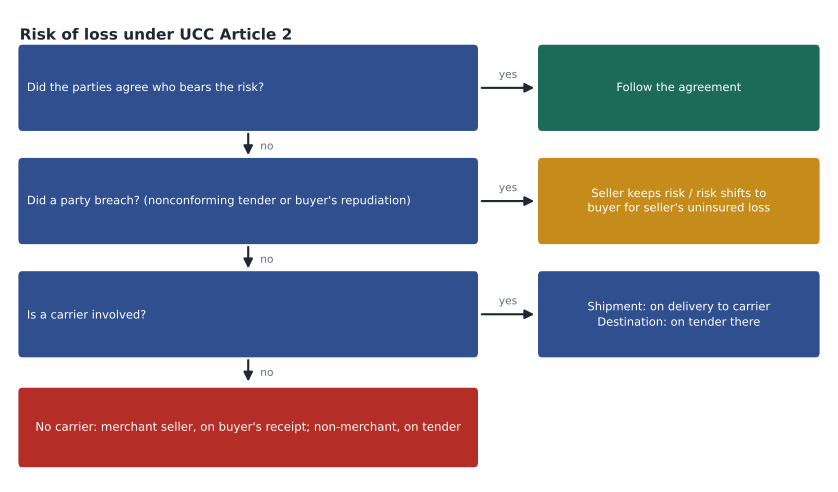
Without an agreement, the seller must tender delivery at its place of business. In a shipment contract, using terms like 'FOB seller's city', the seller must put conforming goods into the hands of a carrier, make a reasonable contract for their transport, deliver documents and notify the buyer; risk of loss passes to the buyer when the goods are delivered to the carrier. In a destination contract, using terms like 'FOB buyer's city', the seller must tender the goods at the destination, and risk passes when they are tendered there. Courts presume a shipment contract when the contract is unclear.
When no carrier is used, risk passes on the buyer's receipt of the goods if the seller is a merchant, and on tender of delivery if not, UCC 2-509(3). Goods held by a bailee pass risk when the buyer receives a negotiable document of title or the bailee acknowledges the buyer's right to possession. If the seller sends nonconforming goods that the buyer may reject, risk stays with the seller until cure or acceptance, and if the buyer rightfully revokes acceptance, risk is treated as having remained with the seller to the extent the buyer's insurance does not cover the loss, UCC 2-510. If the buyer breaches before risk passes, the risk shifts to the buyer for a commercially reasonable time, to the extent the seller's insurance is deficient.
Conditions
A condition is an event, not certain to occur, that must occur before performance under a contract becomes due, unless its nonoccurrence is excused. Express conditions are created by the parties, often with words like 'on condition that', 'provided that' or 'if', and require strict compliance: an express condition must be fully satisfied, though courts avoid forfeiture by interpreting ambiguous language as a promise rather than a condition and may excuse a condition whose occurrence was not a material part of the exchange if enforcement would cause disproportionate forfeiture, Restatement section 229. Conditions of satisfaction are judged by a reasonable person standard for matters of commercial quality or mechanical fitness, and by honest subjective satisfaction for matters of personal taste, such as a portrait.
Constructive conditions are implied by courts to secure fair exchange. When performances can occur simultaneously, such as a sale of land for cash, each party's tender is a condition of the other's duty. When one performance takes time, such as construction, that performance must come first and is a condition of the other's duty to pay, unless the contract provides for progress payments.
A condition may be excused. A party who wrongfully prevents or hinders the occurrence of a condition cannot rely on it. A party may waive a condition that benefits it, though a waiver of a material condition may require consideration, and a waiver of a future condition may be retracted with notice before the other party has relied on it. Anticipatory repudiation excuses the other party's conditions, as discussed below.
Common law performance: substantial performance and material breach
Under the common law, a party who substantially performs can enforce the contract, though the other party may recover damages for the shortfall. Jacob & Youngs v. Kent (1921) held that a builder who used a different brand of pipe of the same quality had substantially performed, and the owner was limited to the difference in value, nearly nothing, rather than the cost of tearing out walls. Whether a breach is material depends on factors in Restatement section 241: the extent to which the injured party loses the benefit it reasonably expected, whether it can be adequately compensated, the forfeiture the breaching party would suffer, the likelihood of cure, and the breaching party's good faith. A material breach suspends the other party's duty to perform and, if uncured, lets it terminate and sue for total breach; a minor breach gives only a claim for damages.
Divisible contracts, where performance is divided into parts paired with corresponding payments, let a party recover for completed parts even if later parts fail. A party in material breach may still recover in restitution for the value of benefits conferred, less the other party's damages, in many jurisdictions.
UCC performance: perfect tender, cure and installment contracts
Under UCC 2-601, if the goods or the tender fail in any respect to conform to the contract, the buyer may reject the whole, accept the whole, or accept any commercial unit and reject the rest. That is the perfect tender rule, the answer to Ngozi's question. Rejection must occur within a reasonable time after delivery and with seasonable notice to the seller; a merchant buyer who rejects must follow the seller's reasonable instructions about the goods.
Two rules soften perfect tender. First, the seller may cure. If the time for performance has not yet expired, the seller may notify the buyer of its intent to cure and deliver conforming goods within the contract time. If the time has expired, a seller who had reasonable grounds to believe the tender would be acceptable may have a further reasonable time to cure, UCC 2-508. Second, in an installment contract, one requiring delivery in separate lots to be separately accepted, the buyer may reject an installment only if the nonconformity substantially impairs its value and cannot be cured, and may cancel the whole contract only if the defect substantially impairs the value of the whole contract, UCC 2-612.
After acceptance, the buyer cannot reject but may revoke acceptance under UCC 2-608 if the nonconformity substantially impairs the value of the goods to the buyer and the buyer accepted either on the reasonable assumption the seller would cure, or without discovering the defect because it was difficult to discover or because of the seller's assurances. Revocation must occur within a reasonable time after the buyer discovers or should have discovered the defect and before any substantial change in the goods not caused by their own defects. A buyer who accepts must notify the seller of any breach within a reasonable time or lose all remedies.
Anticipatory repudiation and adequate assurance
An anticipatory repudiation is a clear and unequivocal statement or act indicating that a party will not perform before performance is due. The nonrepudiating party may treat it as a total breach and sue immediately, suspend its own performance, or wait for performance for a commercially reasonable time while urging retraction. The repudiating party may retract unless the other party has materially changed position in reliance or indicated that it considers the repudiation final. Under UCC 2-609 and Restatement section 251, when reasonable grounds for insecurity arise about the other party's performance, a party may demand adequate assurance in writing and suspend its own performance; failure to provide adequate assurance within a reasonable time, not more than 30 days under the UCC, is a repudiation.
Excuse: impossibility, impracticability and frustration
Performance may be excused by events neither party caused. Impossibility, or impracticability under the modern formulation, excuses performance when an event occurs whose nonoccurrence was a basic assumption of the contract, making performance impracticable, without fault of the party seeking excuse, and the party did not assume the risk. Classic examples include destruction of the specific subject matter, Taylor v. Caldwell (1863), where a music hall burned down; death or incapacity of a person necessary for personal services; and supervening illegality. Increased cost alone is rarely enough, unless it is extreme and unforeseen. For goods, UCC 2-613 excuses the seller when identified goods are destroyed without fault before risk passes, and 2-615 excuses delay or nondelivery made impracticable by a contingency the nonoccurrence of which was a basic assumption, with the seller allocating production fairly among customers.
Frustration of purpose excuses a party whose principal purpose is substantially frustrated by an event whose nonoccurrence was a basic assumption, even though performance remains possible, Krell v. Henry (1903), where a room rented to watch a coronation procession was useless after the procession was canceled. The frustration must be so severe that it is beyond the risks assumed under the contract.
| Situation | Common law | UCC |
|---|---|---|
| Minor defect in performance | Substantial performance; damages only | Perfect tender: buyer may reject (subject to cure) |
| Seller's defective tender before deadline | Material breach analysis | Seller may cure within the contract time |
| Installment deliveries | Material breach analysis | Reject installment only on substantial impairment |
| Insecurity about performance | Section 251 adequate assurance | 2-609 written demand; 30 days to respond |
Worked problem
Perfect tender and cure
A retailer orders 500 blue umbrellas for delivery by May 15. The supplier delivers 500 green umbrellas on May 1. The retailer rejects them promptly. On May 3, the supplier notifies the retailer that it will deliver blue umbrellas by May 12, and it does. Must the retailer accept?
Show solution
- The green umbrellas did not conform, so the retailer could reject under the perfect tender rule.
- The time for performance had not expired, and the supplier seasonably notified the retailer of its intent to cure.
- It made a conforming delivery within the contract time.
Answer: Yes. The supplier cured under UCC 2-508(1), and the retailer must accept the blue umbrellas.
Practice problems
Work each problem on paper first, then reveal the answer to check.
Can parol evidence show that a completely integrated contract was induced by fraud?
Show answer
Yes. The rule does not bar evidence of invalidating causes.
What is the hierarchy among course of performance, course of dealing and usage of trade?
Show answer
Express terms, then course of performance, then course of dealing, then usage of trade.
How does a seller disclaim the implied warranty of merchantability in writing?
Show answer
By a conspicuous writing that mentions merchantability, or by terms like "as is".
In a shipment contract, when does risk pass?
Show answer
When the seller delivers conforming goods to the carrier.
Does a common law builder who substantially performs recover the contract price?
Show answer
Yes, less damages for the shortfall.
When may a buyer cancel an installment contract?
Show answer
When the defect substantially impairs the value of the whole contract.
Common mistakes
MistakeThe parol evidence rule bars later oral modifications.
InsteadIt covers only prior and contemporaneous agreements.
MistakePerfect tender applies to all contracts.
InsteadIt applies to sales of goods; the common law uses substantial performance.
MistakeHigher costs excuse performance as impracticable.
InsteadOnly extreme, unforeseen hardship from an event whose nonoccurrence was a basic assumption.
MistakeA repudiation can always be retracted.
InsteadNot after the other party materially relies or treats it as final.
Summary and key terms
- Parol evidence: complete integration bars additional terms; partial integration allows consistent additions; the rule never bars proof of fraud, conditions, ambiguity or later modifications.
- Interpretation favors specific over general and handwritten over printed, and construes ambiguity against the drafter; good faith is implied in every contract.
- Article 2 warranties: express, merchantability, fitness and title; disclaimers have formal rules. Risk of loss turns on agreement, breach, carrier terms and merchant status.
- Conditions: express conditions require strict compliance unless excused; common law uses substantial performance and material breach; the UCC uses perfect tender softened by cure, installment rules and revocation of acceptance.
- Anticipatory repudiation and adequate assurance; impracticability and frustration excuse performance only for basic-assumption events beyond the risks assumed.
- Integrated agreement
- A writing intended as the final expression of the parties' terms.
- Merchantability
- The implied warranty that goods are fit for ordinary purposes.
- Perfect tender rule
- A buyer of goods may reject if the goods or tender fail to conform in any respect.
- Cure
- A seller's right to fix a nonconforming tender within the contract time or a further reasonable time.
- Anticipatory repudiation
- A clear indication before performance is due that a party will not perform.
Lesson quiz · 5 questions
Score 60% or more to complete this lesson.
Create a free account to save your progress, take quizzes and earn a certificate.