
BAR-101 · Lesson 9 of 12 · 19 min
Score transfer and admission on motion
▶ Video coming soon A video version of this lesson is on the way.
Marcus lives in Kansas City, Missouri, and his firm has clients across the state line in Kansas City, Kansas. His supervising partner has already asked when he can be admitted in Kansas. In the ninth session Marchetti uses his question to explain the two main ways a lawyer gets a second license without sitting a full second exam: transferring a score, and admission on motion.
These routes matter more than most graduates realize. Many lawyers practice in metropolitan areas that cross state lines, move for family or work, or join firms with offices in several states. A plan made before the first exam, such as choosing a jurisdiction whose score transfers widely, or scoring comfortably above the highest passing score, can save a second bar exam later.
Transferring a UBE score
A Uniform Bar Exam score earned in one UBE jurisdiction can be transferred to another. The applicant asks NCBE to send the score and applies to the receiving jurisdiction for admission by transferred UBE score. The receiving jurisdiction then checks that the score meets its own passing score, that the score is not older than its limit, and that the applicant meets all its other requirements: character and fitness, the MPRE at its required score, and any local component, such as the New York Law Exam. The applicant does not need to be admitted in the jurisdiction where they sat; a candidate can sit in one UBE state and use the score only somewhere else.
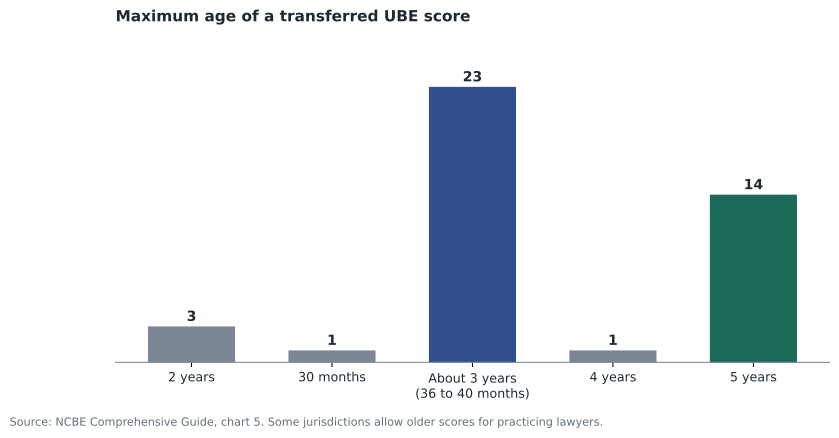
Time limits vary from two to five years after the exam. NCBE's chart shows the most common limit as three years (including limits stated as 36 to 40 months), used by about two dozen jurisdictions, with fourteen allowing five years, Illinois four years, Pennsylvania thirty months and Rhode Island two years. Several jurisdictions allow an older score for applicants who have been practicing law in the meantime. If you sit the UBE intending to move within a few years, check the limit in your target jurisdiction now.
The passing score matters too. A UBE score of 266 transfers to New York (266) but not to Texas or Massachusetts (270). This is why Marchetti tells candidates who might ever move to aim for 270 or more. For Ngozi, sitting in New York, a score of 270 would let her transfer to any UBE jurisdiction later, subject to each jurisdiction's education rules for foreign-educated applicants, which are often stricter than New York's.
Transferring NextGen scores
NCBE applies the same portability program to the NextGen exam. Most jurisdictions that have adopted NextGen announced that they would accept transferred NextGen scores from the July 2026 administration onward, including many that will not give the exam themselves until 2027 or 2028. A few are different. Ohio planned to begin accepting NextGen transfers in November 2026. Florida and New York will not accept NextGen scores from administrations before July 2028. Hawaii has said it will not accept transferred NextGen scores at all. Several adopters, including California, Michigan, New Jersey and Wisconsin, had not announced their transfer policies when NCBE's table was last updated.
Each receiving jurisdiction also sets a passing score on the NextGen scale and a time limit, and may require its own component. A jurisdiction that has not yet given the NextGen exam may set its passing score for transferred scores before its first administration. Marcus's July 2026 Missouri score is the kind of score these rules are being written for, and he is among the first lawyers in the country to test them.
Marcus checks Kansas. NCBE's table shows that Kansas will give its first NextGen exam in July 2028 and accept transferred NextGen scores from July 2026 onward. He writes to the Kansas board in November 2026 to ask when it will publish its passing score for transferred NextGen scores and what else he must file. 'I'd rather transfer the score now than wait five years for admission on motion,' he says. 'But I need their answer in writing before I count on it.'
Legacy and NextGen during the transition
From 2026 to 2028, legacy UBE scores and NextGen scores exist side by side on different scales. Jurisdictions decide which they accept. Many NextGen jurisdictions continue to accept transferred legacy UBE scores within their time limits, and many jurisdictions still giving the legacy exam accept NextGen transfers. Because policies are still being finalized, the safest approach during the transition is to check the receiving jurisdiction's current rule on the specific kind of score you hold.
MBE score transfer
Before the UBE, jurisdictions transferred scaled MBE scores between themselves, and some still do. A jurisdiction with its own written exam may accept an MBE score earned elsewhere, often only if it was earned at the same administration or recently and met a minimum, so that the applicant need only sit the written portion. Rules are listed in NCBE's Charts 6 and 10. This route is narrow and becoming less important as jurisdictions move to the NextGen exam, but it still matters for some candidates in non-UBE jurisdictions.
Admission on motion
Admission on motion lets experienced lawyers be admitted in a new jurisdiction without any exam. The core requirement is a period of active legal practice in another jurisdiction. NCBE's chart shows two common patterns: three of the past five years, used by about fifteen jurisdictions, including Arizona, Colorado, Illinois, Michigan, Minnesota, Utah, Virginia and Wisconsin; and five of the past seven years, used by about fifteen others, including Georgia, Kansas, Massachusetts, New Jersey, New York, Ohio, Pennsylvania and Texas. A few are shorter, such as Washington (one of the past three years) and Oregon (two of the past four); a few are longer, such as Connecticut and Missouri (five of the past ten).
Other requirements usually include a JD from an ABA-approved law school (which can exclude graduates of state-accredited schools and foreign-educated lawyers), good standing everywhere the lawyer is admitted, no pending discipline, a character and fitness review, an MPRE score in some jurisdictions and a fee. Jurisdictions define what counts as the practice of law differently; in-house, government, judicial clerkship and teaching work may or may not count. Some jurisdictions admit only lawyers from jurisdictions that would admit their own lawyers on motion, a requirement called reciprocity.
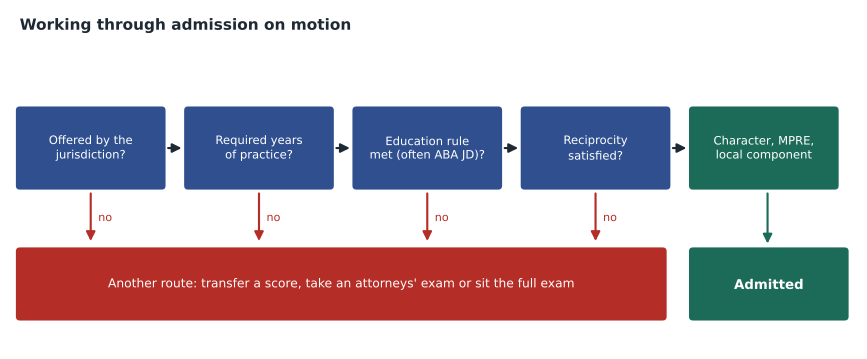
Several jurisdictions do not offer admission on motion at all. NCBE's chart lists California, Delaware, Florida, Louisiana, Nevada, Rhode Island and Puerto Rico, while Hawaii, South Carolina, Guam, the Northern Mariana Islands and Palau allow it only in limited cases, such as for certain government lawyers, military lawyers or law faculty. Experienced lawyers moving to these jurisdictions generally take an exam, sometimes a shorter version: California offers an Attorneys' Exam, a one-day test of the written portions, to lawyers admitted elsewhere for at least four years.
| Route | Who it suits | Main limits |
|---|---|---|
| UBE score transfer | New lawyers who passed the UBE | Passing score, score age (2 to 5 years), local component |
| NextGen score transfer | Lawyers who passed the NextGen exam | Varying acceptance dates; some jurisdictions decline |
| MBE score transfer | Candidates for non-UBE exams | Narrow rules; usually recent scores only |
| Admission on motion | Experienced lawyers | Years of practice, education rule, reciprocity; not offered everywhere |
| Attorneys' exam or full exam | Lawyers moving to jurisdictions without motion | Time and cost of another exam |
Other ways to practice across lines
Not every lawyer who works in another state needs a full license there. Courts allow lawyers licensed elsewhere to appear in a single case by motion for admission pro hac vice, usually with a local lawyer as co-counsel and a fee. Most jurisdictions let lawyers employed as in-house counsel register to practice for their employer without a full license. Many have rules for military spouses, lawyers providing legal services to the poor, and lawyers temporarily present after disasters. Model Rule 5.5, adopted in some form nearly everywhere, allows certain temporary practice by lawyers from other jurisdictions, such as work reasonably related to a matter in their home jurisdiction.
These routes are limited. A lawyer who sets up a regular practice in a jurisdiction where they are not admitted risks discipline for unauthorized practice and may be unable to collect fees. Marcus can attend a client meeting in Kansas about a Missouri matter, but he cannot hold himself out as available to advise on Kansas law until he is admitted there.
Worked problem
Planning for portability
Dana expects to stay in Texas, but her partner may take a job in Illinois in two years. She will sit the legacy UBE in Texas in February 2027. What should she plan for?
Show solution
- Check Illinois's rules: it accepts transferred UBE scores up to four years old and requires 266.
- Texas requires 270, so passing in Texas would also clear Illinois's score.
- A February 2027 score would be within four years until early 2031, comfortably beyond a move in two years.
- Illinois will also require character and fitness, the MPRE at its score (80, below her 93) and any Illinois requirements in force when she applies.
- If the move comes later than four years, she would look at Illinois admission on motion (three of the past five years of practice).
Answer: Passing in Texas would give Dana a score that transfers to Illinois for four years, and admission on motion is a fallback after that. She should confirm the rules again when the move becomes definite.
Eddie notes the limits of his own position. Louisiana gives neither the UBE nor the NextGen exam and does not offer admission on motion, so lawyers moving into Louisiana must take its exam, and Louisiana lawyers moving out have no portable score and must use admission on motion where it is offered or sit another exam. 'So if I move to Texas in five years,' he says, 'I'll have practiced long enough for Texas admission on motion.' Marchetti agrees, adding that he should keep good records of his practice from day one.
Attorneys' exams and shortened exams
Some jurisdictions that do not offer admission on motion, or that require more practice than a lawyer has, give experienced lawyers a shorter exam. California's Attorneys' Exam, for lawyers admitted elsewhere for at least four years, tests only the essays and performance test. NCBE's charts list other attorneys' exams and the experience they require. These exams still demand preparation, especially on local law, but they spare experienced lawyers the multiple-choice day.
Recordkeeping for future motion
Admission on motion depends on proving years of practice, and the definition of practice differs between jurisdictions. Some require full-time practice; others accept part-time work above a minimum number of hours. Some count work as in-house counsel, a government lawyer, a judicial law clerk or a law professor; others count some of these only partly or not at all. Lawyers who may seek admission on motion later should keep a simple record from their first day: employers, dates, hours, the kinds of matters handled and the names of supervisors who could confirm the work. Recreating that record years later is much harder.
Good standing matters as much as years. A lawyer seeking admission on motion must usually show that they are in good standing everywhere they are admitted, which means keeping registration, dues and continuing legal education current in each. A lapse caused by an overlooked dues notice can delay an application for months.
Uniform Bar Exam scores and local components
When a UBE score is transferred, the receiving jurisdiction's local component still applies. A lawyer transferring a score to New York must complete the New York Law Course and New York Law Exam; one transferring to Massachusetts must complete the Massachusetts law component. These are usually online and much shorter than the bar exam, but they have their own deadlines and sometimes their own time limits relative to the application. Build them into any transfer plan.
Finally, keep copies of everything: score reports, transfer confirmations, admission certificates and certificates of good standing. Boards ask for them repeatedly over a career, and having them ready makes every later application faster.
Summary and key terms
- A UBE score can be transferred to another UBE jurisdiction if it meets that jurisdiction's passing score and age limit (2 to 5 years, most often 3) and other requirements.
- Most NextGen adopters accept NextGen transfers from July 2026, but Florida and New York only from July 2028, and Hawaii not at all.
- Admission on motion admits experienced lawyers without an exam, commonly after three of the past five or five of the past seven years of practice.
- California, Delaware, Florida, Louisiana, Nevada, Rhode Island and Puerto Rico do not offer admission on motion under NCBE's chart.
- Pro hac vice, in-house registration and Model Rule 5.5 allow limited practice without a full license.
- Transferred UBE score
- A UBE score sent through NCBE to another jurisdiction for admission there.
- Admission on motion
- Admission without an exam based on years of active practice elsewhere.
- Reciprocity
- A requirement that a lawyer's home jurisdiction would admit the receiving jurisdiction's lawyers on similar terms.
- Pro hac vice
- Permission for a lawyer licensed elsewhere to appear in a single case.
- Attorneys' Exam
- California's one-day exam for lawyers admitted elsewhere for at least four years.
Practice problems
Work each problem on paper first, then reveal the answer to check.
What is the most common maximum age for a transferred UBE score?
Show answer
Three years.
Why might a graduate of a California-accredited school not qualify for admission on motion even after years of practice?
Show answer
Many jurisdictions require a JD from an ABA-approved law school for admission on motion.
When will New York begin accepting transferred NextGen scores?
Show answer
For administrations from July 2028.
What does Model Rule 5.5 address?
Show answer
Unauthorized practice and the limited temporary practice allowed to lawyers from other jurisdictions.
Common mistakes
MistakeYou can only transfer a UBE score from the state where you were admitted.
InsteadYou can sit in one UBE jurisdiction and transfer the score elsewhere without being admitted where you sat.
MistakeEvery state offers admission on motion.
InsteadSeveral, including California, Florida and Louisiana, do not.
MistakePro hac vice admission lets you open an office in another state.
InsteadIt covers a single case and usually requires local counsel.
Lesson quiz · 5 questions
Score 60% or more to complete this lesson.
Create a free account to save your progress, take quizzes and earn a certificate.