
BAR-101 · Lesson 10 of 12 · 20 min
Jurisdictions with their own exams
▶ Video coming soon A video version of this lesson is on the way.
Three members of the group are preparing for exams that look nothing like the Uniform Bar Exam. Sofia faces California's General Bar Exam in February 2027, Eddie the Louisiana exam with its nine tests over three days, and Camila the Puerto Rico exam, in Spanish, followed by a separate exam on notarial law. In the tenth session Marchetti gives each of them ten minutes to explain their exam, and fills in the rest of the map herself.
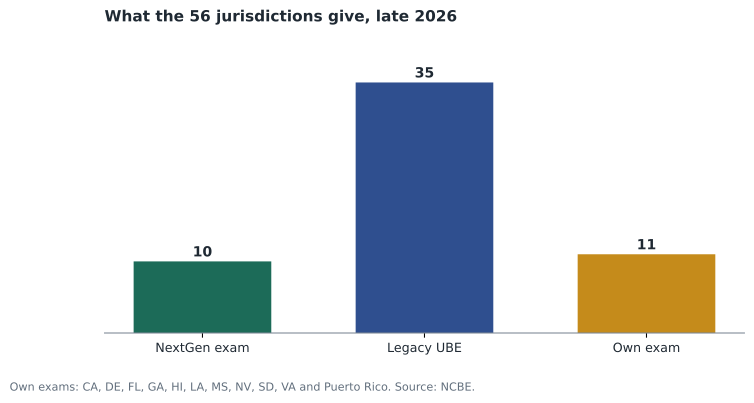
As of late 2026, the 56 jurisdictions fall into three groups. Ten gave the NextGen exam in July 2026. Thirty-five give the legacy Uniform Bar Exam. And eleven give exams of their own design: California, Delaware, Florida, Georgia, Hawaii, Louisiana, Mississippi, Nevada, South Dakota, Virginia and Puerto Rico. Most of the eleven still use NCBE components, especially the MBE, alongside their own essays. Many will move to the NextGen exam by July 2028, but some will not.
California
California runs the country's largest bar exam. Its General Bar Exam takes two days. In July 2026 it combined the MBE with five California essay questions and a performance test written by the State Bar. Scores are reported on a 2,000-point scale, with a passing line of 1,390. California also gives an Attorneys' Exam, a one-day test of the essays and performance test for lawyers admitted elsewhere for at least four years, because it offers no admission on motion. California essays test subjects beyond the MBE, including business associations, community property, professional responsibility under California's own rules, remedies, trusts and wills and succession, often with California law that differs from the majority rule.
California's recent history is a caution about change. To cut costs, the State Bar moved the February 2025 exam to a new format with remote and in-person testing and questions developed under a contract with Kaplan rather than NCBE's MBE. The administration was marked by widespread technical and administrative failures, and it later emerged that some multiple-choice questions had been drafted with the help of artificial intelligence, which the Supreme Court of California said it had not been told about. On May 2, 2025, the court ordered a return to the MBE for July 2025 and approved lowering the raw passing score for February 2025 examinees as a remedy. The California State Auditor later reviewed the February exam. In 2026 California's Committee of Bar Examiners recommended moving to the NextGen exam, and NCBE now lists California's first NextGen administration as July 2028.
Sofia's school, a California-accredited law school, prepared her for California's essays specifically, which is one advantage of studying where you will sit. Her plan for February focuses on timed essays, especially in community property and remedies, the subjects where her July answers were weakest.
Louisiana
Louisiana's private law comes from the civil-law tradition, built on its Civil Code, rather than the English common law used in the other states. Its bar exam reflects that. It has nine tests over three days, given on Monday, Wednesday and Friday: three on the Civil Code on the first day; the Louisiana Code of Civil Procedure, torts and business entities on the second; and constitutional law, criminal law, procedure and evidence, and federal jurisdiction and procedure on the third. The five code-based tests count double. Applicants must score 650 of 900 weighted points.
Louisiana does not use the MBE, the MEE or the MPT; it and Puerto Rico are the only jurisdictions that do not use the MBE. It has not adopted the NextGen exam, does not accept transferred UBE or NextGen scores and does not offer admission on motion, so every lawyer admitted in Louisiana has passed its exam. Eddie's preparation is therefore Louisiana-specific from start to finish: Civil Code articles, Louisiana procedure and the state's distinctive approach to obligations, property, successions and community property. 'You can't buy a national course for this,' he says. 'Louisiana has its own.'
Puerto Rico
Puerto Rico's legal system also draws heavily on the civil-law tradition, with a Civil Code (revised in 2020) alongside federal law and common-law influences. Its Board of Bar Examiners gives a jurisdiction-drafted exam in Spanish. Puerto Rico does not require the MPRE, does not use the UBE or NextGen exam, and does not offer admission on motion. Because notaries in Puerto Rico are lawyers who perform significant legal functions, such as drafting and authenticating public instruments, there is a separate notarial law exam, and lawyers must pass it to practice as notaries.
Camila explains that most of her classmates take both exams in the same cycle, and that many work while preparing. When she checked in November, Puerto Rico's board had not yet announced filing dates for the next administration, so she checks the board's site weekly, as Marchetti suggested.
Florida, Georgia, Virginia and the others
Florida's exam has two parts over two days. Part A, on the first day, tests Florida law with three essays in the morning and 100 Florida multiple-choice questions in the afternoon. Part B, on the second day, is the MBE. The two parts are each scaled and weighted equally. Florida plans to adopt the NextGen exam in July 2028 with a four-hour Florida component given the day before, and, as Lesson 9 noted, it offers no admission on motion and will not accept NextGen transfers from before July 2028.
Delaware, Georgia, Hawaii, Mississippi, South Dakota and Virginia also give their own combinations, typically the MBE with their own essay questions and, in some, a performance test or local multiple-choice section. Delaware has long been known for a demanding exam and a lengthy clerkship requirement before admission. Virginia tests Virginia law in essays and short answers. All of these except Mississippi, which had not set a date, plan to adopt the NextGen exam between July 2027 (South Dakota) and July 2028, several with a state component. The course for each jurisdiction later in this program covers its current format in detail.
Nevada's new plan
Nevada has gone further than any state in redesigning admission without NCBE's new exam. Under the Nevada Plan, which took effect on January 19, 2026, applicants complete a Foundational Law Exam, a closed-book multiple-choice test on the core subjects that can be taken during law school after earning a set number of credits; a Lawyering Performance Exam, a full day of practical tasks based on legal materials and client facts, taken after graduation; and a Supervised Practice Program of at least 40 hours, which can be completed partly in law school clinics or externships. Applicants also need an MPRE score of 85 and character and fitness clearance. Nevada has not adopted the NextGen exam.
Wisconsin and New Hampshire
Wisconsin gives the legacy UBE, but graduates of its two law schools, the University of Wisconsin and Marquette University, who complete the required curriculum are admitted under the diploma privilege without taking any exam. Wisconsin is the last state with a diploma privilege for its own schools. Wisconsin also does not require the MPRE. New Hampshire's Daniel Webster Scholar Honors Program at the University of New Hampshire Franklin Pierce School of Law lets a selected group of students complete a practice-based curriculum with assessments, observed by bar examiners, in place of the bar exam.
Supervised practice pathways
A growing group of states offers licensure based on supervised practice and assessed work, as an alternative to the bar exam rather than a replacement. All keep the traditional exam available.
| Jurisdiction | Pathway | Status | Core requirement |
|---|---|---|---|
| Oregon | Supervised Practice Portfolio Examination | Running; first lawyers licensed 2023 | 675 hours of supervised work in a year; portfolio assessed by the board |
| Utah | Alternate pathway | Applications opened January 1, 2026 | 240 supervised hours, skills courses and a written performance exam; license not portable |
| Nevada | Nevada Plan | Took effect January 19, 2026 | Foundational Law Exam, Lawyering Performance Exam and 40-hour supervised practice |
| Washington | Apprenticeship pathways | Approved; applications expected 2027 | Supervised practice for graduates |
| New Mexico | Skills-based pathway | Approved August 4, 2026; applications expected by mid-2027 | 675 hours in 12 months; portfolio in seven skill areas |
| Wisconsin | Diploma privilege | Running | Graduation from one of its two law schools with required courses |
| New Hampshire | Daniel Webster Scholar Honors Program | Running | Practice-based honors curriculum with assessments |
These pathways share several features. Applicants must find a supervising lawyer or host organization willing to take on the responsibility. The work must be documented and assessed, often in a portfolio. Character and fitness and the MPRE still apply. And the license may not be portable: Utah says plainly that other states do not recognize its alternate pathway, and admission on motion elsewhere may require a bar exam score. A graduate who expects to move should weigh portability carefully.
Supporters argue that supervised practice tests the skills clients rely on more directly than a timed exam, and may reduce barriers for capable graduates who struggle with standardized tests. Critics worry about consistency between supervisors, the burden on small offices and the risk of a two-tier profession. Results from Oregon and the newer programs will shape whether more jurisdictions follow.
Worked problem
Choosing between routes
A graduate of an ABA-approved law school in Oregon has a job offer from a legal aid office that is willing to supervise her. She expects to stay in Oregon. Should she consider the Supervised Practice Portfolio Examination instead of the NextGen exam?
Show solution
- Confirm eligibility: an ABA-approved JD, the MPRE and character and fitness.
- Confirm the supervisor and workload: 675 hours of supervised work in a year, with a portfolio of written work, client interactions and negotiations.
- Consider portability: if she never moves, the Oregon license is all she needs; if she might move, a NextGen score could transfer, while the portfolio license may not help elsewhere until she qualifies for admission on motion.
- Weigh timing and income: the pathway lets her work and earn while qualifying, rather than studying full time for an exam.
Answer: If she is confident she will stay in Oregon and has committed supervision, the portfolio route is a strong option. If moving is likely, the NextGen exam keeps more doors open.
Marchetti ends by pointing out that every member of the group now knows a corner of the system the others don't. 'That's the reason I put you together. When you get to your jurisdiction course, you'll see that the rules make sense once you know why your jurisdiction chose them.'
Why some jurisdictions keep their own exams
Jurisdictions keep their own exams for several reasons. Some, like Louisiana and Puerto Rico, have legal systems different enough from the common-law states that a national exam would not test what their lawyers need. Some, like California, test large populations, including graduates of state-accredited and unaccredited schools, and have built assessment systems over decades. Some value testing state law directly on the exam rather than through a separate course. And some are cautious about change: adopting a new exam requires notice to students, new rules, new grading arrangements and often legislative or court approval.
The trend, however, is toward NCBE's tests. Several jurisdictions that resisted the legacy UBE for years, including California, Florida, Georgia, Hawaii, South Dakota and Virginia, are adopting the NextGen exam, often with a state component. The result by 2028 should be a system in which most jurisdictions share a core exam while keeping a local element, and a handful, chiefly Louisiana, Puerto Rico, Nevada and Arkansas, go their own way.
Preparing for a jurisdiction-specific exam
Candidates for jurisdiction-specific exams face a smaller market for study materials. National commercial courses offer California and Florida programs, but Louisiana and Puerto Rico candidates usually rely on local courses, law school programs and the board's own past questions. The most valuable resource is the board's released questions and, where available, selected answers. Eddie and Camila both build their plans around them, writing answers under time pressure and comparing them with released examples.
Candidates should also learn what makes their jurisdiction's law distinctive. California essays reward knowing where California departs from the majority rule, in community property and in its own professional responsibility rules, for example. Louisiana's code tests reward knowing the Civil Code's structure and article numbers well enough to cite and apply them. Puerto Rico's exam tests a mixed legal system in Spanish. Generic preparation will not substitute for this local knowledge.
Summary and key terms
- In late 2026, ten jurisdictions give the NextGen exam, 35 the legacy UBE and eleven their own exams.
- California's two-day exam uses the MBE with California essays and a performance test; its troubled February 2025 exam led to a court-ordered return to the MBE.
- Louisiana's nine-test civil-law exam and Puerto Rico's Spanish-language exam use no NCBE components except the MPRE in Louisiana.
- Florida combines Florida essays and multiple-choice with the MBE until it moves to NextGen in July 2028; Nevada began its own Nevada Plan in January 2026.
- Wisconsin's diploma privilege, New Hampshire's Daniel Webster program and supervised practice pathways in Oregon, Utah, Washington and New Mexico offer alternatives, often with limited portability.
- General Bar Exam
- California's main bar exam, combining the MBE, California essays and a performance test.
- Civil law
- A legal tradition based on comprehensive codes, used for private law in Louisiana and Puerto Rico.
- Nevada Plan
- Nevada's licensure route from January 2026: a foundational exam, a lawyering performance exam and supervised practice.
- Supervised practice pathway
- Licensure based on documented, assessed legal work under supervision instead of a bar exam.
- Notarial exam
- Puerto Rico's separate exam for lawyers who will practice as notaries.
Practice problems
Work each problem on paper first, then reveal the answer to check.
Which two jurisdictions do not use the MBE?
Show answer
Louisiana and Puerto Rico.
What did the Supreme Court of California order on May 2, 2025?
Show answer
A return to the MBE for July 2025 and a lower raw passing score for February 2025 examinees.
What are the three main exam components of the Nevada Plan?
Show answer
The Foundational Law Exam, the Lawyering Performance Exam and the Supervised Practice Program.
Why should a graduate who may move think twice about Utah's alternate pathway?
Show answer
Utah says the license is not portable to other states.
Common mistakes
MistakeEvery state will give the NextGen exam by 2028.
InsteadArkansas, Louisiana, Nevada and Puerto Rico had not adopted it, and Mississippi had no date.
MistakeDiploma privilege is common.
InsteadOnly Wisconsin has it, for its two law schools.
MistakeSupervised practice pathways replace the bar exam.
InsteadThey are alternatives; the exam remains available.
Lesson quiz · 5 questions
Score 60% or more to complete this lesson.
Create a free account to save your progress, take quizzes and earn a certificate.