
BAR-101 · Lesson 3 of 12 · 20 min
Applying: deadlines, fees and accommodations
▶ Video coming soon A video version of this lesson is on the way.
On the third Tuesday Marchetti begins with a story she tells every group. Years ago a student of hers, top of her class, spent ten weeks preparing for a July exam. In late June she logged in to print her admission ticket and found nothing. She had started the application in March, saved it, and never pressed submit. The final deadline had passed. 'She passed the next February,' Marchetti says, 'but she lost six months of salary and a job offer. The bar application is a legal document with deadlines. Treat it like one.'
This lesson covers the paperwork side of admission: accounts and portals, deadlines and fees, documents, the laptop and testing rules, and testing accommodations for applicants with disabilities and other needs. The details differ in every jurisdiction, so the goal is to know what to look for and when.
Your NCBE account and NCBE Number
Almost every applicant needs an account with the National Conference of Bar Examiners. Creating it generates an NCBE Number, which identifies you across NCBE's services for the rest of your career. You use the account to register for the MPRE, to request transfers of Uniform Bar Exam or NextGen scores, and, in many jurisdictions, to complete the character and fitness application that NCBE investigates for the board. Some boards ask for your NCBE Number on their own application forms.
Marchetti tells everyone to make sure the name on their NCBE account matches their government-issued identification exactly, including middle names and hyphens. Test centers and exam sites check identification against the registration, and a mismatch can keep you out of the room. Ngozi, whose passport and law school records spell one of her names differently, contacts NCBE and the New York board in September to fix the records long before February.
Board portals and the application itself
Each board runs its own application, usually through an online portal. The application asks for your education, employment history, addresses, any criminal or disciplinary history, financial matters, bar admissions elsewhere and the information the character and fitness review needs (Lesson 4). Many jurisdictions combine the exam application and the character application; others separate them, with the character application due first. Some ask law students to register early, as Texas does with its Declaration of Intention to Study Law.
The application is made under oath. Every answer must be complete and accurate, and you have a continuing duty to update it if something changes before admission, such as a new address, a new job, a traffic citation or a new lawsuit. Incomplete or misleading answers are among the most common reasons applicants get into character and fitness trouble, often for things that would have been harmless if disclosed.
Deadlines: timely, late and final
Most jurisdictions set a timely filing deadline, one or more late deadlines with higher fees, and a final deadline after which no application is accepted for that exam. Timely deadlines are often three to six months before the exam, and first-time applicants sometimes face earlier deadlines than repeat takers or attorneys. Some jurisdictions open an application window for only a few weeks. A few have deadlines more than six months ahead for applicants who need a fuller character review or foreign-education evaluation.
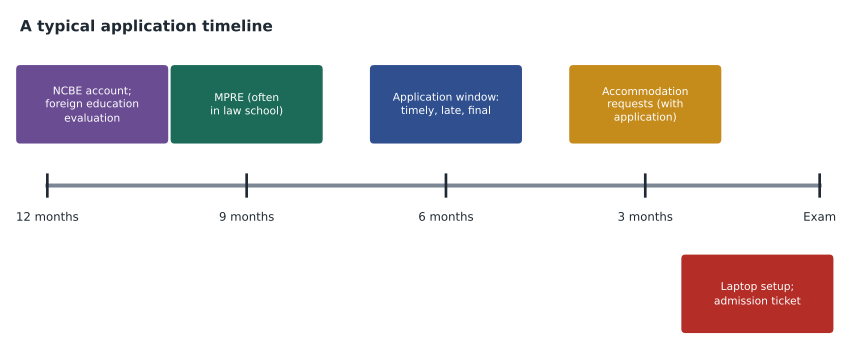
The calendar is crowded at the same time as the hardest semester of law school. Dana filed her Texas application in the late summer of 2026 for the February 2027 exam, comfortably inside the timely window, after confirming that her Declaration of Intention from her first year of law school was already on file. Sofia, as a repeat taker in California, had a separate repeater filing period after her July results were released on October 30, 2026, and she filed the first week it opened.
Missing a deadline is one of the few mistakes in bar admission that no amount of studying can fix. Marchetti asks everyone to put every deadline from their board's calendar into their own calendar with two reminders, one a month before and one a week before, and to submit at least a week early so there is time to deal with a portal failure or a missing document.
Fees
Bar admission is expensive, and the costs arrive in stages. Typical costs include the exam application fee, which is commonly several hundred dollars and higher in some jurisdictions or for attorney applicants; late-filing surcharges; a laptop or software fee for typing the written portions; the MPRE fee; NCBE's fee for a character report where the board uses one; fingerprinting; and, after passing, an admission fee and the first year's bar dues or registration fee. Score transfers, if you later move a score to another jurisdiction, cost extra.
Commercial bar review courses are the largest optional cost, often running to a few thousand dollars, although free and lower-cost options exist. Many graduates also stop working for two or three months to study full time, which is the biggest real cost. Some employers pay bar fees and give paid study time; some lenders offer bar study loans; some law schools and bar foundations offer grants, especially for public interest graduates. Marchetti tells the group to build a budget in their first week of planning, not their last.
| Cost | When | Notes |
|---|---|---|
| MPRE fee | When you register for the MPRE, often in law school | Paid to NCBE; extra for late registration where allowed |
| Character report or investigation fee | With the character application | Charged by NCBE or the board in many jurisdictions |
| Exam application fee | With the bar application | Varies widely; higher for late filing and often for attorneys |
| Laptop or software fee | Weeks before the exam | For typing written answers, where charged |
| Bar review course | Months before the exam | Optional; ranges from free to a few thousand dollars |
| Admission fee and first-year dues | After passing | Paid to the court, the board or a unified state bar |
| Score transfer fee | Whenever you transfer a score | Paid to NCBE, plus the receiving jurisdiction's application fee |
Documents you will need
Most boards require some combination of: a certificate from your law school dean confirming graduation or expected graduation and good standing, usually sent by the school; official transcripts; fingerprint cards or electronic fingerprinting for a criminal background check; a passport-style photograph; certificates of good standing from any other bar where you are admitted; and character references. Foreign-educated applicants also need transcripts and proof of admission sent directly from the issuing institutions, and translations where documents are not in English.
Keep a single folder, paper or digital, with a copy of every page you submit, every payment receipt and every message from the board. Boards handle thousands of applications, and documents do go astray. An applicant who can produce a dated copy and receipt usually resolves the problem in a day.
Laptops, software and exam rules
Most jurisdictions let applicants type the written portions of the legacy Uniform Bar Exam on their own laptops using secure exam software, usually after registering the laptop and installing the software by a deadline. The NextGen exam is computer-based throughout: examinees take every part, including the multiple-choice questions, on their own laptops using NCBE's secure testing browser at sites the jurisdiction manages. Boards publish minimum laptop requirements, and examinees usually must run a practice check well before the exam. A laptop that fails at the site can force you to handwrite or, on a fully computer-based exam, to wait for a replacement under the board's procedures.
Every board publishes rules on what you may bring into the room, when you may leave, what to do if you finish early and how to report problems. Many ban watches, phones, earplugs other than approved ones, and bags. Some provide lockers; some do not. Read the rules twice, once when you register and once in the last week, and plan the morning so that nothing about getting into the building is new.
Testing accommodations
Under the Americans with Disabilities Act, boards must provide reasonable testing accommodations to applicants with disabilities so that the exam measures their knowledge and skills rather than their disability. Common accommodations include extra testing time, extra or longer breaks, a separate or quieter room, a larger screen or font, screen-reading software, permission to bring medication or food, or a reader or scribe. Accommodations for the MPRE are requested separately from NCBE, and accommodations for the bar exam from the board.
Requests usually have their own deadlines, often the same as or earlier than the application deadline, and need documentation: typically a recent evaluation by a qualified professional describing the diagnosis, the functional limitations it causes in a testing setting and the accommodations recommended, plus a history of accommodations received in school or on other standardized tests. Boards may ask for more information, grant some accommodations and not others, or deny a request, and they must have a process for review or appeal. Applicants should apply early enough that there is time for that process before the exam.
Boards also handle needs that are not disabilities. Nursing parents can usually request a private space and extra break time to express milk; applicants whose religious observance conflicts with the exam date can sometimes request an alternative schedule; and applicants with temporary injuries can ask for help. Each of these has its own procedure. Marcus, who broke his wrist playing basketball in May 2026, asked Missouri for permission to use an ergonomic keyboard and extra break time for the July NextGen exam. With a doctor's letter, the board granted it within three weeks.
Changing plans
Life intervenes. Most boards allow withdrawal before the exam, with a partial refund or a credit toward a later exam, under strict deadlines; others give no refund. Some allow transfers between exam sites or deferrals. If you are sick on exam day, follow the board's procedure exactly. Do not simply fail to appear, which may count as a failed attempt in jurisdictions that limit the number of attempts.
Some jurisdictions cap the number of attempts, and others require additional steps after several unsuccessful attempts. Know your jurisdiction's rule before your first attempt. It is not a reason to panic, but it is a reason to sit only when you are ready.
Worked problem
Building an application calendar
Ngozi is sitting the February 2027 New York exam. She has completed her LLM and received her foreign education evaluation. What should her calendar include?
Show solution
- The opening and closing dates of New York's application filing period for the February exam, from the Board's website.
- Any deadline for testing accommodations, if she needs them.
- The laptop registration and software installation deadlines.
- The date admission tickets are released, with a reminder to check the location and rules.
- After the exam: the MPRE (if not yet passed), the New York Law Exam, the 50 hours of pro bono work and the skills competency requirement, all needed before admission.
Answer: A calendar built from the Board's own dates, with reminders, turns a dozen separate deadlines into a checklist.
Marchetti finishes by asking each member to list their next three deadlines and to tell the group by next week that each is in their calendar. Camila laughs. Puerto Rico had not yet announced its next filing dates when she checked. 'Then your deadline,' Marchetti says, 'is to check the board's site every week until it does.'
Exam sites and travel
Most boards run the exam at a small number of large sites, such as convention centers, hotels or university buildings, and assign examinees to a site when they register or when admission tickets are released. Some let applicants choose a site; others assign by location or by laptop or handwriting choice. Applicants who live far from the sites should book a hotel early, because hotels near exam sites fill quickly in February and July, and should plan a test run of the route if they can.
Exam sites have their own rules on parking, food, medication, clear bags and arrival times, and boards publish them in an examinee handbook or on the admission ticket. Marchetti asks the February candidates to read their board's handbook now, once, and again in the final week. Dana discovers that her Texas site does not allow bags of any kind beyond a clear plastic one, and that she must bring her own laptop power cord, which the site will check. Small details like these cause more exam-morning panic than any legal question.
Keeping records after you file
Filing the application is not the end of the paperwork. Boards may write with follow-up questions, ask for additional documents, or tell an applicant that the character review needs more information. Respond quickly and completely, keep copies, and note the date of every exchange. If your address, email or phone number changes, update the board, because notices often have short deadlines. Ngozi sets a weekly reminder to check the New York portal and her email folder for board messages until she is admitted.
Summary and key terms
- An NCBE account and NCBE Number are needed for the MPRE, score transfers and many character applications.
- Applications are sworn documents with a continuing duty to update; incomplete answers cause trouble.
- Jurisdictions set timely, late and final deadlines, often three to six months before the exam; fees rise for late filing.
- The NextGen exam is fully computer-based on examinees' own laptops using NCBE's secure browser.
- ADA testing accommodations need early requests and documentation; MPRE accommodations come from NCBE, bar exam accommodations from the board.
- NCBE Number
- A permanent identifier created with an NCBE account, used for the MPRE, score transfers and character reports.
- Timely filing deadline
- The first and cheapest deadline to apply for a bar exam; late deadlines cost more.
- Testing accommodation
- A change to how the exam is given, such as extra time, that lets an applicant with a disability be tested fairly.
- Admission ticket
- The document, usually downloaded from the board's portal, that lets an applicant into the exam site.
- Continuing duty to update
- The obligation to amend a bar application if information changes before admission.
Practice problems
Work each problem on paper first, then reveal the answer to check.
Why must the name on an NCBE account match government identification exactly?
Show answer
Exam sites check identification against registrations, and a mismatch can keep an applicant out.
Who handles accommodations for the MPRE?
Show answer
NCBE, separately from the board that handles bar exam accommodations.
What should an applicant do if they are sick on exam day?
Show answer
Follow the board's withdrawal or absence procedure exactly rather than simply not appearing.
Name three typical costs of bar admission besides the exam application fee.
Show answer
Any three of: the MPRE fee, character report fee, laptop fee, bar review course, admission fee and dues, fingerprinting, score transfer fees.
Common mistakes
MistakeSaving the application is the same as filing it.
InsteadOnly a submitted, paid application counts.
MistakeSmall traffic tickets do not need to be disclosed.
InsteadDisclose what the application asks for; omissions cause more trouble than the incidents.
MistakeAccommodations can be requested at the exam site.
InsteadRequests need documentation and are due weeks or months before the exam.
Lesson quiz · 5 questions
Score 60% or more to complete this lesson.
Create a free account to save your progress, take quizzes and earn a certificate.