
BAR-101 · Lesson 6 of 12 · 20 min
The Uniform Bar Exam today
▶ Video coming soon A video version of this lesson is on the way.
Dana and Ngozi are both sitting the same exam in February 2027, Dana in Texas and Ngozi in New York. Both states still give the Uniform Bar Exam, which NCBE now calls the legacy UBE to distinguish it from the NextGen exam that is replacing it. Marchetti gives the sixth session to them. 'You two are taking the exam most American lawyers alive today took. Everyone else should listen too: the UBE's three parts are the building blocks of almost every bar exam in the country, including California's.'
The Uniform Bar Exam combines three tests written by NCBE: the Multistate Bar Examination, the Multistate Essay Examination and the Multistate Performance Test. Each jurisdiction that uses it administers it on the same days, grades the written parts using NCBE's grading materials, and reports a total score on a 400-point scale. Because the exam and scoring are uniform, a UBE score can be transferred to other UBE jurisdictions, which is its main advantage. Missouri and North Dakota first gave it in February 2011, and by 2025 more than forty jurisdictions used it.
Where it is given now
In 2026 the picture began to shift. Six states (Connecticut, Idaho, Maryland, Missouri, Oregon and Washington) and four territories switched to the NextGen exam in July 2026, so they no longer give the legacy UBE. As of late 2026 NCBE lists 35 jurisdictions using the legacy UBE: Alabama, Alaska, Arizona, Arkansas, Colorado, the District of Columbia, Illinois, Indiana, Iowa, Kansas, Kentucky, Maine, Massachusetts, Michigan, Minnesota, Montana, Nebraska, New Hampshire, New Jersey, New Mexico, New York, North Carolina, North Dakota, Ohio, Oklahoma, Pennsylvania, Rhode Island, South Carolina, Tennessee, Texas, Utah, Vermont, West Virginia, Wisconsin and Wyoming. NCBE will give the legacy UBE through February 2028, and most of these jurisdictions move to NextGen between July 2027 and July 2028 (Lesson 7).
The two-day schedule
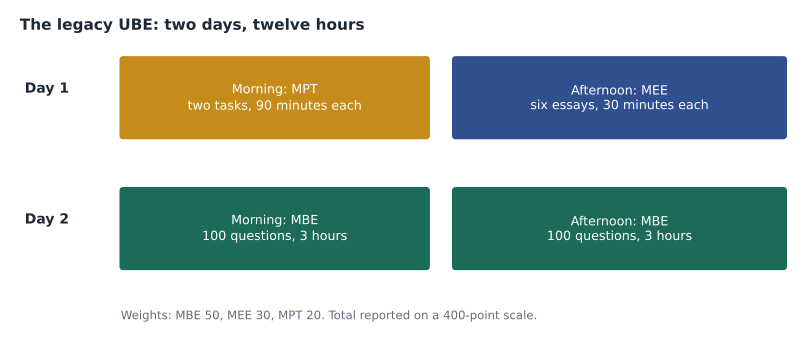
The UBE runs on the last Tuesday and Wednesday of February and July. On the first day, the morning session is the MPT, two tasks of ninety minutes each, and the afternoon session is the MEE, six essay questions of thirty minutes each. The second day is the MBE: two three-hour sessions of one hundred multiple-choice questions each. Total testing time is twelve hours. Most jurisdictions let examinees type the written portions on their laptops; the MBE is answered on paper answer sheets or by computer depending on the jurisdiction's arrangements.
The MBE
The Multistate Bar Examination has 200 multiple-choice questions with four options each. Of these, 175 are scored and 25 are unscored pretest questions mixed in among them. The scored questions are spread equally across seven subjects, twenty-five each: Civil Procedure (under the Federal Rules of Civil Procedure and federal jurisdiction rules), Constitutional Law, Contracts (including Article 2 of the Uniform Commercial Code on sales of goods), Criminal Law and Procedure, Evidence (under the Federal Rules of Evidence), Real Property and Torts.
MBE questions test the generally accepted rules of American law, not any one state's law, and federal law where it governs. A typical question gives a short fact pattern, asks a specific question and offers four answers, often two of which are plausible. Over two sessions of three hours each, examinees have about 1.8 minutes per question. Speed matters, but most examinees can finish; the challenge is accuracy under time pressure for six hours.
NCBE scores the MBE and reports a scaled score. Scaling uses a statistical process called equating, based in part on previously used questions embedded in each exam, so that the same scaled score represents the same level of knowledge on any administration. Lesson 8 explains how the scaled MBE score anchors the whole UBE score.
The MEE
The Multistate Essay Examination has six questions, each written to be answered in thirty minutes. The questions may test any of the MBE subjects and five more: Business Associations (agency, partnerships, corporations and limited liability companies), Conflict of Laws, Family Law, Trusts and Estates (including decedents' estates and trusts and future interests) and Secured Transactions (Article 9 of the Uniform Commercial Code). A single question often crosses subjects, for example combining a contracts problem with a conflict of laws issue.
NCBE writes the questions and analyses and provides detailed grading materials. Each UBE jurisdiction grades its own examinees' answers, usually with graders trained at NCBE's grading workshop after the exam. Graders reward a clear statement of the rule, accurate application to the facts and a sensible conclusion. Marchetti, who graded MEE answers for six years, tells the group that the best answers are rarely the longest. 'Headings, the rule, the facts that matter, a conclusion. Graders read hundreds of answers. Make yours easy to give points to.'
The MPT
The Multistate Performance Test asks examinees to complete a realistic lawyering task in ninety minutes using only the materials provided. Each task comes with a file, containing the facts in the form of documents such as interview transcripts, letters, contracts or police reports, and a library, containing the law in the form of cases, statutes and regulations, some of them invented for the task. A memo from a supervising lawyer sets out the assignment: perhaps an objective memorandum, a persuasive brief, a client letter, a demand letter, a contract provision, a discovery plan or a closing argument.
The MPT tests skills, not memorized law. Examinees who know a rule from law school that differs from the library must use the library. The main challenges are reading quickly, organizing, following the supervising lawyer's instructions exactly (including format and audience) and writing a complete answer in the time. Two tasks make up the morning of day one.
Weights and the total score
The three parts are weighted 50 for the MBE, 30 for the MEE and 20 for the MPT, out of 100. Put another way, the scaled MBE score makes up half of the total, and the six essays and two performance tests together make up the other half. The total is reported on a 400-point scale. Scoring is compensatory: a strong MBE can make up for weaker essays, and the other way round. Each jurisdiction decides what total passes, from 260 to 270 among current UBE jurisdictions (Lesson 8).
For Dana and Ngozi this weighting shapes their study plans. The MBE is half the score and is the part most improved by large volumes of practice questions. The written half rewards regular timed practice with feedback. Both plan to do practice MBE questions every day, two or three timed essays a week and at least four full performance tests.
| Part | Format | Time | Weight | Who grades |
|---|---|---|---|---|
| MBE | 200 multiple-choice questions (175 scored) on seven subjects | Two 3-hour sessions | 50 | NCBE |
| MEE | Six essay questions on twelve possible subjects | Three hours (30 minutes each) | 30 | The jurisdiction, with NCBE materials |
| MPT | Two lawyering tasks from a file and library | Three hours (90 minutes each) | 20 | The jurisdiction, with NCBE materials |
Local components
Many UBE jurisdictions add a requirement covering their own law, which applicants must complete before admission but which does not count in the UBE score. Formats vary. New York requires the New York Law Exam, an online test of New York law that follows the New York Law Course. Massachusetts has its own law component. Texas requires a Texas law component. Some jurisdictions require only an online course with a short quiz; others require a scored test. A few, such as Alabama, have required a separate essay exam on state law.
For Ngozi, the New York requirements after the exam are substantial: the New York Law Course and Law Exam, a passing MPRE score, fifty hours of qualifying pro bono work and New York's skills competency requirement. For Dana, the Texas law component is shorter, but it is still a requirement with its own deadline. The jurisdiction courses later in this program cover each local component in detail.
Transfer, in brief
A UBE score earned in one jurisdiction can be transferred to another UBE jurisdiction, which will accept it if it meets that jurisdiction's passing score and is not too old under its rules, and if the applicant meets its other requirements, including character and fitness and any local component. Scores transfer through NCBE. Lesson 9 covers transfer in detail, including how legacy UBE scores and NextGen scores interact during the transition.
Worked problem
Planning around the weights
Dana's first full practice exam produced an estimated scaled MBE score of 132 and estimated written scores that would scale to about 140. Where should she focus?
Show solution
- Recall that the MBE is half of the total and the written parts are the other half.
- Her MBE estimate is weaker than her written estimate, and the MBE has the larger single weight.
- MBE scores usually improve steadily with daily practice questions and careful review of errors.
- She should not neglect writing, but should shift more time to MBE practice for the next four weeks and then retest.
Answer: Dana should increase MBE practice while keeping a steady writing schedule. Because the score is compensatory, raising her weaker half has the biggest effect on the total.
Marcus adds a note from experience. He studied for the legacy UBE for months before Missouri announced its NextGen move, and he found that the skills transferred. 'The subjects overlap a lot, and the MPT is basically the ancestor of the NextGen performance tasks. Nothing you learn for the UBE is wasted.'
What makes a strong MEE answer
Graders look for the same elements in almost every MEE answer. The answer should address the question actually asked, in the order the question asks it, usually with a short heading for each part. Each part should state the governing rule accurately and concisely, apply it to the specific facts given, explaining why those facts lead to a result, and reach a conclusion. Where the law is unsettled or the facts point both ways, a good answer says so and explains the better argument. Answers that recite every rule the candidate knows, without applying them, score poorly; graders give credit for analysis.
Timing is the most common problem. Thirty minutes per question leaves no room for a long outline, but a minute or two spent listing the issues before writing saves time later. Candidates who run long on one question and leave another unfinished almost always lose more points than they gain. Marchetti teaches a strict rule: when thirty minutes are up, write a one-sentence conclusion for any part left and move on.
What makes a strong MPT answer
The MPT rewards careful reading and organization more than legal knowledge. Strong candidates read the task memo first, so they know the assignment and the audience; then skim the library to learn the legal framework; then read the file for the facts that matter under that framework. Many spend roughly half the time reading and organizing and half writing. The finished product should follow any format the memo specifies, such as headings, a statement of facts or a particular tone for a client letter, and should use the library's authorities by name, applying them to the file's facts.
Ngozi finds the MPT the most comfortable part, because it resembles the research memos she wrote in practice. Dana finds it the hardest, because she reads slowly when she is anxious. Both build performance tests into every week of their plans, one as reassurance and one as training.
Reading MBE questions
MBE questions reward a consistent method. Read the call of the question first, so you know what is being asked, whether the question concerns a party's best argument, the most likely outcome or the strongest defense. Then read the facts actively, noting the parties, the relationships and any unusual details, which are rarely there by accident. Predict the answer before reading the options when you can. Then compare each option with your prediction, eliminating answers that state the wrong rule, apply a right rule to the wrong facts, or reach a conclusion the facts do not support.
Watch the qualifiers in the answer choices. Words such as *because*, *if* and *unless* tie a conclusion to a reason or a condition, and an answer can be wrong because its reasoning is wrong even when its conclusion is right. When two choices remain, ask which one rests on the rule that actually governs the facts as given, not on facts you have imagined. And keep moving: a question that takes four minutes costs the time of two others.
Summary and key terms
- The legacy UBE combines the MBE, MEE and MPT, uniformly administered and scored on a 400-point scale.
- As of late 2026, 35 jurisdictions give it; NCBE gives it through February 2028.
- The MBE has 200 questions (175 scored) on seven subjects; the MEE has six 30-minute essays; the MPT has two 90-minute tasks.
- Weights are MBE 50, MEE 30 and MPT 20; scoring is compensatory.
- Many jurisdictions add a local component, such as the New York Law Exam, that must be completed before admission.
- MBE
- The Multistate Bar Examination, NCBE's 200-question multiple-choice test on seven subjects.
- MEE
- The Multistate Essay Examination, six 30-minute essay questions.
- MPT
- The Multistate Performance Test, a 90-minute lawyering task based on a file and a library.
- Compensatory scoring
- Scoring in which strength in one part can offset weakness in another.
- Local component
- A jurisdiction-specific law course or test required in addition to the UBE.
Practice problems
Work each problem on paper first, then reveal the answer to check.
How many MBE questions are scored, and how are they divided?
Show answer
175, with 25 in each of the seven subjects.
Name the five MEE subjects that are not MBE subjects.
Show answer
Business Associations, Conflict of Laws, Family Law, Trusts and Estates, and Secured Transactions.
What do you do if the MPT library states a rule different from what you learned?
Show answer
Use the library; the MPT tests skills with the materials provided.
What is the last scheduled administration of the legacy UBE?
Show answer
February 2028.
Common mistakes
MistakeThe MBE tests the law of the state where you sit.
InsteadIt tests generally accepted rules and federal law where it governs.
MistakeYou must pass each part of the UBE separately.
InsteadThe score is compensatory; jurisdictions set a total passing score.
MistakeA local component counts toward the UBE score.
InsteadIt is a separate requirement that does not affect the UBE score.
Lesson quiz · 5 questions
Score 60% or more to complete this lesson.
Create a free account to save your progress, take quizzes and earn a certificate.