
BAR-101 · Lesson 2 of 12 · 20 min
Legal education and eligibility
▶ Video coming soon A video version of this lesson is on the way.
The second session opens with the homework. Everyone has found their board's website. Ngozi has found something more worrying: a forty-page handbook on foreign legal education from the New York Board of Law Examiners, with a deadline for a document she had never heard of. Sofia has found that California lists four different kinds of law school. Eddie has learned that Louisiana students take courses in the Civil Code that no other state's students take. Marchetti nods. 'Good. Before you can pass the bar, you have to be allowed to sit it. Tonight is about the education rules that decide that.'
Every jurisdiction sets education requirements for bar applicants. They are set out in court rules and explained on the board's website, and NCBE collects them in the Comprehensive Guide to Bar Admission Requirements (Charts 1, 3 and 4 cover education). The rules are strict. A board cannot usually waive an education requirement because an applicant is talented or experienced; the applicant must fit one of the routes the rules allow.
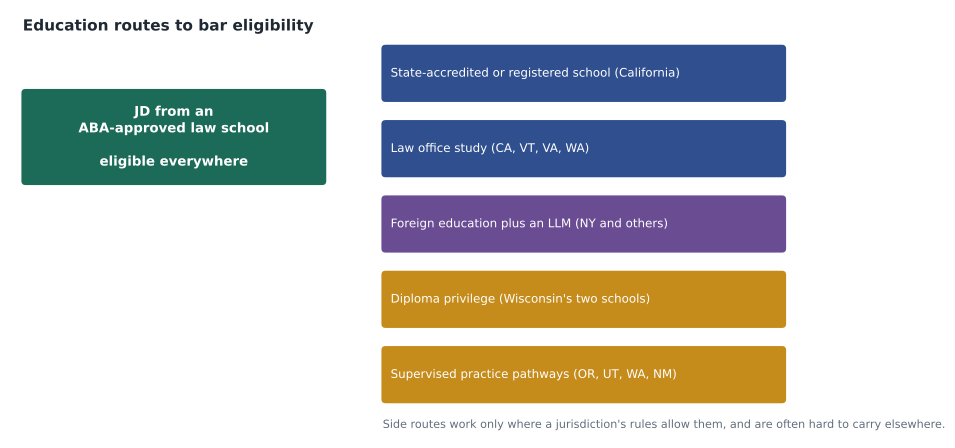
The standard route: a JD from an ABA-approved school
The great majority of applicants qualify with a Juris Doctor from a law school approved by the American Bar Association. About two hundred schools hold ABA approval. They must meet the ABA's Standards and Rules of Procedure for Approval of Law Schools, which govern admissions, faculty, the curriculum, the library, bar passage outcomes and much more. A full-time JD takes three years; part-time programs usually take four.
The ABA standards require every JD student to complete a course in professional responsibility, a substantial writing experience and at least six credit hours of experiential learning, such as a clinic, an externship or a simulation course. Most schools also require first-year courses in civil procedure, contracts, criminal law, property, torts, constitutional law and legal research and writing. Those subjects map closely onto the bar exam. A student who avoids bar subjects in the second and third years can still sit the bar, but will have more to learn during bar preparation.
Before law school, most jurisdictions expect applicants to have completed a bachelor's degree, usually because ABA-approved schools require one for admission. A few jurisdictions spell out prelegal education requirements of their own, and some allow exceptions for applicants admitted to law school without a degree. Dana took the standard route: a bachelor's degree, then three years at an ABA-approved school in Texas, graduating in May 2026.
Accreditation is starting to change
For decades the rule in almost every state was simple: graduate from an ABA-approved school or you cannot sit. In 2025 and 2026 two of the largest states moved away from that. In January 2026 the Supreme Court of Texas finalized rules that end the requirement that bar applicants graduate from an ABA-accredited law school, with Texas taking over the decision about which schools qualify. The Supreme Court of Florida took a different approach: it kept ABA approval as one way to qualify but opened its rules to other accreditors that are recognized by the US Department of Education and approved by the court, and it set October 1, 2026 as the date to begin that process.
Graduates of ABA-approved schools remain eligible in both states, so the changes affect very few current applicants. Their long-term importance is that other accreditors, and new kinds of law schools, may emerge, and that a school's eligibility may differ from state to state. Applicants from any school other than an ABA-approved one should check each target jurisdiction's current rules before relying on them, and should expect that transferring a score or seeking admission on motion later may raise the question again.
California's different system
California has always gone its own way. Besides ABA-approved schools, it recognizes law schools accredited by the State Bar of California's Committee of Bar Examiners, and it registers some unaccredited schools, including fixed-facility, correspondence and distance-learning schools. Graduates of California-accredited schools may sit the California exam, but most other states will not accept their degree. Students at unaccredited schools, and people studying law in a law office, must also pass the First-Year Law Students' Examination, often called the baby bar, after their first year of study before they can continue receiving credit toward bar eligibility.
Sofia studied at a California-accredited law school. It was close to home, cost much less than the ABA-approved schools near her, and let her work part time. The trade-off, which she understood when she enrolled, is portability: if she wants to practice in another state later, she will usually need to be admitted in California first and then use that state's rules for experienced lawyers, which often require years of practice. 'It was the right choice for me,' she tells the group, 'but I'd want any undergraduate considering it to know that.'
Reading the law
A handful of jurisdictions still allow the old route of studying law in a law office or judge's chambers instead of attending law school. California's Law Office Study Program requires four years of supervised study under a qualifying attorney or judge, with minimum weekly hours, regular progress reports and the First-Year Law Students' Examination. Vermont runs a Law Office Study Program, Virginia a Law Reader Program and Washington an APR 6 Law Clerk Program, each with its own length, supervision rules and reporting. A few other jurisdictions allow office study combined with some law school.
Few people use these routes, and they are demanding. The applicant must find a supervising lawyer willing to commit years of teaching, follow a structured curriculum, and then pass the same bar exam as JD graduates. Supporters say the routes keep the profession open to people who cannot afford law school; critics point to low pass rates. Either way, a license earned by reading the law is usually hard to carry to other states, because most require a JD from an ABA-approved school for admission on motion.
Foreign legal education
Ngozi's route is common. Each year thousands of lawyers trained abroad take an American bar exam, most often in New York or California. Most jurisdictions either do not allow foreign-educated applicants to sit at all or require them to earn an American law degree first. A smaller group evaluates foreign education case by case and requires additional study, usually an LLM, to fill the gaps.
New York's rule, Section 520.6 of the Rules of the Court of Appeals, is the best known. An applicant whose foreign legal education is equivalent in length and substance to an American JD can qualify directly. An applicant whose education has either a durational or a substantive shortfall, but not both, can cure it with an LLM at an ABA-approved school that includes at least 24 credits of classroom study, including at least 2 credits in professional responsibility, 2 in legal research, writing and analysis, 2 in American legal studies (such as the American legal system, constitutional law or civil procedure) and 6 in subjects tested on the New York bar exam or the New York Law Exam. At least two-thirds of each counted course must be taught in person. Every foreign-educated applicant must first obtain an advance evaluation of their education from the Board, and the Board asks for that request well before the application period opens.
Ngozi requested her evaluation in early 2026, before she finished her LLM, sending her Nigerian law school transcript directly from the school and proof of her admission in Nigeria directly from the authority that issued it. The Board found a durational shortfall that her LLM could cure. She chose her LLM courses with a checklist in hand to make sure each counted. 'My biggest fear was taking a course I loved that didn't count,' she says. 'The checklist kept me honest.'
California also allows many foreign-educated applicants to sit. Lawyers admitted in another country can generally qualify, and others can qualify through a combination of an LLM and other requirements, or by passing the First-Year Law Students' Examination. The District of Columbia, Texas, Washington and several other jurisdictions have their own foreign-education rules, often requiring a set number of credits at an ABA-approved school. Lesson 10 and the jurisdiction courses give the details for each.
Admission without the traditional exam
Two long-standing programs, and a newer group of pathways, let some graduates qualify without taking the full bar exam. Wisconsin's diploma privilege admits graduates of its two law schools, the University of Wisconsin Law School and Marquette University Law School, who complete required coursework, without a bar exam. New Hampshire's Daniel Webster Scholar Honors Program, at the University of New Hampshire Franklin Pierce School of Law, lets a limited number of students complete a practice-based curriculum with assessments in place of the exam.
The newer pathways require supervised practice. Oregon's Supervised Practice Portfolio Examination, which licensed its first lawyers in 2023, requires 675 hours of supervised legal work within a year and a portfolio of written work, client interactions and negotiations assessed by the board. Utah opened an alternate pathway to applications on January 1, 2026, combining 240 hours of supervised practice, specified skills courses and a written performance exam; Utah notes that the resulting license is not portable to other states. The Supreme Court of Washington has approved apprenticeship pathways for graduates, and the Supreme Court of New Mexico approved a skills-based pathway on August 4, 2026, with 675 hours of supervised work and a seven-area portfolio and applications expected by mid-2027. These routes are explained further in Lesson 10.
| Route | Who can use it | Portability |
|---|---|---|
| JD from an ABA-approved school | Eligible in every jurisdiction | Highest: accepted for score transfer and most admission on motion |
| JD from a California-accredited school | California exam | Low until the lawyer has practiced for years |
| Law office study | California, Vermont, Virginia, Washington (with variations) | Low |
| Foreign education plus an LLM | New York, California and some others under their rules | Varies; many jurisdictions require an ABA JD |
| Diploma privilege (Wisconsin) | Graduates of the two Wisconsin law schools | Limited: no exam score to transfer |
| Supervised practice pathways | Oregon; Utah from 2026; Washington and New Mexico planned | Usually limited to that jurisdiction |
Timing: when you can sit
Most jurisdictions require applicants to have received their degree before the exam, or at least before admission. Some allow students who are close to graduating to sit early, usually only the February exam in their final year, and only if their school certifies that they are on track. These early-testing rules vary widely and come with conditions, so check them in Chart 1 of the Comprehensive Guide and in your board's rules.
Some jurisdictions also ask law students to register with the board during law school. Registration lets the board start its character review early and spot problems while there is still time to address them. Texas, for example, uses a Declaration of Intention to Study Law that students file early in law school. Filing late is usually possible but can cost more and delay the review.
Worked problem
Checking eligibility
A graduate of a California-accredited law school, admitted in California in 2026, wants to sit the Uniform Bar Exam in Arizona in July 2027. What should she check first?
Show solution
- Find Arizona's education rule for exam applicants in its court rules and on the board's website.
- Check whether Arizona accepts a JD from a school that is not ABA-approved, and if so on what conditions, such as years of practice.
- If Arizona does not accept the degree, look at whether practice in California could qualify her later, for example through admission on motion rules.
- Write to the Arizona board with specific questions if the rules are unclear, and keep the reply.
Answer: Eligibility comes first. A degree that qualifies in one state may not qualify in another, so the applicant must confirm Arizona's rule before spending time and money on preparation.
Practical steps
Marchetti closes with a checklist she gives every group. Get certified copies of your law school transcript and, for foreign-educated applicants, transcripts and proof of admission sent directly from the issuing institutions. Find out whether your target jurisdiction needs a dean's certificate, and when your school sends it. Keep a folder of every document you submit and every letter you receive. And if your education does not fit the standard route, ask the board in writing before you apply, not after.
Eddie asks a final question. Louisiana's legal system draws on the civil-law tradition, and his law school offered a civil law track. Does that cause problems? Not for Louisiana, Marchetti says; his degree is from an ABA-approved school, and Louisiana's exam is built for exactly what he studied. But if he later wants to practice in a common-law state, he will find that Louisiana gives neither the Uniform Bar Exam nor the NextGen exam, so he will have no portable score. 'That's a planning point, not a problem. Many Louisiana lawyers never need another license. If you do, you'll use admission on motion after a few years of practice, or sit another state's exam.'
Summary and key terms
- Most applicants qualify with a JD from an ABA-approved law school, which works in every jurisdiction.
- Texas (January 2026) and Florida (from October 2026) no longer require ABA approval alone; ABA graduates remain eligible.
- California recognizes its own accredited and registered schools and law office study, with the First-Year Law Students' Examination for some students.
- Foreign-educated applicants are eligible only in some jurisdictions; New York's Rule 520.6 allows an LLM to cure one kind of shortfall.
- Wisconsin's diploma privilege, New Hampshire's Daniel Webster program and supervised practice pathways in Oregon, Utah, Washington and New Mexico offer routes without the traditional exam.
- ABA-approved law school
- A law school accredited by the American Bar Association's Section of Legal Education and Admissions to the Bar.
- First-Year Law Students' Examination
- California's exam for students at unaccredited schools and in law office study, taken after the first year; also called the baby bar.
- Diploma privilege
- Admission without a bar exam for graduates of particular law schools, now used only in Wisconsin.
- Rule 520.6
- The New York Court of Appeals rule on foreign legal education and the LLM route to the New York bar exam.
- Law office study
- Studying law under a supervising lawyer or judge instead of attending law school.
Practice problems
Work each problem on paper first, then reveal the answer to check.
Why do graduates of California-accredited schools face limits outside California?
Show answer
Most other states require a JD from an ABA-approved school for exam eligibility and for admission on motion.
Under New York Rule 520.6, how many LLM credits must cover subjects tested on the New York bar exam or the New York Law Exam?
Show answer
At least 6 of the 24 required credits.
What is unusual about Utah's alternate pathway license?
Show answer
It is not portable; other states do not recognize it.
Name two jurisdictions where an applicant can qualify by reading the law.
Show answer
Any two of California, Vermont, Virginia and Washington.
Common mistakes
MistakeAny law degree lets you sit any state's bar exam.
InsteadEligibility depends on each jurisdiction's education rules.
MistakeAn LLM alone qualifies a foreign lawyer in every state.
InsteadOnly some jurisdictions accept an LLM route, each with its own conditions.
MistakeTexas no longer accepts graduates of ABA-approved schools.
InsteadThey remain eligible; Texas simply no longer requires ABA approval alone.
Lesson quiz · 5 questions
Score 60% or more to complete this lesson.
Create a free account to save your progress, take quizzes and earn a certificate.