
BAR-101 · Lesson 5 of 12 · 22 min
The MPRE
▶ Video coming soon A video version of this lesson is on the way.
Marchetti opens the fifth session with a roll call. 'MPRE status, everyone.' Dana passed in March 2026, during her last semester. Eddie and Sofia passed in August 2025. Marcus passed in his second year and is relieved never to think about it again. Ngozi has not taken it; New York lets her pass it after the bar exam, and she plans to sit in March 2027. Camila does not need it at all, because Puerto Rico does not require it. 'Six people, five situations,' Marchetti says. 'That's the MPRE in a sentence.'
The Multistate Professional Responsibility Examination is NCBE's test of the rules that govern lawyers' conduct. Almost every jurisdiction requires a passing score for admission, but it is a separate exam from the bar exam, taken on a different day, usually during law school. This lesson explains what it tests, how it works, how it is scored and how to prepare.
Who requires it
NCBE lists two jurisdictions that do not require the MPRE: Wisconsin and Puerto Rico. Two more, Connecticut and New Jersey, accept completion of a law school professional responsibility course, with a minimum grade, in place of a passing MPRE score. Everyone else requires the MPRE, and each jurisdiction sets its own passing score and its own rule on how old a score may be.
Because the MPRE is separate, most students take it during their second or third year of law school, often soon after completing their professional responsibility course, when the material is fresh. Getting it done early removes one task from the bar study months. Some jurisdictions allow it to be passed after the bar exam, as New York does, as long as it is passed within a set period before admission.
Format
The MPRE has 60 multiple-choice questions, each with four answer choices, to be answered in two hours. Only 50 questions count toward the score. The other 10 are pretest questions that NCBE is trying out for future exams; they look exactly like the scored questions, so you cannot tell which is which and should answer every question as if it counts. There is no penalty for a wrong answer, so leave nothing blank.
The MPRE is given at Pearson testing centers on Pearson-provided computers. NCBE offers it three times a year, in March, August and November. The registration deadline falls about six to nine weeks before each administration, and NCBE does not accept late registrations, so put the deadline in your calendar as soon as you decide which administration to take. Registration requires an NCBE account, scheduling a seat with Pearson and paying the fee. Arrive thirty minutes early with identification that matches your registration; arriving more than fifteen minutes late can mean you are not allowed to test.
What it tests
The MPRE tests the law governing the conduct of lawyers, including the disciplinary rules of professional conduct currently articulated in the ABA Model Rules of Professional Conduct, the ABA Model Code of Judicial Conduct, controlling constitutional decisions and generally accepted principles found in leading federal and state cases and in procedural and evidentiary rules. It does not test any particular state's version of the rules. Where a state's rule differs from the Model Rule, the MPRE answer follows the Model Rule unless the question says otherwise.
NCBE publishes a subject matter outline. The major areas, in the outline's order, are: regulation of the legal profession; the client-lawyer relationship; client confidentiality; conflicts of interest; competence, legal malpractice and other civil liability; litigation and other forms of advocacy; transactions and communications with persons other than clients; different roles of the lawyer; safekeeping funds and other property; communications about legal services; lawyers' duties to the public and the legal system; and judicial conduct. Conflicts of interest and the client-lawyer relationship carry the most questions, and judicial conduct among the fewest.
| Area | Typical questions |
|---|---|
| Regulation of the profession | Admission and discipline, unauthorized practice, multijurisdictional practice, reporting misconduct |
| Client-lawyer relationship | Forming and ending the relationship, scope, authority, fees, communication |
| Confidentiality | Rule 1.6 and its exceptions, attorney-client privilege, work product |
| Conflicts of interest | Current and former clients, imputation, business transactions with clients, gifts, third-party payment |
| Competence and civil liability | Competence, malpractice, liability to non-clients |
| Litigation and advocacy | Candor to the tribunal, fairness to opposing parties, trial publicity, prosecutors' duties |
| Others than clients | Truthfulness, communicating with represented and unrepresented persons |
| Roles of the lawyer | Advisor, evaluator, mediator, lawyers in organizations, government lawyers |
| Safekeeping funds | Trust accounts, commingling, disputed funds |
| Communications about services | Advertising, solicitation, specialization claims, firm names |
| Duties to the public | Pro bono, court appointments, law reform activities |
| Judicial conduct | Impartiality, extrajudicial activities, campaigns, disqualification |
The vocabulary of discipline
MPRE questions turn on precise words, and a handful of terms do much of the work. A lawyer who is *subject to discipline* has violated a rule and could be disciplined. If a question asks whether conduct is *proper*, it is asking whether the conduct is consistent with the rules. *May* means the lawyer is permitted to do something but not required; *must* or *required* means the rules demand it. *Subject to litigation sanction* refers to sanctions a court can impose, and *civilly liable* refers to liability for damages, such as malpractice.
These terms are not interchangeable. Conduct can violate a rule without making the lawyer civilly liable, and a lawyer can be liable for malpractice without being subject to discipline. Many wrong answers on the MPRE are right about the facts but wrong about the consequence. Read the call of the question first, so you know which question you are answering.
Scores
MPRE scores are reported on a scale from 50 to 150. The scale is set so that a given score represents the same level of performance on any administration, whatever the difficulty of the particular questions. Each jurisdiction sets its passing score. Among the jurisdictions that use the Uniform Bar Exam, NCBE's chart shows passing scores from 75 to 86: 75 in five jurisdictions, including the District of Columbia, New Jersey and Pennsylvania; 80 in sixteen; 85 in sixteen, including New York and Texas; and a few others, with Utah highest at 86.
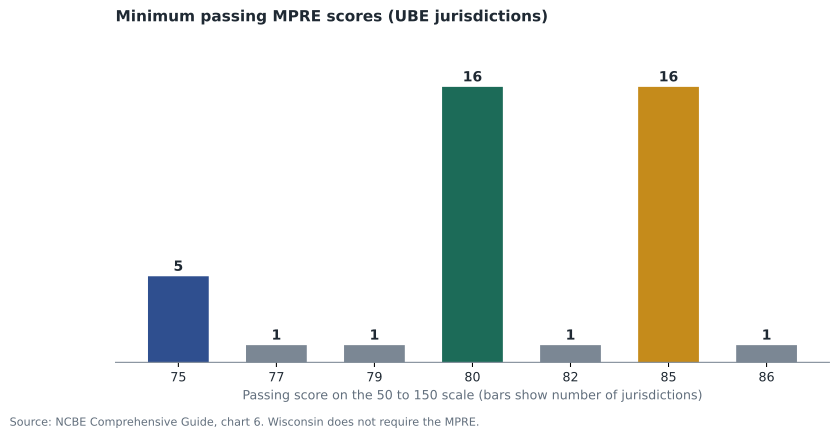
Because jurisdictions differ, a score that passes in one may not pass in another. Dana scored 93, comfortably above Texas's 85, and her score would work almost anywhere. A friend of Marcus scored 81, which passes in Missouri (80) but would not pass in New York or Texas. If you might seek admission in more than one jurisdiction, aim well above the highest passing score you might need.
Scores also age. Jurisdictions set different limits on how long an MPRE score remains usable. NCBE's chart shows New York accepting a passing score for four years from the date of the exam, Alaska accepting scores up to eight years old, Kentucky treating a passing score of 80 as never expiring, and Oklahoma accepting scores for an unlimited period. Others require the MPRE to be passed within a set period before or after the bar exam. Check the rule when you plan, and again if your admission is delayed.
How to prepare
Most students prepare for two to four weeks, often with a free or low-cost course, practice questions and NCBE's own practice exams. A typical plan reviews the rules area by area, then shifts to mixed practice questions under timed conditions, with careful review of every wrong answer. Two hours for 60 questions allows two minutes per question, which is comfortable for most people; the challenge is precision, not speed.
Marchetti's advice is to learn the rules as rules, not as general ethics. Many MPRE questions present a lawyer doing something that seems reasonable or kind but that a specific rule forbids, such as lending a client money for living expenses during litigation, or something that seems harsh but is allowed, such as withdrawing from a representation when the client fails to pay after a warning. Intuition helps less than knowing the exact rule and its exceptions.
Know the confidentiality exceptions in Rule 1.6, the conflict rules in Rules 1.7 to 1.10, the prohibited transactions in Rule 1.8, the duty of candor to the tribunal in Rule 3.3, the communication rules in Rules 4.2 and 4.3, the trust account rules in Rule 1.15 and the advertising and solicitation rules in Rules 7.1 to 7.3. These areas generate many questions.
Worked problem
An original practice question
A lawyer represents a plaintiff in a personal injury case on a contingent fee. The client has lost her job because of her injuries and cannot pay rent. The lawyer offers to pay the client's rent for three months, to be repaid from any recovery. Is the lawyer subject to discipline?
Show solution
- Identify the rule: Model Rule 1.8(e) limits financial assistance to clients in connection with pending litigation.
- Recall the exceptions: a lawyer may advance court costs and litigation expenses, may pay them for an indigent client, and, in a pro bono matter, may give modest gifts for basic living expenses.
- Apply: rent is a living expense, the case is not pro bono, and this is a loan in a contingent fee case.
- Choose the consequence the question asks about: discipline.
Answer: Yes. Paying the client's rent is financial assistance for living expenses in connection with litigation and does not fit an exception, so the lawyer is subject to discipline even though the motive is kind.
Worked problem
A second original practice question
During a deposition, a lawyer's client testifies falsely about a material fact. The lawyer realizes it afterward. The client refuses to correct the testimony. What must the lawyer do?
Show solution
- Identify the rule: Model Rule 3.3 requires candor toward the tribunal, and a deposition is part of the proceeding.
- Rule 3.3(a)(3) and (b) require reasonable remedial measures when a lawyer knows a client has offered material false evidence.
- The first step is to remonstrate with the client; if that fails, the lawyer must take further remedial measures, including disclosure to the tribunal if necessary, even if the information is otherwise confidential.
Answer: The lawyer must take reasonable remedial measures, which can include disclosing the false testimony to the tribunal. Rule 3.3's duty overrides confidentiality under Rule 1.6.
On test day
Arrive early and expect security screening. Pace yourself at about twenty questions every forty minutes. Mark difficult questions and return to them. Watch for questions that ask what a lawyer *should* do as distinct from what the lawyer *may* do. And when two answers both seem plausible, look for the one that states the right rule with the right consequence and the right qualification.
Ngozi asks whether lawyers trained abroad find the MPRE harder. Sometimes, Marchetti says, because conflicts and confidentiality rules differ around the world and the American rules on advertising and solicitation can seem unusual. But the MPRE rewards careful study of a defined set of rules, which favors exactly the kind of disciplined preparation Ngozi has shown with her LLM checklist.
Choosing when to take the MPRE
Because there are three administrations a year, most students can choose a date that suits their law school calendar. Taking it in the March or August of the second year, soon after a professional responsibility course, is common. Taking it in the November of the third year still leaves time to retake in March before a July bar exam if needed. Students in jurisdictions that allow the MPRE after the bar exam sometimes wait, as Ngozi did, but Marchetti suggests that most candidates get it done early so that it never competes with bar study.
If you do not reach your target score, you can retake it at the next administration; there is no penalty for retaking, and jurisdictions generally look only for a passing score within their time limit. Candidates who need a higher score for a second jurisdiction, such as moving from a jurisdiction requiring 80 to one requiring 85, can retake to raise it.
Rules that trip people up
Marchetti keeps a list of rules that MPRE candidates misremember most often. A lawyer may reveal confidential information to prevent reasonably certain death or substantial bodily harm, but the Model Rules make most disclosure permissive rather than mandatory. Conflicts arising from a lawyer's personal interest are generally not imputed to other lawyers in the firm unless they present a significant risk of limiting the firm's representation. A lawyer may not solicit professional employment by live person-to-person contact when a significant motive is the lawyer's financial gain, with exceptions such as contacts with other lawyers, family members and people with whom the lawyer has a close personal or prior professional relationship. And a judge must disqualify herself where her impartiality might reasonably be questioned, not only where she is actually biased.
Summary and key terms
- The MPRE is required everywhere except Wisconsin and Puerto Rico; Connecticut and New Jersey accept a law school course instead.
- 60 four-option questions (50 scored, 10 pretest) in two hours at Pearson test centers, three times a year, with no late registration.
- It tests the ABA Model Rules, the Model Code of Judicial Conduct and generally accepted principles, not any state's own version.
- Scores run from 50 to 150; passing scores in UBE jurisdictions range from 75 to 86, with 80 and 85 most common.
- Jurisdictions set how long a score stays valid; aim above the highest passing score you may need.
- MPRE
- The Multistate Professional Responsibility Examination, NCBE's two-hour test of the law governing lawyers.
- Subject to discipline
- Having violated a rule of professional conduct, so that discipline could be imposed.
- Pretest question
- An unscored question being tried out for future exams, indistinguishable from scored ones.
- Model Rules of Professional Conduct
- The ABA's model ethics rules, adopted in some form by nearly every jurisdiction.
- Scaled score
- A score adjusted so that it means the same level of performance on every administration.
Practice problems
Work each problem on paper first, then reveal the answer to check.
Why should you answer the pretest questions carefully?
Show answer
You cannot tell them apart from scored questions.
Which jurisdictions do not require the MPRE at all?
Show answer
Wisconsin and Puerto Rico.
A score of 82 passes in which of these: Missouri (80), New York (85), Utah (86)?
Show answer
Missouri only.
What is the difference between being subject to discipline and being civilly liable?
Show answer
Discipline follows a rule violation; civil liability means liability for damages, such as malpractice. One can exist without the other.
Common mistakes
MistakeThe MPRE tests your state's version of the ethics rules.
InsteadIt tests the ABA Model Rules and general principles.
MistakeAn MPRE score is valid forever everywhere.
InsteadEach jurisdiction sets its own time limit.
MistakeIf a lawyer's motive is good, the conduct is proper.
InsteadMany questions turn on rules that forbid well-meant conduct.
Lesson quiz · 5 questions
Score 60% or more to complete this lesson.
Create a free account to save your progress, take quizzes and earn a certificate.