
BAR-101 · Lesson 12 of 12 · 24 min
Capstone: planning your path to admission
▶ Video coming soon A video version of this lesson is on the way.
At the end of the eleventh session Marchetti gives the group its capstone assignment. By the end of the week, each member must post a written admission plan to the group's shared folder, answering nine questions she has used with every group for years. 'If you can answer these in writing, with a source for each answer, you understand your path better than most people sitting next to you on exam day.' Between November 17 and November 21, 2026, six plans appear in the folder. This lesson walks through the framework, then through the plans, and ends with problems for you to work through.
The nine questions
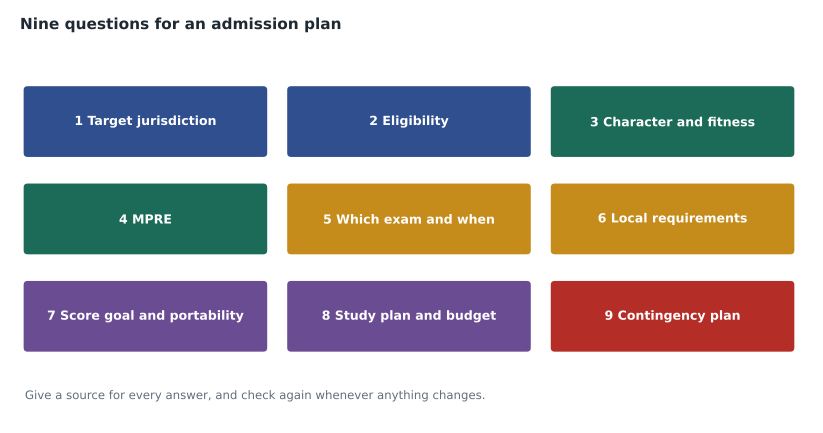
- Target jurisdiction. Where do you want to be admitted first, and where might you want to be admitted later?
- Eligibility. Does your education qualify you to sit there? What is your source in the rules?
- Character and fitness. What must you disclose, what documents support it, and when is the application due?
- MPRE. Is it required, what score, how long is a score valid, and when will you take it or have you passed?
- Which exam and when. Legacy UBE, NextGen or a jurisdiction's own exam, and on which dates? Could a retake fall on a different exam?
- Local requirements. Any local law course or test, pro bono hours, skills requirement, clerkship or other step before admission?
- Score goal and portability. What passing score do you need, and what score would keep future options open?
- Study plan and budget. How many weeks, what resources, what it will cost and how you will pay for it.
- Contingency. What will you do if you do not pass, if your plans change or if the rules change?
Each answer should come with a source: a rule number, a board web page, an NCBE chart, or a written answer from the board. Commercial websites and forums can point you in the right direction, but they are often out of date, especially during the NextGen transition.
Dana: Texas
Dana's plan is the most straightforward. She graduated in May 2026 from an ABA-approved Texas law school, so she is eligible under any version of Texas's rules. Her Declaration of Intention was filed in her first year, and her character application discloses and documents the collection account she paid off in October 2026. Her MPRE score of 93 exceeds Texas's 85. She will sit the legacy UBE in February 2027 and complete Texas's law component, an online course followed by an open-book test, before admission.
Her score goal is at least 270, Texas's passing score, which would also clear every other UBE jurisdiction. Her plan addresses portability directly: if her partner's job takes them to Illinois, a February 2027 score would transfer for four years. Her contingency: if she does not pass in February 2027, she would retake in July 2027, still on the legacy UBE, since Texas plans to switch to NextGen only in July 2028. Her budget relies on her employer paying her bar fees and course, with two months of savings for the full-time study period.
Ngozi: New York
Ngozi's plan is the most document-heavy. Her eligibility rests on New York's foreign education evaluation, which found a durational shortfall cured by her Rule 520.6 LLM; she attaches the Board's letter and her course checklist. Her character application covers her years in practice in Nigeria, with a certificate of good standing sent directly from the Nigerian authority. She will sit the legacy UBE in New York in February 2027 and plans to take the MPRE in March 2027, as New York allows.
Her post-exam list is long: the New York Law Course and New York Law Exam, a passing MPRE score of 85, fifty hours of qualifying pro bono work, which she has already begun at a legal aid clinic, and the skills competency requirement. Her score goal is 270, so that her score clears every UBE passing score, though she notes that many states would not accept her foreign education even with a transferable score. Her contingency is a July 2027 retake, still on the legacy UBE, since New York plans to switch to NextGen in July 2028 and will not accept NextGen transfers from before then.
Marcus: Missouri to Kansas
Marcus is already admitted in Missouri, so his plan concerns his second license. His NextGen score from July 2026 is well above Missouri's 610. Kansas, according to NCBE's table, will accept transferred NextGen scores from July 2026 onward, but had not yet published its passing score for them when he checked. His plan has two branches: transfer his NextGen score as soon as Kansas publishes its rules, if his score meets them, or, failing that, qualify for Kansas admission on motion after five of seven years of practice. He has written to the Kansas board and keeps a log of his practice hours and matters in case he needs it.
Sofia: California, again
Sofia's plan starts with her score report. Her MBE was above California's mean, but two essays and the performance test fell short. Her eligibility as a graduate of a California-accredited school is settled for California, and she has already filed her repeater application for February 2027. Her plan sets four timed essays a week, a performance test every other week, and feedback from Marchetti and a former classmate who passed in July. Her budget covers reduced working hours from January.
Her contingency planning is unusually careful, because California is changing. If she needed to retake again, July 2027 would still be California's current format, but July 2028 is expected to be NextGen. She also notes the portability limit of her degree: if she ever wants to practice outside California, she will need years of California practice first, and some states may never accept her degree. 'I've accepted that,' she writes. 'California is where my family and my clients are.'
Eddie: Louisiana
Eddie's plan is Louisiana from top to bottom. His ABA-approved JD qualifies him; his college conduct matter is disclosed with the university's letter; his MPRE score exceeds Louisiana's 80. His study plan, revised after Marchetti's critique, now interleaves timed practice from the first week, gives extra weight to the three Civil Code tests and the other code-based tests that count double, and ends with two full simulations of the Monday-Wednesday-Friday schedule.
His portability section is short and honest: Louisiana scores do not transfer anywhere, and Louisiana itself admits no one on motion. If he moves, he will use admission on motion in a state that offers it, once he has the required years of practice. He has started keeping a practice log too, on Marcus's advice.
Camila: Puerto Rico
Camila's plan has two exams in it: the Puerto Rico bar exam and the notarial exam. Puerto Rico does not require the MPRE, so that line of her plan reads 'not required, per the Board.' Her eligibility as a graduate of a Puerto Rico law school is straightforward. Her biggest uncertainty is timing, because the Board had not announced the next filing dates when she wrote her plan, so her plan includes a weekly check of the Board's site and a provisional study calendar keyed to the usual exam season. Like Eddie, she notes that her license will not be portable by score and that Puerto Rico offers no admission on motion in either direction.
| Member | Jurisdiction | Exam | MPRE | Key extra step | Portability note |
|---|---|---|---|---|---|
| Dana | Texas | Legacy UBE, Feb 2027 | Passed (93) | Texas law component | Score of 270 transfers widely |
| Ngozi | New York | Legacy UBE, Feb 2027 | Planned March 2027 | NY Law Exam, 50 pro bono hours, skills requirement | Foreign education limits transfers |
| Marcus | Missouri, then Kansas | NextGen, July 2026 (passed) | Passed | Kansas transfer rules | Transfer now or motion after 5 of 7 years |
| Sofia | California | General Bar Exam, Feb 2027 | Passed | Repeater application | Degree limits practice elsewhere |
| Eddie | Louisiana | Louisiana exam | Passed | Code tests count double | No score transfer; motion elsewhere later |
| Camila | Puerto Rico | Puerto Rico exam in Spanish | Not required | Notarial exam | No transfer or motion |
Problems to work through
The following problems use invented applicants. For each, work through the nine questions, decide what the applicant should do, and check your reasoning against the answers.
Worked problem
Problem 1: The moving candidate
Lena graduates in May 2027 from an ABA-approved law school in Arizona. She wants to practice in Arizona but may move to Colorado within three years. Arizona plans its first NextGen exam in July 2027; Colorado plans its first in July 2028 and accepts transferred NextGen scores from July 2026. What should her plan say about the exam and portability?
Show solution
- Which exam: Arizona's July 2027 exam will be the NextGen exam.
- Portability: Colorado accepts NextGen transfers from July 2026 onward, so an Arizona NextGen score could transfer if it meets Colorado's NextGen passing score and age limit.
- Score goal: aim comfortably above both jurisdictions' NextGen passing scores once they are published.
- Local requirements: Arizona requires an online course on Arizona law; Colorado may have its own requirements.
- Contingency: if she moves after Colorado's time limit, look at Colorado admission on motion (three of the past five years).
Answer: Lena should prepare for the NextGen exam in Arizona, aim high enough to transfer to Colorado, and confirm Colorado's NextGen passing score and time limit before relying on a transfer.
Worked problem
Problem 2: The disclosure question
Raj, applying in a UBE jurisdiction, was suspended from his job for two weeks in 2023 for falsifying a timesheet. He has worked elsewhere since with good reviews. The application asks about employment discipline for dishonesty. What should he do?
Show solution
- Character and fitness: the question expressly covers this, so he must disclose it.
- Explain factually: what happened, his responsibility, what he learned, and his record since.
- Document: a letter from his current employer and, if possible, records of the suspension.
- Do not minimize or omit; dishonesty about a dishonesty incident would be far worse.
Answer: Raj must disclose the suspension with a candid explanation and evidence of his conduct since. A single incident three years ago, openly addressed, is unlikely to prevent admission; concealment could.
Worked problem
Problem 3: The retake on a different exam
Priya sits the legacy UBE in Pennsylvania in February 2028 and does not pass. Pennsylvania plans its first NextGen exam in July 2028. What does she face, and what should she plan?
Show solution
- Which exam: February 2028 is the last legacy UBE administration, so a July 2028 retake in Pennsylvania would be the NextGen exam.
- Preparation: she must prepare for NextGen's format, including integrated question sets and performance tasks.
- Transfer: her legacy score is not passing, so there is nothing to transfer.
- Timing: she should start NextGen preparation as soon as results arrive, using NCBE's official materials.
Answer: Priya will face a different exam on her retake. Candidates sitting the last legacy administrations should plan for that possibility before they sit.
Closing the course
Marchetti's final message to the group is brief. 'You've learned the map. In the next courses you'll learn the territory: the MBE subjects, essay writing, the performance test, the NextGen exam, the MPRE and then your own jurisdiction. Keep your nine answers somewhere you'll see them, and check them again whenever anything changes. And when you pass, come back and help the next group.' Marcus replies first: he already has.
Writing your own plan
Your own plan should take about two hours to draft and much longer to verify. Start with the nine questions, write a one-paragraph answer to each, and add the source for each answer. Then read your jurisdiction's admission rules from beginning to end, which most candidates never do, and check each answer against them. Finally, ask someone else, a classmate, a law school adviser or a mentor, to read the plan and question it. Marchetti finds that a second reader catches at least one missing deadline in almost every plan.
Keep the plan where you will see it. Several of Marchetti's former students printed it and pinned it above their desks; others kept it as the first page of their study notebook. Update it whenever something changes: a new job, a move, a new rule from the board, or a result. By the time you are admitted, it will have become a record of how you got there, which is useful the next time you need a license somewhere new.
What comes next in this program
The remaining core courses in this program cover the exams in depth. Two courses review the MBE subjects, one covers the MEE subjects and essay writing, one covers the performance test, one covers the NextGen exam's skills and question types, and one prepares candidates for the MPRE. The rest of the program has one course for each state, the District of Columbia and the territories, covering its admission rules, its exam, its local component and the local law that sets it apart. Each of the group's members appears again in their own jurisdiction's course, and Marchetti continues to coach them through their exams.
Summary and key terms
- A complete admission plan answers nine questions: jurisdiction, eligibility, character and fitness, MPRE, exam and date, local requirements, score goal and portability, study plan and budget, and contingency.
- Every answer should have a source in the rules, the board's website, NCBE's charts or a written answer from the board.
- Portability planning matters most for UBE and NextGen candidates who may move; own-exam jurisdictions offer no score transfer.
- Candidates sitting the last legacy UBE administrations should plan for a possible retake on the NextGen exam.
- Plans must be revisited when personal plans or rules change, especially during the 2026 to 2028 transition.
- Admission plan
- A written plan covering every requirement and decision between law school and admission.
- Portability
- The ability to use a score or license to gain admission in another jurisdiction.
- Contingency plan
- What a candidate will do if they do not pass or their circumstances change.
- Repeater application
- An application for a retake, often with its own filing period.
- Source
- The rule, board page, NCBE chart or written answer that supports a planning decision.
Practice problems
Work each problem on paper first, then reveal the answer to check.
Why should each answer in an admission plan have a source?
Show answer
Rules change and secondary sources are often out of date; a source lets you verify and re-check.
What is special about February 2028 for legacy UBE candidates?
Show answer
It is the last legacy administration, so a retake afterward will usually be on the NextGen exam.
Why does Eddie keep a practice log from his first day?
Show answer
To document the years of practice he may need for admission on motion elsewhere.
What score goal keeps every UBE jurisdiction open?
Show answer
At least 270.
Common mistakes
MistakeA plan is finished once it is written.
InsteadPlans must be revisited whenever circumstances or rules change.
MistakeForums are a reliable source for current rules.
InsteadUse the rules, the board, NCBE's charts or written answers.
MistakeA retake is always the same exam as the first attempt.
InsteadDuring the transition, a retake may be on the NextGen exam.
Lesson quiz · 5 questions
Score 60% or more to complete this lesson.
Create a free account to save your progress, take quizzes and earn a certificate.