
BAR-101 · Lesson 8 of 12 · 19 min
Scores, scaling and passing scores
▶ Video coming soon A video version of this lesson is on the way.
Sofia has her California score report open when the eighth session starts. She missed passing in July 2026 by a small margin, and she wants to understand exactly what the numbers mean before she plans for February. 'I keep reading about scaled scores and equating,' she says, 'and I don't know whether my essays or my multiple-choice let me down.' Marchetti says that is the right question, and that answering it is the point of tonight.
Bar exam scoring confuses almost everyone, partly because jurisdictions report scores differently and partly because the raw number of questions answered correctly is never the score that counts. Understanding the system matters for three reasons: it tells you how to allocate study time, it lets you read a failing score report and plan a retake, and it explains why a score that passes in one jurisdiction may fail in another.
Raw scores and scaled scores
A raw score is the direct count of points earned: the number of MBE questions answered correctly, or the points a grader gives an essay. Raw scores cannot be compared fairly across administrations, because one exam may be slightly harder than another. If the February questions are harder than the July questions, the same raw score reflects more knowledge in February.
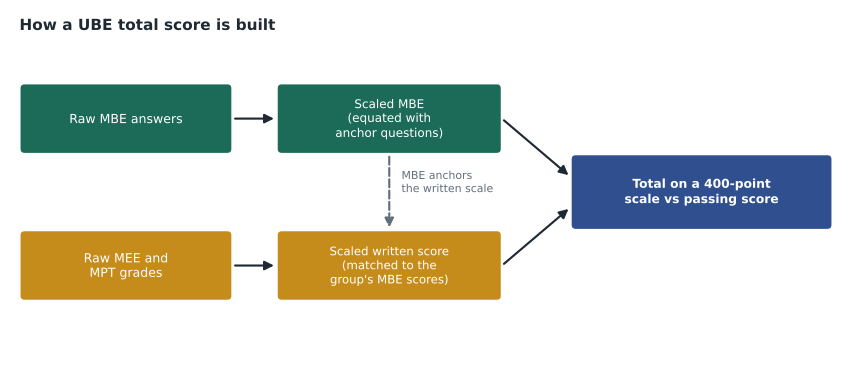
A scaled score adjusts for that. NCBE converts raw MBE scores to scaled scores through equating. Every MBE includes questions that appeared on earlier exams, whose difficulty is already known. By comparing how examinees perform on these anchor questions, NCBE can measure whether the group, or the new questions, are stronger or weaker than before, and convert raw scores to a common scale on which a given score means the same level of knowledge on every administration. Scaled MBE scores run up to about 200; national means have typically been in the high 130s and low 140s. California's July 2026 report, for example, gave the national mean scaled MBE as 1407 on California's own 2,000-point scale, the equivalent of about 140.7.
Scaling the written scores
Essays and performance tests cannot be equated the same way, because each question is new and graders vary. Instead, NCBE recommends, and UBE jurisdictions use, a method called scaling written scores to the MBE. After grading, the jurisdiction's total raw written scores for that administration are converted so that they have the same mean and spread as the scaled MBE scores of the same group of examinees. If this February's group scores well on the MBE, the written scale shifts up for everyone; if the group is weaker, it shifts down.
Two consequences follow. First, the MBE anchors the whole exam: it controls not only its own half of the score but also the level of the written half. Second, the written score is relative. What matters is how your essays and performance tests rank among the other examinees in your jurisdiction that administration, not their absolute quality. Graders often grade on a relative scale too, sorting answers into groups from strongest to weakest. A good essay is one that is better organized and more complete than most.
Putting the UBE total together
On the UBE, the scaled MBE score counts for half the total and the scaled written score for the other half, with the MEE contributing 30 and the MPT 20 out of 100. The total is reported on a 400-point scale. A rough rule of thumb is that the total is about the scaled MBE score plus the scaled written score, each on a scale up to about 200. A candidate with a scaled MBE of 138 and a scaled written score of 132 would have a total of about 270.
Because scoring is compensatory, that candidate passes in a jurisdiction requiring 270 even though her written score alone would fall short; her MBE carries it. A candidate with a scaled MBE of 128 and a written score of 135 would total about 263, which passes in jurisdictions requiring 260 but fails in those requiring 266 or 270.
Worked problem
Reading a UBE score
An examinee's report shows a scaled MBE score of 134.5 and a scaled written score of 129.8. Does she pass in Minnesota (260), New York (266) or Texas (270)?
Show solution
- Add the two scaled components: 134.5 plus 129.8 equals 264.3.
- Round as the jurisdiction does; UBE totals are usually reported as whole numbers, so about 264.
- Compare with each passing score: 264 is above 260, below 266 and below 270.
Answer: She passes in Minnesota but not in New York or Texas. If she might want to transfer her score later, a total of at least 270 would have kept every UBE jurisdiction open.
Passing scores
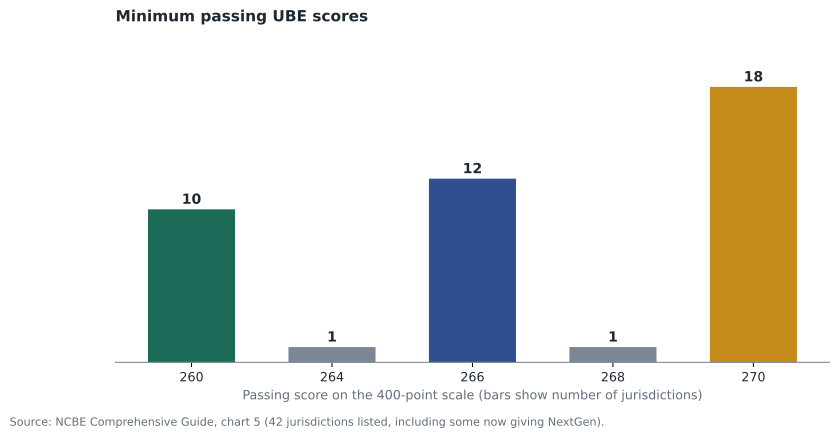
Each jurisdiction sets its own passing score, usually through a standard-setting study in which experienced lawyers judge what a minimally competent new lawyer should be able to do, followed by a decision of the court. Among the jurisdictions whose UBE minimums appear in NCBE's chart, the lowest passing score is 260 and the highest 270. Ten use 260, including Minnesota, Missouri, New Mexico, Utah, Washington and Wisconsin; twelve use 266, including the District of Columbia, Illinois, New Jersey and New York; Indiana uses 264 and Michigan 268; and eighteen use 270, including Arizona, Massachusetts, Ohio, Pennsylvania and Texas.
On the NextGen scale, passing scores for July 2026 ran from 610 (Missouri and Washington) to 616 (Connecticut, Idaho, Maryland and the Virgin Islands), with Oregon moving to 620 after its first administration. Jurisdictions with their own exams use their own scales: California reports General Bar Exam scores on a 2,000-point scale, with a passing line of 1,390 since 2020 (adjusted for the troubled February 2025 exam); Louisiana grades nine tests of 100 points each, counts the five Civil Code and code-based tests double, and requires 650 of the 900 weighted points.
Score reports and release dates
Boards release results on their own schedules, typically eight to twelve weeks after the exam. Most publish a pass list and notify each applicant through the portal. What the report contains varies. Many jurisdictions give failing candidates their scaled MBE score, their written score and sometimes the raw grade on each essay and performance test, which is invaluable for planning a retake. Some report total scores to passing candidates too, which matters for anyone who may transfer a UBE score later. Copies of essay answers are available in some jurisdictions on request.
Sofia's report shows a scaled MBE score above California's mean and essay grades that were mostly solid but uneven, with two noticeably weak answers and a middling performance test. Marchetti reads it with her. 'This is good news, honestly. Your multiple-choice is where it needs to be. Two essays cost you most of the gap. That's a writing and timing problem, and it's fixable in three months.'
Pass rates
Pass rates are reported by jurisdiction and administration, usually split into first-time and repeat takers. First-time takers pass at much higher rates than repeaters, because repeaters include those who struggled the first time and, often, those studying while working. In July 2026, NCBE reported that 85.2 percent of first-time NextGen examinees passed, compared with 41.0 percent of repeaters. California's July 2026 results showed the same pattern: 64.7 percent of first-time takers and 14.1 percent of repeaters passed the General Bar Exam, for an overall rate of 48.3 percent.
February exams usually have lower pass rates than July exams, mainly because more February takers are repeaters. Pass rates also differ widely by law school. ABA Standard 316 requires an accredited law school to show that at least 75 percent of its graduates who sat a bar exam passed within two years of graduation. That standard gives schools strong reasons to invest in bar preparation, and many offer courses, coaching and stipends.
Using scores to plan
For someone preparing for the first time, the lesson is to practice under realistic conditions and to estimate scores honestly. Most commercial courses and NCBE's practice tests estimate a scaled MBE score from practice results. Timed essays graded against model answers, ideally by someone experienced, show whether written work is at a passing level. Because the written score is scaled to the MBE, a candidate with a strong MBE has a cushion; one with a weak MBE needs both halves to improve.
For a repeat taker, the score report is the starting point. Marchetti asks repeaters to answer three questions: which component fell short, whether the problem was knowledge, skill or time, and what will be different this time. Sofia writes her answers in the chat: the two weakest essays were on subjects she had studied last, she ran out of time on one, and this time she will write a timed essay every weekday in December and January and get feedback on each.
| Exam | Scale | Typical passing score | Notes |
|---|---|---|---|
| Legacy UBE | 400 points | 260 to 270 | MBE 50, MEE 30, MPT 20; written scaled to MBE |
| NextGen UBE | 500 to 750 | 610 to 620 | Recommended range; jurisdictions set the score |
| MPRE | 50 to 150 | 75 to 86 | Separate exam; each jurisdiction sets its score |
| California General Bar Exam | 2,000 points | 1,390 | MBE plus California essays and a performance test |
| Louisiana bar exam | 900 weighted points | 650 | Nine tests; code tests count double |
Why passing scores differ
Jurisdictions set different passing scores because they reach different judgments about the minimum competence a new lawyer needs, and because those judgments were made at different times by different panels. A standard-setting study typically asks a panel of experienced lawyers to review actual exam answers or questions and decide how a just-qualified new lawyer would perform. The court then considers the panel's recommendation alongside other evidence, such as the effect on pass rates and on the diversity of new lawyers, and adopts a score.
These choices are debated. Some argue that higher passing scores protect the public; others argue that there is little evidence that lawyers who passed with a 266 practice worse than those who passed with a 270, and that high cut scores keep capable people out of the profession. Several jurisdictions lowered their passing scores in recent years, including California in 2020 and Oregon. The NextGen transition required every adopting jurisdiction to set a new score on the new scale, and most chose numbers within NCBE's recommended range.
Reading a failing score report
A failing score report is uncomfortable, but it is the most useful document a repeat taker has. The first step is to separate the components: how far was the scaled MBE from what would have been needed, given the written score, and how far was the written score from what would have been needed, given the MBE? The second is to look at individual essay and performance test grades where the jurisdiction reports them, to see whether the weakness was spread evenly or concentrated in a few answers. The third is to think about why: missing knowledge, poor organization, timing, or exam-day stress.
Sofia's analysis shows a concentrated problem: two weak essays and a middling performance test. That points to targeted practice rather than relearning everything. A candidate whose MBE was far short, by contrast, needs a plan built around daily multiple-choice practice and review. Marchetti also reminds the group that a near miss is common, and that most repeat takers who change their approach, rather than repeating the same plan, improve their score.
Percentiles and comparisons
Some jurisdictions and NCBE publish percentile tables showing how scores compare with all examinees. These help put a score in context but do not change whether it passes. A scaled MBE score near the national mean, for example, is a sound foundation in a jurisdiction that requires 266 or 270, provided the written score is near average too. Candidates should resist comparing their raw practice percentages with friends': practice materials differ in difficulty, and only scaled estimates from official practice exams give a meaningful prediction.
Summary and key terms
- Raw scores are converted to scaled scores so that a score means the same thing on every administration; the MBE is equated using anchor questions.
- Written scores are scaled to the MBE distribution of the same jurisdiction and administration, so they are relative and the MBE anchors the whole score.
- The UBE total, on a 400-point scale, is roughly the scaled MBE plus the scaled written score; passing scores range from 260 to 270.
- NextGen passing scores in July 2026 ran from 610 to 616; California and Louisiana use their own scales.
- First-time takers pass at much higher rates than repeaters; score reports guide retake planning.
- Raw score
- The direct count of points earned before any adjustment.
- Equating
- The statistical process that puts scores from different administrations on the same scale.
- Scaling to the MBE
- Converting written scores to match the mean and spread of the same group's scaled MBE scores.
- Passing score
- The minimum total score a jurisdiction requires, set by its court.
- ABA Standard 316
- The accreditation standard requiring 75 percent of a school's graduates who sit a bar exam to pass within two years.
Practice problems
Work each problem on paper first, then reveal the answer to check.
Why is the written score described as relative?
Show answer
Because it is scaled to the MBE scores of the same group, so it reflects ranking among those examinees.
What UBE total keeps every UBE jurisdiction open for transfer?
Show answer
270 or more.
A scaled MBE of 141 and a scaled written score of 125: about what total, and does it pass at 266?
Show answer
About 266, so it passes at 266, assuming the jurisdiction rounds to 266.
How does Louisiana weight its code tests?
Show answer
They count double compared with the other tests.
Common mistakes
MistakeThe number of MBE questions you answer correctly is your MBE score.
InsteadThe score that counts is the scaled score after equating.
MistakeA good essay earns the same points whatever others write.
InsteadWritten scores are scaled relative to the group.
MistakeA UBE score that passes in one state passes everywhere.
InsteadPassing scores range from 260 to 270.
Lesson quiz · 5 questions
Score 60% or more to complete this lesson.
Create a free account to save your progress, take quizzes and earn a certificate.