
BAR-101 · Lesson 7 of 12 · 20 min
The NextGen bar exam
▶ Video coming soon A video version of this lesson is on the way.
Marcus Bell is the only member of the group who has already passed a bar exam, and he passed one that had never been given before. On a Tuesday in late July 2026 he sat down at a table in a Missouri testing room with his own laptop, opened NCBE's secure testing browser and began the first administration of the NextGen bar exam. Missouri released results on October 2. He passed. Marchetti asks him to lead the seventh session. 'You're our field report,' she says.
The NextGen bar exam is NCBE's replacement for the Uniform Bar Exam. It was designed after a multi-year study of what newly licensed lawyers actually do, and it is meant to test lawyering skills and a focused set of legal knowledge together rather than broad memorization. NCBE calls it the NextGen UBE, because jurisdictions that adopt it will use uniform scoring and score transfer, just as they did with the legacy UBE.
Why the exam is changing
NCBE began a review of the bar exam in 2018 and published the findings of its testing task force in 2021. Its practice analysis surveyed thousands of lawyers about the knowledge and skills they use in their first years of practice. The results confirmed that new lawyers rely on foundational legal knowledge, but also that they spend much of their time on skills such as research, writing, investigation, counseling and negotiation that the legacy exam tested only partly, mainly through the MPT. The task force recommended an exam that integrates skills and knowledge, tests a narrower set of subjects in more depth, and relies less on memorizing fine points of law that a lawyer would look up in practice.
Critics of the legacy UBE had long argued that it rewarded memorizing large numbers of rules, and that its emphasis on speed in the MBE bore little relation to practice. Supporters of the NextGen design say it better reflects real work. Skeptics worry about the cost of preparing for a new exam, the lack of years of practice materials, and the risks of computer-based testing at scale. All of those concerns were tested in July 2026.
What it tests
The NextGen exam tests two kinds of content. The first is foundational concepts and principles in eight subjects: business associations and relationships (including agency); civil procedure; constitutional law (including proceedings before administrative agencies); contracts (including Article 2 of the Uniform Commercial Code); criminal law and constitutional protections of accused persons; evidence; real property; and torts. NCBE has announced that family law will be added in July 2028. NCBE's content scope outlines list the specific concepts tested in each subject, with some topics marked as ones examinees should be able to recall and others that will be provided in the materials when tested.
The second is foundational lawyering skills, in seven categories: legal research; legal writing; issue spotting and analysis; investigation and evaluation; client counseling and advising; negotiation and dispute resolution; and client relationship and management. Questions test these skills in context. A question might ask what additional fact an investigator should seek, which advice best serves a client's stated goals, or which negotiation response protects the client's interests.
| Foundational concepts and principles | Foundational lawyering skills |
|---|---|
| Business associations and relationships (including agency) | Legal research |
| Civil procedure | Legal writing |
| Constitutional law (including administrative proceedings) | Issue spotting and analysis |
| Contracts (including UCC Article 2) | Investigation and evaluation |
| Criminal law and constitutional protections of accused persons | Client counseling and advising |
| Evidence | Negotiation and dispute resolution |
| Real property | Client relationship and management |
| Torts (family law added July 2028) |
Format
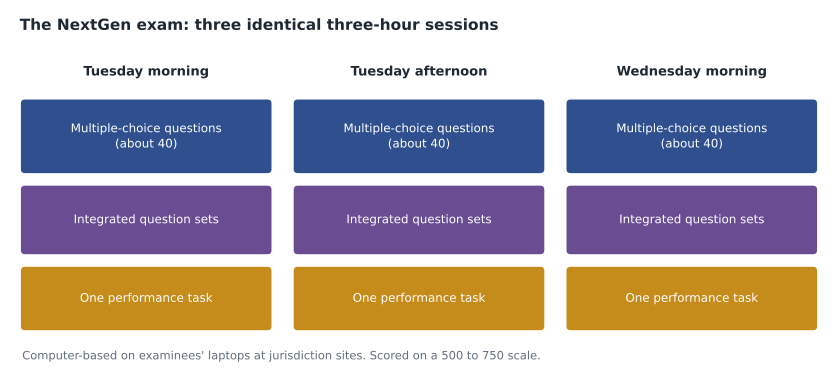
The exam takes nine hours over a day and a half, in three sessions of three hours: Tuesday morning, Tuesday afternoon and Wednesday morning. Each session has the same structure. There are standalone multiple-choice questions, about forty per session and about 120 in all; some questions use formats beyond the classic four options, such as choosing two correct answers from a longer list. There are integrated question sets, in which several questions of different types, including short written answers, build on one fact scenario and sometimes a set of legal materials. And there is one performance task, an extended written assignment based on a file and a library, much like the MPT but with more emphasis on research.
The whole exam is computer-based. Examinees use their own laptops running NCBE's secure testing browser at sites the jurisdiction manages; they do not test at home. NCBE scores the multiple-choice questions and jurisdictions score the written answers, using NCBE's grading materials, as with the legacy MEE and MPT. Roughly half of the score comes from the multiple-choice questions and the rest from the written work in the question sets and performance tasks.
Marcus describes the experience. 'The multiple-choice felt familiar, but the questions were less about tiny rule distinctions and more about what a lawyer should do next. The question sets felt like a mini case file. The performance tasks were the hardest part to pace, because you have to read the materials, research in the library and write, all in one block. The software was fine. A few people near me had laptop trouble in the first session and the staff sorted it out.'
Scoring and passing scores
NextGen scores are reported on a new scale from 500 to 750, deliberately different from the legacy UBE's 400-point scale so that the two cannot be confused. Each jurisdiction sets its passing score. NCBE recommended a range of about 610 to 620. For July 2026, Missouri and Washington set 610, Guam and Palau 612, Oregon and the Northern Mariana Islands 615, and Connecticut, Idaho, Maryland and the Virgin Islands 616. Oregon used 615 for July 2026 and set 620 for later administrations.
The first administration: July 2026
Ten jurisdictions gave the first NextGen exam in July 2026: Connecticut, Idaho, Maryland, Missouri, Oregon and Washington, and four territories, Guam, the Northern Mariana Islands, Palau and the US Virgin Islands. NCBE reported that 2,630 examinees received official scores, with an overall pass rate of 72.7 percent: 85.2 percent of first-time takers and 41.0 percent of repeat takers. Pass rates differed by jurisdiction, from about 63 percent in Connecticut to about 80 percent in Idaho and Oregon, and very small groups in some territories make their figures volatile.
The administration was not smooth everywhere. In Washington, one testing site's July sitting was canceled, and affected examinees took a make-up exam on September 1 and 2. Missouri ran an adjusted schedule. NCBE reported that it did not find a consistent pattern showing that examinees affected by disruptions scored differently. Results arrived from late September through mid-October, and boards released them on their usual schedules: Missouri on October 2, Idaho on October 6, and Connecticut, Maryland and Washington on October 9.
The transition, 2026 to 2028
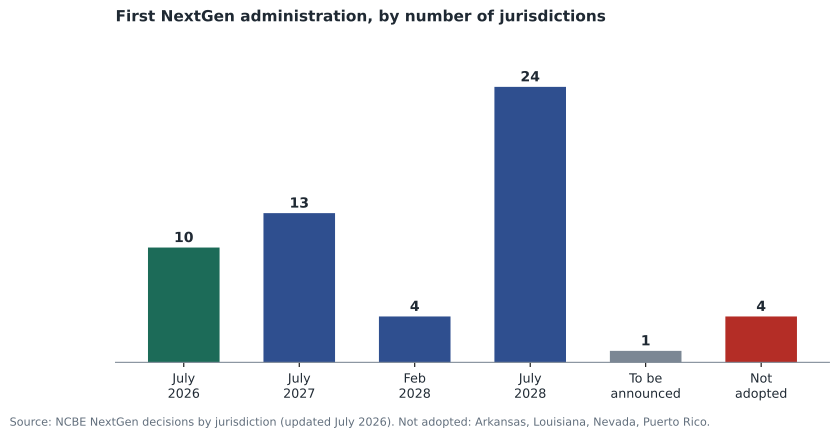
NCBE will give the legacy UBE through February 2028, so most jurisdictions are switching between July 2027 and July 2028. NCBE's table of decisions, updated in July 2026, showed thirteen jurisdictions planning their first NextGen exam in July 2027 (including Arizona, Iowa, Kentucky, Minnesota, Nebraska, New Mexico, North Dakota, Oklahoma, South Dakota, Tennessee, Vermont and Wyoming), four in February 2028 (Delaware, the District of Columbia, Illinois and Montana), and twenty-four in July 2028, including California, Florida, New York and Texas. Mississippi had adopted the exam without announcing a date. Arkansas, Louisiana, Nevada and Puerto Rico had not adopted it. Sources sometimes differ on a jurisdiction's date as boards finalize plans, so always confirm with the board.
Several states that never used the legacy UBE, including California, Florida, Georgia, Hawaii, South Dakota and Virginia, are adopting the NextGen exam. That will make NextGen scores more widely accepted than legacy UBE scores ever were. Not every adopter accepts every transferred score, though: Hawaii has said it will not accept transferred NextGen scores, and Florida and New York will not accept NextGen scores from administrations before July 2028. Many adopters also keep or add a jurisdiction-specific component; Florida, for example, plans a four-hour state component given the day before the NextGen exam.
Preparing for a new exam
The biggest practical problem for early NextGen takers is the shortage of past exams. NCBE has published sample questions, a content scope, study aids and practice materials, and commercial courses have built NextGen programs, but there is nothing like the decades of released MBE questions available for the legacy exam. Marcus's advice is to use every official NCBE resource first, to practice performance tasks under time pressure from the start, and to treat the skills categories as subjects in their own right.
For candidates in jurisdictions switching in 2027 or 2028, there is a choice to make. Someone graduating in May 2027 in a state switching in July 2028 will take the legacy UBE in July 2027; a repeat taker in February 2028 will take the legacy exam again; a repeat taker in July 2028 will take the NextGen exam. Candidates who might need to retake should understand which exam they would face. And a candidate who expects to move should consider which score will transfer to their future jurisdiction.
Worked problem
Which exam will I take?
A student will graduate in May 2028 from a law school in Illinois and plans to sit in Illinois. Illinois plans its first NextGen exam in February 2028. Which exam will she take in July 2028, and what should she use to prepare?
Show solution
- Check Illinois's planned first NextGen administration: February 2028.
- July 2028 is after that date, so she will take the NextGen exam.
- Prepare with NCBE's NextGen content scope, sample questions and practice materials and a NextGen course.
- Confirm Illinois's plans with the board during her final year, in case the date moves.
Answer: She will take the NextGen exam and should prepare for its format and content scope, not the legacy UBE.
Sofia asks whether California's move matters for her. Not for February 2027, Marchetti says; California will give its own exam then, with the MBE, California essays and a performance test. But if she does not pass in February, and if plans hold, the July 2028 California exam would be NextGen. 'Which is one more reason,' Sofia says, 'to pass in February.'
How the skills appear in questions
Each skill category shows up in recognizable ways. Legal research questions may ask which source a lawyer should consult first, or ask examinees to find and apply the relevant authority in a set of materials. Investigation and evaluation questions ask what additional facts or documents a lawyer should obtain, or how strong a piece of evidence is. Client counseling questions ask which advice best serves a client's stated goals and explains the risks. Negotiation questions ask which proposal or response best protects the client's interests. Client relationship and management questions cover matters such as scope of representation, communication and handling a conflict of interest that arises during a matter.
Marcus found the skills questions easier than he expected, because many turned on judgment he had built in a clinic and two summer jobs. 'If you've done real legal work, a lot of it feels natural. If you haven't, practice these as seriously as any doctrinal subject.' His advice to the group is to read NCBE's skills descriptions closely, because they explain what a good answer looks like in each category.
Reading the content scope
NCBE's content scope outlines are the most important single preparation document for the NextGen exam. For each of the foundational subjects, they list the concepts and principles that may be tested, and they indicate which topics examinees should be prepared to recall and which will be provided in the exam materials if they are tested. That distinction matters: memorizing material that will be provided wastes time, while skipping material that must be recalled loses points. Candidates should study from the scope, not from an old MBE outline, and check that any course they buy is built around it.
Jurisdiction components under NextGen
Adopting the NextGen exam does not end jurisdiction-specific requirements. NCBE's chart of NextGen jurisdictions lists components such as Maryland's Maryland Law Component, Missouri's Missouri Educational Component Test, Washington's open-book online Washington Law Component and Tennessee's Tennessee Law Course, and planned components such as a four-hour Florida component, a Texas Law Component covering subjects including trusts, wills and family law, a three-hour Alabama essay exam and a North Carolina component on decedents' estates and trusts. Candidates should treat their jurisdiction's component as part of the exam, with its own preparation time.
Summary and key terms
- The NextGen UBE tests eight foundational subjects (family law added July 2028) and seven foundational lawyering skills.
- Nine hours over 1.5 days in three identical sessions, each with multiple-choice questions, integrated question sets and a performance task.
- Fully computer-based on examinees' laptops at jurisdiction sites; scored on a 500 to 750 scale, with passing scores around 610 to 620.
- First given in July 2026 in ten jurisdictions; 2,630 examinees received scores, with a 72.7 percent pass rate.
- The legacy UBE runs through February 2028; most jurisdictions switch between July 2027 and July 2028; Arkansas, Louisiana, Nevada and Puerto Rico had not adopted it.
- NextGen UBE
- NCBE's new bar exam, first given in July 2026, replacing the legacy Uniform Bar Exam.
- Integrated question set
- A group of questions of different types built on one fact scenario.
- Performance task
- An extended written lawyering assignment based on a file and a library.
- Foundational lawyering skills
- The seven skill categories the NextGen exam tests, from legal research to client relationship and management.
- Content scope
- NCBE's published outline of the concepts and skills the NextGen exam tests.
Practice problems
Work each problem on paper first, then reveal the answer to check.
What scale are NextGen scores reported on, and why is it different from the UBE's?
Show answer
500 to 750, so the two kinds of scores cannot be confused.
Name four of the seven foundational lawyering skills.
Show answer
Any four of: legal research, legal writing, issue spotting and analysis, investigation and evaluation, client counseling and advising, negotiation and dispute resolution, client relationship and management.
Which four jurisdictions had not adopted the NextGen exam as of NCBE's July 2026 table?
Show answer
Arkansas, Louisiana, Nevada and Puerto Rico.
Which subject will be added to the NextGen exam in July 2028?
Show answer
Family law.
Common mistakes
MistakeNextGen scores are on the same 400-point scale as the UBE.
InsteadNextGen uses a 500 to 750 scale.
MistakeThe NextGen exam can be taken at home.
InsteadExaminees use their own laptops at jurisdiction-managed sites.
MistakeEvery jurisdiction that adopts NextGen accepts every NextGen transferred score.
InsteadSome, such as Hawaii, Florida and New York, limit transfers.
Lesson quiz · 5 questions
Score 60% or more to complete this lesson.
Create a free account to save your progress, take quizzes and earn a certificate.