
ARCH-510 · Lesson 9 of 12 · 22 min
Airflow and CFD
Holm lights a stick of incense at the door of the studio's stair on a cool autumn afternoon, with the windows at the top of the stair open. The smoke drifts toward the stair, rises in a lazy column, and slides out of the top window. 'Stack effect,' he says. 'Warm air inside is lighter than the cool air outside, so the building behaves like a chimney. Air comes in low and leaves high. Now open the door on the windward side.' Callum opens it, and the smoke swerves sideways and races up the stair. 'Wind. Two forces, both changing all the time, pushing air through openings of every size. Predicting where the air goes is the hardest problem in building simulation, and today we will look at two very different ways of attempting it.'
Why airflow matters
Air movement in and around buildings affects almost everything the course has covered. Infiltration through cracks adds heating load. Natural ventilation through windows and vents can cool buildings without machines, as the students planned for the hub's hall and reading room. Air movement at people's bodies affects comfort, as Lesson 8 showed. Air carries heat between zones, so stratified air in a tall space wastes heat or helps cooling. Air carries contaminants, from carbon dioxide and odors to smoke and airborne infection, so ventilation effectiveness matters for health. And wind around a building affects the comfort of people outside it, at entrances, plazas and balconies.
Two families of models address these questions. Airflow network models represent the building as a set of zones joined by openings and calculate the flow through each opening from the pressure difference across it. Computational fluid dynamics (CFD) divides the air inside a space, or around a building, into millions of small cells and solves the equations of fluid motion in each. Network models are fast and can run for a whole year inside an energy simulation; CFD is detailed but slow, and is usually run for a few critical moments.
The physics of openings
Air flows through an opening when the pressure on one side is higher than on the other. For a large opening such as a window, the flow is related to the square root of the pressure difference by the orifice equation, with a discharge coefficient that accounts for the contraction of the flow as it passes through.
Two forces create the pressure differences. Wind presses on the windward face of a building and sucks on the leeward face and roof; the pressure at each point is the wind's dynamic pressure multiplied by a pressure coefficient, positive on the windward side and negative on the others, which depends on the building's shape and its surroundings. Stack effect arises because warm air is less dense than cold air: the pressure inside a heated building falls more slowly with height than the pressure outside, so near the bottom outside air pushes in and near the top inside air pushes out. The height at which the pressures are equal is the neutral plane.
Solving an airflow network
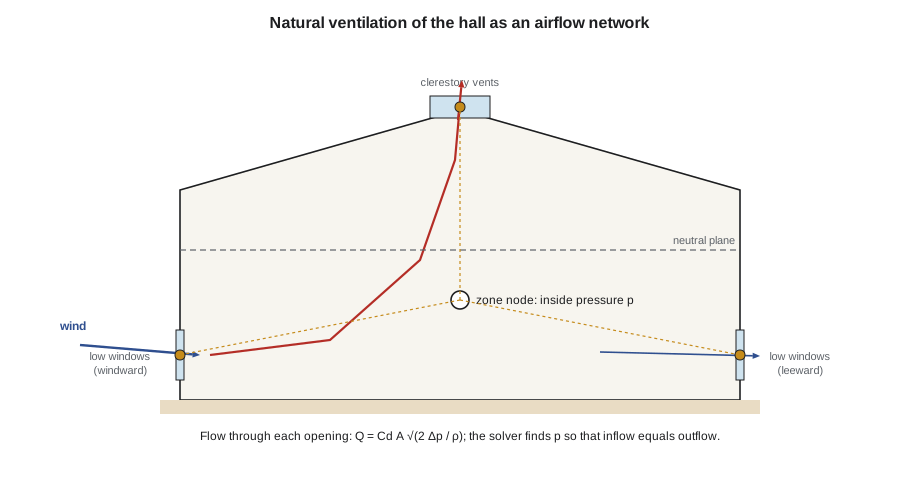
In a network, the unknown is the pressure inside each zone. For any guess of that pressure, the flow through each opening can be calculated from the wind and stack pressures outside it. The correct inside pressure is the one at which the mass of air entering the zone equals the mass leaving. With several zones the network solver finds all the pressures together by Newton's method; for one zone, a simple bisection search is enough. The students write a one-zone network for the hub's hall, with low windows on both long sides and vents near the ridge 33 ft above them.
# Natural ventilation of the hub's hall: a two-opening airflow network solved for the inside pressure
import math
RHO0, G, CD = 1.2, 9.81, 0.6
VOLUME = 4200.0                                  # hall volume, m3 (about 148,000 ft3)
openings = [   # (area m2, height m, wind pressure coefficient); 1 m2 = 10.8 ft2, 1 m = 3.28 ft
    (4.0, 1.0, 0.5),      # low windows on the windward side
    (4.0, 1.0, -0.3),     # low windows on the leeward side
    (3.0, 11.0, -0.5),    # clerestory vents near the ridge
]
def flows(p_in, t_in, t_out, wind):
    rho_in = RHO0 * 293.0 / (t_in + 273.0); rho_out = RHO0 * 293.0 / (t_out + 273.0)
    qs = []
    for area, z, cp in openings:
        p_out = 0.5 * rho_out * cp * wind ** 2 - rho_out * G * z
        p_i = p_in - rho_in * G * z
        dp = p_out - p_i                          # positive: air flows in
        q = CD * area * math.sqrt(2 * abs(dp) / rho_out) * (1 if dp > 0 else -1)
        qs.append(q)
    return qs
def solve(t_in, t_out, wind):
    lo, hi = -200.0, 200.0
    for _ in range(80):                           # bisection on the inside reference pressure
        mid = (lo + hi) / 2
        if sum(flows(mid, t_in, t_out, wind)) > 0:
            lo = mid
        else:
            hi = mid
    return flows((lo + hi) / 2, t_in, t_out, wind)
# cases: inside and outside temperature in C, wind speed in m/s (26 C = 79 F, 18 C = 64 F; 1 m/s = 2.2 mph)
for label, t_in, t_out, wind in (("still evening, stack only", 26.0, 18.0, 0.0),
                                 ("light breeze", 26.0, 18.0, 2.0),
                                 ("breeze, warm day", 27.0, 26.0, 3.0)):
    q = solve(t_in, t_out, wind)
    inflow = sum(x for x in q if x > 0)
    print(f"{label:26s} airflow {inflow * 2119:,.0f} cfm, air changes {inflow * 3600 / VOLUME:4.1f} per hour; "
f"vent flow {q[2] * 2119:+,.0f} cfm")still evening, stack only airflow 8,183 cfm, air changes 3.3 per hour; vent flow -8,183 cfm light breeze airflow 9,379 cfm, air changes 3.8 per hour; vent flow -9,379 cfm breeze, warm day airflow 12,552 cfm, air changes 5.1 per hour; vent flow -7,199 cfm
On a still evening, with the hall at 79 °F and the outdoors at 64 °F, stack effect alone drives about 8,200 cfm through the hall, about 3.3 air changes an hour, all leaving through the high vents. A light breeze raises the flow to about 9,400 cfm. On a warm, breezy day, when the inside is barely warmer than outside, stack effect almost vanishes, but the wind drives about 12,600 cfm through the windows, and less than two-thirds of it now leaves through the high vents; the rest crosses the hall and leaves through the leeward windows. Joon-ho observes that the high vents work hardest exactly when the hall needs them most, on still evenings after an event, and that the hall's ventilation strategy should not depend on the wind.
Holm points out what the network cannot tell them: whether the fresh air actually reaches the audience or short-circuits from the low windows straight up to the vents; how the temperature varies across the hall; whether people near the windows feel a draft. For those questions, the designer needs CFD.
Airflow networks inside energy models
EnergyPlus includes an airflow network that runs with the heat balance at each time step: the zone temperatures set the stack pressures, the weather sets the wind pressures, the network calculates the flows, and the flows feed back into the zones' heat balances. Window opening can be controlled by schedules, by temperature or by rules that imitate occupants, for example opening when the inside is warmer than a setpoint and warmer than outside. This lets the designer test natural ventilation strategies over a whole year, including the hours when windows must close because it is too cold, too windy, too noisy or too smoky. Wind pressure coefficients are the weakest input: the defaults for simple box-shaped buildings may be far from the real values for a building with a complex roof among neighbors, and wind tunnel tests or CFD can supply better ones.
Computational fluid dynamics
CFD solves the Navier-Stokes equations, which express the conservation of mass, momentum and energy in a moving fluid, in each cell of a mesh that fills the space. The air in buildings is turbulent: it swirls in eddies of every size, and resolving every eddy would require impossibly fine meshes. Most building CFD therefore uses a turbulence model, which represents the average effect of the eddies. The Reynolds-averaged Navier-Stokes approach with a k-epsilon or k-omega turbulence model is the workhorse for indoor and outdoor building studies; large eddy simulation resolves the larger eddies and models only the small ones, at much greater cost.
A CFD study requires careful setup. The geometry must include the openings, the furniture and people that obstruct flow, and the heat sources that drive it. The mesh must be fine where velocities and temperatures change rapidly, near openings, walls and heat sources, and coarse elsewhere. Boundary conditions set the flows, temperatures and heat at openings and surfaces, often taken from the energy model or the airflow network at the hour being studied. The solution must converge, and the analyst must check that refining the mesh does not change the answer, a mesh independence check. Holm insists on two more checks: that the results conserve mass and energy, and that they agree with a simple hand estimate, such as the stack-driven flow from the network.
CFD results are seductive. A vivid image of airflow vectors looks authoritative whether or not the model is right. Holm warns the students against what he calls pretty-picture fluid dynamics: images presented without any account of the mesh, the turbulence model, the boundary conditions or the checks. 'If you cannot explain why the air goes where the picture says, you do not understand the picture.'
What CFD is used for
Architects usually commission CFD rather than run it themselves, and they need to know what to ask for. Common indoor studies include the performance of displacement ventilation and of natural ventilation in tall spaces such as atria, auditoria and the hub's hall; thermal comfort near large windows and in spaces with radiant systems; the spread of contaminants and the ventilation effectiveness of different supply positions, a question that became urgent during the COVID-19 pandemic; and smoke movement in fires, which is studied with specialized fire models such as the Fire Dynamics Simulator. Outdoor studies include pedestrian wind comfort around tall buildings, which many cities now require for planning approval, the dispersal of exhaust plumes, and the wind pressure coefficients needed for natural ventilation design.
For pedestrian wind comfort, criteria such as the Lawson criteria classify locations by how often wind speeds exceed thresholds suitable for sitting, standing, walking or strolling. Many US cities, including San Francisco and New York, require pedestrian wind studies for tall buildings, and the downtown plazas of Minneapolis show how wind and cold shape the use of public space. Wind tunnel testing with scale models remains the reference method for complex sites, with CFD increasingly used for early studies.
Ventilation effectiveness
Whether ventilation air reaches people matters as much as how much of it arrives. The age of air, the average time since air at a point entered the room, and the air change effectiveness, the ratio of the age of air for perfect mixing to the actual age at the breathing zone, describe how well a ventilation system delivers fresh air. Displacement ventilation, which supplies cool air slowly at floor level and lets it rise around people's bodies, can achieve air change effectiveness above 1, delivering fresher air to the breathing zone than mixing would. A short-circuiting system, where supply and exhaust are close together, achieves less. CFD can map the age of air through a room and reveal dead zones.
Worked problem
Commissioning a CFD study for the hall
The hub's engineers propose to rely on natural ventilation in the hall for events in spring and fall, when 300 people are present. The city wants evidence that the audience will be comfortable and that carbon dioxide will stay acceptable. Callum must write the brief for a CFD study. What should it contain?
Show solution
- The question: will air speed, temperature and carbon dioxide at seated head height stay within agreed limits during a full event, on a still evening and with a light breeze?
- Scenarios: a still evening at the outdoor temperature at which the windows open; a breezy evening from the prevailing direction; a warm evening near the upper limit for natural ventilation.
- Boundary conditions: opening areas and positions from the drawings; heat and carbon dioxide from 300 seated people, lights and audiovisual equipment; wall and roof temperatures from the energy model.
- Outputs: maps of temperature, air speed, age of air and carbon dioxide on horizontal planes at ankle, seated head and standing head height, and a vertical section through the hall.
- Checks: mesh independence, mass and energy balance, and agreement of total flow with the airflow network within a reasonable margin.
- Criteria: agreed in advance, such as operative temperature within the adaptive band, air speed below the draft limit near the windows, carbon dioxide below a set limit at seated head height.
Answer: The brief turns a vague worry into specific scenarios, outputs and criteria, and it asks for the checks that make CFD results trustworthy.
Exercise 9: natural ventilation of a tall space
Each student studies natural ventilation in one tall space in their project.
- Calculate stack and wind flows with a simple network for three conditions.
- Run an energy model with an airflow network and window controls for a year, and report hours of natural ventilation and comfort.
- Write a CFD brief for the critical condition, with scenarios, outputs, checks and criteria.
Self-critique checklist
- Does my strategy work on still evenings, not only on breezy days?
- Have I questioned the wind pressure coefficients?
- Do my window controls reflect when windows can really open?
- Would my CFD brief let me judge whether the results are trustworthy?
Common mistakes
MistakeDesigning natural ventilation that depends on wind alone.
InsteadMake sure stack effect can carry the critical case on still days.
MistakeAccepting default wind pressure coefficients for a complex building.
InsteadQuestion them and obtain better values from wind tunnel tests or CFD where they matter.
MistakePresenting CFD images without their setup and checks.
InsteadReport the mesh, turbulence model, boundary conditions, convergence and independence checks.
MistakeAssuming windows open whenever it is warm.
InsteadModel rules for rain, wind, noise, smoke and security.
MistakeMeasuring ventilation by quantity alone.
InsteadConsider whether fresh air reaches the breathing zone.
Summary and key terms
- Airflow is driven by wind pressure and stack effect; flow through an opening depends on its area, discharge coefficient and the square root of the pressure difference.
- Airflow network models balance flows between zones and can run with an energy model for a whole year.
- CFD solves the equations of fluid motion on a mesh, with turbulence models, for detailed questions at critical moments.
- CFD needs careful geometry, meshing, boundary conditions and checks; unexplained images can mislead.
- Ventilation effectiveness, comfort near openings and outdoor wind comfort are common reasons to commission CFD.
- Stack effect
- Airflow driven by the difference in density between warm inside air and cooler outside air.
- Neutral plane
- The height at which inside and outside pressures are equal.
- Pressure coefficient
- The ratio of wind pressure at a point on a building to the wind's dynamic pressure.
- Discharge coefficient
- A factor accounting for the contraction of flow through an opening.
- Airflow network
- A model of zones joined by openings, solved for pressures and flows.
- CFD
- Computational fluid dynamics: numerical solution of fluid flow on a mesh.
- Mesh independence
- A check that refining the mesh does not change the results.
- Age of air
- The average time since air at a point entered the room.
Practice problems
Work each problem on paper first, then reveal the answer to check.
An opening of 21.5 ft² has a discharge coefficient of 0.6 and a pressure difference of 4 Pa across it. Air density is 1.2 kg/m³. What is the flow?
Show answer
Q = 0.6 × 2 m² × √(2 × 4 ÷ 1.2) = 3.1 m³/s, about 6,600 cfm.
Why does stack-driven ventilation weaken on a warm day?
Show answer
The temperature difference between inside and outside, and so the density difference that drives it, becomes small.
What can an airflow network not tell the designer about a tall hall?
Show answer
How air, temperature and contaminants are distributed within the space, whether fresh air reaches the occupants, or whether people near openings feel drafts.
What is a mesh independence check?
Show answer
Repeating a CFD calculation with a finer mesh to confirm that the results do not change significantly.
What does an air change effectiveness above 1 mean?
Show answer
The breathing zone receives fresher air than it would with perfect mixing, as in good displacement ventilation.
Lesson quiz · 5 questions
Score 60% or more to complete this lesson.
Create a free account to save your progress, take quizzes and earn a certificate.