
ARCH-510 · Lesson 6 of 12 · 20 min
Daylight simulation
In Environmental Systems I the students estimated the hub reading room's daylight with the average daylight factor formula and found about 4 under the north clerestory monitor. Holm asks what that number means on a dull afternoon in December, on a bright morning in March, and on a June evening. 'A daylight factor describes one sky: a uniform overcast sky, with no sun. Your readers will sit in the room for three thousand hours a year under every sky the upper Midwest can produce. Today we ask what they will actually see.'
From daylight factor to climate-based metrics
The daylight factor, the ratio of indoor illuminance to the simultaneous outdoor illuminance under a standard overcast sky, has served designers since the mid-twentieth century. It is simple, independent of orientation and climate, and easy to calculate. Those are also its weaknesses. It cannot distinguish a south window from a north one, a sunny climate from a cloudy one, or a well-shaded room from one flooded with glare. Since the early 2000s, research and practice have moved to climate-based daylight modeling, which calculates illuminance hour by hour for a year from the sun and sky described in the weather file.
Climate-based modeling produces, for every point of a grid on the work plane, a year of hourly illuminance values. These are summarized by annual metrics.
- Daylight autonomy (DA): the share of occupied hours in which a point receives at least a target illuminance, such as 300 lux, from daylight alone.
- Spatial daylight autonomy (sDA): the share of the floor area that achieves a target illuminance for at least a share of occupied hours. sDA300/50 is the share of the floor receiving at least 300 lux for at least half of the occupied hours.
- Annual sunlight exposure (ASE): the share of the floor that receives more than 1,000 lux of direct sunlight for more than 250 occupied hours a year, a measure of the risk of glare and overheating from direct sun.
- Useful daylight illuminance (UDI): the share of hours in which illuminance falls in bands, such as below 100 lux (too dark), 100 to 3,000 lux (useful) and above 3,000 lux (likely too bright).
The Illuminating Engineering Society defined sDA and ASE in its method LM-83, first published in 2012 and revised as LM-83-23. LEED adopted them, and many owners now set sDA and ASE targets. Many US school districts and university campuses also set sDA targets in their design guidelines. Europe follows a different standard, EN 17037 of 2018, which sets targets for daylight provision, views, sunlight exposure and glare protection, with daylight provision expressed as illuminance targets exceeded for half of daylight hours over a share of the floor.
How daylight engines work
Most annual daylight tools use Radiance, which traces rays backward from each sensor point into the scene, following reflections from surfaces until they reach a light source or the sky. Calculating every hour of the year by ray tracing would be slow, so annual tools divide the problem. They calculate, once, how much each patch of the sky contributes to each sensor, a set of daylight coefficients, and then multiply these by the brightness of each sky patch for each hour, taken from the weather file. Methods such as the three-phase and five-phase methods extend this to complex fenestration, such as blinds and light-redirecting glazing, by separating the sky, the window system and the room into stages.
The accuracy of the result depends on Radiance's parameters, the most important being the number of ambient bounces: the number of times light is followed as it reflects from surface to surface. A setting that is too low, such as one or two bounces, underestimates light deep in a room, where most light arrives after several reflections. Holm's lab uses at least five or six bounces for interior daylight studies and checks that adding more does not change the results. Surface reflectances matter as much as the engine: a ceiling of 0.85 reflectance and one of 0.70 can change sDA at the back of a deep room substantially. The modeler should use measured or specified reflectances, not the software's defaults, and record them.
Blinds and occupant behavior
Real rooms have blinds, and people lower them when sun falls on their desks or screens. A daylight simulation that ignores blinds will overstate useful daylight in sunny rooms. LM-83 includes a simple rule: for each hour, if more than 2 in 100 of the sensor points receive direct sunlight above 1,000 lux, the blinds in that window group are assumed to be closed, and the light is calculated through them. ASE, by contrast, is calculated without operable blinds, because it is meant to show how much direct sun the design admits before occupants fight back. Fixed shading, such as overhangs, fins and frits, is included in both.
This distinction is important. A design with large unshaded windows may show a good sDA, because the simulation closes the blinds only when needed, but a poor ASE, because sun floods the room. In use, people often leave blinds down for days after they were lowered, which reduces daylight further. Fixed or automated shading that blocks direct sun while admitting diffuse light usually performs better in practice than operable blinds alone.
A simple annual daylight study
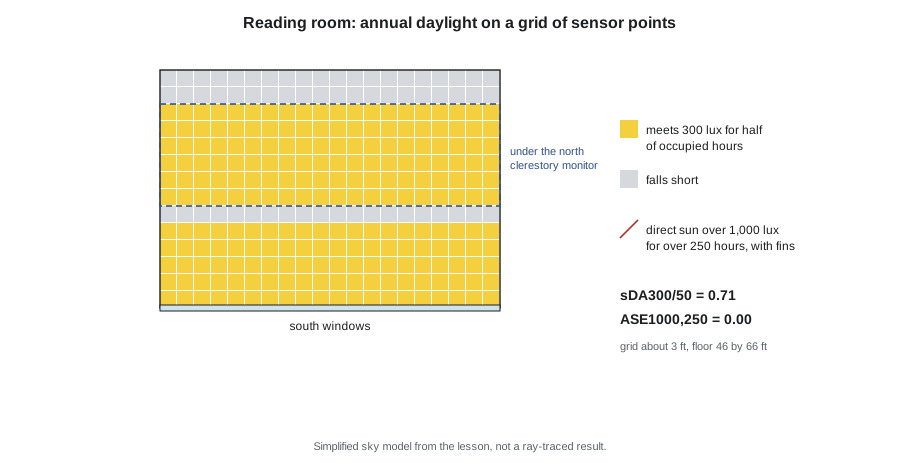
Holm asks the students to write a simplified annual daylight calculation for the reading room. It is not a ray tracer: it uses a daylight factor that falls off with distance from the south windows, a separate contribution from the north monitor, and a crude sky model driven by the sun's position at the hub's latitude. But it applies the LM-83 logic: hourly illuminance on a grid, blinds closed when direct sun reaches more than 2 in 100 of the points, and ASE counted without blinds.
# Annual daylight metrics for the hub's south reading room from a simple sky model (not a ray tracer)
import math, random
LAT = math.radians(45.0)
HEAD = 3.6                                          # window head height, m
pts = [(0.5 + i, 0.5 + j) for i in range(14) for j in range(20)]   # 1 m grid over a 14 x 20 m floor
def side(d):                                        # daylight factor from the south windows
    return 9.0 * math.exp(-d / 2.6)
def roof(d):                                        # daylight factor from the north clerestory monitor
    return 3.4 if 6.0 <= d <= 12.0 else 1.2
def sun(day, hour):
    dec = math.radians(23.45) * math.sin(2 * math.pi * (284 + day) / 365)
    ha = math.radians(15 * (hour - 12))
    alt = math.asin(math.sin(LAT) * math.sin(dec) + math.cos(LAT) * math.cos(dec) * math.cos(ha))
    az = math.atan2(math.sin(ha), math.cos(ha) * math.sin(LAT) - math.tan(dec) * math.cos(LAT))
    return alt, az
def run(monitor, fins):
    random.seed(6)
    lit = [0] * len(pts); sunny = [0] * len(pts); hours = 0
    for day in range(365):
        for hour in range(8, 18):
            hours += 1
            alt, az = sun(day, hour + 0.5)
            if alt <= 0:
                continue
            clear = random.random() < 0.45
            e_h = (12000 + 9000 * math.sin(alt)) * (0.7 if clear else 1.0) * math.sin(alt) ** 0.5   # diffuse sky, lux
            limit = math.radians(35 if fins else 75)          # vertical fins cut off sun from the east and west
            beam = clear and abs(az) < limit and math.degrees(alt) < 30   # an overhang stops sun above 30 degrees
            reach = HEAD / math.tan(alt) * math.cos(az) if beam else 0.0
            hit = [d < reach for d, w in pts]
            closed = sum(hit) > 0.02 * len(pts)                # blinds drawn when sun lands on 2/100 of the floor
            for k, (d, w) in enumerate(pts):
                f = side(d) * (0.25 if closed else 1.0) + (roof(d) if monitor else 0.0)
                if f / 100 * e_h >= 300:
                    lit[k] += 1
                if hit[k]:                                          # ASE ignores blinds
                    sunny[k] += 1
    sda = sum(1 for v in lit if v >= 0.5 * hours) / len(pts)
    ase = sum(1 for v in sunny if v > 250) / len(pts)
    return sda, ase
for name, monitor, fins in (("windows only", False, False),
                            ("windows and monitor", True, False),
                            ("monitor and fins", True, True)):
    sda, ase = run(monitor, fins)
print(f"{name:24s} sDA300/50 = {sda:.2f} of the floor ASE1000,250 = {ase:.2f} of the floor")windows only sDA300/50 = 0.21 of the floor ASE1000,250 = 0.64 of the floor windows and monitor sDA300/50 = 0.71 of the floor ASE1000,250 = 0.64 of the floor monitor and fins sDA300/50 = 0.71 of the floor ASE1000,250 = 0.00 of the floor
The results reveal the reading room's daylight design. With windows only, just 0.21 of the floor meets the sDA criterion, because daylight from the south windows fades within a few meters of the glass; adding the north monitor raises sDA to 0.71, easily above the common target of 0.55. ASE is high without fins: 0.64 of the floor receives more than 250 hours of direct sun, because the low winter sun reaches deep into the room under the overhang. Vertical fins that cut off sun from the east and west eliminate it entirely, bringing ASE to zero in this simple model.
The students debate what the result means. The fins solve the ASE problem, but they also cut some winter solar gain, which the reading room's slab is meant to store. Joon-ho notes that the result depends on latitude: at the hub's latitude the low winter sun is mostly from the south, which the fins allow, and he proposes testing the fins with the energy model before adopting them. Holm approves. 'Metrics are tools. Know what each one was designed for, and say clearly when you choose to depart from it.'
Daylight and energy together
Daylight affects energy in two ways: it reduces electric lighting when lighting controls dim or switch off lamps in response to daylight, and it brings solar heat. An energy model must therefore know how much daylight reaches each zone and how the lighting controls respond. Simple energy engines estimate daylight at one or two reference points per zone with a split-flux or daylight factor method; more rigorous workflows run an annual Radiance simulation first and pass hourly lighting schedules to the energy model. Modern LED lighting has made electric lighting a smaller share of energy use than it was, so the main energy effect of daylight design is often through the windows' heat loss and gain, not the lighting saving.
Views and sunlight
Daylight is not only illuminance. Views to the outside, contact with the sky, and access to sunlight affect wellbeing, and newer standards try to measure them. EN 17037 assesses the width of the view, the distance to the outside and the number of view layers, ground, landscape and sky. LEED v4 and its successors credit quality views. Sunlight access in dwellings, such as hours of possible sunlight on a key day, is regulated in some cities. Simulation tools can calculate view metrics by casting rays from occupant positions to the windows and beyond.
Worked problem
Setting daylight targets for the daycare playrooms
Rita Moreau, the daycare director, wants bright playrooms but no glare on the children's faces when they nap. Wren must propose daylight targets for the south-facing playrooms. What should she propose?
Show solution
- Daylight provision: sDA300/50 of at least 0.75 of the play area, higher than an office target, because children spend long hours there and daylight supports their sleep cycles.
- Direct sun: ASE below 0.10 in the nap area only, with direct sun allowed in the active play area, where it is welcome in winter.
- Views: a view to the sky and ground from every child's eye height, about 3 ft, not an adult's.
- Glare: assessed in Lesson 7 at the nap positions and at the staff's main supervision point.
- Method: annual simulation with measured reflectances of the playroom finishes, six ambient bounces, and the LM-83 blind rule for the nap area's blackout blinds.
Answer: Targets are set by zone and use, not as a single number for the whole room. The nap area needs control of direct sun; the play area welcomes it; views are measured at children's eye height.
Exercise 6: annual daylight of a room
Each student runs an annual daylight simulation of one room in their studio project.
- Model the room and its surroundings with measured or specified reflectances.
- Run sDA300/50, ASE1000,250 and UDI on a grid at work-plane height.
- Test the effect of ambient bounces on the result.
- Compare two shading or window options.
- State which targets you chose, why, and where you depart from standard criteria.
Self-critique checklist
- Have I used enough ambient bounces and checked convergence?
- Are my reflectances specified, not defaults?
- Did I model blinds for sDA and omit them for ASE?
- Do my targets suit the room's use and latitude?
Common mistakes
MistakeJudging a sunny room by its daylight factor alone.
InsteadUse climate-based metrics that account for sun, sky, orientation and climate.
MistakeUsing too few ambient bounces.
InsteadUse enough bounces that light deep in the room converges, and check by adding more.
MistakeIgnoring blinds in sDA calculations.
InsteadApply a blind operation rule; people close blinds when sun falls on them.
MistakeTreating ASE criteria as universal.
InsteadUnderstand where they were developed and how latitude and use change their meaning.
MistakeUsing default reflectances.
InsteadUse the reflectances of the specified finishes.
Summary and key terms
- Climate-based daylight modeling calculates hourly illuminance for a year from the sun and sky in the weather file.
- sDA measures the share of floor with enough daylight for enough of the time; ASE measures the share with too much direct sun; UDI sorts hours into useful and excessive bands.
- Radiance-based tools use daylight coefficients; results depend strongly on ambient bounces and reflectances.
- Blinds are modeled for sDA but not for ASE; fixed shading counts in both.
- Daylight targets should be set by zone and use, and criteria developed elsewhere should be applied with an understanding of latitude and purpose.
- Daylight factor
- Indoor illuminance as a share of simultaneous outdoor illuminance under a standard overcast sky.
- Climate-based daylight modeling
- Annual hourly daylight calculation from the sun and sky of a weather file.
- Daylight autonomy
- Share of occupied hours a point meets a target illuminance from daylight alone.
- sDA
- Spatial daylight autonomy: share of floor meeting a target illuminance for a share of hours.
- ASE
- Annual sunlight exposure: share of floor receiving over 1,000 lux of direct sun for over 250 hours.
- UDI
- Useful daylight illuminance: share of hours in illuminance bands.
- Ambient bounces
- The number of reflections followed by a ray tracer.
- Daylight coefficients
- Pre-calculated contributions of each sky patch to each sensor point.
Practice problems
Work each problem on paper first, then reveal the answer to check.
A room's grid has 280 points; 196 receive at least 300 lux for at least half of occupied hours. What is sDA300/50?
Show answer
196 ÷ 280 = 0.70 of the floor.
Why is ASE calculated without operable blinds?
Show answer
It measures how much direct sun the design itself admits; blinds are the occupants' response to that sun, not a design feature.
A deep room shows almost no daylight at the back. The model used two ambient bounces. What should the modeler check?
Show answer
Increase the bounces to five or more and check that results converge, since light at the back of a room arrives after several reflections; also check reflectances.
Why may the energy benefit of daylight be smaller than it was twenty years ago?
Show answer
LED lighting uses much less power, so dimming saves less; window heat loss and gain now dominate the energy effect of daylight design.
What does EN 17037 assess besides daylight provision?
Show answer
Views, exposure to sunlight and protection from glare.
Lesson quiz · 5 questions
Score 60% or more to complete this lesson.
Create a free account to save your progress, take quizzes and earn a certificate.