
ARCH-510 · Lesson 7 of 12 · 21 min
Glare and visual comfort
On a clear October morning Holm takes the students to the reading room of the city's central library, a building with a wall of south-facing glass. Half the readers have retreated to tables away from the windows; a student near the glass has propped a notebook against his laptop screen; the blinds on the east side are down although the sun left them an hour ago. 'This room has excellent daylight by every annual metric,' Holm says. 'Look at what people are doing. Daylight that people cannot use because it hurts their eyes is not daylight; it is a problem they solve with blinds and electric light.' The students spend twenty minutes mapping where people sit and where the blinds are, and return to the studio with a new respect for glare.
What glare is
Glare is visual discomfort or loss of visibility caused by excessive brightness or excessive contrast in the field of view. Lighting researchers distinguish two kinds. Disability glare reduces the ability to see, as when the low sun in a windshield hides the road; it is caused by light scattered in the eye, which veils the image. Discomfort glare causes annoyance without necessarily reducing visibility, as when a bright window behind a speaker makes the audience squint. Discomfort glare is the usual concern in buildings. It depends on the brightness of the glare source, its size and position in the field of view, and the brightness of the surroundings to which the eye is adapted.
The traditional glare indices, such as the Unified Glare Rating used for electric lighting, were developed for small, bright sources such as lamps against a darker ceiling. Windows are large sources whose brightness varies across their area and over time, and those indices predict daylight glare poorly. In 2006 Jan Wienold and Jens Christoffersen published the daylight glare probability (DGP), derived from experiments in which people sat in offices with real windows and rated their discomfort. DGP estimates the probability that a person in a given position and view direction is disturbed by glare. It is now the most widely used daylight glare metric and is referenced in EN 17037.
Daylight glare probability
DGP combines two terms: the vertical illuminance at the eye, which captures how bright the whole view is, and a sum over glare sources of their luminance, size and position, which captures contrast. It is calculated from a high dynamic range image of the view, a fisheye picture with the luminance of every pixel, either rendered by Radiance or photographed with a calibrated camera.
Here E_v is the vertical illuminance at the eye in lux, L_s the luminance of each glare source in candelas per square meter, ω_s its solid angle and P its position index, which reduces the weight of sources far from the line of sight. When no direct sun or very bright source is in view, the contrast term is small, and Wienold proposed a simplified form, DGPs, that uses the vertical illuminance alone. It is much faster to calculate for every hour of a year, which makes annual glare studies practical.
Comfort classes and annual glare
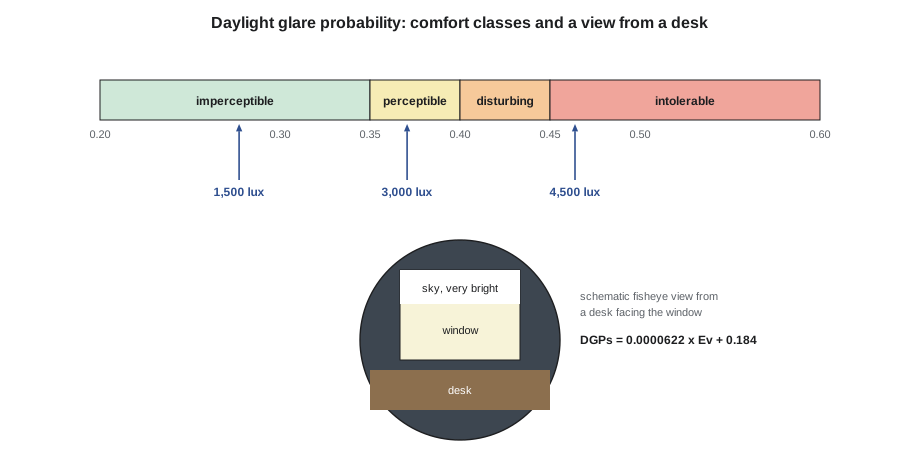
Wienold's classes, used in EN 17037 and in most glare studies, divide DGP into four bands: below 0.35 glare is imperceptible, 0.35 to 0.40 perceptible, 0.40 to 0.45 disturbing, and above 0.45 intolerable. A single DGP value applies to one position, one view direction and one moment. To judge a design, the analyst runs many hours and positions, and summarizes them. A common annual summary is glare autonomy: the share of occupied hours in which DGP stays below a threshold, often 0.40, at a given seat and view. EN 17037 sets its own requirement: DGP must exceed the chosen comfort class in no more than 5 in 100 of the occupied hours.
The students calculate DGPs for a reading desk in the hub, first for a few eye illuminances and then for every occupied hour of a year, with a crude model of how bright the window view is. They compare a desk facing the window with one turned 90 degrees, and with blinds that people lower when glare becomes disturbing.
# Glare at a reading-room desk: the simplified daylight glare probability from vertical eye illuminance
import math, random
def dgps(ev):
    """Simplified DGP (Wienold 2009), valid when no direct sun reaches the eye."""
    return 6.22e-5 * ev + 0.184
def band(d):
    return "imperceptible" if d < 0.35 else "perceptible" if d < 0.40 else "disturbing" if d < 0.45 else "intolerable"
for ev in (1500, 3000, 4500, 6000):
    print(f"Ev {ev:5d} lux -> DGPs {dgps(ev):.2f} ({band(dgps(ev))})")
def year(seat_ev_scale, blinds):
    random.seed(7)                     # the same sky for every option
    bad = 0; hours = 0; drawn = 0
    for day in range(365):
        for hour in range(8, 18):
            hours += 1
            sky = max(0.0, random.gauss(1.0, 0.45)) * (0.6 + 0.4 * math.cos(2 * math.pi * (day - 172) / 365))
            ev = 7000 * sky * seat_ev_scale * math.sin(math.pi * (hour - 7) / 11)
            if blinds and dgps(ev) >= 0.40:
                ev *= 0.3; drawn += 1
            if dgps(ev) >= 0.40:
                bad += 1
    return 1 - bad / hours, drawn / hours
for name, scale, blinds in (("desk facing the window", 1.0, False),
                            ("desk turned 90 degrees", 0.55, False),
                            ("facing window, with blinds", 1.0, True)):
    ga, drawn = year(scale, blinds)
print(f"{name:28s} glare autonomy {ga:.2f} of occupied hours; blinds down {drawn:.2f}")Ev 1500 lux -> DGPs 0.28 (imperceptible) Ev 3000 lux -> DGPs 0.37 (perceptible) Ev 4500 lux -> DGPs 0.46 (intolerable) Ev 6000 lux -> DGPs 0.56 (intolerable) desk facing the window glare autonomy 0.69 of occupied hours; blinds down 0.00 desk turned 90 degrees glare autonomy 0.90 of occupied hours; blinds down 0.00 facing window, with blinds glare autonomy 1.00 of occupied hours; blinds down 0.31
An eye illuminance of 1,500 lux is comfortable, 3,000 lux is perceptible, and 4,500 lux is already intolerable. The desk facing the window keeps DGPs below 0.40 for only 0.69 of occupied hours, which means a reader there would be disturbed by glare for almost a third of the year. Turning the desk 90 degrees, so that the window is to the reader's side rather than in front, raises glare autonomy to 0.90 with no change to the building at all. Blinds remove glare entirely in this model, but they are down for 0.31 of occupied hours, during which daylight and the view are lost and the lights probably go on.
Callum draws the lesson Holm hoped for: the first tool against glare is the layout of the room, not the shading. Desks with windows to the side, screens facing away from bright glass, and reading positions in the shadow of a pier or an alcove all cut glare cheaply. Shading comes second, and it is most effective when it blocks direct sun and the brightest part of the sky while keeping the view.
Luminance ratios and contrast
Glare is relative. A window of a given brightness is less glaring in a room with bright walls and ceiling, because the eye adapts to a higher level. Lighting designers use luminance ratios as rules of thumb: about 1 to 3 between a task and its immediate surroundings, and about 1 to 10 between the task and the far field, with brighter walls around windows to soften their contrast. Splayed, pale window reveals, deep window jambs that catch light, and pale ceilings all reduce contrast. The reading room's deep timber window surrounds, designed in second year for their warmth, turn out to raise contrast around the glass; the students propose a paler finish on the reveals.
Shading and glare control
Shading devices differ greatly in how they handle glare. Exterior overhangs and fins block direct sun but leave the bright sky in view. Interior roller shades of a given openness factor reduce the brightness of the whole window; darker fabrics preserve the view better than light ones, but transmit less daylight. Venetian blinds can be tilted to block sun and redirect light to the ceiling. Electrochromic and other dynamic glazing tints the glass in response to sun and glare. Each needs to be modeled properly: for daylight and glare, as a complex fenestration system with measured optical data; for energy, as a change in solar gain and visible transmittance that depends on how it is controlled.
Holm stresses control. A shade that is never lowered does nothing; one that is lowered and left down for weeks removes daylight. Automated shading driven by sensors, with occupant override, usually performs better than manual shading, but only if it is commissioned and maintained. Simulation should represent the realistic control, not the ideal one.
Glare from electric light and other sources
Glare is not only a daylight problem. Poorly shielded luminaires, bright reflections in screens and glossy surfaces, and the contrast between a bright screen and a dark room all cause discomfort. Electric lighting glare is assessed with the Unified Glare Rating (UGR); limits such as UGR 19 for offices and classrooms are common in lighting standards. Reflections on screens depend on the position of luminaires and windows relative to the screen and the viewer, and a quick check in a rendered view of each workstation can avoid them.
Glare in other building types
Different uses need different glare criteria. In a gymnasium, glare from windows can be dangerous for players tracking a ball; in a museum, contrast and reflections matter for viewing art; in a hospital room, patients lie looking at the ceiling and the window from angles a desk-based metric ignores; in a daycare, children nap on the floor. Wren notes that the hub's playrooms need a glare study at floor level for the nap area and at the staff's supervision point, not only at a desk. Holm agrees, and adds that view direction matters as much as position: glare studies should test the directions people actually look.
Worked problem
Glare study of the hall's west window
The hub's hall has a large west window that frames a view of the park. At events, the stage is at the east end and the audience faces it, with the window behind them; at weekday exercise classes, the instructor faces the class with the window behind her. Joon-ho must judge whether glare will be a problem. How should he set up the study?
Show solution
- Identify the critical views: the instructor at the east end looking west into the window during afternoon classes; the audience looking east, with the window behind; the presenter on stage looking west over the audience.
- Choose the hours: afternoon and early evening through the year, when the west sun is low and in view.
- Render high dynamic range fisheye views from each position for representative hours and calculate DGP, including direct sun.
- Summarize as glare autonomy at DGP 0.40 for each view, and as the number of hours with DGP above 0.45.
- Test options: exterior vertical fins, a low-transmittance shade for event use, and moving the instructor's position.
Answer: The audience is comfortable because the window is behind them. The instructor and the presenter face intolerable glare on many afternoons. Joon-ho recommends an automated exterior shade on the west window, raised to keep the park view on dull days, and relocating the instructor's position to the north wall.
Exercise 7: glare at the critical seats
Each student carries out a glare study for one room in their studio project.
- Identify the critical positions and view directions.
- Calculate DGP at representative hours with images that include direct sun.
- Calculate annual glare autonomy with DGPs where no sun is in view.
- Compare at least one layout change with one shading change.
Self-critique checklist
- Have I tested the views people actually take, at the right eye height?
- Have I used full DGP where direct sun or bright sources are in view?
- Have I modeled realistic shading control?
- Did I consider layout before shading?
Common mistakes
MistakeAssessing glare at one desk facing one direction.
InsteadTest the positions and view directions people actually use.
MistakeUsing simplified DGP when the sun is in view.
InsteadUse full DGP from images when direct sun or very bright sources are visible.
MistakeAssuming blinds are always used correctly.
InsteadModel realistic control, including blinds left down.
MistakeSolving glare only with shading.
InsteadConsider layout, reveal finishes and room brightness first.
MistakeIgnoring glare from electric light and screens.
InsteadCheck UGR and screen reflections as well.
Summary and key terms
- Discomfort glare depends on the brightness, size and position of sources and on the brightness of the surroundings.
- Daylight glare probability, from experiments with real windows, estimates the chance that a viewer is disturbed; DGPs uses eye illuminance alone when no bright source is in view.
- DGP classes are imperceptible below 0.35, perceptible to 0.40, disturbing to 0.45 and intolerable above; annual glare autonomy summarizes a year at one view.
- Layout and view direction are the cheapest glare controls; shading must be modeled with realistic control.
- Glare criteria and positions should suit the building type and the people using it.
- Discomfort glare
- Visual discomfort caused by excessive brightness or contrast, without necessarily reducing visibility.
- Disability glare
- Reduced visibility caused by scattered light in the eye.
- DGP
- Daylight glare probability: the estimated probability that a viewer is disturbed by daylight glare.
- Vertical eye illuminance
- Illuminance on a vertical plane at the viewer's eye, facing the view direction.
- Glare autonomy
- The share of occupied hours in which glare stays below a threshold at a given view.
- Luminance
- The brightness of a surface in a given direction, in candelas per square meter.
- UGR
- Unified Glare Rating, an index of glare from electric luminaires.
- HDR image
- A high dynamic range image recording the luminance of every pixel.
Practice problems
Work each problem on paper first, then reveal the answer to check.
What is DGPs for a vertical eye illuminance of 2,500 lux, and in which class does it fall?
Show answer
6.22 × 10⁻⁵ × 2,500 + 0.184 = 0.34, imperceptible.
Why did turning the desk 90 degrees improve glare autonomy so much?
Show answer
With the window to the side, much less of its brightness reaches the reader's eye in the view direction, so eye illuminance and glare fall.
Why is simplified DGP unsuitable when the sun is in view?
Show answer
It ignores the contrast term, which dominates when a very bright source such as the sun is visible.
A room's blinds remove all glare but are down for a third of occupied hours. Is this a good result?
Show answer
Not entirely: glare is controlled, but daylight and views are lost for those hours and electric lights probably run; better shading or layout might keep both.
Name two ways to reduce contrast around a window without shading it.
Show answer
Use pale, splayed reveals and a bright ceiling and walls near the window, so the eye adapts to a higher level.
Lesson quiz · 5 questions
Score 60% or more to complete this lesson.
Create a free account to save your progress, take quizzes and earn a certificate.