
APT-230 · Lesson 8 of 12 · 21 min
Wheels, tires and bearings
▶ Video coming soon A video version of this lesson is on the way.
On Saturday, October 17, the counter was busy with the first rush of the winter tire season. A customer named Odile Marchetti came in with her 2023 Vela and a plan: she drove to Colorado every winter to ski, and wanted winter tires on steel wheels before her trip in December. "They have a traction law on the mountain highways," she said. What Talia had to work out was everything else: the tire size, the load and speed rating, whether steel wheels from the catalog would clear the JL4 brakes (her Vela had none), the bolt pattern, the lug nuts that steel wheels need, and the TPMS sensors. It took twenty minutes and three questions to Imani, and when Odile left with a booking for the following week, Talia had filled two pages of her notebook.
At the next Thursday session, Imani laid a tire on its side on the training bench. "Everything you need is written on the sidewall," she said. "You just have to read it."
Reading a tire size
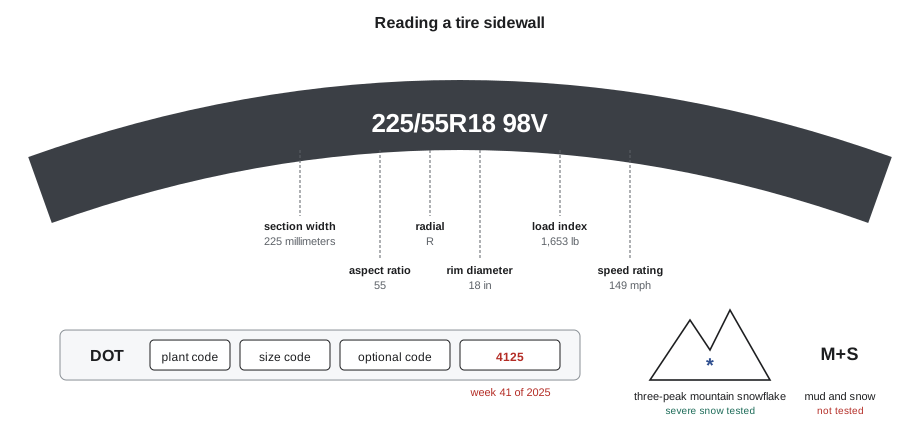
Passenger and light truck tires sold in North America carry a size in the metric (P-metric or Euro-metric) format. The Vela's original tire reads 225/55R18 98V. Each part means something:
- 225 is the section width in millimeters, measured across the widest point of the tire when mounted and inflated (about 8.9 inches).
- 55 is the aspect ratio: the sidewall height is 55 in 100 of the section width. A lower number means a shorter sidewall.
- R means radial construction, which almost every modern tire uses.
- 18 is the rim diameter in inches, the wheel size the tire fits.
- 98 is the load index, a code for the most weight the tire can carry at its maximum pressure: 98 means 1,653 lb per tire.
- V is the speed rating, a code for the highest sustained speed the tire is rated for: V means 149 mph.
A P before the size (P225/55R18) marks a P-metric passenger tire; no letter usually means a Euro-metric tire, whose load index can differ slightly at the same size. LT marks a light truck tire, built for heavier loads and higher pressures, with a load range letter (C, D, E). XL or Extra Load means a passenger tire built to carry more at a higher pressure. The rule is that a replacement tire must have a load index and speed rating at least equal to the vehicle's original, as listed on the tire placard on the driver's door jamb.
| Speed rating | Maximum speed | Load index | Load per tire |
|---|---|---|---|
| S | 112 mph | 91 | 1,356 lb |
| T | 118 mph | 94 | 1,477 lb |
| H | 130 mph | 96 | 1,565 lb |
| V | 149 mph | 98 | 1,653 lb |
| W | 168 mph | 100 | 1,764 lb |
| Y | 186 mph | 104 | 1,984 lb |
Worked problem
How tall is the tire?
Odile wants winter tires one size narrower than her 225/55R18, a common winter choice. Before checking a 215/60R18, Talia works out the overall diameter of the original tire, to compare. What is it?
Show solution
- Section width in inches:
- \[225 \div 25.4 \approx 8.86 \text{ in}\]
- Sidewall height:
- \[8.86 \times 0.55 \approx 4.87 \text{ in}\]
- Overall diameter (two sidewalls plus the rim):
- \[18 + 2 \times 4.87 = 27.74 \text{ in}\]
- For the 215/60R18:
- \[18 + 2 \times (8.46 \times 0.60) \approx 18 + 10.15 = 28.15 \text{ in}\]
Answer: The original is about 27.7 in tall; the 215/60R18 is about 28.2 in, roughly 1.5 in 100 larger. Many makers accept a difference of up to about 3 in 100, but Talia checks Tessaro's approved winter sizes before selling it, and confirms the load index and speed rating still meet the placard. A winter tire may carry a lower speed rating than the original if the maker allows it; the placard's load index must still be met.
The tire identification number and tire age
Every tire sold in Canada and the United States carries a tire identification number (TIN), often called the DOT code because it begins with the letters DOT. It is up to 13 characters after DOT: a plant code for the factory where the tire was made, a size code, an optional code the tire maker uses, and, at the end, a four-digit date code. The date code gives the week and year of manufacture: 4125 means week 41 of 2025. Tires made before 2000 used a three-digit code, so any tire with a three-digit date is far too old to sell.
The full TIN is usually on one side of the tire only, so a tire may have to be turned to find it. The TIN matters for recalls: tire makers identify recalled tires by plant and date, and the dealer records TINs for the tires it sells.
Tires age even in storage, because rubber dries out and hardens. There is no single legal age limit for passenger tires, but many vehicle and tire makers recommend inspecting tires every year after about five years and replacing them after six to ten years from the date of manufacture, whatever the tread depth. The counter should sell stock oldest first and check date codes on tires that have been on the shelf a long time; a customer who sees a two-year-old date on a new tire may ask why.
Winter tires and the mountain snowflake
Tires marked M+S (mud and snow) have a tread pattern meant for some traction in snow, but the marking is based on tread design, not a traction test. Many all-season tires carry it. Tires marked with the three-peak mountain snowflake (3PMS) symbol have passed a standard snow traction test, showing better grip on packed snow than a reference tire. Winter tires carry the 3PMS symbol, and so do some all-weather tires designed for year-round use.
Ohio has no winter tire requirement, and most US states have none. Some mountain states have traction laws. Colorado's traction law, when in effect on mountain highways such as I-70, requires vehicles to have tires with the M+S marking, the three-peak mountain snowflake, or all-weather tires, with a minimum tread depth, or four-wheel or all-wheel drive, or chains or another traction device. Odile's Vela is AWD, but Talia still recommended 3PMS tires: AWD helps a car go, not stop or turn. In Canada, Quebec requires winter tires with the 3PMS symbol from December 1 to March 15, which matters to customers who drive north.
Winter tires use a softer rubber that stays flexible in the cold and a tread with many small slits (sipes). They wear fast in warm weather, so most customers swap them in spring. Many customers buy them on a second set of wheels, often steel, which makes the twice-a-year swap quick and protects the alloy wheels from road salt.
Wheels and bolt patterns
A wheel fits a vehicle only if several measurements match:
- Bolt pattern (lug pattern): the number of studs and the diameter of the circle they sit on. The Vela uses 5 × 4.5 in, written 5×114.3 in the metric catalog listing (114.3 millimeters). On a five-stud wheel, which has no stud directly opposite another, the diameter is measured from the center of one stud to the far edge of a stud two along, or worked out with a gauge.
- Center bore: the hole in the middle of the wheel. A hub-centric wheel fits snugly on the hub, which centers it; a wheel with a larger bore needs a hub-centric ring.
- Offset: how far the wheel's mounting face sits from its centerline. The wrong offset can rub the suspension or fender, or overload the hub bearings.
- Width and diameter, which must suit the tire and clear the brakes. Larger brake packages, like JL4, may not fit inside smaller or steel wheels.
- Lug nuts or bolts: thread size (the Vela uses M14 × 1.5) and seat type. Conical (tapered), ball (rounded) and flat seats are not interchangeable, and steel wheels often need different nuts from alloy wheels. The wrong seat lets a wheel work loose.
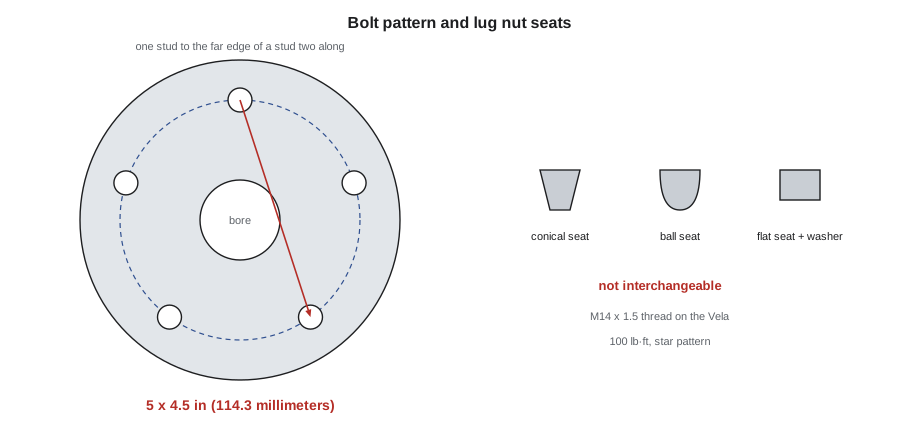
Wheel nuts must be tightened to the maker's torque, in a star pattern, with a torque wrench, not just an impact gun. Tessaro specifies 100 lb·ft for the Vela. The shop re-checks the torque after a short distance, often 30 to 60 miles, especially on new wheels. Over-tightening stretches studs and can warp rotors; under-tightening lets wheels come loose.
Most vehicles have a tire pressure monitoring system (TPMS), with a sensor inside each wheel. A second set of wheels needs its own sensors, which are either the maker's part or an aftermarket sensor programmed or listed for the vehicle, and the system may need a relearn procedure. TPMS sensors also have service kits (valve core, cap, nut and seal) to sell at every tire change.
Hub bearings
Each wheel turns on a wheel bearing. Older vehicles used pairs of tapered roller bearings that were greased and adjusted. Most modern cars use sealed bearings, sold in one of three forms, often called generations:
- Pressed-in bearing (generation 1): a sealed double-row bearing pressed into the knuckle, with the hub pressed into it. Needs a press.
- Flanged bearing (generation 2): the bearing has a flange that bolts to the knuckle or hub.
- Hub assembly (generation 3): the bearing, hub flange and wheel studs in one unit that bolts to the knuckle. Many include the ABS sensor or tone ring.
A worn bearing hums or growls, getting louder with speed or in turns. Questions to ask: front or rear, drive layout (driven and non-driven hubs differ), ABS sensor type, and whether the axle nut is single-use. Bearings are not sold in pairs as a rule; only the worn one is replaced.
Tire pressure, rotation and repair
The tire placard on the driver's door jamb gives the recommended cold inflation pressure for the front and rear tires, which is the figure to use, not the maximum pressure molded on the sidewall. A typical passenger car figure is about 33 to 36 psi. Under-inflated tires flex, run hot, wear their edges and waste fuel; over-inflated tires wear the center and grip less. Pressure drops in cold weather, so the first cold mornings of autumn bring a rush of TPMS warning lights to the counter. The counter can sell gauges, valve stems and TPMS service kits, and can explain that the light usually means low pressure, not a failed sensor, though a sensor battery wears out after many years.
Shops rotate tires on a schedule to even out wear, following the maker's pattern; some tires are directional and can only move front to back on the same side. A punctured tire can often be repaired if the hole is in the tread area and small, using a plug and patch combination fitted from inside the tire after it is removed from the wheel. Punctures in the sidewall or shoulder are not repaired. Run-flat tires and tires that have been driven while flat have their own rules, and many makers do not allow repairs to them.
Tread depth and replacement
Tires have tread wear indicators, small bars molded across the bottom of the grooves at 2/32 in. When the tread is worn level with the bars, the tire is worn out. Many safety groups suggest replacing tires well before that, especially winter tires, which lose much of their snow grip as the tread wears, and all-season tires used in wet weather. Tires should be replaced in at least axle pairs, with the newer pair usually fitted on the rear axle for stability, as many tire makers advise. On AWD vehicles, the maker may require all four tires to be the same size, brand, model and close in tread depth, because differences in rolling diameter can strain the AWD coupling. A customer with one damaged tire on a Vela with worn tires on the other three may need more than one tire, or a new tire shaved to match, which some tire shops offer.
Wheel and tire packages for winter are a big seasonal sale. A package sale is only as good as its weakest part: the tire size and rating, the wheel fit and brake clearance, the right lug nuts, the TPMS sensors and the torque check after the first drive.
Common mistakes
MistakeSelling a tire with a lower load index than the placard.
InsteadMatch or exceed the load index on the door placard.
MistakeCounting an M+S tire as a winter tire.
InsteadWinter tires carry the three-peak mountain snowflake symbol.
MistakeUsing alloy wheel lug nuts on steel wheels.
InsteadMatch the nut's seat type and thread to the wheel and studs.
MistakeSelling an old tire without checking its date code.
InsteadRead the last four digits of the TIN and rotate stock oldest first.
Summary and key terms
- 225/55R18 98V gives section width, aspect ratio, radial construction, rim diameter, load index and speed rating.
- The TIN begins with DOT and ends with a four-digit week-and-year date code.
- M+S is a tread design marking; the three-peak mountain snowflake shows a passed snow traction test.
- Wheels must match bolt pattern, center bore, offset, width, brake clearance and lug nut seat; tighten nuts to the specified torque.
- Hub bearings come pressed in, flanged or as hub assemblies, often with the ABS sensor built in.
- Aspect ratio
- Sidewall height as a fraction of section width, written as the number after the slash in a tire size.
- Load index
- A code for the maximum load a tire can carry at its maximum pressure.
- Speed rating
- A letter code for the highest sustained speed a tire is rated for.
- TIN
- The tire identification number beginning with DOT, ending with a four-digit date code.
- Three-peak mountain snowflake
- The symbol on tires that have passed a standard snow traction test.
- Bolt pattern
- The number of wheel studs and the diameter of the circle they sit on.
Practice problems
Work each problem on paper first, then reveal the answer to check.
What does the date code 0726 mean?
Show answer
Week 7 of 2026.
What is, to the nearest tenth of an inch, the sidewall height of a 205/60R16 tire?
Show answer
205 ÷ 25.4 ≈ 8.07 in; 8.07 × 0.60 ≈ 4.8 in.
Does an M+S marking alone meet a rule requiring the three-peak mountain snowflake?
Show answer
No; M+S is based on tread design, not a snow traction test.
Why can't any lug nut be used on any wheel?
Show answer
The seat type (conical, ball or flat) and thread must match the wheel and studs.
A wheel bearing hums louder in a left turn on the highway. What type of part is likely being sold?
Show answer
A wheel bearing or hub assembly, front or rear as diagnosed by the technician.
Lesson quiz · 5 questions
Score 60% or more to complete this lesson.
Create a free account to save your progress, take quizzes and earn a certificate.