
APT-230 · Lesson 5 of 12 · 21 min
Brake system parts
▶ Video coming soon A video version of this lesson is on the way.
Gordon Achterhof came to the front counter one afternoon in early October with a box of front brake pads from another store and a question. "I'm doing the brakes on the Vela myself," he said. "Do I need rotors?" Talia remembered the JL4 pads. Before answering, she ran his VIN: 2017 Vela, AWD, no JL4. Then she asked what the rotors looked like, whether the pedal pulsed when he stopped, and whether he had measured them. He had not. Talia explained the minimum thickness stamped on the rotor, sold him a set of rotors only after he came back with a measurement from his own calipers, and added the hardware kit his pad box did not include. At the next Thursday session, Imani said brakes were the system where a parts person's questions matter most, "because when brakes are wrong, people get hurt."
How the brake system is laid out
Pressing the brake pedal pushes a piston in the master cylinder, helped by a brake booster that uses engine vacuum, a vacuum pump or, on many new vehicles, an electric motor. The master cylinder sends brake fluid under pressure through steel brake lines and flexible brake hoses to each wheel. Because liquid does not compress, the pressure arrives at every wheel at once. At the wheel, it pushes pistons that press friction material against a spinning rotor or drum. Friction turns the vehicle's motion into heat, and the vehicle slows.
The anti-lock brake system (ABS) watches each wheel through a wheel speed sensor reading a toothed or magnetic tone ring. If a wheel starts to lock, the ABS module pulses the pressure to that wheel. The same sensors feed stability control and traction control. A damaged wheel speed sensor is a common sale, often after a hub or axle repair.
Disc brakes
Almost all front brakes, and most rear brakes on cars, are disc brakes. The parts:
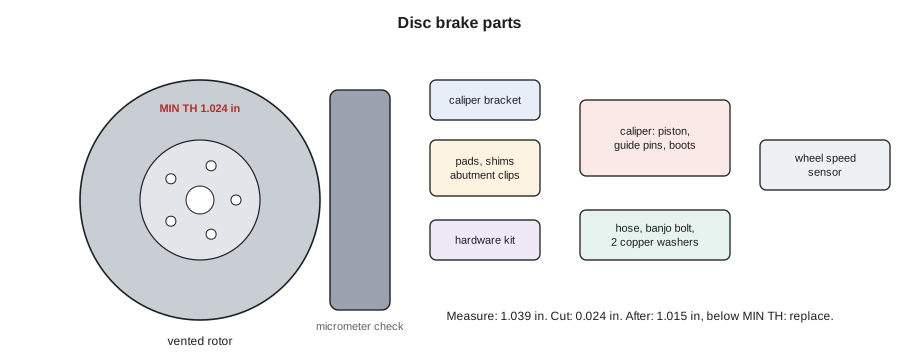
- The rotor (disc) turns with the wheel. Rotors are solid or vented, with cooling vanes between two faces; some vanes are directional, so left and right rotors differ. Many rotors are coated to resist rust on the parts not swept by the pads.
- The caliper holds the pads and the pistons. A floating caliper has pistons on one side and slides on guide pins; a fixed caliper has pistons on both sides and does not move. Calipers are sold new or remanufactured with a core charge (APT-220), and sometimes loaded, with pads and hardware already fitted.
- The caliper bracket (anchor) bolts to the knuckle and holds the caliper.
- Brake pads are friction material bonded or riveted to a steel backing plate, often with shims on the back to reduce noise.
- Hardware: abutment clips the pads slide on, guide pin boots and grease, and anti-rattle springs. A hardware kit renews these, and many squeal complaints come from reusing old hardware.
- Wear indicators: a steel tab that squeals when the pad is nearly worn, or an electronic sensor that lights a warning on the dashboard. Electronic sensors are usually single-use once the pad has worn into them.
Pad compounds
Brake pads differ in their friction material, and the choice changes noise, dust, rotor wear and how the brake feels.
| Compound | Character | Typical use |
|---|---|---|
| Organic (non-asbestos organic, NAO) | Quiet, gentle on rotors, more dust, wears faster, less heat tolerance | Light cars, gentle driving |
| Low-metallic NAO | Some metal added for heat and bite; more dust and some noise | Many European vehicles |
| Semi-metallic | Steel fibers; strong bite and heat tolerance; noisier, more rotor wear and dust | Trucks, towing, heavy vehicles, police and fleet use |
| Ceramic | Ceramic fibers; quiet, low, light-colored dust, long life, stable over a range of temperatures | Many modern cars and crossovers |
The safest choice is the compound the vehicle was built with, or an aftermarket pad that its maker lists for the vehicle and the use. A customer who tows, drives a heavy SUV or runs a delivery van may be better served by a pad for severe duty. A customer who complains of dust on alloy wheels may want ceramic. Pad brands also offer good, better and best lines, and the difference is usually in shims, hardware, chamfers and slots, and the friction formula. Never sell a pad that is not listed for the vehicle, however close it looks: backing plate shape, wear sensor position and thickness differ.
Rotors: minimum thickness
As rotors wear, they get thinner. A thin rotor holds less heat, can crack or warp, and lets the caliper piston travel further than it was designed to. Every rotor has a minimum thickness, usually cast or stamped on the rotor hat or edge as "MIN TH" or "MIN THK" followed by the figure. The technician measures thickness with a micrometer in several places.
A worn rotor can sometimes be machined (turned or resurfaced) on a brake lathe to give it a fresh, flat surface. Machining removes metal. The rule is that the rotor must be at or above its minimum thickness after machining, not just before. Many shops now replace rotors with pads rather than machining them, because modern rotors are thin to begin with and new rotors cost little compared with the labor. Rotors should always be replaced in axle pairs, left and right together.
Drums have a similar limit: a maximum diameter, cast inside the drum, because a drum gets larger as it wears.
Drum brakes
Many smaller cars and most light trucks with older designs use drum brakes at the rear. A wheel cylinder pushes two curved brake shoes outward against the inside of the drum. Drum parts include the shoes, the wheel cylinder, a hardware kit of return springs, hold-down springs and the self-adjuster, and the drum itself. Many vehicles with rear discs have a small drum brake inside the rear rotor hat for the parking brake, with its own small shoes. Shoes are sold in axle sets, often with a core charge on bonded shoes in some programs.
Parking brakes
Traditional parking brakes use a lever or pedal pulling cables to the rear brakes. Many new vehicles, including the Vela, use an electronic parking brake (EPB): an electric motor on each rear caliper applies the brake. EPB calipers are specific parts with a motor and connector, and the technician must put the system into a service mode with a scan tool before changing rear pads. A customer doing rear brakes at home on an EPB vehicle needs to know this.
Brake fluid
Brake fluid must not compress, must not boil under the heat of hard braking, and must protect the system's metal and rubber parts. It is sold by DOT grade, set by Federal Motor Vehicle Safety Standard 116, so the grade on the bottle tells you which requirements it meets.
| Grade | Base | Minimum dry boiling point | Minimum wet boiling point | Mixes with |
|---|---|---|---|---|
| DOT 3 | Glycol ether | 401 °F | 284 °F | DOT 4, DOT 5.1 |
| DOT 4 | Glycol ether with borate esters | 446 °F | 311 °F | DOT 3, DOT 5.1 |
| DOT 5.1 | Glycol ether with borate esters | 500 °F | 356 °F | DOT 3, DOT 4 |
| DOT 5 | Silicone | 500 °F | 356 °F | Nothing else; never mix |
The glycol-based fluids, DOT 3, DOT 4 and DOT 5.1, are hygroscopic: they absorb moisture from the air over time, through the hoses and the reservoir cap. Water lowers the boiling point and causes corrosion, which is why makers call for brake fluid replacement every few years. Glycol fluids can be mixed with each other, but the mix is only as good as the lowest grade, and the right practice is to use the grade the vehicle specifies. A higher glycol grade such as DOT 4 in a DOT 3 system is generally accepted; a lower grade in a DOT 4 system is not.
DOT 5 is silicone-based and is not compatible with the others. It does not absorb water, and it is used mainly in some military and classic vehicles. Mixed with glycol fluid, it does not blend; it can cause seals to swell or fail and leave a system that will not bleed properly. Never sell DOT 5 to someone who means DOT 5.1, and if a customer asks for "DOT 5", confirm which they mean. Many new cars and their ABS units specify DOT 4 or a low-viscosity DOT 4 for faster ABS response; some makers have their own fluid specification.
Brake fluid also strips paint, so wipe spills at once. Keep containers sealed: an opened bottle that sits on the shelf absorbs moisture. Sell small sizes for top-ups, and do not resell returned opened bottles.
Questions that separate brake parts
- Front or rear, and which side? Calipers and directional rotors come left and right.
- Drive layout and options. The JL4 package on the Vela changes both rotors and calipers.
- Rotor size. Some vehicles have two front rotor sizes in the same year; the technician can measure the diameter or check the caliper casting.
- Electronic wear sensors and EPB. Does the vehicle have them, and does the pad set include the sensor?
- Use. Towing, delivery or police use may call for a severe-duty pad.
- Hardware and fluid. A brake job usually needs a hardware kit, brake cleaner, high-temperature brake grease and sometimes fluid.
Worked problem
Machine or replace?
Gordon's front rotor is marked MIN TH 1.024 in. He measures it at 1.039 in at its thinnest point. A machine shop says a clean-up cut would remove 0.024 in in total. Can the rotor be machined?
Show solution
- Thickness after machining:
- \[1.039 - 0.024 = 1.015 \text{ in}\]
- Compare with the minimum:
- \[1.015 \text{ in} < 1.024 \text{ in}\]
Answer: No. After the cut the rotor would be below its minimum thickness, so it must be replaced, and both front rotors should be replaced as a pair. Gordon's rotor was legal as it stood, but not once machined.
Brake complaints and the parts they lead to
Customers describe brake problems by feel and sound. The counter can link each to the likely parts, while leaving the diagnosis to the technician.
- Squeal when braking: the wear indicator tab touching the rotor, glazed pads, missing shims or old hardware. Many squeals are cured by the pads plus a hardware kit and the correct lubricant on the contact points.
- Grinding: pads worn to the backing plate, metal on metal. The rotors are almost always damaged too, as Talia's RO 1 in lesson 12 shows.
- Pulsing pedal or steering wheel shake when braking: uneven rotor thickness, often called warped rotors, usually caused by uneven pad deposits, wheel nuts tightened unevenly or worn hub runout. New rotors, correct lug nut torque and a clean hub face solve most cases.
- Pulling to one side: a seized caliper guide pin or piston, a collapsed hose, or contaminated pads on one side. The parts are a caliper or caliper kit, a hose, or pads and rotors in axle pairs.
- Soft or sinking pedal: air in the system, a leak, or a failing master cylinder. Brake fluid, a hose, a caliper or a master cylinder may follow.
- ABS warning light: often a wheel speed sensor, a damaged tone ring or a wiring fault; the scan tool code names the wheel.
Brake parts are also among the most returned parts at any counter, often because the wrong version was sold. Before a brake job goes out, check side, axle, rotor size, option codes and wear sensors, and compare the new pads with the old ones if the technician brings them. And because brakes are a safety system, a customer working on brakes at home should hear the important points: replace pads and rotors in axle pairs, use the hardware, torque the caliper bolts and wheel nuts, bleed the system correctly if it was opened, and pump the pedal before driving away so the pistons come out to meet the pads.
Common mistakes
MistakeSelling pads by model and year without checking options.
InsteadCheck drive layout, option packages such as JL4, rotor size and wear sensors.
MistakeMachining a rotor that will finish below minimum thickness.
InsteadMeasure, subtract the cut, and compare with MIN TH; replace if below.
MistakeTreating DOT 5 and DOT 5.1 as the same fluid.
InsteadDOT 5 is silicone and does not mix with glycol fluids; DOT 5.1 is glycol and does.
MistakeLeaving out the hardware kit.
InsteadSuggest new clips, pins, boots and grease; reused hardware causes noise and uneven wear.
Summary and key terms
- The master cylinder and booster send fluid pressure to calipers or wheel cylinders; ABS uses wheel speed sensors to stop lock-up.
- Disc brakes use rotors, calipers, brackets, pads and hardware; drums use shoes, wheel cylinders and spring kits.
- Pad compounds include organic, low-metallic, semi-metallic and ceramic; sell what is listed for the vehicle and use.
- Rotors must be at or above their stamped minimum thickness after any machining; drums have a maximum diameter.
- DOT 3, 4 and 5.1 are glycol fluids that absorb moisture; DOT 5 is silicone and must never be mixed with them.
- Caliper
- The part that holds the brake pads and pistons and squeezes the pads against the rotor.
- Minimum thickness
- The thinnest a rotor may be in service, marked on the rotor as MIN TH.
- Hardware kit
- A set of abutment clips, springs, pins, boots and grease for a brake job.
- Hygroscopic
- Absorbing moisture from the air, as glycol brake fluids do.
- Electronic parking brake
- A parking brake applied by electric motors at the rear calipers, needing a service mode for pad changes.
- Wheel speed sensor
- The sensor at each wheel that tells the ABS and stability control how fast the wheel turns.
Practice problems
Work each problem on paper first, then reveal the answer to check.
Which brake fluid grade is silicone-based?
Show answer
DOT 5.
A rotor is marked MIN TH 0.866 in and measures 0.886 in. A cut would remove 0.016 in. Can it be machined?
Show answer
Yes: 0.886 − 0.016 = 0.870 in, above 0.866 in.
Why do makers call for brake fluid replacement every few years?
Show answer
Glycol fluid absorbs moisture, which lowers its boiling point and causes corrosion.
Name two reasons to sell a hardware kit with pads.
Show answer
Old clips and springs cause noise and uneven pad wear; boots and pins may be worn or seized.
What must a technician do before changing rear pads on a vehicle with an electronic parking brake?
Show answer
Put the system into service mode with a scan tool to retract the motors.
Lesson quiz · 5 questions
Score 60% or more to complete this lesson.
Create a free account to save your progress, take quizzes and earn a certificate.