
APT-230 · Lesson 10 of 12 · 23 min
Heavy truck and trailer systems
▶ Video coming soon A video version of this lesson is on the way.
On Saturday, November 7, Talia spent the morning across the lot at Linmore Truck and Equipment, the group's heavy truck dealer, at Rolf's suggestion. Hamish Corrigall, its parts manager, met her at a counter that looked like hers but bigger: brake drums stacked like tires, slack adjusters in long bins, air dryer cartridges, filters the size of coffee cans, and jugs of diesel exhaust fluid on a pallet by the door. "Same job as yours," Hamish said. "Find the right part, fast. The difference is that when one of our customers' trucks is down, it's costing them money every hour, and some of what we sell keeps a 80,000-lb vehicle on the road." He spent three hours walking her through the systems that make a heavy truck different. This lesson is an awareness-level tour; APT-320 goes further into heavy and industrial parts.
How heavy trucks are different
Heavy trucks share the basic systems of a car, but scaled up and built for a working life of a million miles or more. A few differences shape the parts counter:
- Body-on-frame, always. A heavy truck has a ladder frame of steel or aluminum rails, and almost everything bolts to it.
- Diesel engines with large filters, high-pressure common-rail injection, turbochargers and exhaust aftertreatment.
- Air brakes and air systems, which also work the suspension, the seats, the horn and the transmission on many trucks.
- Tractors and trailers: a tractor pulls a semi-trailer that rests on the tractor's fifth wheel, held by the trailer's kingpin. Parts for each are separate, and trailers have their own brakes, lights, suspension and landing gear.
- Fleet customers who run on preventive maintenance schedules, buy in volume, and need parts quickly when a truck breaks down.
Heavy truck parts are identified by the truck's make, model and VIN, but just as often by the component maker's part number on the axle, brake, transmission or engine, because the same truck can be built with many different components. Hamish's counter keeps cross-reference books for brake, axle and filter makers.
Air brakes: the air supply
Air brakes use compressed air instead of brake fluid. Air does not leak away as dangerously as fluid, since a leak simply lets the brakes apply, and the system can supply trailers through a simple connection. The supply side:
- An engine-driven air compressor pumps air, controlled by a governor that typically cuts out at around 120 to 130 psi and cuts back in when pressure drops.
- An air dryer removes water and oil from the air before it reaches the tanks. Its desiccant cartridge is a regular maintenance part.
- Reservoirs (air tanks) store the air, with drain valves to remove water. Separate tanks feed the front and rear brake circuits.
- The foot valve (treadle valve) under the brake pedal sends air to the brakes in proportion to pedal pressure, through relay valves near the axles that speed up the response.
- On a combination vehicle, gladhands couple the tractor's air lines to the trailer: the supply (emergency) line, usually red, and the service (control) line, usually blue.
Air brakes: at the wheel
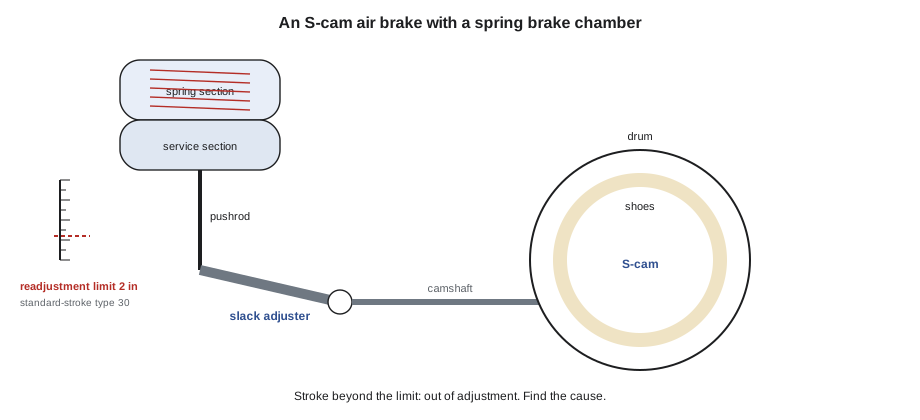
At each wheel, air pushes a diaphragm in a brake chamber, which moves a pushrod. On the common S-cam drum brake, the pushrod turns a slack adjuster, a lever on the end of a brake camshaft. The S-shaped cam at the other end spreads the brake shoes against the drum. Air disc brakes, with calipers and rotors, are now common on new trucks, especially on steer axles.
Drive and trailer axles use spring brake chambers: a service chamber plus a second chamber with a very strong spring. Air pressure holds the spring back. When the driver sets the parking brake, or when air pressure is lost, the spring applies the brakes. Spring brake chambers can be dangerous to take apart, and they are replaced as units; the counter sells them by type and size, such as type 30/30 (service/spring chamber area in square inches), and by standard-stroke or long-stroke design.
As brake linings wear, the pushrod has to travel further to apply the brake. The slack adjuster takes up that slack. Air-braked trucks and trailers built in North America since the mid-1990s must have automatic slack adjusters, which adjust themselves. An automatic slack adjuster that keeps going out of adjustment is a sign of a problem, a worn camshaft bushing, a bad adjuster or worn foundation brake parts, and the right repair is to find the cause, not just to wind it back. Brake adjustment is measured as pushrod stroke: the distance the pushrod travels on a full brake application. Each chamber size has a readjustment limit; a brake beyond it is out of adjustment, and enforcement officers place trucks with too many out-of-adjustment brakes out of service.
Worked problem
Is the brake out of adjustment?
A technician measures the applied pushrod stroke on a standard-stroke type 30 chamber at 2 1/4 in. The readjustment limit for that chamber is 2 in. Is the brake within adjustment?
Show solution
- Compare stroke with limit:
- \[2\tfrac{1}{4} \text{ in} - 2 \text{ in} = \tfrac{1}{4} \text{ in over}\]
Answer: No. The brake is out of adjustment. With automatic slack adjusters, the technician looks for the cause: a worn adjuster, cam bushings or shoes. The likely parts are a slack adjuster, a cam and bushing kit or a brake shoe kit, which is why Hamish's counter asks what the technician found before selling an adjuster. A long-stroke type 30 chamber has a higher limit; the counter must know which chamber is fitted.
Heavy diesel engines and their filters
Heavy diesels use more filters than cars, and diesel fuel must be very clean because common-rail injectors run at extreme pressures. A typical truck has a primary fuel filter with a water separator, a finer secondary fuel filter, a full-flow and sometimes a bypass oil filter, an air filter with a restriction indicator, sometimes a coolant filter with conditioner, and an air dryer cartridge. Heavy-duty diesel oils use API C categories such as CK-4, or FA-4 for some newer engines that call for it, and the engine maker's approvals. Heavy-duty coolants have their own specifications as well.
Exhaust aftertreatment: DPF, SCR and DEF
Modern diesel trucks clean their exhaust in several stages:
- A diesel oxidation catalyst (DOC) burns off carbon monoxide and unburned fuel.
- A diesel particulate filter (DPF) traps soot. It cleans itself by regeneration, burning the soot at high temperature, and is removed and cleaned at intervals to clear ash. DPF cleaning and exchange programs are a big business at heavy truck dealers.
- Selective catalytic reduction (SCR) cuts nitrogen oxides by spraying diesel exhaust fluid (DEF) into the exhaust ahead of a special catalyst. The DEF breaks down into ammonia, which reacts with the nitrogen oxides to form nitrogen and water.
DEF is a solution of 32.5 in 100 high-purity urea in deionized water, made to the international standard ISO 22241; many products are also certified under an API program. It has a blue filler cap on the truck. DEF use is roughly 2 to 3 in 100 of diesel used, depending on the engine. It freezes at about 12 °F, so trucks have heated DEF tanks and lines, and the counter stores DEF out of extreme heat and cold and sells it oldest first, because it slowly breaks down in storage. DEF must never be contaminated with diesel fuel, coolant, tap water or anything else, and diesel must never go in the DEF tank; either mistake can ruin the SCR system. If the system detects bad or empty DEF, the engine limits power or speed until it is fixed.
Worked problem
DEF for a week
A customer's truck uses about 105 gallons of diesel a week, and its engine uses DEF at about 3 in 100 of diesel use. DEF is sold in 2.5-gallon jugs. How much DEF does the truck need each week, and how many jugs?
Show solution
- DEF used:
- \[105 \times 0.03 = 3.15 \text{ gal}\]
- Jugs needed:
- \[3.15 \div 2.5 = 1.26, \text{ so 2 jugs}\]
Answer: About two jugs a week. A fleet with many trucks would buy DEF in drums or bulk totes with a dedicated, clean pump.
Trailers
Trailers bring their own parts: kingpins and upper couplers, landing gear (the legs that hold the front of a trailer when unhooked), suspensions (spring or air ride), axles, hubs and wheel seals, brakes with spring brake chambers, trailer ABS, lights and wiring with a 7-way connector, mud flaps, doors, hinges and seals, and reflective tape (conspicuity markings) that regulations require. Many trailer parts are sold by the trailer maker's part number or the axle maker's.
Inspection and rules: awareness
Commercial vehicles in the United States are regulated by the Federal Motor Carrier Safety Administration (FMCSA). Under its rules in 49 CFR Part 396, drivers inspect their vehicles before driving and complete a driver vehicle inspection report when they find defects, and every commercial motor vehicle must pass a periodic (annual) inspection. Drivers of heavy trucks need a commercial driver's license (CDL), and those who drive air-braked vehicles must pass the air brake knowledge test, or their CDL carries a restriction. Ohio applies the federal safety rules to motor carriers operating in the state. For the parts counter, these rules explain why fleet customers order brake parts, lights, tires and mud flaps before an annual inspection, and why a part that fails a pre-trip inspection is urgent.
Roadside inspections by enforcement officers, including the yearly brake safety checks run across North America by the Commercial Vehicle Safety Alliance, find brakes out of adjustment more than almost any other defect. When a fleet customer calls about an out-of-service order, it is the parts counter's most urgent call of the day.
Heavy truck wheels, tires and hubs
Heavy truck wheel ends bring parts that cars do not have. Wheels are steel or aluminum, most commonly hub-piloted, centered on the hub by the wheel's center bore, with large flange nuts tightened to a high torque by a defined procedure and rechecked after the first run. Older stud-piloted wheels use ball-seat nuts and are not interchangeable with hub-piloted parts. Dual wheels on drive and trailer axles need matched tires, with their diameters and pressures close together, so the load is shared. Truck tires are often retreaded, a new tread bonded to an inspected casing, which is common and accepted on drive and trailer axles; many fleets do not use retreads on steer axles, and some rules restrict them there.
Wheel bearings on heavy axles are tapered roller bearings running in oil or semi-fluid grease, sealed by a wheel seal. A leaking seal lets lubricant reach the brakes, and the counter sells seals by the axle maker's number and the seal maker's interchange. Many newer axles have pre-set hub assemblies or unitized hubs that do not need bearing adjustment, while older designs need careful adjustment with a specified procedure. Hub caps with sight windows let drivers check oil levels during their inspection.
Air suspension and fifth wheels
Most heavy tractors and trailers ride on air suspension: air springs (air bags) fed through height control valves that keep the frame at a set ride height whatever the load. Air springs, height control valves, shock absorbers, bushings and torque rods are common sales. The fifth wheel on a tractor has a locking jaw that grips the trailer's kingpin; its wear parts, jaws and locks, and its grease are inspection items, and a worn fifth wheel lock is a serious defect. Trailer landing gear has gearboxes, legs and feet, and is often damaged by trailers dropped without the gear down.
For a parts person used to cars, the scale is the biggest change. A brake drum weighs about 100 lb; a box of brake shoes is a lift for two. Lifting rules from APT-110 apply, and Hamish's counter uses a small crane arm for drums and rotors.
Heavy truck counters also sell a great deal of electrical and lighting: LED marker and clearance lamps, stop, turn and tail lamps, the seven-way trailer cord and its plugs, and junction boxes. Lighting defects are among the most common roadside findings after brakes, and a fleet preparing for its annual inspection often orders lamps by the box. The parts are cheap; the truck being held off the road for a missing lamp is not.
Common mistakes
MistakeSelling a new automatic slack adjuster without asking why the old one went out of adjustment.
InsteadAsk what the technician found; worn cams, bushings or shoes may be the real cause.
MistakeTreating DEF as interchangeable with any urea solution or water.
InsteadSell DEF meeting ISO 22241 and keep it clean and in date.
MistakeSelling a type 30 chamber without asking standard or long stroke.
InsteadConfirm the chamber type, size and stroke design.
MistakeLooking up heavy truck parts by truck make only.
InsteadUse the component maker's part number from the axle, brake, transmission or engine.
Summary and key terms
- Heavy trucks use body-on-frame construction, diesel engines, air systems and tractor-trailer combinations.
- Air brakes use a compressor, air dryer, reservoirs and valves; at the wheel, chambers push slack adjusters on S-cam brakes or apply air disc brakes.
- Automatic slack adjusters are required; pushrod stroke beyond the readjustment limit means the brake is out of adjustment.
- Diesel aftertreatment uses a DOC, a DPF and SCR with DEF, a 32.5 in 100 urea solution to ISO 22241.
- FMCSA rules require pre-trip and annual inspections, and CDL drivers need air brake qualification.
- Slack adjuster
- The lever between the brake chamber pushrod and the brake camshaft that takes up lining wear.
- Spring brake chamber
- A brake chamber with a strong spring that applies the brake when air pressure is released or lost.
- Air dryer
- The unit that removes water and oil from compressed air before it reaches the reservoirs.
- Gladhands
- The couplings that join the tractor and trailer air lines.
- DEF
- Diesel exhaust fluid, a solution of high-purity urea in deionized water used in SCR systems.
- DPF
- A diesel particulate filter, which traps soot and cleans itself by regeneration.
Practice problems
Work each problem on paper first, then reveal the answer to check.
What applies the brakes on a spring brake chamber when air pressure is lost?
Show answer
The strong spring in the spring brake section.
What color is the supply (emergency) gladhand line usually?
Show answer
Red; the service (control) line is usually blue.
A truck burns 80 gallons of diesel a week and uses DEF at 2.5 in 100. How much DEF a week?
Show answer
80 × 0.025 = 2 gallons.
Why should diesel never be put in the DEF tank?
Show answer
It contaminates the SCR system and can ruin it.
What does it mean when an automatic slack adjuster keeps going out of adjustment?
Show answer
Something is wrong, such as a worn adjuster, camshaft bushings or shoes; the cause should be found.
Lesson quiz · 5 questions
Score 60% or more to complete this lesson.
Create a free account to save your progress, take quizzes and earn a certificate.