
APT-230 · Lesson 4 of 12 · 21 min
Fuel and exhaust system parts
▶ Video coming soon A video version of this lesson is on the way.
Wen Okafor-Lund came to the back counter with a scan tool printout. "Upstream oxygen sensor for the Vela in bay four," she said. "And a set of injector seals for the Arden 2.0 on the next lift." Talia found the oxygen sensor, then stopped at the seals. The catalog showed one seal kit per injector, each with a combustion seal, an O-ring and a backup ring, and a note that the special tool to fit the combustion seal was sold separately. She asked Wen whether the shop had the tool. It did; but the question earned a nod. At Thursday's session Imani picked up the thread. "Fuel goes in, exhaust comes out," she said. "In between, there are more sensors than there used to be wires on a whole car."
Getting fuel to the engine
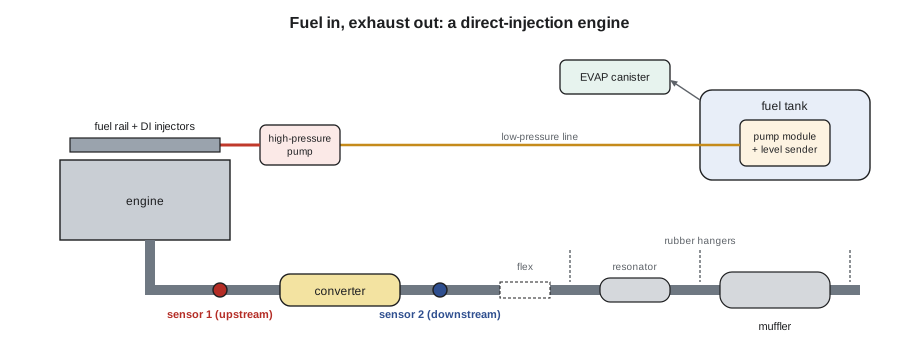
The fuel system stores fuel, delivers it to the engine at the right pressure, and meters it into the cylinders in exactly the amount the engine computer asks for. The parts, from the back of the vehicle forward:
- The fuel tank, usually plastic on modern cars, with a filler neck and cap.
- The fuel pump module, which sits inside the tank on almost every modern car. It holds an electric fuel pump, a strainer (sock), often a fine filter and a pressure regulator, and the fuel level sender that works the gauge. Many modules are sold only as an assembly; some allow the pump or sender to be replaced separately.
- A fuel filter, either built into the module and meant to last the life of the vehicle, or a separate inline filter under the car that is replaced on a schedule. Diesels have their own filters with water separators.
- Fuel lines and quick-connect fittings, which often need new retaining clips or O-rings when disconnected.
- The fuel rail and fuel injectors, which spray fuel into the engine.
- The evaporative emission (EVAP) system, which stops fuel vapor escaping: a charcoal canister that stores vapor, a purge valve that lets the engine draw it in and burn it, a vent valve, and the fuel cap, whose seal is part of the system. A loose or worn cap is a classic cause of an EVAP warning light.
Port injection and direct injection
There are two main ways to put fuel in a gasoline engine, and they use quite different parts.
Port fuel injection (PFI) sprays fuel into the intake port, just ahead of the intake valve. Fuel pressure is modest, typically about 45 to 60 psi, supplied by the in-tank pump. The injectors are fairly simple, sealed with O-rings, and many are interchangeable within an engine family. The older Marlo uses port injection.
Gasoline direct injection (GDI or DI) sprays fuel straight into the combustion chamber. That needs much higher pressure, typically from about 1,500 to 5,000 psi depending on the engine, so DI engines add a high-pressure fuel pump, usually driven by a lobe on a camshaft, feeding a heavy steel fuel rail with a pressure sensor. The in-tank pump becomes a low-pressure lift pump feeding the high-pressure pump. The Vela's 2.0 L turbo and the Arden 2.0 are DI engines.
DI changes the counter in three ways.
- Injectors are engine-specific and expensive, and some must be coded to the engine computer when replaced. Each DI injector has a combustion seal (often a PTFE ring) that faces the fire, plus O-rings and backup rings. The seals are single-use: any time an injector comes out, it needs a new seal kit, and fitting the combustion seal usually needs a special tool. That was Talia's question to Wen.
- High-pressure parts are not mix-and-match. High-pressure pumps, rails, lines and sensors are specific to the engine and sometimes to the production date. High-pressure lines are often single-use once loosened.
- Intake valve deposits. Because fuel no longer washes over the intake valves, oil vapor from the PCV system can bake into carbon on the valves over time. Shops clean them with walnut-shell blasting or chemical cleaners, and some engine makers moved to dual injection, with both port and direct injectors, partly to fight this. Dual-injection engines have two sets of injectors to look up.
Diesel engines have used direct injection for decades, at even higher pressures, from a common rail. Diesel injectors and pumps are precision parts; dirt or water in diesel fuel ruins them, which is why diesel filters matter so much (lesson 10).
Air in: the intake side
The engine computer meters fuel by measuring air. The intake side has its own parts: the engine air filter (lesson 9), the mass airflow (MAF) sensor, which measures air entering the engine, a manifold absolute pressure (MAP) sensor on many engines, the electronically controlled throttle body, and the intake manifold. Turbocharged engines like the Vela add the turbocharger, a charge air cooler (intercooler) and boost hoses and clamps; a split boost hose is a common, cheap repair that the counter should be able to find quickly.
The exhaust system
The exhaust system carries burned gases away from the engine, cleans them, and quiets them. From the engine back:
- The exhaust manifold, or on many new engines a manifold cast into the cylinder head, collects gas from the cylinders. Its gasket is a common leak point.
- The upstream oxygen sensor sits before the catalytic converter. On most modern vehicles it is a wide-range air-fuel ratio sensor, which tells the engine computer how rich or lean the mixture is so it can adjust fuel every fraction of a second.
- The catalytic converter uses a ceramic or metal honeycomb coated with precious metals (platinum, palladium and rhodium) to turn carbon monoxide, unburned fuel and nitrogen oxides into carbon dioxide, water and nitrogen. Many engines have a close-coupled converter right at the manifold, and some have a second converter under the floor.
- The downstream oxygen sensor sits after the converter. Its job is to check that the converter is working: a good converter evens out the oxygen swings that the upstream sensor sees. When the downstream signal starts to look like the upstream signal, the computer sets a converter efficiency code.
- Pipes, a flex pipe or flexible joint, a resonator and a muffler, hung on rubber hangers and joined by gaskets, clamps or flanges.
Sensor position names follow the convention from lesson 1. Sensor 1 is upstream of the converter, sensor 2 downstream. Bank 1 is the side of the engine with cylinder 1; an inline four-cylinder has only bank 1. On a V6 with two converters there are four sensors: bank 1 sensor 1, bank 1 sensor 2, bank 2 sensor 1, bank 2 sensor 2. Upstream and downstream sensors on the same engine are usually different part numbers, with different connectors and lead lengths.
Catalytic converter rules
Catalytic converters are emission control equipment, and the law treats them that way. The counter's part in this is simple: sell a converter that is legal for that vehicle, and never sell or suggest a part whose purpose is to remove or defeat one.
In the United States, the Clean Air Act prohibits removing or defeating emission controls, and the EPA's aftermarket converter policy sets out when a non-original converter may be installed: when the original is missing, when an inspection program finds it damaged or in need of replacement, or when the vehicle is past its emission warranty period and a real need for replacement is documented. A new aftermarket converter must be labeled by its maker, carry a warranty of 5 years or 50,000 miles on the shell and end pipes and 25,000 miles on emission performance, and be the type made for that vehicle. The installer completes the paperwork: the reason for replacement, the customer's details, and the warranty card. A converter still under the vehicle's emission warranty or a recall should go through the dealer. California, and a few other states such as New York, Maine and Colorado, require converters approved by the California Air Resources Board (CARB). Ohio is not one of them: in Columbus, a converter that complies with the federal EPA policy and is listed for the vehicle is the legal choice, and Ohio's guidance adds that the replacement must be the same type as the original and sized for the engine. A straight "test pipe" or delete kit is never sold for road use.
Converters are valuable because of their precious metals, which makes them a target for theft and makes a cheap converter that seems too good to be true worth questioning. A converter usually fails because something upstream killed it: an engine misfire that sent unburned fuel into it, oil or coolant burning in the engine, or a failed sensor. A shop replacing a converter should find and fix the cause first, or the new one will fail too. A good counter question is "was the cause fixed?"
Sensors and gaskets for exhaust work
Exhaust jobs need more than the main part. Oxygen sensors are often seized in place and may need a thread chaser; a new sensor usually comes with anti-seize on its threads already, and the counter should advise against adding more on the sensor tip. Exhaust gaskets, nuts and studs at the manifold and flanges are often single-use because heat stretches or rusts them. Hangers go hard and crack with age. Ask whether the shop needs gaskets, studs, nuts, hangers or clamps before the job starts; a converter fitted with old rusty flange bolts is a comeback waiting to happen.
Worked problem
Which sensor is it?
A technician working on a V6 with two converters reads a fault code for bank 2 sensor 1. Cylinder 1 is on the passenger side of this engine. Where is the sensor, and what does it do?
Show solution
- Bank 1 is the side with cylinder 1, so bank 1 is the passenger side.
- Bank 2 is therefore the driver's side.
- Sensor 1 is upstream of the converter.
Answer: It is the driver's-side upstream sensor, before that bank's converter. It reads the air-fuel mixture for bank 2 so the computer can control fuel. Look it up by bank and position; on many engines the four sensors are not all the same part.
Common fuel and exhaust jobs at the counter
A few fuel and exhaust jobs come through the back counter week after week. Knowing what each needs keeps them moving.
- EVAP leak codes: the cheapest fix is a fuel cap, but the technician will usually smoke-test the system first. Purge and vent valves, the canister and its hoses are the next suspects. The cap must be the type made for the vehicle; a universal cap may not seal or may lack the right pressure valve.
- Fuel pump replacement: usually the whole module, with a new lock ring and tank seal, which are often single-use. Some tanks must be lowered, so ask whether straps or fuel line clips are needed. Never sell a pump to a customer who plans to work on a fuel tank indoors or near a flame.
- Throttle body cleaning or replacement: an electronic throttle body may need a relearn with a scan tool after cleaning or replacement; the counter sells the body, its gasket and, if the shop wants it, a throttle body cleaner safe for the sensors.
- MAF sensor: a contaminated sensor may be cleaned with a cleaner made for it; ordinary carburetor cleaner can damage it. A dirty or poorly sealed air filter is often the cause.
- Intake valve carbon cleaning on DI engines: the shop may order a cleaning kit, intake manifold gaskets and, on some engines, a new PCV valve or oil separator.
- Exhaust leak repair: manifold gaskets, studs and nuts; flange gaskets and bolts; a flex pipe, which is often welded in by an exhaust shop; hangers and clamps.
- Oxygen sensor replacement: the right sensor by bank and position, a sensor socket if the customer needs one, and thread chasers for seized threads.
Exhaust parts are also where rust makes jobs grow. A technician who starts out replacing a muffler may find the pipe ahead of it rotted through and the hangers broken. A good counter question for any exhaust job on an older vehicle is "how much of the system is original, and how does the rest look?" That lets the counter quote the whole job, or at least have the next part ready.
Fuel system parts need care on the shelf too. Fuel pumps and injectors are sensitive to dirt, so their packaging stays sealed until the technician fits them, and open returns of fuel parts are inspected carefully before they go back to stock, because a part that has had fuel through it cannot be resold as new.
Common mistakes
MistakeSelling a DI injector without a seal kit.
InsteadEvery injector removed needs new combustion seals and O-rings; check whether a fitting tool is needed.
MistakeAssuming upstream and downstream oxygen sensors are the same part.
InsteadLook up each by bank and position; they often differ in type, connector and lead length.
MistakeSelling a converter that is not EPA-compliant or listed for the vehicle.
InsteadSell a labeled, compliant converter listed for the vehicle, with the paperwork done.
MistakeReplacing a converter without asking what killed it.
InsteadAsk whether the cause, such as a misfire or oil burning, has been fixed.
Summary and key terms
- The fuel system runs from the tank and in-tank pump module through filters and lines to the injectors, with an EVAP system to trap vapor.
- Port injection uses modest pressure; direct injection adds a high-pressure pump and engine-specific injectors with single-use seals.
- The upstream oxygen sensor controls fuel; the downstream sensor checks the catalytic converter.
- Bank 1 contains cylinder 1; sensor 1 is upstream and sensor 2 is downstream.
- Converters must meet the EPA aftermarket policy, or CARB rules in CARB states; Ohio follows the federal policy.
- Fuel pump module
- The in-tank assembly holding the fuel pump, strainer, often a filter and regulator, and the fuel level sender.
- Direct injection
- A fuel system that sprays fuel at high pressure straight into the combustion chamber.
- High-pressure fuel pump
- On a direct-injection engine, the engine-driven pump that raises fuel pressure for the injectors.
- EVAP system
- The evaporative emission system that stores fuel vapor in a charcoal canister and burns it in the engine.
- Upstream oxygen sensor
- The sensor before the catalytic converter that measures the air-fuel mixture; sensor 1.
- Downstream oxygen sensor
- The sensor after the catalytic converter that checks how well the converter works; sensor 2.
Practice problems
Work each problem on paper first, then reveal the answer to check.
Where is the fuel pump on most modern cars?
Show answer
Inside the fuel tank, as part of the pump module.
Why does a direct-injection engine need a second fuel pump?
Show answer
The injectors need much higher pressure than the in-tank pump supplies, so an engine-driven high-pressure pump raises it.
On an inline four-cylinder engine, how many banks are there?
Show answer
One, bank 1.
What does the downstream oxygen sensor tell the engine computer?
Show answer
Whether the catalytic converter is working.
Name two common causes of catalytic converter failure.
Show answer
Engine misfire sending unburned fuel into it, and oil or coolant burning in the engine (also failed sensors).
Lesson quiz · 5 questions
Score 60% or more to complete this lesson.
Create a free account to save your progress, take quizzes and earn a certificate.