
APT-230 · Lesson 2 of 12 · 21 min
Engine parts and gaskets
▶ Video coming soon A video version of this lesson is on the way.
The second Thursday session began with a phone call. Corinne Ferraby at Bramhall Auto Service needed a timing belt for a 2017 Arden 1.8. Talia found the belt, quoted it, and was about to send it on the 2 p.m. van when Imani asked one question: "Does she want the belt, or the kit?" Talia called back. Corinne laughed. "The kit, with the water pump. Nobody does a belt job twice." The belt alone would have sent a technician looking for a tensioner, two idlers, a water pump and a gasket that were not in the bag, with an engine in pieces on the lift. That afternoon Imani took Talia to the cutaway engine in the training corner of the shop and started from the bottom.
The engine, from the counter
A car engine is a set of parts that turn the energy in fuel into a turning crankshaft. AUTO-110 explains how the four strokes work; at the counter, what matters is which parts make up the engine, which wear or fail, and how they are sold.
- The cylinder block holds the cylinders, the crankshaft and, on many engines, the oil and coolant passages. Blocks are cast iron or aluminum.
- Pistons move up and down in the cylinders, sealed by piston rings, and turn the crankshaft through connecting rods. Rod and main bearings are thin shells that the crank turns on.
- The cylinder head bolts on top of the block and holds the valves, valve springs and, on most modern engines, one or two camshafts (overhead cam). A V engine has two heads.
- The timing drive (belt, chain or gears) turns the camshafts in step with the crankshaft so the valves open at the right moment.
- Outside the engine sit the parts that sell most often: engine mounts, the accessory drive belt and its tensioner, spark plugs and ignition coils, crankshaft and camshaft position sensors, the thermostat and water pump (lesson 3) and the intake and exhaust manifolds.
Internal parts such as pistons, rings and bearings are sold mainly to engine rebuilders and to shops doing major repairs. Many dealership engine repairs now use a long block (block, crank, pistons, heads and valve train assembled) or a short block (block with crank and pistons, no heads), new or remanufactured, rather than rebuilding the old engine. A long block replaces almost the whole engine; the technician moves over the manifolds, sensors and accessories. Knowing which one is being replaced tells the counter which gaskets and small parts go with it.
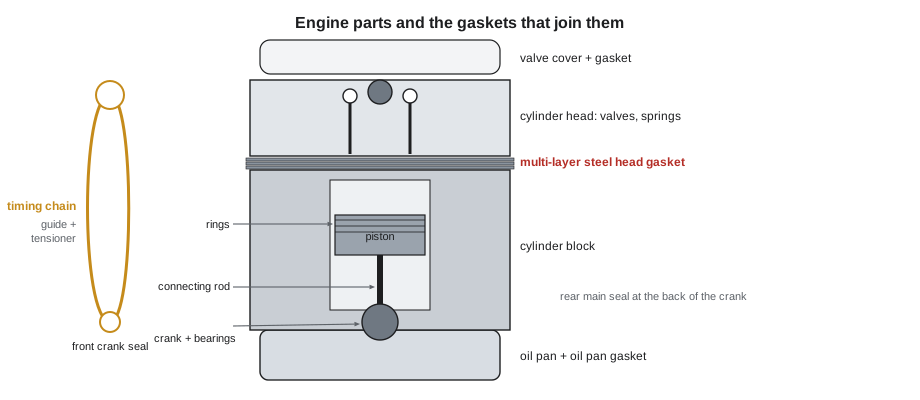
Gaskets and seals
Wherever two engine parts meet and fluid or gas must stay inside, there is a gasket (between two flat surfaces) or a seal (around a turning shaft). Gaskets are some of the most common engine parts sold, and some of the most commonly sold wrong.
- The head gasket seals the joint between block and head: combustion pressure in the cylinders, coolant passing between block and head, and oil feeding the valve train. It takes the highest loads of any gasket in the engine.
- Valve cover gaskets seal the cover on top of the head, often with separate seals for spark plug tubes.
- Intake manifold and exhaust manifold gaskets seal the manifolds to the head. Exhaust gaskets must take high heat and are often layered steel.
- The oil pan gasket seals the pan to the block. Many modern engines use no pre-cut gasket here; instead the technician lays a bead of formed-in-place gasket material (RTV silicone or anaerobic sealant) that the manufacturer specifies.
- The front crankshaft seal, camshaft seals and rear main seal are lip seals around turning shafts. A leaking rear main seal is replaced with the transmission removed, which is why it is often done during a clutch job.
- Front cover, water pump, thermostat housing and oil cooler gaskets complete the list.
Gaskets are sold one at a time or in gasket sets. A full gasket set has everything needed to rebuild the engine. A head set (upper set) has the head gasket and the gaskets and seals disturbed when a head is removed: valve cover, intake and exhaust manifold gaskets, valve stem seals and often head bolts. A lower set (conversion set) covers the oil pan, front cover and crank seals. When a technician says "head gasket", the right question is "just the gasket, or the head set and bolts?"
Multi-layer steel head gaskets
Older head gaskets were made of composite material over a steel core. Almost every modern engine uses a multi-layer steel (MLS) head gasket: three to five thin layers of embossed spring steel, often with a thin rubber coating. MLS gaskets handle the heat and pressure of modern engines, especially aluminum heads on aluminum or iron blocks and turbocharged engines like the Vela's.
MLS gaskets bring two counter questions. First, they need very flat, smooth surfaces. A head that has overheated may have warped, and a machine shop checks it for flatness and resurfaces it if needed. If the head is machined, the engine maker may specify a thicker service gasket, and some engines offer gaskets in more than one thickness, marked by notches or a grade number. Second, MLS gaskets are sensitive to dirt and old sealant on the surfaces, and the technician may ask for a surface-preparation product the maker approves. Never suggest coating an MLS gasket with sealant unless the maker's instructions call for it.
Many engines use torque-to-yield (TTY) head bolts, which stretch permanently when tightened to their final angle. They are single-use and must be replaced whenever the head comes off. A head set may include them; if not, they are a separate part, and a technician who reuses them risks a failed head gasket. When you sell a head gasket, ask whether the bolts are included and whether they are needed.
Timing belts and timing chains
The timing drive keeps the camshafts in step with the crankshaft. There are two common kinds.
A timing belt is a toothed rubber belt reinforced with fiber cords. It runs quietly and is light and cheap, but it wears out and must be replaced on a schedule, typically between 60,000 and 100,000 miles, or after a set number of years, whichever comes first. A belt that breaks stops the engine. On an interference engine, where the valves and pistons share space at different times, a broken belt lets the pistons hit the open valves, bending valves and sometimes breaking pistons. The Arden 1.8 is an interference engine, which is why Bramhall replaces its belt on time.
A timing chain is a steel roller chain, like a bicycle chain, running in oil inside the engine. It is meant to last the life of the engine, but it can wear and stretch, especially if oil changes are missed. A stretched chain can rattle on start-up and can set fault codes when the cam and crank sensors no longer agree. The 2.0 L engines in the Arden and the Vela use chains.
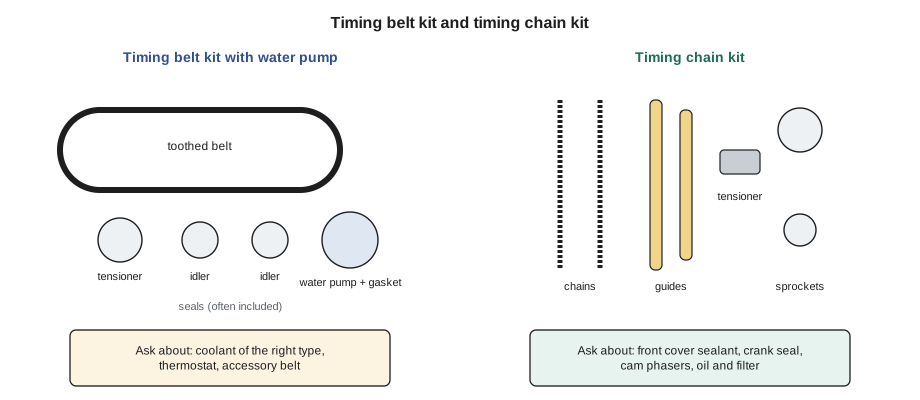
Both are sold as kits, and the kit is almost always the right sale:
| Kit | Typical contents | Ask about |
|---|---|---|
| Timing belt kit | Belt, tensioner, idler pulleys; often camshaft and crank seals | Water pump (kit with pump), thermostat, coolant, accessory belt |
| Timing belt kit with water pump | As above, plus water pump and gasket | Coolant of the right type, thermostat |
| Timing chain kit | Chain or chains, guides, tensioner, sprockets; sometimes gaskets | Front cover gasket or sealant, crank seal, VVT phasers or actuators, oil and filter |
On many belt engines the water pump is driven by the timing belt and sits behind the timing cover. Replacing the belt without the pump saves a little today and risks a second full job if the old pump leaks later; that is why Corinne said nobody does a belt job twice. On chain engines, many variable valve timing systems use cam phasers on the camshaft sprockets, and a chain job may reveal a worn phaser. Phasers are usually separate parts, not in the kit.
Questions that separate engine parts
Engine parts depend heavily on the exact engine. Before the shelf, confirm:
- Engine size and code. The eighth character of the VIN usually codes the engine (APT-120). Hugo Wexcombe's Arden thermostat housing showed that two engines in the same model share almost nothing.
- Production date. Engines get running changes: a revised gasket material, a new tensioner, a changed oil pan.
- Previous repairs. A head that has been machined may need a thicker gasket; an engine that has already had a long block fitted may be a later version than the VIN suggests.
- What is being replaced. Gasket alone, set, or set with bolts; belt alone or kit; kit with or without pump.
Spark plugs and ignition coils follow the same rule. Plugs are specified by thread, reach, heat range and gap, and modern engines usually take long-life iridium or platinum plugs with a set replacement interval. A plug that looks the same but has the wrong heat range or reach can damage the engine. Coils on modern engines sit directly on each plug (coil-on-plug), and one failed coil is often sold singly, though some shops replace them as a set on high-mileage engines.
Engine mounts
Engine mounts and transmission mounts hold the powertrain in the vehicle and soak up vibration. They are rubber, sometimes filled with fluid (hydraulic mounts), and some are electronically controlled to change stiffness. A transverse FWD engine typically has three or four mounts in different positions, often called the right, left, front and rear mounts or the torque strut. Ask which mount, and confirm engine and transmission: mounts for a manual car can differ from an automatic, and electronically controlled mounts have a connector.
Worked problem
Is the belt due?
A customer's 2017 Arden 1.8 has 76,000 miles on it. The maker's interval for the timing belt is 100,000 miles or 8 years, whichever comes first. It is now November 2026. Is the belt due?
Show solution
- Check distance:
- \[76{,}000 \text{ miles} < 100{,}000 \text{ miles}\]
- Not due by distance.
- Check time:
- \[2026 - 2017 = 9 \text{ years} > 8 \text{ years}\]
- Due by time.
Answer: The belt is overdue by time. Rubber ages whether or not the car is driven. On an interference engine, the counter should quote the kit with water pump and coolant, and the service advisor should explain the risk to the customer.
Engine noises, leaks and the parts they point to
Customers and technicians often describe engine problems by what they hear, see or smell, and a parts person who knows the common links can help the job along, while leaving the diagnosis to the technician.
- A rattle for a few seconds at cold start on a chain engine can point to a worn chain tensioner or stretched chain, or, as lesson 9 shows, to an oil filter without an anti-drainback valve.
- A squeal from the front of the engine usually means the accessory drive belt or its tensioner or idler pulleys. Belts are sold by the engine and by whether the vehicle has air conditioning or other accessories; the tensioner is often sold separately.
- Oil on the outside of the engine may come from the valve cover gasket, the front cover, the oil pan, the filter housing, the oil cooler or the rear main seal. Each has its own part and its own labor, and some use formed-in-place sealant instead of a gasket.
- White smoke with a sweet smell, and coolant loss with no visible leak can mean a failed head gasket, which a technician confirms with a pressure or chemical test before ordering a head set.
- A misfire code on one cylinder often leads to a spark plug, an ignition coil or a fuel injector on that cylinder, and sometimes to a compression or valve problem that needs more work.
- A rough idle and a whistle on a turbocharged engine can point to a vacuum or boost leak, a cracked hose, or a failed PCV valve or diaphragm.
Knowing these links lets the counter be ready: when a technician mentions a head gasket, the head set, bolts, coolant and perhaps a thermostat are likely to follow, and a machine shop may be needed for the head. When the misfire is on a coil-on-plug engine, the counter can check stock of coils and the plug the engine takes. The counter does not diagnose; it prepares. Selling a part on a customer's guess, without a technician's diagnosis, is how good parts get returned and how customers spend money on the wrong repair.
Common mistakes
MistakeSelling a timing belt alone when the job needs a kit.
InsteadAsk whether the shop wants the belt, the kit, or the kit with water pump.
MistakeAssuming a head gasket comes with new head bolts.
InsteadCheck the set contents; TTY bolts are single-use and often sold separately.
MistakeSuggesting sealant on an MLS head gasket.
InsteadFollow the maker's instructions; most MLS gaskets go on clean and dry.
MistakeLooking up engine parts by model and year only.
InsteadConfirm the engine code, production date and previous repairs.
Summary and key terms
- The block, pistons, crankshaft, head, valves and camshafts make up the engine; long and short blocks replace most of it at once.
- Gaskets seal flat joints and seals ring turning shafts; gasket sets bundle the parts one job disturbs.
- MLS head gaskets need flat, clean surfaces; TTY head bolts must be replaced.
- Timing belts are replaced on a schedule by distance or time; chains are meant to last but can stretch.
- Timing parts sell as kits; ask about the water pump, seals, phasers, coolant and oil.
- Head gasket
- The gasket that seals the joint between the cylinder block and the cylinder head.
- MLS gasket
- A multi-layer steel gasket made of several thin embossed steel layers, used as the head gasket on most modern engines.
- Torque-to-yield bolt
- A bolt that stretches permanently when tightened to specification and must not be reused.
- Interference engine
- An engine in which a broken timing belt or chain lets the pistons strike the valves.
- Long block
- An assembled engine with block, crankshaft, pistons, heads and valve train, sold new or remanufactured.
- Formed-in-place gasket
- A gasket made from a bead of sealant laid on the part, used instead of a pre-cut gasket.
Practice problems
Work each problem on paper first, then reveal the answer to check.
Which gasket set covers the parts disturbed when a cylinder head is removed?
Show answer
A head set, also called an upper gasket set.
Why must torque-to-yield head bolts be replaced?
Show answer
They stretch permanently when tightened and will not hold the correct clamping force if reused.
What can happen when the timing belt breaks on an interference engine?
Show answer
The pistons can strike the open valves, bending valves and damaging pistons.
A timing belt interval is 100,000 miles or 7 years. A 2020 car has 61,000 miles in late 2026. Is it due?
Show answer
No. Distance is under the limit and 2026 minus 2020 is 6 years, under 7.
Name two parts often sold with a timing chain kit job that are not usually in the kit.
Show answer
For example, the front cover gasket or sealant, the crank seal, cam phasers, or oil and a filter.
Lesson quiz · 5 questions
Score 60% or more to complete this lesson.
Create a free account to save your progress, take quizzes and earn a certificate.