
APT-230 · Lesson 7 of 12 · 21 min
Drivetrain, clutch and transmission parts
▶ Video coming soon A video version of this lesson is on the way.
Two requests reached the back counter on the same morning, and Talia nearly treated them the same way. Dario Pellicano needed transmission fluid for a 2021 Arden 1.8 with a CVT, and Bramhall Auto Service wanted a clutch kit for a 2016 Arden 2.0 with a six-speed manual. For the fluid, Talia reached for the large drum of multi-vehicle automatic transmission fluid the aftermarket store had suggested to Rolf last spring as a way to save shelf space. Imani stopped her. "Read the label on the drum, then read what Tessaro calls for," she said. The drum did not list CVT fluid at all; it was a fluid for conventional automatics, and a CVT runs on something quite different. Talia sold two bottles of Tessaro CVT fluid instead. Then, for the clutch kit, she asked the questions Imani had taught her in lesson 1: engine, transmission, and whether the flywheel was single-mass or dual-mass. Corinne's technician had already measured it: dual-mass, and worn. The order became a clutch kit plus a flywheel.
The drivetrain, from engine to wheels
The drivetrain (or driveline) carries power from the engine to the driven wheels. Its parts depend on the layout from lesson 1:
- A clutch (manual transmission) or torque converter (most automatics) connects and disconnects the engine and the transmission.
- The transmission or transaxle changes the gear ratio, so the engine can run at a useful speed while the vehicle goes from a standstill to highway speed.
- A differential lets the left and right wheels turn at different speeds in a corner while both are driven. On FWD vehicles it sits in the transaxle; on RWD vehicles it is in the rear axle.
- CV axles (half shafts) or axle shafts carry power from the differential to each wheel; driveshafts (propeller shafts) carry it front to back on RWD, AWD and 4WD vehicles.
- AWD vehicles add a power take-off unit and a rear drive unit; 4WD vehicles add a transfer case, a front differential and often locking hubs.
CV axles
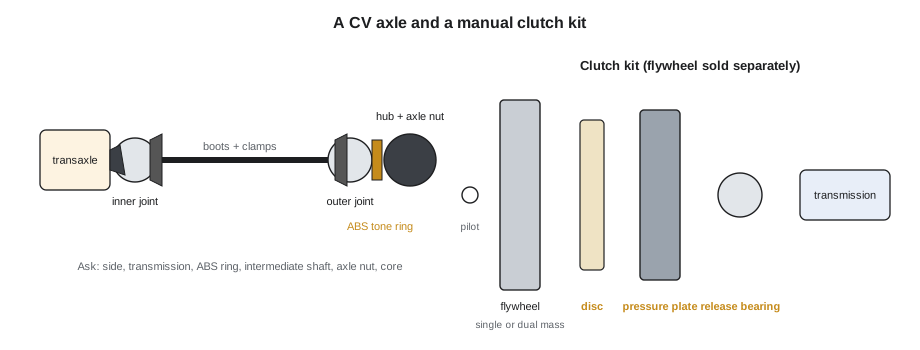
A constant-velocity (CV) joint passes power smoothly at a changing angle, which a FWD front axle needs because the wheel steers and moves up and down at the same time. Each CV axle has an inner joint at the transaxle (usually a plunging tripod or cross-groove type, which can change length) and an outer joint at the wheel (usually a fixed ball-type joint that handles steering angles). Each joint is packed with special grease and sealed by a rubber or plastic CV boot held by clamps.
A torn boot is the usual start of CV failure. Grease flies out, dirt and water get in, and the joint wears. Caught early, a boot kit (boot, clamps and grease) saves the joint; a joint that clicks when turning, usually the outer one, means the joint is worn. Most shops now replace the complete CV axle assembly, new or remanufactured, rather than rebuilding a joint, because it is quicker and the price is low. Questions to ask:
- Which side? On many transaxles the left and right axles are different lengths, and some vehicles use an intermediate shaft with a support bearing on one side.
- Transmission and drive layout. Manual and automatic transaxles can use different inner joints and spline counts; AWD versions differ from FWD.
- ABS tone ring. Some outer joints carry the ABS tone ring, so the new axle must have the matching ring.
- Axle nut. Many axle nuts are single-use, staked or with a locking feature, and must be replaced.
- Core. Remanufactured axles carry a core charge (APT-220).
Clutches
A manual transmission connects to the engine through a clutch. The parts, from the engine back:
- The flywheel bolts to the crankshaft. Many modern manual cars use a dual-mass flywheel (DMF), two masses joined by springs, which soaks up engine vibration. DMFs wear and are expensive; a technician checks one for play and noise and replaces it when worn. Some can be swapped for a single-mass conversion kit, but only where the kit's maker lists the vehicle.
- The clutch disc has friction linings riveted to a spring-damped hub, splined onto the transmission input shaft.
- The pressure plate (clutch cover) bolts to the flywheel and clamps the disc against it with a diaphragm spring.
- The release bearing (throw-out bearing) pushes on the diaphragm spring when the pedal is pressed. On many cars it is part of a hydraulic concentric slave cylinder inside the bell housing.
- A pilot bearing or bushing in the crankshaft supports the input shaft on some vehicles.
- The clutch hydraulic system: a clutch master cylinder at the pedal, a line, and a slave cylinder. Most share brake fluid from the brake reservoir or have their own; check which fluid the maker specifies.
A clutch kit usually contains the disc, pressure plate and release bearing, and often a pilot bearing and an alignment tool. It usually does not include the flywheel, the slave cylinder or the flywheel bolts, which are often single-use. A clutch job is also the time to replace a leaking rear main seal (lesson 2) and the transmission input shaft seal, because both are reached with the transmission out. Ask about each.
Automatic transmissions, CVTs and dual-clutch units
Most new vehicles have automatic transmissions of one of three kinds.
- A conventional automatic uses a torque converter and planetary gear sets with clutch packs, controlled by a valve body with electric solenoids and a transmission computer. Six to ten speeds are common now. The Vela uses an eight-speed automatic.
- A continuously variable transmission (CVT) uses a steel belt or chain running between two pulleys whose widths change, giving an endless range of ratios. Many compact cars, including the Arden 1.8, use a CVT. The belt grips the pulleys through the fluid's special friction properties.
- A dual-clutch transmission (DCT) is like two manual gearboxes run by computer, one for odd gears and one for even, each with its own clutch. Some DCTs use wet clutches running in fluid, others dry clutches.
Dealership parts sales for automatics are mostly fluids, filters, pan gaskets, cooler lines, solenoids, mounts and seals, plus complete remanufactured or new transmissions. Internal parts go to transmission specialists. Many modern automatics have no dipstick and no regular fluid change in the owner's schedule, but service information may still call for one under severe use, and a repair always needs fluid.
Transmission fluids: one size does not fit all
Transmission fluid is not just a lubricant. In a conventional automatic it is the hydraulic fluid that applies the clutches, and its friction properties decide how smoothly and firmly they engage. In a CVT it lets the steel belt transmit power through the pulleys without slipping. In a DCT it may cool wet clutches and lubricate gears at the same time. Each design needs a fluid made for it, and engine makers specify their fluids by their own names and specification numbers.
- ATF for conventional automatics comes in many specifications, and fluids for older and newer transmissions differ in viscosity and friction behavior. Many newer transmissions use low-viscosity fluids.
- CVT fluid is a different product from ATF and must never be replaced with ordinary ATF. The wrong fluid can let the belt slip and destroy the transmission.
- DCT fluid and manual transmission fluid or gear oil have their own specifications. Some manual transmissions use ATF, some a gear oil such as 75W-90, some a dedicated manual transmission fluid.
- Differential and transfer case fluids are usually gear oils by API GL grade and SAE viscosity, and limited-slip differentials may need a friction modifier additive or a fluid that already contains one. Rear drive units with electronic couplings, like the Vela's, often use a special fluid of their own.
"Multi-vehicle" or "universal" ATFs are sold by many brands and claim to meet a long list of specifications. Some are well made and suitable for the transmissions their makers list; none is suitable for every transmission. The safe rules at the counter are: use the vehicle maker's fluid or one whose maker lists the exact specification the vehicle calls for; never put ATF in a CVT or CVT fluid in a conventional automatic; never sell a fluid for a transmission under warranty unless it meets the maker's specification by name; and if the label does not list the specification, do not guess. A transmission is the most expensive part most vehicles have. Two bottles of the right fluid are cheap insurance.
Driveshafts, differentials and transfer cases
On RWD, AWD and 4WD vehicles, a driveshaft joins the transmission or PTU to the rear differential, with universal joints (U-joints), CV joints or flexible couplings at the ends and sometimes a center support bearing in the middle. U-joints are sold by size and series, and some driveshafts are only sold complete. Differentials have pinion seals, axle seals, bearings and gears; most counter sales are seals, fluid and gaskets or sealant for the cover. Transfer cases have their own fluid, seals, chains and, on electronic units, shift motors.
Worked problem
Which fluid for which unit?
A 2024 Vela AWD is in for service. The technician asks for fluid to service the transmission and the rear drive unit. What should the counter check?
Show solution
- Transmission: the eight-speed automatic takes the Tessaro ATF named in the service information. Check the specification name, not just the word ATF.
- Rear drive unit: its electronically controlled coupling often needs its own fluid, which may differ from the differential gear oil of other vehicles.
- PTU: many AWD vehicles have a separate PTU fluid as well; ask whether it is being serviced.
- Quantities: look up each unit's capacity; drain-and-fill capacity is usually less than total capacity.
Answer: Three different fluids may be needed for one AWD vehicle: transmission, PTU and rear drive unit. Look up each by its unit and specification, and sell the quantity for a drain and fill, not the dry total.
Driveline complaints and the parts they lead to
- Clicking when turning sharply: a worn outer CV joint; sell the complete axle, and ask about the axle nut and the ABS ring.
- Vibration on acceleration: a worn inner CV joint, a worn engine or transmission mount, or a driveshaft U-joint or center support bearing on RWD and AWD vehicles.
- Clutch slipping (engine speed rises but the car does not speed up): a worn disc, oil on the disc from a leaking rear main seal, or a hydraulic fault. A clutch kit, often with a flywheel, follows.
- Clutch chatter or judder: oil contamination, a worn dual-mass flywheel or worn mounts.
- Hard shifting on a manual: a clutch that does not release fully, often a hydraulic problem, or worn synchronizers inside the transmission.
- Harsh or slipping shifts on an automatic: low or wrong fluid, a solenoid, or internal wear; the technician will check the fluid level and condition and the codes first.
- Whine or howl from the rear: a worn differential, pinion bearing or wheel bearing; the technician separates them by road test.
Remanufactured transmissions and units
When an automatic transmission, a transfer case or a differential has failed internally, many dealerships now replace the whole unit with a remanufactured one rather than repair it. Reman units are rebuilt in a factory to a standard, often with updated parts that fix known faults, and they carry a warranty. They are sold with a core charge: the old unit must come back, drained, complete and undamaged in the ways the reman program sets out, or the core credit is reduced (APT-220). Reman transmissions often need related parts that do not come with them: cooler lines or a cooler flush, new fluid, mounts, and sometimes programming of the transmission computer with a scan tool. Many reman programs also require the old cooler to be flushed or replaced, because debris left in it can ruin the new unit, and they may refuse warranty if it was not. The counter's job is to read the reman program's installation requirements and make sure every required part goes out with the unit.
Driveline parts are heavy and awkward, and many come with cores, so they also test the warehouse. A reman transmission arrives on a pallet with a core return crate, and the old unit must go back in the same crate, drained and capped, with the paperwork the program asks for. CV axles arrive in long boxes that go back as core boxes. The counter that tags each core to its RO and puts it in the core area the same day, rather than leaving it in the bay, keeps the core credits that make the reman price worthwhile.
Common mistakes
MistakePutting conventional ATF in a CVT because both are called transmission fluid.
InsteadSell the CVT fluid the vehicle maker specifies; CVT fluid and ATF are different products.
MistakeAssuming a "universal" fluid fits every transmission.
InsteadCheck that its label lists the exact specification the vehicle calls for.
MistakeSelling a clutch kit without asking about the flywheel.
InsteadAsk whether it is single-mass or dual-mass and whether it needs replacing.
MistakeSelling a CV axle by side only.
InsteadCheck transmission, drive layout, ABS tone ring, intermediate shaft and the axle nut.
Summary and key terms
- The drivetrain runs from the clutch or torque converter through the transmission and differential to the axles, with driveshafts on RWD, AWD and 4WD.
- CV axles have inner and outer joints sealed by boots; most are replaced as complete assemblies.
- A clutch kit holds the disc, pressure plate and release bearing; the flywheel, slave cylinder and bolts are usually separate.
- Conventional automatics, CVTs and DCTs each need fluids made for them.
- Use the maker's fluid or one listing its exact specification; never put ATF in a CVT.
- CV joint
- A constant-velocity joint that passes power smoothly at changing angles, used on FWD and AWD axles.
- Dual-mass flywheel
- A flywheel made of two masses joined by springs to absorb engine vibration.
- Clutch kit
- A set of clutch disc, pressure plate and release bearing, sometimes with a pilot bearing and alignment tool.
- Torque converter
- A fluid coupling between the engine and a conventional automatic transmission.
- CVT
- A continuously variable transmission that uses a belt or chain between variable pulleys.
- Concentric slave cylinder
- A hydraulic clutch release bearing and slave cylinder in one unit inside the bell housing.
Practice problems
Work each problem on paper first, then reveal the answer to check.
Which CV joint usually clicks when it is worn?
Show answer
The outer joint, when turning.
What usually starts a CV joint failure?
Show answer
A torn boot that lets grease out and dirt in.
Name three parts often sold with a clutch kit that are not usually in it.
Show answer
The flywheel, the slave cylinder, flywheel bolts, the rear main seal or the input shaft seal (any three).
Can conventional ATF be used in a CVT?
Show answer
No. CVTs need the CVT fluid the vehicle maker specifies.
Why might an AWD vehicle need three different fluids for one driveline service?
Show answer
The transmission, PTU and rear drive unit can each have their own specified fluid.
Lesson quiz · 5 questions
Score 60% or more to complete this lesson.
Create a free account to save your progress, take quizzes and earn a certificate.