
APT-230 · Lesson 3 of 12 · 21 min
Cooling and lubrication system parts
▶ Video coming soon A video version of this lesson is on the way.
On a wet Tuesday morning a retail customer named Malcolm Tepperwine put an empty coolant jug on the front counter. "Same again," he said. "The orange one." The jug was an aftermarket coolant labeled for a different family of chemistry from the one Tessaro specifies, and his car was a 2019 Arden. Talia looked at Imani, who nodded at her to handle it. Talia asked what he had been topping up, and how often. He had been adding a little every week for a month. Two problems surfaced at once: the wrong coolant was diluting the right one, and a car that needs coolant every week has a leak. Talia sold him a jug of Tessaro long-life coolant, explained why the color on the jug was not the way to choose, and booked him a cooling system check with the service advisor. At that Thursday's session, Imani made cooling and lubrication the topic.
What the cooling system does
An engine turns only about a third of its fuel energy into motion; much of the rest is heat. The cooling system carries that heat away and keeps the engine at its best working temperature, typically about 195 to 220 °F. An engine that runs too hot can warp a head and fail a head gasket; one that runs too cold wastes fuel, pollutes more and gives poor cabin heat.
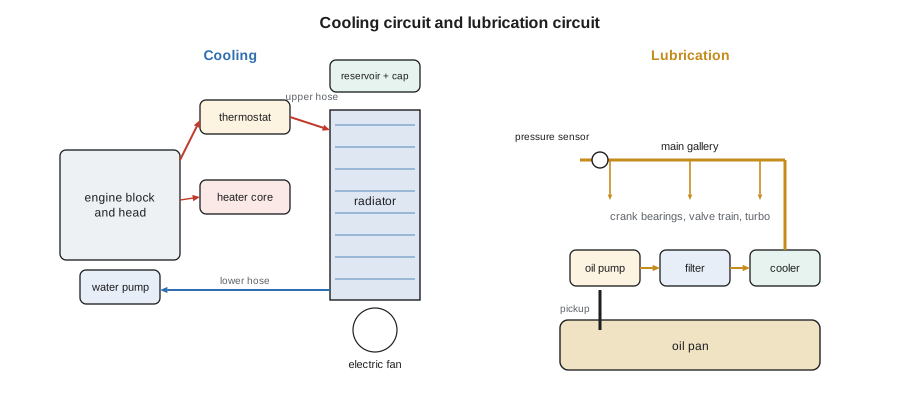
The parts, in the order coolant meets them:
- The water pump, driven by the accessory belt, the timing belt or, on many new engines, an electric motor, pushes coolant through passages in the block and head.
- The thermostat is a valve that stays closed while the engine warms up, then opens to let coolant flow to the radiator. Many modern thermostats sit in a plastic thermostat housing sold as one assembly, and some are electronically heated so the engine computer can change the opening temperature.
- The radiator passes hot coolant through thin tubes and fins, where air flowing through cools it. Most radiators have aluminum cores and plastic end tanks. Automatic transmission cars often have a transmission fluid cooler built into one tank.
- Cooling fans, almost always electric now, pull air through the radiator when the vehicle is slow or stopped.
- Hoses join the parts: upper and lower radiator hoses, heater hoses and bypass hoses. Many are molded to a shape and fit only one engine.
- The pressure cap, on the radiator or the coolant reservoir (expansion tank), holds the system under pressure, which raises the coolant's boiling point. A cap is rated by pressure, and the right rating matters.
- The heater core is a small radiator behind the dashboard that heats the cabin.
- A coolant temperature sensor reports engine temperature to the computer and the gauge.
Coolant: chemistry, not color
Coolant is a mix of antifreeze, usually ethylene glycol, and water. The glycol lowers the freezing point and raises the boiling point. Just as important are the corrosion inhibitors, the additives that protect the metals, rubber and plastics inside the system. Different engine makers use different inhibitor chemistries, and that is what separates one coolant from another.
| Type | Inhibitor approach | Where it is used (typical) |
|---|---|---|
| IAT (inorganic additive technology) | Silicates and phosphates; short life | Older vehicles, mostly before the late 1990s |
| OAT (organic acid technology) | Organic acids; long life, no silicates | Many modern vehicles, often as long-life coolant |
| HOAT (hybrid OAT) | Organic acids plus a small amount of silicate | Many North American and European makers |
| P-HOAT | Organic acids plus phosphate, no silicate | Many Asian makers |
| Si-OAT | Organic acids plus silicate, different balance | Many recent European vehicles |
Here is the rule that Malcolm's jug illustrated: color is not a reliable guide to coolant type. Coolant is dyed, and makers choose the dye. The same color can be used for different chemistries by different brands, and the same chemistry can be sold in different colors. Two orange coolants may be quite different inside, and a green coolant may be a modern long-life product rather than the old IAT. Some vehicles even changed coolant type part-way through their production, keeping the same color.
Choose coolant by the specification in the owner's manual or service information: the maker's own specification number, or the chemistry it calls for. A dealership sells the maker's own coolant, which is right by definition. Aftermarket coolants list the specifications they meet on the label; check that the one you sell names the specification the vehicle needs. "All makes, all models" coolants are designed to be compatible with many systems, but the maker's own specification remains the safest choice, especially for a vehicle under warranty.
Mixing different chemistries can cut the protection of both, and in bad cases can form gel or sludge. A small top-up of a compatible coolant in an emergency is not a disaster, but a system that has been topped up with the wrong coolant for months should be flushed and refilled with the right one.
Coolant is sold as concentrate, which must be mixed with water, or as premix, usually 50/50 with water already added. Concentrate is cheaper per liter of glycol but must be mixed with clean, preferably distilled or deionized water. A 50/50 mix protects against freezing to about −34 °F, which is the usual target in most of Canada and the northern United States; a stronger mix up to about 60 or 70 in 100 glycol gives more freeze protection, but beyond that protection falls and heat transfer suffers. Never use straight concentrate.
Coolant is toxic. Ethylene glycol tastes sweet and is deadly to pets and children in small amounts. Wipe up spills, keep jugs closed, and take used coolant for recycling, never down a drain.
Selling cooling parts
Cooling repairs come in groups, and the counter can help the shop get everything at once.
- Radiator: confirm engine, transmission (automatic radiators carry the fluid cooler) and whether the vehicle has a towing package with a heavy-duty radiator. Suggest hoses if they are original, a cap, and coolant of the right type.
- Water pump: is it belt-driven outside the engine, timing-belt driven, or electric? Timing-belt pumps go with a belt kit (lesson 2). Every pump needs a gasket or O-ring; check whether it is included.
- Thermostat: often sold with its housing; ask whether the housing is cracked or just the thermostat failed. Check the opening temperature; a lower-temperature thermostat is not an upgrade on a modern engine.
- Hoses: molded hoses are engine-specific; check the shape. Clamps may be spring, worm-gear or single-use crimp types.
- Pressure cap: match the pressure rating. A cap with too low a rating lets the coolant boil; too high can burst hoses or the radiator.
Every cooling repair loses coolant, so every cooling repair needs coolant. Know the system capacity (lesson 9) so the counter can sell the right amount.
What the lubrication system does
The lubrication system keeps a thin film of oil between moving parts so metal never touches metal. Oil also carries heat away from the pistons and bearings, cleans by holding dirt and soot in suspension until the filter catches it, seals the piston rings against the cylinder walls, and, in many engines, works hydraulic parts such as valve lifters, chain tensioners and variable valve timing.
- The oil pan (sump) holds the oil. The drain plug has a sealing washer, often a crush washer meant to be replaced at every change.
- The oil pump, driven by the crankshaft, draws oil from the pan through a pickup tube and screen. Many new engines use a variable-displacement pump controlled by the engine computer.
- The oil filter catches particles. It is a spin-on canister or a cartridge element in a housing; cartridge housings have O-rings that come with the element and must be replaced.
- An oil cooler on some engines, especially turbocharged ones, passes oil past coolant or air to keep it cool.
- Oil passages (galleries) carry oil to the crankshaft and camshaft bearings, the valve train and the turbocharger.
- An oil pressure sensor or switch works the warning light or gauge.
- The PCV valve (positive crankcase ventilation) draws gases that leak past the rings out of the crankcase and burns them in the engine. A failed PCV valve can cause oil leaks and sludge.
The Vela's turbocharger is fed by engine oil and cooled by both oil and coolant. Turbochargers spin very fast and are hard on oil, which is one reason turbocharged and direct-injection engines call for the latest oil specifications (lesson 9).
Selling lubrication parts
Most lubrication sales are maintenance: oil, filter, drain plug washer. A few rules keep them right.
- Look up the filter by engine; two filters that thread on can still differ in bypass valve pressure, anti-drainback valve and size (lesson 9).
- Sell a new drain plug washer with every oil change if the maker specifies one. A reused crush washer is a common cause of slow drips.
- For a cartridge filter, confirm the O-rings come with the element.
- For an oil leak, ask where: valve cover, front cover, oil pan, filter housing, oil cooler or rear main seal. Each has its own gasket or seal, and some use formed-in-place sealant that the maker specifies.
- For an oil pressure warning, the sensor or switch is a common, cheap part, but low oil pressure can mean real engine damage; the technician will check pressure with a gauge before replacing parts.
Worked problem
Coolant for a radiator job
A Vela's cooling system holds 7.6 quarts. The shop is replacing the radiator and will drain and refill the whole system with a 50/50 mix made from concentrate. How much concentrate does it need, and how many 1-gallon jugs?
Show solution
- Concentrate is half the mix:
- \[7.6 \text{ qt} \times 0.5 = 3.8 \text{ qt}\]
- Compare with one jug (4 quarts):
- \[3.8 \text{ qt} < 4 \text{ qt}\]
Answer: 3.8 quarts of concentrate, so one 1-gallon jug, plus 3.8 quarts of distilled water. If the shop prefers premix, sell two gallons of 50/50 premix (8 quarts), which covers the 7.6-quart capacity with a little to spare.
Overheating: the parts behind the problem
When an engine overheats, the cause is usually one of a handful of parts, and each points to a different sale.
- Low coolant from a leak: hoses, clamps, the water pump seal, the radiator, the heater core or the reservoir. External leaks often leave dried coolant crust around the leak.
- A thermostat stuck closed: the engine heats fast and the upper hose stays cool. A thermostat stuck open causes the opposite, a slow warm-up and poor heat.
- A failed cooling fan or fan relay: overheating in traffic but not on the highway, where air flows through the radiator anyway.
- A blocked radiator: inside by old, mixed or neglected coolant, outside by leaves and dirt.
- A failed pressure cap: coolant boils over at a lower temperature than it should.
- A failed water pump: a worn impeller, a leaking seal or a noisy bearing; on electric pumps, a failed motor or connector.
- A head gasket leak pushing combustion gas into the coolant, which a technician confirms by test.
An engine that has overheated badly may also need a head checked for flatness (lesson 2) and new coolant, because overheated coolant can break down. For the counter, an overheating job is a reminder to ask about the coolant type and quantity, the cap, the hoses and the thermostat, whatever the main part turns out to be.
Oil leaks and consumption
Oil that disappears without a visible leak is being burned, through worn rings or valve stem seals, a failed PCV valve, or a failed turbocharger seal. Some engines are known to use a little oil between changes, and makers state an acceptable rate. Customers who top up often should be pointed to the service advisor rather than sold a quart of thicker oil, which may mask the problem and can upset an engine designed for thin oil. Oil additives that promise to stop leaks or burning are popular, but the right answer is a diagnosis and, usually, a gasket, a seal or a PCV valve.
Common mistakes
MistakeChoosing coolant by its color.
InsteadChoose by the maker's specification printed in the service information or owner's manual.
MistakeSelling straight concentrate for a top-up.
InsteadSell premix, or concentrate with instructions to mix it with distilled water.
MistakeSelling a water pump without checking for the gasket.
InsteadConfirm whether the gasket or O-ring is in the box.
MistakeTreating weekly top-ups as normal.
InsteadA system that keeps losing coolant has a leak; refer the customer to service.
Summary and key terms
- The cooling system moves heat from the engine to the air through the pump, thermostat, radiator, fan and hoses, under pressure set by the cap.
- Coolant types differ by inhibitor chemistry: IAT, OAT, HOAT, P-HOAT and Si-OAT.
- Color is not a reliable guide; choose coolant by the maker's specification.
- The lubrication system feeds oil from the pan through the pump and filter to the bearings, valve train and turbocharger.
- Every cooling repair needs coolant, and every oil change may need a drain plug washer or filter O-rings.
- Thermostat
- A temperature-controlled valve that holds coolant in the engine until it warms up, then opens to the radiator.
- OAT coolant
- Organic acid technology coolant, a long-life coolant without silicates.
- HOAT coolant
- Hybrid organic acid technology coolant, with organic acids and a small amount of silicate.
- Premix
- Coolant already mixed with water, usually 50/50, ready to pour.
- Pressure cap
- The radiator or reservoir cap that holds the cooling system at a set pressure, raising the boiling point.
- PCV valve
- The positive crankcase ventilation valve, which draws blow-by gases from the crankcase into the intake to be burned.
Practice problems
Work each problem on paper first, then reveal the answer to check.
Why is color not a reliable way to choose coolant?
Show answer
Coolant is dyed by its maker; the same color can be used for different chemistries.
What does the pressure cap do?
Show answer
It holds the system under pressure, which raises the coolant's boiling point.
A system holds 8.4 quarts and will be filled with a 50/50 mix from concentrate. How much concentrate is needed?
Show answer
8.4 × 0.5 = 4.2 quarts.
Name three jobs engine oil does besides reducing friction.
Show answer
Carrying heat away, cleaning by holding dirt for the filter, sealing the rings, and working hydraulic parts (any three).
What part often comes with a cartridge oil filter element and must be replaced?
Show answer
The O-rings for the filter housing.
Lesson quiz · 5 questions
Score 60% or more to complete this lesson.
Create a free account to save your progress, take quizzes and earn a certificate.