
APT-230 · Lesson 12 of 12 · 21 min
Matching parts to repair orders
▶ Video coming soon A video version of this lesson is on the way.
For the last Thursday session of the autumn, Imani brought no cutaway parts. She brought six repair orders. Each was a real job from the past few weeks, copied with the customer's name removed, and each had been through the back counter. "You've seen every system now," she said. "Here is where it all comes together. A technician hands you a repair order and a diagnosis. Your job is to turn it into a complete, correct list of parts before the car comes apart, so that nothing is missing, nothing is wrong, and the car leaves on time." She gave Talia an hour. This lesson works through what Talia did with them.
What a repair order tells the counter
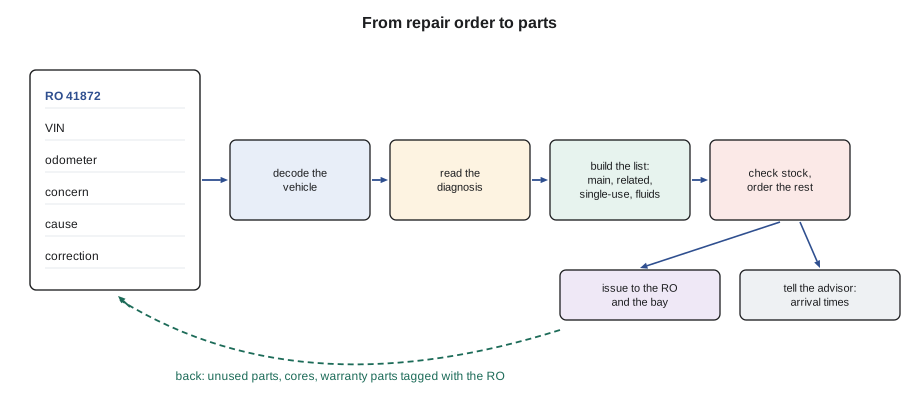
A repair order (RO) is the service department's record of a job. It opens when the customer books in and stays open until the work is paid for. For the parts counter, the useful parts of an RO are:
- The RO number, which every parts sale for the job is charged against, so the cost of parts lands on the right job.
- The vehicle: VIN, year, model, engine, and the odometer reading, which matters for maintenance intervals and warranty.
- The customer's concern in the customer's words, the cause the technician finds, and the correction: the three Cs.
- Operation codes (op codes) for each job line, which in a dealership often link to standard parts lists or labor times.
- The pay type for each line: customer pay, warranty, internal (the dealership's own vehicles) or an extended service contract. Warranty lines change what the counter must do with the old parts.
- The technician and the service advisor, so the counter knows whom to ask and whom to tell.
Technicians usually come to the counter with the RO, or send a parts request through the dealer management system, once they have diagnosed the problem. The earlier the counter sees it, the better: a part that has to be ordered can be on its way while the technician finishes the inspection.
The matching method
Every job goes through the same steps, whatever the system.
- 1. Decode the vehicle. Run the VIN; note engine, transmission, drive layout, option codes and build date (lessons 1 and APT-120).
- 2. Read the diagnosis. What exactly failed, on which side or bank, and what did the technician find around it?
- 3. Build the full list. Main part; related parts the job disturbs or that fail together; single-use parts such as bolts, nuts, seals and gaskets; fluids in the right quantity and specification; and shop supplies.
- 4. Check pairs and sets. Brakes, struts, shocks and springs go in axle pairs; timing parts go in kits.
- 5. Check stock and order. Pick what is in stock; order what is not, by the fastest sensible route; tell the advisor the arrival time so the customer can be told.
- 6. Issue to the RO. Charge every part to the right RO line and pay type, label the parts with the RO number and bay, and put them where the technician expects them.
- 7. Close the loop. Bring back unused parts for credit, cores for return, and warranty parts tagged and held as the maker requires.
Talia's six repair orders
RO 1: 2024 Vela, front brakes. The concern was a grinding noise when braking. The technician found the front pads worn to the backing plates and the rotors scored below minimum thickness. The VIN showed AWD with JL4. Talia's list: JL4 front pads, two JL4 front rotors (an axle pair), the hardware kit, brake cleaner and high-temperature brake grease, and, because the RO also had a brake fluid service line due by time, 1 quart of the specified DOT 4 fluid. She checked the pad box for wear sensors; the Vela's front pads use an electronic sensor, sold separately and single-use once worn through. She added one.
RO 2: 2017 Arden 1.8, timing belt. The customer had asked about the belt; the technician confirmed it was due by time (lesson 2). Talia's list: the timing belt kit with water pump, the accessory drive belt (the technician noted cracks), Tessaro long-life coolant for the refill, and the camshaft and crank seals if not in the kit. She checked the kit list: the seals were included. For coolant, the Arden 1.8 holds 6.8 quarts, and the shop mixes from concentrate.
RO 3: 2021 Arden 1.8, CVT fluid service. The service was due under the severe-use schedule. Talia's list: Tessaro CVT fluid, the drain plug gasket, and, after checking the service information, the CVT fluid filter that this transmission uses. She sold the drain-and-fill quantity, 4.2 quarts, not the total capacity of over 7.4 quarts. She did not touch the multi-vehicle ATF drum.
RO 4: 2019 Vela, check engine light. The codes were a cylinder 2 misfire and a catalyst efficiency code for bank 1. The technician found a failed ignition coil on cylinder 2 and confirmed with tests that the front converter had been damaged by the misfire. Talia's list: one ignition coil and, at the technician's request, a set of four spark plugs because they were near their interval; the Tessaro close-coupled converter for that engine with its gaskets and new flange nuts and studs; and nothing for the downstream oxygen sensor, which tested good. The vehicle was past its emission warranty period for the converter, so the customer could choose a compliant aftermarket converter, but the shop preferred the original; either way, the paperwork recorded the reason for replacement. The cause, the misfire, was being fixed, so the converter would not be killed again.
RO 5: 2018 Arden, front suspension noise. The technician found both front struts leaking and the left outer tie rod end loose. Talia's list: left and right complete front strut assemblies for the trim, one left outer tie rod end (tie rods are not sold in pairs as a rule), any single-use strut-to-knuckle bolts, and a note to the advisor that an alignment line should be added. She asked whether the sway bar end links had been checked; they had, and were fine.
RO 6: 2023 Vela, winter tire changeover on new steel wheels. The customer had bought winter tires and steel wheels. Talia's list: four 3PMS-marked winter tires in the approved size, four steel wheels that cleared the brakes, twenty lug nuts with the conical seat the steel wheels needed (the alloy wheel nuts would not fit them), four TPMS sensors for the steel wheels, programmed or listed for the vehicle, and TPMS service kits. She checked the tires' date codes before they went out: all from 2026.
Worked problem
How well did the counter fill the six jobs?
Across the six repair orders, Talia's lists came to 22 part lines. Nineteen were in stock when the technicians asked; three were ordered (the JL4 wear sensor, the CVT filter and the converter) and arrived the next morning. What was the first-time fill rate for these jobs?
Show solution
- First-time fill is lines filled from stock divided by lines requested:
- \[19 \div 22 \approx 0.864\]
- As a rate:
- \[0.864 \times 100 \approx 86 \text{ in } 100\]
Answer: About 86 in 100, below the department's usual first-time fill of about 91 in 100 (APT-210). The three missed lines are worth a look: if the JL4 wear sensor is requested often enough, it should be stocked (APT-210). The other two were one-off needs.
Related parts and the walk-around question
The most valuable thing a counter can do for a job is catch the part nobody asked for before the car is apart. A few questions cover most cases:
- What else comes off to do this job? Seals, gaskets and single-use bolts disturbed by the job.
- What usually fails with it? A water pump with a timing belt; rotors with pads; the other side's strut.
- What fluid does it lose? Coolant, transmission fluid, brake fluid, refrigerant.
- What did you see while you were in there? Torn boots, cracked belts, leaking seals. The technician's notes on the RO often say.
- What caused it? A failed converter, a worn automatic slack adjuster or a CV joint with a torn boot all have a cause that needs its own part.
None of this means pushing parts a job does not need. A technician who has checked the end links and found them fine does not need them, and a counter that sells parts the shop sends back loses its credibility. The aim is a complete list, not a long one.
Warranty and internal jobs
Some RO lines are paid by the vehicle maker under warranty. Those parts must be the maker's genuine parts, issued to the warranty line, and the failed parts removed from the vehicle are usually tagged with the RO number, VIN, date and claim information and held for a set period in case the maker asks for them back for inspection. Some must be shipped to the maker. The warranty administrator and the parts department share this job, and the counter's part is to tag correctly, store neatly and never scrap a held part early. Internal ROs, for the dealership's own used vehicles before sale, are charged at internal rates and need the same accuracy, because their cost goes into the price of the used car.
Bringing back what returns
When the job is done, some parts come back: an unused part from a kit the technician did not need, a core for a remanufactured part, a warranty part. Each has its own path (APT-220). The counter credits unused parts to the RO promptly, so the customer is not charged for them and the part goes back into stock; tags cores with the RO and the part they came from; and puts warranty parts in the warranty hold area. A part left on a bench at the end of a job is a part that will be lost.
Imani's last rule
When Talia finished, Imani went through the six lists line by line and found one gap: the converter job needed a new oxygen sensor gasket that the Tessaro converter did not include. Talia added it. "Twenty-three lines, and you missed one," Imani said. "Now you know why I check everything twice, and why I want you to as well." She wrote a last line under the rule on the inside of Talia's notebook: "A part fits a vehicle, not a model, and a job, not a part." The next course, APT-310, takes the same habits into electrical, electronic and electric vehicle parts.
Communicating with the service advisor
The service advisor is the link between the shop and the customer, and the parts counter feeds the advisor the information that turns into a phone call to the customer. For each RO, the advisor needs to know: are all the parts here; if not, which ones, when they will arrive and whether there is a faster option at a higher cost; whether any part is a special order with a deposit or non-returnable terms (APT-130); and whether the technician's list has grown because of something found during the work. A short, clear message in the dealer management system, or a word at the advisor's desk, saves a customer from hearing about a delay only at pick-up time.
At Linmore Tessaro, Rolf and Priyanka Rautela review open ROs waiting for parts at their Monday meeting. Each one has a reason and a date, and the ones without either are chased first. Talia's six-RO exercise ended with her writing the advisor notes for the three ordered lines: the JL4 wear sensor and the CVT filter arriving on the morning depot truck, and the converter on the same truck, all before 9 a.m., so the cars could be booked to finish by midday.
Learning from returns
Every part that comes back unused from a job is information. A return because the technician changed the diagnosis is normal. A return because the counter sold the wrong version is a lesson, and a pattern of them is a training need. Imani kept a simple log of wrong-part returns for the back counter, with the reason for each: wrong side, wrong option, wrong engine, wrong kit, missed related part. Over the autumn, Talia's entries moved from wrong option and wrong kit, the mistakes of her first weeks, to almost none. The log is a good habit for any parts person: it shows which questions you are forgetting to ask.
Common mistakes
MistakePulling only the part named on the RO.
InsteadBuild the full list: related parts, single-use parts, fluids and supplies.
MistakeSelling the total transmission capacity for a drain and fill.
InsteadUse the drain-and-fill figure from the service information.
MistakeScrapping a failed warranty part after the job.
InsteadTag it with the RO and claim details and hold it as the maker requires.
MistakeAdding parts the technician has checked and found good.
InsteadAim for a complete list, not a long one; ask what was inspected.
Summary and key terms
- A repair order gives the RO number, vehicle, concern, cause, correction, op codes and pay type.
- The matching method is decode, read, build, check pairs and kits, stock and order, issue to the RO, and close the loop.
- Related parts, single-use parts and fluids are the usual gaps; the walk-around questions catch them.
- Warranty parts must be genuine, issued to the right line, and tagged and held after the job.
- First-time fill on service requests shows how well stock matches the shop's work.
- Repair order
- The service department's record of a job, against which parts and labor are charged.
- Three Cs
- Concern, cause and correction: the customer's complaint, what the technician found and what was done.
- Op code
- An operation code for a job line on a repair order, often linked to labor times or parts lists.
- Pay type
- Who pays for an RO line: customer, warranty, internal or a service contract.
- First-time fill
- The share of parts requests filled from stock at the moment they are asked for.
- Warranty hold
- The tagged storage of failed parts from warranty repairs until the maker releases or requests them.
Practice problems
Work each problem on paper first, then reveal the answer to check.
What are the three Cs on a repair order?
Show answer
Concern, cause and correction.
Why should the counter see an RO as early as possible?
Show answer
So any part that must be ordered can be on its way while the technician finishes diagnosis.
A job has 30 part lines and 27 were in stock when requested. What was the first-time fill?
Show answer
27 ÷ 30 = 0.90, or 90 in 100.
What must happen to a failed part replaced under warranty?
Show answer
It is tagged with the RO, VIN and claim details and held as the maker requires, or shipped back.
RO 2's Arden holds 6.8 quarts of coolant and the shop mixes 50/50 from concentrate. How much concentrate?
Show answer
6.8 × 0.5 = 3.4 quarts, one 1-gallon jug.
Lesson quiz · 5 questions
Score 60% or more to complete this lesson.
Create a free account to save your progress, take quizzes and earn a certificate.