
APT-230 · Lesson 11 of 12 · 21 min
Small engines and power equipment
▶ Video coming soon A video version of this lesson is on the way.
One afternoon in late October, Rolf lent Talia to Linmore Parts Supply, the group's aftermarket store, to cover a counter shift while two of its staff were at a supplier training day. The store sold car parts like her own counter, but along one wall it also sold small-engine parts: spark plugs, air filters, trimmer line, chainsaw chains, mower blades, belts and carburetor kits. Her first customer was a landscaper named Bertrand Okonjo with a leaf blower that would not start. He had a fuel can in one hand and a question in the other: "What's the mix on this thing again?" Talia did not know the blower. She found the model and the engine's label, read the maker's ratio off the manual on the parts screen, and worked out the oil for his can. Then she asked how long the fuel had been in the can. "Since July," he said. That turned out to be the real problem.
Small engines and where they are used
Small engines power lawn mowers, trimmers, blowers, chainsaws, snow blowers, generators, pressure washers, tillers, outboard motors, all-terrain vehicles and much more. They are simple compared with a car engine: one or two cylinders, air-cooled on most equipment, often with a carburetor rather than fuel injection, and no engine computer on many models. They divide into two kinds.
- A four-stroke engine works like a car engine: intake, compression, power and exhaust strokes, with valves, and oil in a crankcase separate from the fuel. Lawn mowers, snow blowers, generators, pressure washers and many newer trimmers and outboards use four-stroke engines. They run on plain gasoline, and the oil is checked and changed like a car's.
- A two-stroke engine completes its cycle in two strokes, with ports in the cylinder wall instead of most valves. It is light and powerful for its size and runs at any angle, which is why chainsaws, most trimmers and blowers, and many older outboards use it. Most two-stroke engines are lubricated by oil mixed into the fuel, at a ratio the maker specifies. Some larger engines inject the oil from a separate tank.
Running a two-stroke engine on plain gasoline, without oil, ruins it in minutes. Putting mixed fuel in a four-stroke engine causes smoke and fouled plugs. The fuel can should always be labeled.
Identifying small-engine parts
Small-engine parts are looked up differently from car parts. There is no VIN. Instead, the equipment has a model and serial number on a label on the deck, frame or housing, and the engine often has its own label with its own model, type and code numbers, stamped or printed on the engine shroud or block. Many pieces of equipment are built by one company using an engine from another, so the equipment maker's catalog covers the deck, blades, belts and wheels, and the engine maker's catalog covers the carburetor, filters, plug and recoil starter.
Common small-engine parts sold at a counter:
- Spark plugs, by the engine maker's specification; small engines use many different plugs with different reach and heat ranges.
- Air filters (paper, foam or both, with a pre-cleaner) and fuel filters.
- Carburetor parts: rebuild kits with gaskets, needles and diaphragms, or a complete replacement carburetor, plus primer bulbs and fuel lines.
- Recoil starter parts: starter cord, pulley, spring, handle, or a complete assembly.
- Cutting parts: mower blades by length, center hole shape and lift; chainsaw chain by pitch, gauge and number of drive links, matched to the bar; trimmer line by diameter and shape.
- Belts for mower decks and drives, by the equipment maker's part number, and batteries for riding mowers and generators with electric start.
- Oil: SAE 30 or a multigrade such as 10W-30 for many four-stroke mowers and generators, as the engine maker specifies; and two-stroke oil for mixing.
Chainsaw chain is a good example of why every number matters. A chain is identified by pitch (the distance between rivets), gauge (the thickness of the drive links where they ride in the bar groove) and the number of drive links. All three must match the bar and the drive sprocket. These are usually stamped on the bar near the saw. A chain with the right length but the wrong gauge will not run safely.
Two-stroke oil and mix ratios
Two-stroke oil is a special oil designed to mix with gasoline and burn cleanly. Air-cooled engines such as chainsaws and trimmers use oils rated to standards such as JASO FD or ISO-L-EGD; outboard motors, which are water-cooled, use oil rated TC-W3. Do not sell car engine oil for mixing; it does not mix or burn the same way.
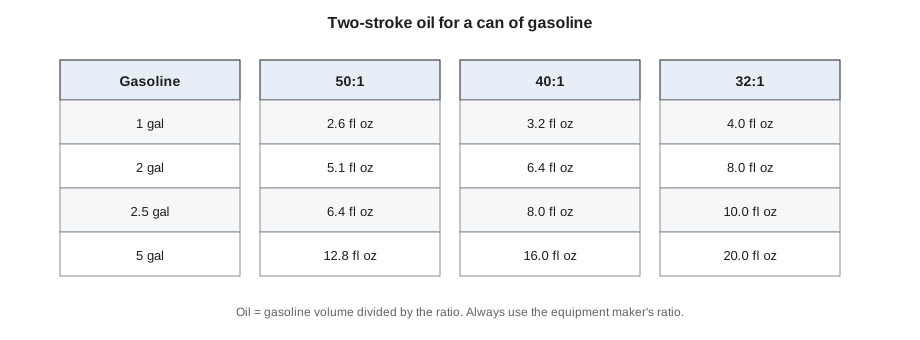
The mix ratio says how many parts of gasoline go with one part of oil. 50:1 is the most common on modern equipment, but older and some commercial equipment use 40:1, 32:1 or other ratios. Always use the maker's ratio. Many two-stroke oils come in bottles sized to mix with a set amount of fuel at a set ratio, which makes the counter's job easy; where they do not, a quick calculation does.
Worked problem
Mixing fuel for the blower
Bertrand's blower calls for 50:1. His can holds 2 gallons of fresh gasoline. How much two-stroke oil should he add? What if the blower called for 40:1?
Show solution
- There are 128 fl oz in a gallon, so 2 gallons is 256 fl oz.
- At 50:1:
- \[256 \div 50 \approx 5.1 \text{ fl oz}\]
- At 40:1:
- \[256 \div 40 = 6.4 \text{ fl oz}\]
Answer: About 5.1 fl oz of two-stroke oil for 2 gallons at 50:1, or 6.4 fl oz at 40:1. Talia sold him a bottle sized for 2 gallons at 50:1 and showed him the line on the side. Strictly, 50:1 means 50 parts fuel to one part oil, so the oil is one part in 51 of the mix, but the convention is to divide the fuel volume by the ratio, and the mixing bottles do the same.
Ethanol in fuel: E10 and E15
Most gasoline sold in Canada and the United States contains ethanol, an alcohol made mostly from corn. E10, up to 10 in 100 ethanol, is common regular gasoline, and almost all modern small engines are designed to run on it. Ethanol brings problems for small engines all the same:
- It absorbs water. Fuel left in a can or tank for months can take on enough water that the ethanol and water separate out and sink to the bottom (phase separation). The engine then draws a slug of water-alcohol mix, and will not run.
- It ages and leaves varnish in tiny carburetor passages. Fuel that has sat for a few months goes stale, which is exactly what happened to Bertrand's July fuel.
- It can attack older rubber and plastic fuel lines, primer bulbs and carburetor parts not designed for it.
E15, up to 15 in 100 ethanol, is sold at many US stations, often labeled Unleaded 88 or E15. The EPA approves it only for cars, light-duty trucks and medium-duty passenger vehicles from the 2001 model year and newer, and pumps must carry a label saying it is not for use in other vehicles and engines, which include motorcycles, boats, small engines and off-road equipment, and vehicles from 2000 and earlier. It is illegal to put E15 in those. Whatever the pump says, the rule for small engines is to use the fuel their maker allows, which for most equipment is no more than E10. Engine damage from higher blends is usually not covered by the maker's warranty.
What the counter can sell and say:
- Fresh fuel: buy only what will be used within about 30 days, and mix two-stroke fuel in small batches.
- Fuel stabilizer for fuel that will sit longer, added when the fuel is fresh.
- Ethanol-free gasoline or premixed canned fuel, sold in some stores and favored for equipment that sits for months, such as generators and snow blowers in summer.
- Storage: run the engine dry or drain the fuel before storing it for the season, as the maker recommends.
- Carburetor service parts for engines that have already gummed up: a rebuild kit, a cleaner, or a replacement carburetor where the old one is past saving.
Seasons at the small-engine counter
Small-engine sales follow the calendar. In Columbus, spring brings mower blades, belts, plugs, air filters and oil; summer, trimmer line and two-stroke oil; fall, leaf blower parts, fuel stabilizer and chainsaw chain; and the first snowfall, snow blower belts, shear pins, scraper bars and skid shoes. A counter that stocks for the next season, not the current one, catches the rush. Generators sell before storms; a power outage in a summer storm or a winter cold snap can empty a store of generator oil and spark plugs in an afternoon.
Snow blowers bring one part that surprises new staff: the shear pin, a soft bolt in the auger that breaks on purpose if the auger hits something solid, protecting the gearbox. Customers break them on newspapers and ice chunks and need the exact pin the maker specifies, never a hardened bolt, which would pass the shock on to the gearbox.
Safety at the small-engine counter
Gasoline, two-stroke oil and fuel stabilizer are flammable and fall under the store's handling rules for flammable products (APT-110). Customers sometimes bring equipment or fuel cans into the store; fuel cans stay outside. Chainsaw chain is sharp and is handled in its packaging. And small-engine customers often ask for repair advice; the counter can explain the parts and the maker's instructions, and should point customers to the equipment maker's manual or a repair shop for anything beyond that.
Bertrand left with a mixing bottle, a fuel stabilizer, a fresh can of fuel and a carburetor kit in case draining the old fuel did not cure the blower. He called the next day to say a fresh mix had it running.
Four-stroke small engine service parts
Most lawn mowers, snow blowers and generators use four-stroke engines, and their yearly service follows a short list: oil, oil filter if the engine has one, air filter and pre-cleaner, spark plug, and often a fuel filter. Many walk-behind mower engines have no oil filter and hold well under a liter of oil, so the counter sells small bottles. The oil grade depends on the engine maker and the temperature: SAE 30 is common for summer use, multigrades such as 10W-30 or 5W-30 for a wider range, and synthetic oils for snow blowers that start in deep cold. Generators often need their oil changed after a short break-in period and then at set hours of use, which the manual lists in hours, not distance.
Riding mowers and lawn tractors add drive belts, deck belts, blades, spindles, batteries, tires and sometimes hydrostatic transmission oil. Deck belts are sold by the equipment maker's number; a belt that matches in length but not in width or construction can slip or roll off the pulleys. Blades must match length, center hole shape and lift, and are balanced after sharpening. A mower blade that is not balanced shakes the spindle bearings to pieces.
Engines in other equipment
Outboard motors, personal watercraft and all-terrain vehicles bring their own parts: water pump impellers on outboards, which are replaced on a schedule; gear lube for the outboard's lower unit; sacrificial anodes that protect metal from corrosion in the water; and drive belts and CV boots on ATVs and side-by-sides. Many of these are better served by a marine or powersports dealer, and APT-320 covers them in more depth. The general lesson from small engines carries over: identify by model and serial number, use the maker's fluids and ratios, and treat fuel as a part of the repair, not an afterthought.
Small-engine customers are often homeowners doing their own work, so the counter's explanation matters. A customer who leaves knowing to drain the fuel before storage, to use fresh fuel at the right ratio and to check the oil before each use will come back for parts, not for a new machine.
Seasonal stocking also means watching shelf life. Two-stroke oil and fuel stabilizer keep well when sealed, but premixed canned fuel and opened containers have dates or guidance on the label, and the counter rotates them oldest first like any other stock. Rubber parts such as primer bulbs and fuel lines harden on the shelf over the years, so a dusty primer bulb that has sat since the store opened is a poor sale. Snow blower belts and shear pins are worth counting in early autumn, before the first storm, because the supplier's own stock runs short once the snow falls and every store in the region orders at once.
Common mistakes
MistakeSelling car engine oil for a two-stroke mix.
InsteadSell two-stroke oil to the right standard, such as JASO FD for air-cooled equipment or TC-W3 for outboards.
MistakeGuessing a mix ratio.
InsteadRead the ratio from the equipment maker's manual or label.
MistakeSelling chainsaw chain by length only.
InsteadMatch pitch, gauge and the number of drive links to the bar.
MistakeTelling a customer any pump fuel is fine for a small engine.
InsteadMost small engines allow no more than E10; fuel should be fresh or stabilized.
Summary and key terms
- Small engines are two-stroke or four-stroke; most two-strokes run on oil mixed into the fuel.
- Parts are looked up by equipment model and serial number and by the engine's own model and code numbers.
- Two-stroke oil must suit the engine, and the mix ratio comes from the maker.
- Ethanol absorbs water, goes stale and can harm older fuel parts; most small engines allow up to E10 only.
- Sales follow the seasons, and small parts such as shear pins and chain must match exactly.
- Two-stroke engine
- An engine that completes its cycle in two strokes, usually lubricated by oil mixed into the fuel.
- Mix ratio
- The ratio of gasoline to two-stroke oil, such as 50:1.
- Phase separation
- The separation of water and ethanol from gasoline, which sink to the bottom of a tank or can.
- E15
- Gasoline containing up to 15 in 100 ethanol, not for use in small engines.
- Fuel stabilizer
- An additive that slows the aging of stored gasoline.
- Shear pin
- A soft bolt designed to break and protect a machine's drive, as on a snow blower auger.
Practice problems
Work each problem on paper first, then reveal the answer to check.
How much two-stroke oil goes in 1 gallon of gasoline at 50:1?
Show answer
128 ÷ 50 ≈ 2.6 fl oz.
Which two-stroke oil standard is for water-cooled outboard motors?
Show answer
TC-W3.
Name the three measurements that identify a chainsaw chain.
Show answer
Pitch, gauge and number of drive links.
What happens in phase separation?
Show answer
Water absorbed by the ethanol separates from the gasoline and sinks to the bottom.
Why must a snow blower shear pin not be replaced with a hardened bolt?
Show answer
The pin is meant to break and protect the gearbox; a hardened bolt passes the shock to the gearbox.
Lesson quiz · 5 questions
Score 60% or more to complete this lesson.
Create a free account to save your progress, take quizzes and earn a certificate.