
ACCT-470 · Lesson 8 of 12 · 27 min
Financial instruments II: credit losses and hedge accounting
The global financial crisis of 2008 exposed a weakness in the old incurred loss models: banks could not recognize credit losses until a loss event had occurred, so allowances were too little and too late. Both standard setters replaced those models with forward-looking expected loss models, but they could not agree on a single one. IFRS 9 recognizes twelve months of expected losses at first and lifetime losses only after a significant increase in credit risk. The FASB's current expected credit loss (CECL) model, in ASC 326, recognizes lifetime expected losses from the day an asset is recognized. For a food manufacturer the effect is smaller than for a bank, but the same models apply to trade receivables, loans and contract assets. The second half of the lesson turns to hedge accounting, where the frameworks again differ in important details.
Expected credit losses: the IFRS 9 general approach
CECL requires an entity to estimate expected credit losses over the contractual life of a financial asset measured at amortized cost, adjusted for expected prepayments, from initial recognition. The estimate reflects historical loss experience, current conditions and reasonable and supportable forecasts, reverting to historical experience for periods beyond the forecast horizon. There are no stages: the allowance is always lifetime. For comparison, IFRS 9's general approach starts with twelve months of expected losses (stage 1) and moves to lifetime losses only after a significant increase in credit risk (stage 2) or when the asset is credit-impaired (stage 3), which produces a cliff effect when an asset changes stage. Available-for-sale debt securities are not in CECL's scope; their credit losses are recognized through an allowance under a separate impairment model in ASC 326-30.
Measuring expected losses requires three inputs: the probability of default (PD) over the relevant horizon, the loss given default (LGD), the share of the exposure that would not be recovered, and the exposure at default (EAD). The estimate is unbiased and probability-weighted, considers a range of possible outcomes and reflects the time value of money. Forward-looking information, such as forecasts of unemployment, sector insolvencies or commodity prices, must be incorporated. Banks build complex models for these inputs; a manufacturer like Tamarind Bay uses simpler approaches but faces the same principles.
# Credit losses at December 31, 2026 (invented). IFRS 9 expected credit losses vs ASC 326 CECL.
# 1. Supplier loan of 25.0 (lesson 7), amortized cost.
ead, lgd = 25.0, 0.45
pd12, pd_life = 0.012, 0.045          # at origination
print("Supplier loan")
print(f"  IFRS 9 stage 1 (12-month ECL): {ead * pd12 * lgd:.3f}")
print(f"  ASC 326 CECL (lifetime from day one): {ead * pd_life * lgd:.3f}")
pd_life2 = 0.110                      # after the supplier lost a major customer
print(f"  After significant increase in credit risk -> IFRS 9 stage 2 (lifetime): {ead * pd_life2 * lgd:.3f}")
print(f"  CECL updated lifetime estimate: {ead * pd_life2 * lgd:.3f}")
# 2. Trade receivables: provision matrix with a forward-looking overlay.
buckets = [("Current", 168.0, 0.004), ("1-30 days", 41.5, 0.012), ("31-60 days", 12.2, 0.045),
           ("61-90 days", 4.6, 0.140), ("Over 90 days", 3.1, 0.480)]
overlay = 1.10                        # forecast: higher grocery-sector insolvencies
print("\nTrade receivables (lifetime losses under both frameworks)")
print(f"{'Age':<14}{'Balance':>9}{'Hist. rate':>12}{'Adjusted':>10}{'Allowance':>11}")
tot = tot0 = 0
for b, bal, r in buckets:
    a = bal * r * overlay; tot += a; tot0 += bal * r
    print(f"{b:<14}{bal:>9.1f}{r:>12.1%}{r * overlay:>10.2%}{a:>11.2f}")
print(f"{'Total':<14}{sum(x[1] for x in buckets):>9.1f}{'':>22}{tot:>11.2f}")
print(f"Allowance without the forward-looking overlay: {tot0:.2f}")
print("ASU 2025-05 expedient: assume current conditions persist for current receivables ->", f"{tot0:.2f}")Supplier loan IFRS 9 stage 1 (12-month ECL): 0.135 ASC 326 CECL (lifetime from day one): 0.506 After significant increase in credit risk -> IFRS 9 stage 2 (lifetime): 1.238 CECL updated lifetime estimate: 1.238 Trade receivables (lifetime losses under both frameworks) Age Balance Hist. rate Adjusted Allowance Current 168.0 0.4% 0.44% 0.74 1-30 days 41.5 1.2% 1.32% 0.55 31-60 days 12.2 4.5% 4.95% 0.60 61-90 days 4.6 14.0% 15.40% 0.71 Over 90 days 3.1 48.0% 52.80% 1.64 Total 229.4 4.24 Allowance without the forward-looking overlay: 3.85 ASU 2025-05 expedient: assume current conditions persist for current receivables -> 3.85
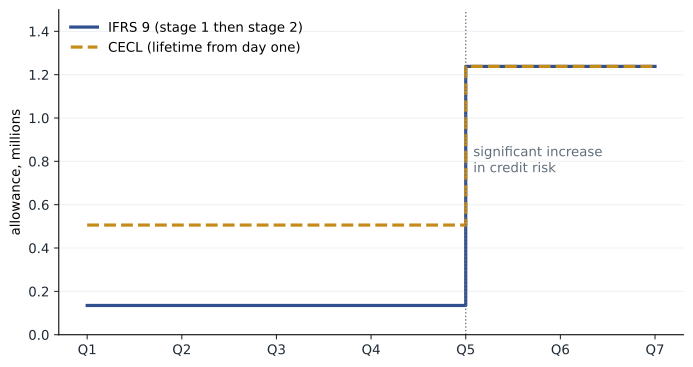
For the 25.0 million supplier loan, CECL requires the lifetime loss of 0.506 million from day one, while IFRS 9 would initially require only the 12-month loss of 0.135 million. In November 2026 the supplier lost a major customer, and the lifetime PD rose from 4.5 to 11.0 percent. Under CECL, Tamarind Bay simply updates its lifetime estimate to 1.238 million. Under IFRS 9 a Canadian competitor would have to decide whether credit risk had increased significantly, which it almost certainly had; the loan would move to stage 2 and the allowance would jump to the same lifetime figure. The difference between the frameworks is greatest for new, performing assets, where CECL front-loads the allowance.
Trade receivables and the provision matrix
For trade receivables, CECL also requires lifetime losses, and a provision matrix is a common method. The program applies a 10 percent forward-looking overlay to Tamarind Bay's historical loss rates because economists forecast higher insolvencies among regional grocers in 2027, raising the allowance from 3.85 to 4.24 million. ASU 2025-05, issued in July 2025 and effective for annual periods beginning after December 15, 2025, offers relief: all entities may elect a practical expedient that assumes current conditions at the balance sheet date do not change for the remaining life of current accounts receivable and current contract assets arising under ASC 606, removing the need for reasonable and supportable forecasts for these short-term balances. Entities other than public business entities may also make a policy election to consider collection activity after the balance sheet date. If Tamarind Bay elects the expedient in 2026, its allowance would be the 3.85 million based on current conditions, although it must still consider current conditions, such as known customer difficulties, at the balance sheet date.
For comparison, Canadian private enterprises using ASPE still apply an incurred loss model, recognizing impairment only when there are indications such as significant financial difficulty of the debtor, so their allowances are typically smaller than those under either CECL or IFRS 9.
Hedge accounting: why it exists
Hedge accounting is optional. It exists because the normal measurement rules can create accounting mismatches: a derivative used to hedge a risk is measured at fair value through profit or loss, while the hedged item, such as a forecast purchase, is not recognized at all until it occurs. Without hedge accounting, profit would swing with the derivative even though the economic position is hedged. Hedge accounting changes the timing of recognition so that gains and losses on the hedging instrument and the hedged item affect profit in the same period. In exchange, the entity must designate the relationship at inception, document the risk management objective and strategy, and show that the hedge is expected to be effective.
| Type | What is hedged | Accounting |
|---|---|---|
| Fair value hedge | Exposure to changes in fair value of a recognized asset, liability or firm commitment | Derivative and hedged item both remeasured through profit or loss |
| Cash flow hedge | Variability in cash flows of a recognized item or highly probable forecast transaction | Effective portion of the derivative in OCI, reclassified when the hedged item affects profit |
| Net investment hedge | Foreign currency exposure of a net investment in a foreign operation | Effective portion in OCI with translation differences |
Tamarind Bay's cash flow hedge of natural gas purchases
Tamarind Bay's Frozen plants use large amounts of natural gas for cooking and steam. To protect its margins, it hedges about 70 percent of forecast gas purchases for the next twelve months with pay-fixed commodity swaps and designates them as cash flow hedges of highly probable forecast purchases. ASC 815 requires the hedge to be highly effective, generally interpreted as offset within 80 to 125 percent, both at inception and on an ongoing basis. After ASU 2017-12, an entity may perform the initial quantitative test and then use qualitative assessments if facts support it, and, for a highly effective cash flow hedge, it records the entire change in the fair value of the hedging instrument in OCI, without separately measuring ineffectiveness.
# Cash flow hedge of forecast natural gas purchases with pay-fixed swaps (ASC 815; invented).
# After ASU 2017-12, a highly effective hedge records the whole change in the swap's fair value
# in OCI; amounts are reclassified to earnings when the gas affects cost of sales.
periods = [  # cumulative changes in fair value, millions of dollars
    ("Q1", 1.10, -1.05), ("Q2", 2.40, -2.28), ("Q3", 0.90, -0.97), ("Q4", 3.20, -2.95)]
print(f"{'Quarter':<8}{'Swap':>8}{'Hedged item':>13}{'Offset':>9}{'Highly effective?':>19}{'To OCI':>9}")
for q, swap, item in periods:
    ratio = -swap / item
    he = 0.80 <= ratio <= 1.25
    print(f"{q:<8}{swap:>8.2f}{item:>13.2f}{ratio:>9.0%}{'yes' if he else 'NO':>19}{swap if he else 0:>9.2f}")
print("Dollar-offset within 80-125% is a common way to show the hedge is highly effective.")
print("No ineffectiveness is measured separately; the full change is deferred in OCI.")Quarter Swap Hedged item Offset Highly effective? To OCI Q1 1.10 -1.05 105% yes 1.10 Q2 2.40 -2.28 105% yes 2.40 Q3 0.90 -0.97 93% yes 0.90 Q4 3.20 -2.95 108% yes 3.20 Dollar-offset within 80-125% is a common way to show the hedge is highly effective. No ineffectiveness is measured separately; the full change is deferred in OCI.
Because the hedge is highly effective in every quarter, the whole change in the swap's fair value is deferred in OCI, and nothing is recognized in earnings until the hedged gas purchases affect cost of sales, at which point the accumulated amount is reclassified into the same line item. IFRS 9, by contrast, would recognize the excess of the hedging instrument's cumulative change over the hedged item's cumulative change as ineffectiveness in profit or loss, about 0.25 million by the fourth quarter on these figures, and would require the deferred amount to be included in the initial cost of the purchased inventory as a basis adjustment. The US approach produces less volatility in earnings for highly effective hedges; the IFRS approach shows imperfections in the hedge as they occur.
Hedge accounting judgments
Several judgments recur. The first is whether a forecast transaction is highly probable: a purchase that the company expects but has not committed to must be supported by budgets, past patterns and the company's ability to carry it out, and hedging 100 percent of forecast volumes invites challenge. If a forecast transaction is no longer expected to occur, the accumulated amount in OCI must be reclassified to profit immediately, and a pattern of forecasts that fail to occur can call into question the entity's ability to forecast at all. The second is the hedge ratio and sources of ineffectiveness, such as differences in timing, location or quality between the derivative's underlying and the hedged item, or the credit risk of the counterparty. The third is the hedged risk component: IFRS 9 permits hedging a separately identifiable and reliably measurable component of a non-financial item, such as the benchmark gas price embedded in a delivered price, and ASU 2017-12 introduced a similar contractually specified component approach in US GAAP.
The IASB published a request for information on the post-implementation review of IFRS 9's hedge accounting requirements in September 2026, so the IFRS model may change. The FASB continues to make targeted improvements to ASC 815; companies should check for recent updates when designing new hedge programs.
Disclosures
Credit risk disclosures explain the entity's credit risk management practices, the inputs, assumptions and techniques used to measure expected losses, how forward-looking information is incorporated, changes in the allowance during the period, the credit quality of financial assets and concentrations of risk. Hedge accounting disclosures cover the risk management strategy, how hedging affects the amount, timing and uncertainty of future cash flows, and the effects on the financial statements, including amounts in the hedge reserve and, under IFRS 9, ineffectiveness recognized. Tamarind Bay's largest customer accounts for 14 percent of revenue, a concentration that must be disclosed and that also matters for the going concern assessment in lesson 12.
Worked problem
Moving between stages
A 10.0 million loan to a distributor has a 12-month PD of 1.0 percent and a lifetime PD of 3.0 percent at origination, with LGD of 50 percent. A year later its lifetime PD is 9.0 percent and the distributor is 20 days late on a payment. What allowance is required?
Show solution
- CECL at origination: 10.0 × 3.0% × 50% = 0.15 million (lifetime from day one).
- Assess significant increase in credit risk: lifetime PD has tripled, a significant increase; the 30-day rebuttable presumption has not been reached, but it is not needed.
- Update the lifetime estimate: 10.0 × 9.0% × 50% = 0.45 million.
- Disclose the change in the allowance and the reasons.
Answer: The allowance becomes 0.45 million. Under IFRS 9 the increase from 0.05 is the cliff effect; under CECL the increase is from 0.15.
Common mistakes
MistakeRecognizing credit losses only when a customer defaults.
InsteadRecognize expected losses using forward-looking information, under IFRS 9 or CECL.
MistakeUsing historical loss rates without considering forecasts.
InsteadAdjust historical rates for current conditions and reasonable and supportable forecasts, and document overlays.
MistakeWaiting for 30 days past due before moving loans to stage 2.
InsteadThe 30-day test is a backstop; assess significant increases in credit risk with forward-looking information.
MistakeDesignating hedges of forecast volumes the company may never buy.
InsteadHedge only highly probable transactions and reclassify OCI amounts if a forecast transaction is no longer expected.
MistakeLeaving basis adjustments or reclassifications to chance.
InsteadPlan how OCI amounts will be reclassified or included in inventory cost when the hedged item affects profit.
MistakeForgetting that hedge accounting is optional and documentation is required at inception.
InsteadDesignate and document the relationship when it starts; it cannot be applied retrospectively.
Summary and key terms
- CECL recognizes lifetime expected losses from initial recognition, with no stages.
- Expected losses combine PD, LGD and EAD with forward-looking information in an unbiased, probability-weighted estimate.
- ASU 2025-05 provides a practical expedient for current receivables and contract assets from 2026.
- Hedge accounting aligns the timing of gains and losses on hedging instruments and hedged items, but requires documentation at inception.
- ASC 815 requires highly effective hedges and, after ASU 2017-12, defers the entire change in OCI for cash flow hedges.
- Highly probable forecasts, hedge ratios and risk components are the main hedge accounting judgments.
- CECL
- The current expected credit loss model of ASC 326, recognizing lifetime losses from day one.
- Highly effective
- The ASC 815 requirement that a hedge achieve offset, generally within 80 to 125 percent.
- ASU 2025-05
- The 2025 update providing a credit loss practical expedient for current receivables and contract assets.
- Expected credit losses
- A probability-weighted estimate of credit losses over the relevant horizon.
- Probability of default (PD)
- The likelihood that a borrower will default over a given period.
- Loss given default (LGD)
- The proportion of an exposure that would be lost if default occurs.
- Exposure at default (EAD)
- The amount owed at the time of default.
- Provision matrix
- A method that applies loss rates to receivables grouped by age or other characteristics.
- Cash flow hedge
- A hedge of exposure to variability in cash flows, with effective gains and losses deferred in OCI.
- Highly probable forecast transaction
- An expected transaction that is significantly more likely than not to occur.
Practice problems
Work each problem on paper first, then reveal the answer to check.
What is the CECL allowance on the supplier loan at origination?
Show answer
0.506 million.
Rerun the credit loss program with an overlay of 1.25. What is the trade receivables allowance?
Show answer
About 4.81 million.
Why is the supplier's loss of a major customer relevant?
Show answer
It raises the lifetime PD, increasing the CECL allowance.
What is the cliff effect?
Show answer
The jump in the allowance under IFRS 9 when an asset moves from 12-month to lifetime expected losses.
Why must overlays be documented?
Show answer
They are judgments that can be used to manage earnings; evidence and consistent removal criteria are needed.
In the hedge program, why is all of the swap's change deferred in OCI?
Show answer
The hedge is highly effective, so ASU 2017-12 defers the entire change.
What happens if a hedged forecast purchase is no longer expected to occur?
Show answer
The accumulated amount in OCI is reclassified to profit or loss immediately.
Name two sources of hedge ineffectiveness.
Show answer
Differences in timing, location or quality between the derivative and hedged item; counterparty credit risk; differences in notional amounts.
Why is hedging 100 percent of forecast volume risky for hedge accounting?
Show answer
Forecasts are uncertain; overhedging may mean some transactions are not highly probable.
Which concentration must Tamarind Bay disclose?
Show answer
Its largest customer accounts for 14 percent of revenue.
Lesson quiz · 5 questions
Score 60% or more to complete this lesson.
Create a free account to save your progress, take quizzes and earn a certificate.