
ACCT-470 · Lesson 4 of 12 · 28 min
Revenue recognition: complex judgments
You studied the five-step model of ASC 606 in intermediate accounting, including variable consideration, principal versus agent and licenses. This lesson returns to revenue because it remains the single largest source of restatements and SEC comments, and because the hard cases in practice rarely fit the textbook examples. A food company's revenue looks simple, goods shipped to retailers, but the contracts around those shipments contain rebates, promotional allowances, slotting fees, co-manufacturing arrangements and brand licenses, each of which requires judgment. The lesson works through five of Tamarind Bay's 2026 arrangements, noting where IFRS 15 differs.
Variable consideration and the constraint
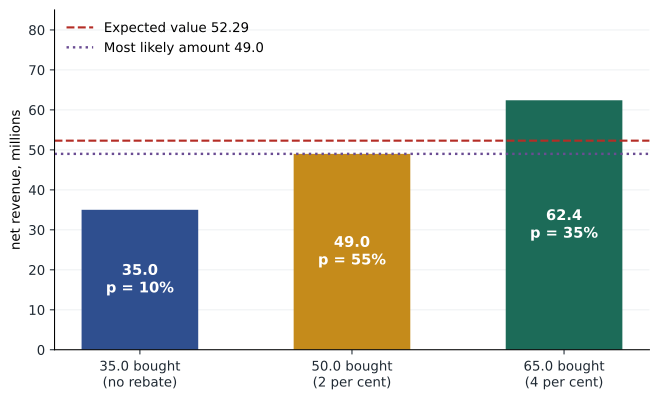
Tamarind Bay's contract with a national grocery chain gives the chain a retroactive volume rebate: no rebate if annual purchases are below 40 million dollars at list price, 2 percent of all purchases from 40 million, and 4 percent of all purchases from 60 million. Because the rebate depends on future purchases, the transaction price for each shipment is variable. The standards require the company to estimate the variable consideration using either the expected value or the most likely amount, whichever better predicts the amount to which it will be entitled, and then to include it in the transaction price only to the extent that a significant reversal of cumulative revenue is unlikely when the uncertainty is resolved.
# Variable consideration in Tamarind Bay's 2026 contract with a national grocery chain (invented).
# Retroactive volume rebate: 0% below 40m of purchases, 2% from 40m, 4% from 60m (on all purchases).
scen = [(35.0, 0.10), (50.0, 0.55), (65.0, 0.35)]   # (annual purchases at list price, probability)
def rebate_rate(v): return 0.04 if v >= 60 else 0.02 if v >= 40 else 0.0
print(f"{'Purchases':>10}{'Prob':>7}{'Rebate %':>10}{'Net revenue':>13}")
ev = 0
for v, p in scen:
    net = v * (1 - rebate_rate(v)); ev += p * net
    print(f"{v:>10.1f}{p:>7.0%}{rebate_rate(v):>10.0%}{net:>13.2f}")
ml = max(scen, key=lambda s: s[1])
print(f"\nExpected value of net revenue: {ev:.2f}")
print(f"Most likely amount: {ml[0] * (1 - rebate_rate(ml[0])):.2f}")
# Per-unit view used through the year: estimated rebate rate applied to each sale
exp_rate = sum(p * rebate_rate(v) * v for v, p in scen) / sum(p * v for v, p in scen)
print(f"Expected effective rebate rate: {exp_rate:.2%}")
# Q1 purchases of 14.0: revenue recognized and rebate liability accrued
q1 = 14.0
print(f"Q1 sales {q1}: revenue {q1 * (1 - exp_rate):.2f}, refund liability {q1 * exp_rate:.2f}")
# Consideration payable to the customer: slotting fees are not for a distinct good or service
slotting, gross_sales = 14.0, 1854.0
print(f"\nSlotting fees reduce revenue: {gross_sales:.1f} - {slotting:.1f} = {gross_sales - slotting:.1f}") Purchases Prob Rebate % Net revenue
35.0 10% 0% 35.00
50.0 55% 2% 49.00
65.0 35% 4% 62.40
Expected value of net revenue: 52.29
Most likely amount: 49.00
Expected effective rebate rate: 2.72%
Q1 sales 14.0: revenue 13.62, refund liability 0.38
Slotting fees reduce revenue: 1854.0 - 14.0 = 1840.0With three distinct outcomes and a contract that applies to many shipments, the expected value is usually the better predictor, because it reflects the full range of possible rebates; the most likely amount suits binary outcomes such as a performance bonus that is either earned or not. Tamarind Bay therefore applies an expected rebate rate of 2.72 percent to each sale and records a refund liability for the estimated rebate. It updates the estimate every quarter as purchases accumulate. If, by the third quarter, purchases are running well above 60 million, the rate rises to 4 percent and the company records a cumulative catch-up adjustment that reduces revenue for the earlier shipments.
The constraint is the judgment that matters most. ASC 606 includes variable consideration only to the extent that it is probable that a significant reversal will not occur; IFRS 15 uses highly probable, which the boards intended to mean the same level of confidence because probable in US GAAP means likely, a higher threshold than the more-likely-than-not meaning of probable in IFRS. Factors that increase the likelihood of a reversal include susceptibility to factors outside the entity's influence, such as retailer demand, a long period before the uncertainty is resolved, limited experience with similar contracts and a broad range of possible amounts. For the rebate, the constraint has little effect, because the rebate reduces revenue and Tamarind Bay estimates it from a large volume of similar contracts. It matters more for amounts that increase revenue, such as price escalators or performance bonuses.
Consideration payable to a customer
To win shelf space for a new snack line, Tamarind Bay paid the same chain 14.0 million in slotting fees in 2026. Payments to a customer are accounted for as a reduction of the transaction price unless they are made in exchange for a distinct good or service that the customer transfers to the entity, measured at its fair value. Shelf space in the customer's own store is not distinct from the sale of products to that customer: Tamarind Bay obtains no benefit from the shelf except selling its products through it. The fees therefore reduce revenue, as the program's last line shows, rather than being recorded as selling expense. The timing follows the later of when the related revenue is recognized and when the company pays or promises to pay.
Two related judgments arise. First, some payments to customers are for genuinely distinct services, such as a retailer's in-store advertising that Tamarind Bay could buy from a media company at a known price. If the price paid exceeds the fair value of the service, the excess reduces revenue. Second, slotting fees that secure a multi-year supply arrangement are sometimes capitalized as an asset and amortized against revenue over the expected period of sales, when the payment creates enforceable rights. Practice varies here, and Tamarind Bay's policy, disclosed in its significant accounting policies note, is to recognize slotting fees as a reduction of revenue when the related products are first shipped, because its arrangements do not give it enforceable rights beyond a year.
Principal or agent: the co-manufacturing arrangement
In 2026 Tamarind Bay agreed to supply a discount retailer with private-label crackers. Its own plants were full, so it contracted a co-manufacturer in another province or state to produce them to Tamarind Bay's recipe and specifications. The co-manufacturer ships directly to the retailer's distribution centers. Tamarind Bay negotiates the price with the retailer, sets the quality standards, pays the co-manufacturer a fixed price per case and bears the risk if the retailer rejects a shipment or does not pay. Should it report the retailer's payments as revenue, with the co-manufacturer's charges in cost of sales, or only its net margin?
The answer depends on whether Tamarind Bay controls the crackers before they are transferred to the retailer. The standards provide indicators of control: whether the entity is primarily responsible for fulfilling the promise, whether it has inventory risk before or after transfer, and whether it has discretion in establishing the price. None is decisive, and the analysis is about control, not about risks and rewards. Here, Tamarind Bay is responsible to the retailer for acceptability, it bears the risk of rejected goods and it sets the price, so it is the principal and reports gross revenue. If instead the retailer had chosen the co-manufacturer, negotiated the price and dealt directly with it on quality, with Tamarind Bay earning a fixed fee for arranging the deal, Tamarind Bay would be an agent and report only the fee.
| Indicator | Facts | Points to |
|---|---|---|
| Primary responsibility for fulfillment | Tamarind Bay contracts with the retailer and answers for quality | Principal |
| Inventory risk | Tamarind Bay bears losses on rejected cases and holds safety stock | Principal |
| Price discretion | Tamarind Bay negotiates the selling price; co-manufacturer price fixed | Principal |
| Credit risk | Tamarind Bay is exposed if the retailer does not pay | Supporting, not an indicator in itself |
| Physical possession | Goods never pass through Tamarind Bay's warehouses | Not decisive |
The judgment matters because gross or net presentation can change revenue by tens of millions without changing profit, and revenue growth is a headline measure for investors and for some bonus plans. Regulators have challenged companies that report gross revenue in arrangements where they are, in substance, arranging for another party to provide the goods, especially in online marketplaces and logistics. A change in a company's presentation from net to gross, or the reverse, is a change that auditors and analysts will question.
Licensing the brand
In 2026 Tamarind Bay licensed its Tamarind Bay brand to a distributor in Mexico for five years. The distributor manufactures and sells snacks under the brand and pays a royalty of 5 percent of its sales, with no upfront fee. ASC 606 classifies intellectual property as functional, such as software or a film, which has standalone functionality and is generally recognized at a point in time, or symbolic, such as a brand, logo or trade name, which has little standalone functionality and is recognized over time because the licensor supports its value. IFRS 15 reaches similar answers through a different test, asking whether the license gives a right to access or a right to use the intellectual property. In any case, the sales-based royalty exception applies under both frameworks: revenue from a royalty based on the licensee's sales is recognized only when the later of the sales occurring and the performance obligation being satisfied, so Tamarind Bay recognizes royalty revenue as the distributor makes sales.
If the contract had included a guaranteed minimum royalty of 2.0 million a year, the minimum would be fixed consideration, recognized over the license period as Tamarind Bay provides access to the brand, with royalties above the minimum recognized as sales occur. Upfront fees, renewals and licenses combined with goods, such as supplying a proprietary seasoning blend together with the brand, add further judgments about whether the license is a distinct performance obligation.
Contract modifications
In September 2026 the grocery chain agreed to extend its contract for the new snack line into 2027 at a price 6 percent lower than the original 2026 price, in exchange for a commitment to double the shelf space. The standards treat a modification as a separate contract if it adds distinct goods at their standalone selling prices. If it does not, and the remaining goods are distinct from those already delivered, the modification is accounted for prospectively, as if the old contract had ended and a new one had begun. Only when the remaining goods are not distinct, as in a construction contract, is there a cumulative catch-up adjustment.
Here the additional units are distinct, but the reduced price is not their standalone selling price, because it reflects the shelf space concession. The modification is therefore treated as the termination of the old contract and the creation of a new one: the remaining 2026 units and the 2027 units are priced together at a blended transaction price, and revenue for units already delivered is not changed. A company that wrongly treated the modification as a separate contract would keep revenue on the remaining 2026 units at the old price and push the discount entirely into 2027, flattering the current year. Such timing choices are exactly what auditors probe at year end.
Worked problem
Accounting for the modification
Before the September 2026 modification, 600,000 cases remain to be delivered in 2026 at 30.00 dollars a case. The modification adds 1,500,000 cases for 2027 at 28.20 a case, below the standalone selling price of 30.00. How should the remaining 2026 cases be priced?
Show solution
- The added cases are distinct but not priced at standalone selling price, so the modification is not a separate contract.
- The remaining goods are distinct from those already delivered, so account for it prospectively as a new contract.
- Total consideration for remaining goods: 600,000 × 30.00 + 1,500,000 × 28.20 = 18,000,000 + 42,300,000 = 60,300,000.
- Blended price: 60,300,000 ÷ 2,100,000 cases = 28.71 a case, applied to the remaining 2026 cases and the 2027 cases.
Answer: Recognize 28.71 a case for all 2,100,000 remaining cases; 2026 revenue on the 600,000 cases falls by about 0.77 million compared with the old price.
Framework differences and disclosures
IFRS 15 and ASC 606 are largely converged, but a few differences remain. US GAAP permits an accounting policy election to treat shipping and handling after control transfers as a fulfillment cost and to present sales taxes net; IFRS has no such elections. The collectability threshold in step one uses probable, which means likely in US GAAP and more likely than not in IFRS. US GAAP provides more detailed guidance on licenses of functional and symbolic intellectual property and on renewals. Private companies can apply practical expedients that public companies cannot. For Tamarind Bay, ASC 606 requires disclosure of disaggregated revenue, contract balances, remaining performance obligations, and the significant judgments in determining the timing of satisfaction of performance obligations and the transaction price, including the methods and inputs used to estimate variable consideration and the constraint.
Tamarind Bay's revenue note in 2026 disaggregates revenue by segment, by channel (grocery, mass merchandise, club, foodservice and export) and by geography, and explains its estimates of trade promotion and rebate accruals, which total about 8 percent of gross sales. The SEC staff and Canadian regulators frequently comment when the significant judgments disclosure merely repeats the standard. A good disclosure names the judgments specific to the business, such as the method for estimating promotion accruals and how the company decided it is principal in co-manufacturing arrangements.
Common mistakes
MistakeRecording slotting fees as selling expenses.
InsteadPayments to customers reduce revenue unless they buy a distinct good or service at fair value.
MistakeUsing the most likely amount for a rebate with several possible outcomes.
InsteadUse the method that better predicts the amount; for many outcomes this is usually the expected value.
MistakeDeciding principal or agent by who holds the goods physically.
InsteadAssess control before transfer, using fulfillment responsibility, inventory risk and price discretion as indicators.
MistakeTreating every contract modification as a separate contract.
InsteadA modification is separate only if it adds distinct goods at standalone selling prices.
MistakeRecognizing a sales-based royalty upfront because the license is granted on day one.
InsteadRecognize sales-based royalties as the licensee's sales occur.
MistakeWriting a generic revenue judgments note.
InsteadDisclose the specific judgments and estimates the business actually makes.
Summary and key terms
- Variable consideration is estimated with the expected value or most likely amount and constrained to avoid significant reversals.
- Payments to customers, such as slotting fees, reduce revenue unless they buy a distinct good or service at fair value.
- Principal versus agent turns on control before transfer, assessed with indicators, not on physical possession.
- Symbolic intellectual property such as a brand is recognized over time, and sales-based royalties are recognized as sales occur.
- Contract modifications are separate contracts only if they add distinct goods at standalone prices; otherwise they are usually prospective.
- Revenue disclosures should name the entity's specific judgments and estimates.
- Symbolic intellectual property
- Intellectual property such as a brand that has little standalone functionality; licenses of it are recognized over time.
- Functional intellectual property
- Intellectual property such as software with significant standalone functionality; licenses are generally recognized at a point in time.
- Variable consideration
- An amount of consideration that can vary because of discounts, rebates, refunds, incentives or other items.
- Constraint on variable consideration
- The limit that includes variable consideration only to the extent a significant reversal is unlikely.
- Refund liability
- An obligation to return consideration received, such as an estimated rebate.
- Slotting fees
- Payments by a supplier to a retailer to obtain shelf space for products.
- Principal
- An entity that controls a good or service before it is transferred to the customer and reports revenue gross.
- Agent
- An entity that arranges for another party to provide goods or services and reports revenue net as a fee or commission.
- Sales-based royalty exception
- The rule that royalties based on a licensee's sales are recognized when the sales occur.
Practice problems
Work each problem on paper first, then reveal the answer to check.
Why does Tamarind Bay use the expected value for the rebate?
Show answer
There are several possible outcomes across many shipments, so the expected value better predicts the consideration.
Rerun the rebate program with probabilities of 5, 45 and 50 percent. What is the expected rebate rate?
Show answer
About 3.08 percent: 1.75 of expected rebates on 56.75 of expected purchases, with more weight on the 4 percent tier.
When would slotting fees not reduce revenue?
Show answer
If the payment buys a distinct good or service from the customer at fair value; any excess over fair value still reduces revenue.
Which facts make Tamarind Bay the principal for private-label crackers?
Show answer
It is responsible for fulfillment and quality, bears inventory risk on rejected goods and sets the price.
How would the answer change if the retailer chose the co-manufacturer and Tamarind Bay earned a fixed arranging fee?
Show answer
Tamarind Bay would likely be an agent and report only the fee.
When is royalty revenue under the brand license recognized?
Show answer
As the distributor makes sales, under the sales-based royalty exception.
In the modification example, why is revenue not adjusted for cases already delivered?
Show answer
The remaining goods are distinct, so the modification is accounted for prospectively.
What is the effect on 2026 revenue of applying the blended price to the remaining 600,000 cases?
Show answer
600,000 × (30.00 − 28.71) ≈ 0.77 million less revenue in 2026.
Why do regulators focus on gross versus net presentation?
Show answer
It changes revenue, a headline growth measure, without changing profit.
Give one difference between IFRS 15 and ASC 606.
Show answer
US policy elections for shipping and handling and sales taxes; the meaning of probable in the collectability threshold; more detailed US license guidance.
Lesson quiz · 5 questions
Score 60% or more to complete this lesson.
Create a free account to save your progress, take quizzes and earn a certificate.