
ACCT-470 · Lesson 3 of 12 · 25 min
Performance measures: non-GAAP measures and the SEC
Almost every listed company tells its story with numbers that are not defined in the accounting standards: adjusted earnings, adjusted EBITDA, organic growth, free cash flow, same-store sales. Management argues that these measures strip out items that do not reflect underlying performance and show the business as management runs it. Investors use them heavily, and many executive pay plans are built on them. Regulators accept that they can be useful but worry that they are often used to present a rosier picture, by excluding costs that are in fact normal and recurring. This lesson looks at how each framework and regulator handles these measures, and at the judgments a reporting team makes when it chooses and reconciles them.
What the SEC rules require
Regulation G applies whenever an SEC registrant publicly discloses a non-GAAP financial measure, in an earnings release, on a call, on a website or anywhere else, and requires presentation of the most directly comparable GAAP measure and a quantitative reconciliation. Item 10(e) of Regulation S-K adds requirements for filed documents such as Forms 10-K and 10-Q: the GAAP measure must be presented with equal or greater prominence, the company must state why management believes the measure is useful to investors and, if material, how management uses it, and certain adjustments are prohibited, such as excluding charges that require cash settlement from liquidity measures other than EBIT and EBITDA, or labeling an item non-recurring, infrequent or unusual when a similar item occurred in the prior two years or is reasonably likely to recur within two years. The SEC staff's Compliance and Disclosure Interpretations (C&DIs), last substantively updated in December 2022, explain how the staff applies these rules.
The C&DIs that cause the most comment letters deal with misleading adjustments. Excluding normal, recurring, cash operating expenses necessary to operate the business, such as ordinary marketing or slotting fees for a food company, can make a measure misleading even if the adjustment is disclosed. Individually tailored accounting principles, such as accelerating revenue that GAAP recognizes over time, can make a measure misleading. Presenting a full non-GAAP income statement, or leading an earnings release with adjusted figures before GAAP figures, violates equal prominence. Adjusting only for charges and not for similar gains is also a concern. The staff reviews earnings releases, investor presentations and websites as well as filings, and non-GAAP measures have for years been among the most frequent topics in SEC comment letters.
| Requirement | Regulation G (all public disclosure) | Item 10(e) of S-K (filings) |
|---|---|---|
| Scope | Any public disclosure of a non-GAAP measure | Non-GAAP measures in SEC filings |
| Reconciliation | Quantitative, to the most directly comparable GAAP measure | Same, with the GAAP measure presented first or equally |
| Prominence | Not misleading | Equal or greater prominence for the GAAP measure |
| Explanation | Not required by Regulation G itself | Why useful to investors and how management uses it |
| Prohibited adjustments | Measure must not be misleading | Certain exclusions and non-recurring labels prohibited |
Tamarind Bay's adjusted measures
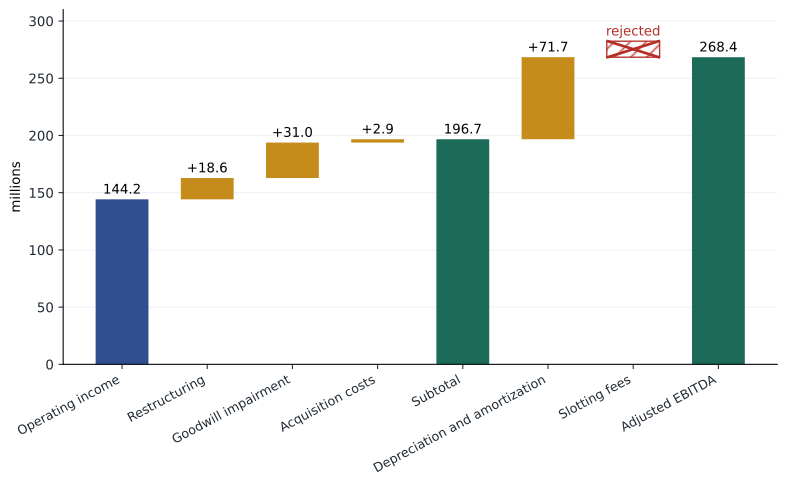
Tamarind Bay has reported two adjusted measures for years: adjusted operating profit, which adds back restructuring, impairment and acquisition-related costs, and adjusted EBITDA, which also adds back depreciation and amortization. Its credit agreement defines a covenant EBITDA that happens to equal adjusted EBITDA. In 2026 the business development team proposes a new adjustment: excluding 14.0 million of slotting fees paid to a national grocery chain to win shelf space for a new snack line, on the grounds that the fees are a one-off investment.
# Non-GAAP reconciliation for Tamarind Bay Foods, 2026, millions (invented).
# Adjusted EBITDA is reconciled from net income, the most directly comparable GAAP measure.
ni, tax, int_exp, int_inc, da = 80.7, 37.2, 36.6, 3.1, 71.7
adj = [("Goodwill impairment, Frozen reporting unit", 31.0), ("Restructuring", 18.6),
       ("Acquisition-related costs", 2.9), ("Share of earnings of equity method investee", -6.4),
       ("Dividend income", -0.8)]
ebitda = ni + tax + int_exp - int_inc + da
print(f"{'Net income':<46}{ni:>8.1f}")
for n, v in [("Income tax expense", tax), ("Interest expense", int_exp), ("Interest income", -int_inc),
             ("Depreciation and amortization", da)]:
    print(f"{n:<46}{v:>8.1f}")
print(f"{'EBITDA':<46}{ebitda:>8.1f}")
tot = ebitda
for n, v in adj:
    tot += v; print(f"{n:<46}{v:>8.1f}")
print(f"{'Adjusted EBITDA':<46}{tot:>8.1f}")
# Adjusted EPS: after-tax effect of each adjustment, attributable to Tamarind shareholders
ni_attr, shares, rate = 79.5, 120.0, 0.25
aftertax = 31.0 + 18.6 * (1 - rate) + 2.9 - 2.9 * 0.4 * rate - 1.5 * (1 - rate) * 0.20
print(f"\nGAAP basic EPS: {ni_attr / shares:.2f}")
print(f"Adjusted EPS: ({ni_attr} + {aftertax:.2f}) / {shares:.0f} = {(ni_attr + aftertax) / shares:.2f}")
print("Rejected: excluding 14.0 of slotting fees - a normal, recurring cash operating expense")Net income 80.7 Income tax expense 37.2 Interest expense 36.6 Interest income -3.1 Depreciation and amortization 71.7 EBITDA 223.1 Goodwill impairment, Frozen reporting unit 31.0 Restructuring 18.6 Acquisition-related costs 2.9 Share of earnings of equity method investee -6.4 Dividend income -0.8 Adjusted EBITDA 268.4 GAAP basic EPS: 0.66 Adjusted EPS: (79.5 + 47.34) / 120 = 1.06 Rejected: excluding 14.0 of slotting fees - a normal, recurring cash operating expense
The reconciliation starts from net income, the most directly comparable GAAP measure for adjusted EBITDA as a performance measure, and works up to adjusted EBITDA of 268.4 million, which happens to equal the covenant definition in the credit agreement. Adjusted EPS starts from GAAP net income attributable to Tamarind Bay and adds the after-tax effect of each adjustment, net of the non-controlling interest's share; the goodwill impairment is added in full because it is not deductible. The release must present GAAP EPS of 0.66 with at least equal prominence to adjusted EPS of 1.06, and explain why each measure is useful.
The slotting fee proposal fails. Slotting fees are a normal, recurring cost of selling packaged food: Tamarind Bay pays them every time it launches a product or enters a retailer, and lesson 4 shows that they reduce revenue. Excluding them would overstate the profitability of the new line and make the measure misleading. Calling them a one-off investment does not change their nature; every launch is a one-off in isolation. The audit committee rejects the adjustment, and the minutes record why.
Recurring restructuring and other hard cases
Restructuring raises a harder question. Tamarind Bay has reported restructuring charges in each of the last four years: plant consolidation in 2023, a sales reorganization in 2024, warehouse automation in 2025 and the Frozen network review in 2026. Each program is different, but a reader could fairly ask whether restructuring is part of how this company normally operates. The regulators' position is not that recurring charges cannot be excluded, but that they cannot be described as non-recurring, unusual or infrequent, and that the explanation must be honest about the pattern. Tamarind Bay's 2026 disclosure therefore lists the charges for the last four years and explains why management still finds a measure before restructuring useful for comparing the operating performance of the continuing business.
| Adjustment | Usually acceptable? | Comment |
|---|---|---|
| Goodwill impairment | Yes | Non-cash, unusual in size, explained |
| Acquisition-related transaction costs | Generally | Clearly linked to specific transactions |
| Restructuring | With care | Recurring programs must not be called non-recurring |
| Share-based compensation | Common but debated | A real cost of employing people; explain why excluded |
| Slotting fees, ordinary marketing | No | Normal recurring cash operating expenses |
| Only losses, never gains | No | One-sided adjustments are misleading |
| Revenue on a different basis than GAAP | No | Individually tailored accounting principle |
Share-based compensation is a recurring debate. Many technology companies exclude it, arguing that it is non-cash and that its fair value depends on volatile share prices. Critics, including several large investors, reply that paying employees in shares is as much a cost as paying them in cash and that excluding it overstates profitability. Tamarind Bay does not exclude it, which makes its adjusted measures more conservative than some peers'. Whatever a company does, consistency matters: changing the definition of an adjusted measure from year to year to improve the trend is one of the patterns regulators look for, and IFRS 18 requires an explanation of any change in an MPM's calculation, with restated comparatives.
Key performance indicators and other measures
Not every measure is a non-GAAP financial measure. Operating and statistical measures, such as metric tons produced or number of retail doors, are outside Regulation G, though the SEC's 2020 interpretive release on key performance indicators in MD&A expects them to be clearly defined, consistently calculated and accompanied by an explanation of any change. Organic revenue growth and free cash flow are non-GAAP measures, and free cash flow must not be presented in a way that implies it represents residual cash available for discretionary expenditure if mandatory debt payments are not deducted. Segment measures reported under ASC 280 are not non-GAAP measures in the segment note, but they become non-GAAP measures if presented on a consolidated basis outside the note.
Using adjusted measures in pay and covenants
Adjusted measures matter beyond investor communication. Most of Tamarind Bay's annual bonus depends on adjusted operating profit, and its long-term incentive plan uses adjusted EPS. That creates a direct incentive for management to classify costs as adjustments. The compensation committee therefore approves the definition at the start of the year, specifies which kinds of items can be adjusted, and reviews every adjustment at year end, with internal audit testing the calculation. Lenders do the same in a different way: the credit agreement defines covenant EBITDA precisely, caps the add-backs for restructuring at a percentage of EBITDA, and requires a compliance certificate signed by the chief financial officer. When the definitions in pay plans, covenants and public reporting differ, the company must keep three sets of calculations, and analysts must be told which one they are reading.
Worked problem
Is it an MPM?
Which of these measures, each disclosed in Tamarind Bay's earnings release, is an MPM under IFRS 18, and which would be a non-GAAP measure under the SEC rules? (a) adjusted operating profit; (b) EBITDA defined as operating profit before depreciation and amortization; (c) free cash flow; (d) adjusted operating margin; (e) revenue growth at constant currency.
Show solution
- (a) A subtotal of income and expenses expressing management's view: an MPM; also a non-GAAP measure.
- (b) Operating profit before depreciation, amortization and IAS 36 impairments is a listed exempt subtotal under IFRS 18: not an MPM, though still subject to securities rules outside the statements; under US rules it is a non-GAAP measure with its own C&DI guidance.
- (c) Not a subtotal of income and expenses: not an MPM; a non-GAAP measure under both countries' securities rules.
- (d) A ratio: not an MPM, but the numerator is, so the ratio is a non-GAAP ratio and its components must be explained.
- (e) Not a subtotal of income and expenses: not an MPM; a non-GAAP or supplementary measure that must be defined and reconciled.
Answer: Only (a) is an MPM. All five are regulated as non-GAAP or other financial measures in public communications.
Common mistakes
MistakeExcluding normal recurring operating costs, such as slotting fees, from an adjusted measure.
InsteadAdjust only for items that do not reflect ongoing operations, and explain each.
MistakeCalling recurring restructuring non-recurring.
InsteadDescribe the pattern honestly and explain why the measure is still useful.
MistakeLeading an earnings release with adjusted results.
InsteadGive the comparable GAAP or IFRS measure equal or greater prominence.
MistakeChanging the definition of an adjusted measure to improve the trend.
InsteadKeep definitions consistent; explain and restate if a change is justified.
MistakeShowing the tax effect of all adjustments as one number.
InsteadCompute the tax effect of each adjustment using the applicable rate and explain the method.
MistakeAssuming a measure is unregulated because it is not in the statements.
InsteadSecurities rules govern measures in news releases, presentations and websites as well.
Summary and key terms
- Regulation G applies to all public disclosure of non-GAAP measures; Item 10(e) adds requirements for filings.
- The comparable GAAP measure must have equal or greater prominence in filings, and certain adjustments and labels are prohibited.
- The C&DIs explain that excluding normal recurring cash operating expenses or using tailored accounting can be misleading.
- Excluding normal recurring costs such as slotting fees makes a measure misleading.
- Recurring restructuring may be excluded with care but must not be called non-recurring.
- Adjusted measures used in pay and covenants need strong governance over definitions and adjustments.
- Regulation G
- The SEC rule requiring reconciliation of non-GAAP measures in any public disclosure.
- Item 10(e)
- The Regulation S-K provision governing non-GAAP measures in SEC filings.
- C&DI
- SEC staff Compliance and Disclosure Interpretations explaining how the rules are applied.
- Non-GAAP financial measure
- A numerical measure of performance, financial position or cash flow that adjusts a measure presented in the financial statements.
- Adjusted EBITDA
- Earnings before interest, taxes, depreciation and amortization, further adjusted for items management considers not representative of ongoing operations.
- Equal prominence
- The requirement that the comparable statement measure be shown at least as prominently as the non-GAAP measure.
- Covenant EBITDA
- EBITDA as defined in a credit agreement for testing financial covenants.
Practice problems
Work each problem on paper first, then reveal the answer to check.
Why does the slotting fee adjustment fail?
Show answer
Slotting fees are normal, recurring costs of selling packaged food; excluding them would make the measure misleading.
Rerun the reconciliation with the impairment set to 46.0. What is adjusted EBITDA?
Show answer
Still 268.4, because the higher impairment reduces net income by the same amount it adds back.
Can restructuring be excluded from an adjusted measure if it occurs every year?
Show answer
It may be excluded if the measure is not misleading, but it cannot be called non-recurring, and the pattern should be disclosed.
Is EBITDA a non-GAAP measure?
Show answer
Yes; it must be reconciled to net income and presented with equal prominence in filings.
Why does consistency of definitions matter?
Show answer
Changing definitions to improve trends misleads investors; regulators look for this pattern.
Who should approve the definition of an adjusted measure used in a bonus plan?
Show answer
The compensation committee, at the start of the year, with year-end review of adjustments.
Name two prohibited or misleading practices.
Show answer
Excluding normal recurring cash operating expenses; presenting a full non-GAAP income statement; one-sided adjustments; tailored revenue recognition.
Why should gains be adjusted as well as losses?
Show answer
Adjusting only losses biases the measure upward.
Which documents does Regulation G cover?
Show answer
Any public disclosure, including earnings releases, calls, presentations and websites.
How should a company treat share-based compensation in adjusted measures?
Show answer
Either way can be acceptable if explained, but excluding it is debated because it is a real cost; consistency matters.
Lesson quiz · 5 questions
Score 60% or more to complete this lesson.
Create a free account to save your progress, take quizzes and earn a certificate.