
ACCT-311 · Lesson 9 of 12 · 25 min
Variable interest entities and the voting interest model
Most subsidiaries are controlled the ordinary way: the parent owns most of the voting shares and elects the board. Some entities, however, are designed so that voting rights are not what determines who directs them. A securitization vehicle that buys a company's receivables, a leasing entity created to own a single building, a research partnership funded by a sponsor or an investment fund run by a manager may have little or no voting equity, and their activities are set largely by contracts drawn up when they were created. Enron's use of such entities to keep debt off its balance sheet in the 1990s led standard setters to write rules that look past voting rights to who really directs the entity and who bears its risks and rewards. This lesson explains those rules.
Two models for a controlling financial interest
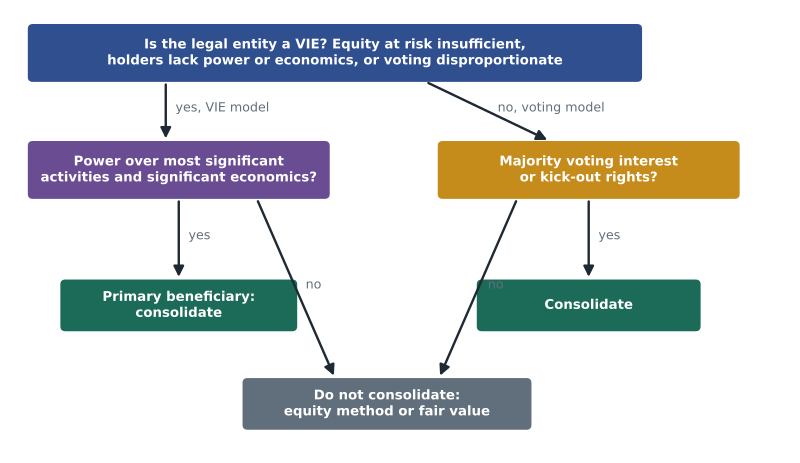
ASC 810 has two consolidation models. The variable interest entity model applies first: if a legal entity is a VIE, the reporting entity that is its primary beneficiary consolidates it, regardless of voting ownership. If the entity is not a VIE, the voting interest model applies, under which a controlling financial interest is usually a majority of the voting interests (or, for limited partnerships, the ability to exercise kick-out rights). IFRS, by contrast, uses a single control model built on power, returns and the link between them.
A legal entity is a VIE if any of these conditions applies: its total equity investment at risk is not sufficient to finance its activities without additional subordinated financial support; the holders of the equity investment at risk, as a group, lack the power to direct the activities that most significantly affect its economic performance, the obligation to absorb its expected losses or the right to receive its expected residual returns; or voting rights are disproportionate to economic interests and substantially all the entity's activities are conducted on behalf of an investor with disproportionately few voting rights. Equity of less than 10 percent of total assets is presumed insufficient unless the entity can demonstrate otherwise, for example by showing it could obtain financing without support.
The primary beneficiary of a VIE is the variable interest holder that has both the power to direct the activities of the VIE that most significantly affect its economic performance and the obligation to absorb losses of the VIE, or the right to receive benefits from it, that could potentially be significant to the VIE. Variable interests are contractual, ownership or other interests whose value changes with changes in the VIE's net assets: equity, subordinated debt, guarantees, residual value guarantees on leased assets and some service contracts. If power is shared among unrelated parties so that no one directs the significant activities, no party consolidates. Related-party rules prevent splitting interests among related parties to avoid consolidation.
Typical variable interest entities
Common VIEs include securitization trusts that buy receivables and issue notes, single-asset leasing entities, research and development arrangements funded by a sponsor, franchise entities that depend on the franchisor's financial support, entities used in tax credit structures, and some joint ventures with disproportionate economics. The VIE model asks who has power over the activities that matter most, which may be as narrow as servicing defaulted receivables, and who absorbs significant variability.
Worked problem
Larkspur's receivables vehicle
In 2028 Larkspur creates a trust to buy $20,000,000 of its customer receivables. The trust issues $18,400,000 of senior notes to banks and a $1,600,000 subordinated note to Larkspur, which absorbs the first losses. The trust has nominal voting equity held by a charitable trust. Larkspur services the receivables, including deciding how to work out defaulted accounts, under a servicing agreement it cannot be removed from without cause. Must Larkspur consolidate the trust?
Show solution
- VIE test: equity at risk is nominal, far below the 10 percent presumption, so the trust is a VIE.
- Power: Larkspur directs the activity that most significantly affects performance, managing defaults, and cannot be removed without cause.
- Economics: the first-loss subordinated note could absorb losses significant to the trust.
- Larkspur is the primary beneficiary and consolidates the trust; the receivables remain on its balance sheet with the senior notes as debt.
Answer: Larkspur consolidates the trust.
# Who absorbs the variability? Expected losses of a receivables vehicle (illustrative)
import statistics
scenarios = [(0.60, 0), (0.25, 300_000), (0.10, 900_000), (0.05, 2_400_000)]   # (probability, credit losses)
assets = 20_000_000
tranches = [("Larkspur subordinated note", 1_600_000), ("Bank senior notes", 18_400_000)]
expected = sum(p * l for p, l in scenarios)
print(f"Expected credit losses on {assets:,.0f} of receivables: {expected:,.0f}")
absorbed = {n: 0.0 for n, _ in tranches}
for p, loss in scenarios:
    remaining = loss
    for n, size in tranches:                      # first loss goes to the subordinated note
        take = min(remaining, size); absorbed[n] += p * take; remaining -= take
for n, v in absorbed.items():
print(f"{n:<28} expected loss absorbed {v:>10,.0f} ({v / expected:.0%})")Expected credit losses on 20,000,000 of receivables: 285,000 Larkspur subordinated note expected loss absorbed 245,000 (86%) Bank senior notes expected loss absorbed 40,000 (14%)
The expected-loss program shows why the first-loss position matters. Across the scenarios, expected credit losses are $285,000, and Larkspur's $1,600,000 subordinated note absorbs about 86 percent of them, because it takes every loss up to $1,600,000 before the banks lose anything. Under current standards the analysis is qualitative, focusing on power and the potential significance of exposure, but quantitative work like this supports the judgment that the exposure is significant.
Principals and agents
A decision maker with power may be acting as an agent for others rather than for itself. A fund manager that directs a fund's investments under a contract with investors uses its power on their behalf. The standards look at the scope of the decision maker's authority, the rights held by others (especially rights to remove the decision maker without cause), its remuneration and whether it is commensurate with the services provided and on market terms, and its exposure to variability from other interests it holds. A manager with a market-rate fee and a small investment, who can be removed by a simple majority of independent investors, is usually an agent and does not consolidate the fund.
# Assessing control of four entities (illustrative assessments)
entities = {
    "Receivables trust": {"vote_pct": 0.00, "power_by_contract": True,  "variable_returns": "subordinated note, 8% of assets", "agent": False},
    "Fjord supplier":    {"vote_pct": 0.00, "power_by_contract": False, "variable_returns": "guarantees supplier debt",        "agent": False},
    "Sensor fund":       {"vote_pct": 0.02, "power_by_contract": True,  "variable_returns": "1% fee, 2% units",                "agent": True},
    "Prairie Labs":      {"vote_pct": 0.45, "power_by_contract": False, "variable_returns": "45% of dividends",                "agent": False},
}
dispersed_others = {"Prairie Labs": True}
for name, e in entities.items():
    power = e["vote_pct"] > 0.5 or e["power_by_contract"] or (e["vote_pct"] >= 0.40 and dispersed_others.get(name, False))
    controls = power and bool(e["variable_returns"]) and not e["agent"]
    reason = "agent, not principal" if e["agent"] else ("no power over relevant activities" if not power else "power + returns + link")
print(f"{name:<18} power={str(power):<5} consolidate={str(controls):<5} ({reason})")Receivables trust power=True consolidate=True (power + returns + link) Fjord supplier power=False consolidate=False (no power over relevant activities) Sensor fund power=True consolidate=False (agent, not principal) Prairie Labs power=True consolidate=True (power + returns + link)
The program applies a simplified version of the analysis. Larkspur consolidates the receivables trust (power by contract plus first-loss exposure) and Prairie Labs, where its 45 percent stake gives de facto control because the other shareholders are widely dispersed. It does not consolidate the sensor fund, where it acts as an agent, or the Fjord supplier, where a guarantee gives it exposure but no power over the supplier's activities. Real assessments involve more facts and judgment, and IFRS and US GAAP can reach different answers on de facto control.
IFRS 10 recognizes de facto control: an investor with a large minority stake and widely dispersed other holders may control an investee and consolidate it. Under the ASC 810 voting interest model, Larkspur's 45 percent stake in Prairie Labs would normally lead to the equity method instead, unless the entity were a VIE or contractual rights gave Larkspur control. This is one of the clearest practical differences between the frameworks.
Investment entities
Investment companies within the scope of ASC 946 measure their investments at fair value and generally do not consolidate portfolio companies, other than investment companies or operating entities that provide services to them. Unlike IFRS 10, US GAAP allows a non-investment-company parent to retain its investment company subsidiary's fair value accounting in consolidation.
Private company and other options
Private companies may elect not to apply the VIE guidance to legal entities under common control when certain criteria are met (ASU 2018-17), an expansion of an earlier alternative for common-control leasing arrangements. A family that owns both an operating company and a property company leasing it a building, for example, need not consolidate the property company into the operating company solely because of the VIE rules, although disclosures are required.
| Issue | IFRS 10 | ASC 810 |
|---|---|---|
| Models | Single control model | VIE model, then voting interest model |
| De facto control with large minority stake | Can lead to consolidation | Generally not, under the voting model |
| Potential voting rights | Considered if substantive | Generally not considered unless exercised |
| Principal versus agent | Explicit guidance | Guidance on fees as variable interests and kick-out rights |
| Investment entity subsidiaries | Fair value exception does not carry to a non-investment parent | Fair value retained in parent's consolidation |
| Private company relief | Not applicable (ASPE has its own options) | Common-control VIE alternative |
Why it matters
Whether a structured entity is consolidated changes reported assets, debt and ratios, sometimes dramatically. Securitizations kept off the balance sheet before 2008 hid exposures that returned to banks' balance sheets during the financial crisis. Current rules bring most sponsor-designed vehicles onto the sponsor's balance sheet, and disclosures about unconsolidated structured entities and VIEs, including the maximum exposure to loss, tell users about risks that remain off balance sheet.
Disclosures about involvement with other entities
ASC 810 requires a primary beneficiary to disclose the carrying amounts and classification of the VIE's assets and liabilities, and any restrictions on them, while a holder of a variable interest that is not the primary beneficiary discloses the carrying amounts of its interests, its maximum exposure to loss and how that maximum was determined. Both must describe the significant judgments and assumptions made in deciding whether to consolidate. These disclosures let users see the judgments behind the consolidation boundary.
Common mistakes
MistakeAssuming no voting shares means no consolidation.
InsteadPower can come from contracts and design; first-loss holders that direct key activities usually consolidate.
MistakeCounting protective rights as power.
InsteadOnly substantive rights to direct relevant activities give power; protective rights do not.
MistakeTreating every decision maker as a principal.
InsteadAssess removal rights, remuneration and other interests; many managers are agents.
MistakeApplying IFRS de facto control under the voting interest model.
InsteadUS GAAP generally requires a majority voting interest or contractual control unless the entity is a VIE.
MistakeConcluding that an investment entity parent's fair value exception carries to its non-investment parent.
InsteadUnder US GAAP it is retained, but under IFRS 10 it is not.
Summary and key terms
- ASC 810 applies the VIE model first and the voting interest model otherwise.
- Power comes from substantive rights to direct relevant activities; protective rights do not give power.
- A VIE has insufficient equity at risk, equity holders lacking power or economics, or disproportionate voting.
- The primary beneficiary has power over the most significant activities and potentially significant economics.
- Decision makers acting as agents for others do not consolidate.
- Investment entities measure controlled investees at fair value instead of consolidating.
- Consolidation decisions on structured entities can change reported debt and ratios significantly.
- Variable interest entity
- A legal entity consolidated by its primary beneficiary because equity at risk or equity holders' rights are deficient.
- Variable interest
- An interest whose value changes with the VIE's net assets, such as equity, subordinated debt or a guarantee.
- Kick-out right
- A right to remove the decision maker, relevant to limited partnerships and agency assessments.
- Relevant activities
- The activities of an investee that significantly affect its returns.
- Substantive right
- A right the holder has the practical ability to exercise.
- Protective right
- A right designed to protect the holder's interest without giving power over the investee.
- Principal
- A decision maker using power primarily for its own benefit.
- Agent
- A decision maker using power on behalf of others.
- Investment entity
- An entity that invests for returns from capital appreciation or income and measures investments at fair value.
- Securitization
- Transferring financial assets to a vehicle that funds them by issuing notes.
Practice problems
Work each problem on paper first, then reveal the answer to check.
A vehicle's only relevant activity is managing defaulted loans, done by a servicer that holds the first-loss tranche. Who controls it?
Show answer
The servicer, if it cannot be removed without cause and acts as principal.
A lender can block the sale of a borrower's main asset. Power?
Show answer
No; it is a protective right.
An investor holds 42 percent; the rest is spread among thousands of holders who rarely vote. Consolidate under the voting interest model?
Show answer
Generally no; the equity method would apply unless the entity is a VIE or contracts give control.
A fund manager earns a market fee, owns 1 percent of units and can be removed by a simple majority of investors. Principal or agent?
Show answer
Agent; it does not consolidate the fund.
Rerun the expected-loss program with a subordinated note of $800,000 and senior notes of $19,200,000. Share absorbed by the subordinated note?
Show answer
About 68 percent.
Name two features of a structured entity.
Show answer
Restricted activities, narrow objective, insufficient equity, tranched financing (any two).
Can a non-investment parent retain an investment company subsidiary's fair value accounting under US GAAP?
Show answer
Yes.
Why did standard setters tighten rules after Enron?
Show answer
Special purpose entities were used to keep debt and losses off sponsors' balance sheets.
Rerun the control program setting Prairie Labs' other holders as concentrated. Result?
Show answer
Prairie Labs is no longer consolidated; power is lacking.
What disclosure helps users assess unconsolidated structured entities?
Show answer
The nature of involvement and the maximum exposure to loss.
Lesson quiz · 5 questions
Score 60% or more to complete this lesson.
Create a free account to save your progress, take quizzes and earn a certificate.