
ACCT-311 · Lesson 7 of 12 · 27 min
Intercompany depreciable assets and bonds
Lesson 6 dealt with goods that pass through the group quickly. Some intercompany transactions involve long-lived assets, and their effects last for years. In 2027 Larkspur sells a used machine to Blue Heron, Blue Heron sells a parcel of land to Larkspur, and Larkspur buys some of Blue Heron's bonds on the open market. Each transaction creates a gain or loss in one company's books that, from the group's point of view, either has not happened yet or happened differently. This lesson shows how to eliminate and gradually realize those effects.
Intercompany sales of land
Land is not depreciated, so a gain on an intercompany sale of land remains unrealized until the land is sold to an outsider. On consolidation, the gain is eliminated and the land is restored to its original cost to the group. Every year after, while the land is still held, the worksheet repeats the elimination against opening retained earnings (and NCI, if the seller was the subsidiary). When the buyer eventually sells the land outside the group, the group recognizes the whole gain, measured from the original cost.
Worked problem
Upstream land sale
On 1 March 2027 Blue Heron sells land that cost it $120,000 to Larkspur for $180,000. Larkspur still holds the land at the end of 2027. Show the consolidation effect for 2027 and when the gain will be realized.
Show solution
- Blue Heron records a $60,000 gain; Larkspur records land at $180,000.
- Consolidation entry: debit gain on sale of land $60,000; credit land $60,000.
- Because Blue Heron (the subsidiary) was the seller, NCI's share of profit falls by 20% × $60,000 = $12,000.
- Each later year: debit opening retained earnings $48,000 and NCI $12,000; credit land $60,000, until the land is sold outside.
- If Larkspur sells the land to an outsider for $200,000 in 2030, the group recognizes a gain of $80,000 ($200,000 − $120,000), of which $60,000 was previously deferred.
Answer: A $60,000 gain is deferred, shared 80:20 with NCI, until the land leaves the group.
Intercompany sales of depreciable assets
When the asset is depreciable, the unrealized gain is realized gradually through depreciation. The buyer depreciates the asset on its transfer price, which includes the seller's gain, so its depreciation is higher than the group's depreciation on the original carrying amount. Each year the excess depreciation is eliminated, which realizes part of the gain. By the end of the asset's life the whole gain has been realized, and consolidated profit over the life is the same as if no transfer had occurred.
On the worksheet in the year of transfer, three things happen: the gain is eliminated; the asset and its accumulated depreciation are restored to the amounts the seller carried (gross cost and accumulated depreciation, as many groups prefer, or simply the net carrying amount); and the year's excess depreciation is removed. In later years, the cumulative unrealized gain at the start of the year is charged to opening retained earnings (and NCI for upstream transfers), and the current year's excess depreciation is removed again.
Worked problem
Downstream equipment transfer
On 1 January 2027 Larkspur sells a calibration machine to Blue Heron for $260,000. Larkspur's cost was $300,000 and accumulated depreciation $100,000. The remaining useful life is 5 years, straight-line, with no residual value. Show the 2027 consolidation entries.
Show solution
- Larkspur's gain: $260,000 − $200,000 = $60,000.
- Eliminate the gain and restore the original cost and accumulated depreciation: debit gain $60,000 and equipment $40,000 (to restore cost from $260,000 to $300,000); credit accumulated depreciation $100,000.
- Excess depreciation: Blue Heron depreciates $260,000 ÷ 5 = $52,000; the group's depreciation is $200,000 ÷ 5 = $40,000; eliminate $12,000: debit accumulated depreciation $12,000; credit depreciation expense $12,000.
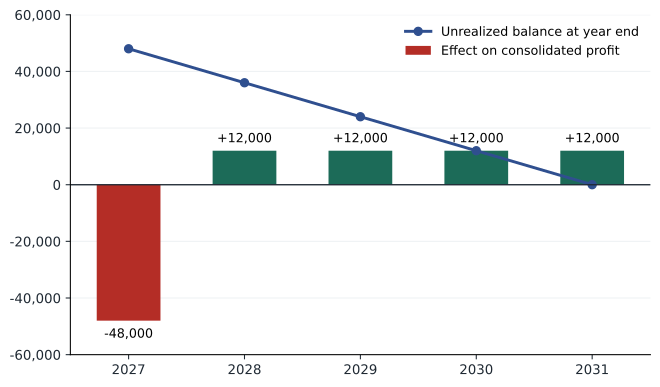
- Net effect on 2027 consolidated profit: −$60,000 + $12,000 = −$48,000, all borne by the parent because the sale was downstream.
- Unrealized gain carried forward at the end of 2027: $48,000, realized at $12,000 a year to 2031.
Answer: Profit falls $48,000 in 2027 and rises $12,000 a year from 2028 to 2031.
# Downstream equipment transfer: Larkspur sells a machine to Blue Heron on 1 January 2027
cost, accum, price, life = 300_000, 100_000, 260_000, 5
carrying = cost - accum
gain = price - carrying
excess_dep = gain / life
print(f"Gain recorded by Larkspur: {gain:,.0f}; excess depreciation each year: {excess_dep:,.0f}")
print(f"{'Year':>4} {'Gain eliminated':>16} {'Dep reduced':>12} {'Net effect':>11} {'Unrealized at end':>18}")
unreal = 0
for i, yr in enumerate(range(2027, 2032)):
    g = gain if i == 0 else 0
    unreal += g - excess_dep
print(f"{yr:>4} {g:>16,.0f} {excess_dep:>12,.0f} {-g + excess_dep:>11,.0f} {unreal:>18,.0f}")Gain recorded by Larkspur: 60,000; excess depreciation each year: 12,000 Year Gain eliminated Dep reduced Net effect Unrealized at end 2027 60,000 12,000 -48,000 48,000 2028 0 12,000 12,000 36,000 2029 0 12,000 12,000 24,000 2030 0 12,000 12,000 12,000 2031 0 12,000 12,000 0
The schedule shows the unrealized gain falling to zero at the end of 2031. If Blue Heron sold the machine to an outsider before then, the remaining unrealized gain would be realized immediately as part of the group's gain or loss on disposal.
| Asset transferred | When the gain is realized | Who bears it |
|---|---|---|
| Inventory | When the goods are sold outside the group | Seller: parent (downstream) or shared with NCI (upstream) |
| Land | When the land is sold outside the group | Same rule |
| Depreciable asset | Over the remaining life through reduced depreciation, or on sale outside | Same rule |
| Services | Immediately; no deferral | No attribution adjustment |
Intercompany bonds and the constructive retirement
A different situation arises when one group member buys the bonds of another from outside investors. Blue Heron issued $1,000,000 of 10-year, 5 percent bonds at par on 1 January 2025, with interest paid annually. On 1 January 2027, when market rates have risen, Larkspur buys 40 percent of them, $400,000 of face value, in the market for $384,000. In Blue Heron's books the bonds are still a liability at par. In Larkspur's books they are an investment at $384,000. From the group's point of view, however, $400,000 of debt owed to outsiders has been retired for $384,000: the bonds are now owed by one member of the group to another and must be eliminated.
The difference between the carrying amount of the bonds in the issuer's books and the price paid by the buyer is recognized as a gain or loss on constructive retirement in consolidated profit in the year of purchase. Here the group recognizes a gain of $400,000 − $384,000 = $16,000. In later years, the separate books record interest that the consolidated statements eliminate: Blue Heron records interest expense of $20,000 on the $400,000, and Larkspur records interest income of $20,000 plus amortization of its $16,000 discount. Because Larkspur's discount amortization effectively recognizes the gain bit by bit in its own books, the consolidation reverses that amortization each year, so that the gain is counted only once, in the year of purchase.
US GAAP also leaves the attribution of a constructive retirement gain between the parent and the noncontrolling interest to policy. A common approach attributes it to the issuer of the bonds, here Blue Heron, so that the noncontrolling interest shares 20 percent; another divides it between issuer and purchaser. The policy should be applied consistently.
# Constructive gain when Larkspur buys 40% of Blue Heron's bonds on 1 January 2027
face, coupon_rate, years_left, price = 400_000, 0.05, 8, 384_000
cf = face * coupon_rate
lo, hi = 0.0, 0.2
for _ in range(100):                       # solve for the yield that prices the bonds at 384,000
    y = (lo + hi) / 2
    pv = sum(cf / (1 + y) ** t for t in range(1, years_left + 1)) + face / (1 + y) ** years_left
    lo, hi = (y, hi) if pv > price else (lo, y)
gain = face - price                        # issuer carries its bonds at par
print(f"Purchase yield: {y:.4%}; constructive gain on retirement: {gain:,.0f}")
cv, net_2027 = price, None
print(f"{'Year':>4} {'Larkspur interest income':>25} {'Blue Heron expense':>19} {'Consolidated effect':>20}")
for i, yr in enumerate(range(2027, 2030)):
    income = cv * y
    cv += income - cf
    effect = (gain if i == 0 else 0) - (income - cf)   # gain recognized up front, then reverses
    if i == 0: net_2027 = effect
    print(f"{yr:>4} {income:>25,.0f} {cf:>19,.0f} {effect:>20,.0f}")
# 2027 consolidated profit and NCI after all items (lessons 5-7)
before = 2_275_000; nci_before = 114_000
equip, land = -60_000 + 12_000, -60_000
profit = before + equip + land + net_2027
nci = nci_before + 0.20 * land + 0.20 * net_2027     # land and bonds relate to Blue Heron (issuer/seller)
print(f"2027 consolidated profit {profit:,.0f}; NCI {nci:,.0f}; owners of parent {profit - nci:,.0f}")Purchase yield: 5.6349%; constructive gain on retirement: 16,000 Year Larkspur interest income Blue Heron expense Consolidated effect 2027 21,638 20,000 14,362 2028 21,730 20,000 -1,730 2029 21,828 20,000 -1,828 2027 consolidated profit 2,181,362; NCI 104,872; owners of parent 2,076,490
The program finds a purchase yield of about 5.63 percent. In 2027 Larkspur's own books record interest income of $21,638, including $1,638 of discount amortization. On consolidation, the group recognizes the $16,000 gain and eliminates both companies' interest, so the net 2027 effect is $16,000 − $1,638 = $14,362. In 2028 and 2029 the effect is negative, by the amount of Larkspur's discount amortization, because that amortization would otherwise count the gain a second time. Combined with the equipment and land transfers, 2027 consolidated profit falls from the $2,275,000 of lesson 6 to about $2,181,362, and NCI's share falls from $114,000 to about $104,872.
Gains and losses on retirement in practice
A constructive gain arises when market interest rates have risen since the bonds were issued, because the bonds can be bought below their carrying amount; a constructive loss arises when rates have fallen. The amount depends on the issuer's carrying amount, including any unamortized premium, discount or transaction costs, not on face value alone. If the issuer had issued at a discount, the gain would be the difference between the issuer's amortized cost and the buyer's price. Groups sometimes buy back each other's bonds as an inexpensive way to reduce external debt without the issuer formally redeeming them, but the accounting treats the result as a retirement.
Putting the worksheet together
By the third or fourth year after an acquisition, a consolidation worksheet carries a series of recurring adjustments: the acquisition-date eliminations and cumulative amortization of the acquisition differential (lesson 5), unrealized profits in opening and closing inventory (lesson 6), cumulative unrealized gains on land and depreciable assets, and the effects of intercompany bonds. A useful discipline is to keep a schedule for each item showing its effect on opening retained earnings, opening NCI, current-year profit and closing balances. The schedule makes it easier to prove consolidated retained earnings and NCI and to check that every deferred gain is eventually realized.
| Item | Effect on 2027 consolidated profit | Effect on NCI share |
|---|---|---|
| Profit before items in this lesson (lesson 6) | $2,275,000 | $114,000 |
| Downstream equipment: gain less excess depreciation | ($48,000) | — |
| Upstream land gain deferred | ($60,000) | ($12,000) |
| Constructive bond gain, net of reversed amortization | $14,362 | $2,872 |
| Adjusted totals | $2,181,362 | $104,872 |
Common mistakes
MistakeTreating an intercompany equipment gain as realized in the year of sale.
InsteadEliminate the gain and realize it through reduced depreciation over the asset's remaining life.
MistakeForgetting to restore the original cost and accumulated depreciation.
InsteadRestore the seller's carrying amount so consolidated assets reflect the group's cost.
MistakeIgnoring the intercompany land gain after the year of transfer.
InsteadRepeat the elimination against opening retained earnings (and NCI for upstream) until the land is sold outside.
MistakeComputing the constructive gain against face value when the issuer has an unamortized discount.
InsteadCompare the issuer's carrying amount with the purchase price.
MistakeCounting the bond gain both up front and through the buyer's discount amortization.
InsteadRecognize it once, in the year of purchase, and reverse the buyer's later amortization on consolidation.
Summary and key terms
- Gains on intercompany land sales stay unrealized until the land is sold outside the group.
- Gains on intercompany depreciable assets are realized through reduced depreciation over the remaining life.
- The worksheet restores the seller's cost and accumulated depreciation and removes excess depreciation each year.
- Upstream gains are shared with NCI; downstream gains are borne by the parent.
- Buying another member's bonds in the market is a constructive retirement, with a gain or loss in consolidated profit.
- The buyer's later discount or premium amortization is reversed so that the gain is counted only once.
- Attribution of constructive gains between parent and NCI is a policy choice; attributing them to the issuer is common.
- Excess depreciation
- The extra depreciation a buyer records because an intercompany transfer price includes the seller's gain.
- Constructive retirement
- The group's view that its debt to outsiders is retired when one member buys another member's bonds.
- Constructive gain or loss
- The difference between the issuer's carrying amount of bonds and the price a group member pays for them.
- Unrealized gain on assets
- A gain on an intercompany transfer of a long-lived asset not yet realized through use or outside sale.
- Agency approach
- Attributing a constructive bond gain to the issuer, treating the buyer as acting on its behalf.
- Restoring cost
- Reinstating the seller's gross cost and accumulated depreciation on the consolidation worksheet.
Practice problems
Work each problem on paper first, then reveal the answer to check.
A parent sells equipment with a carrying amount of $90,000 to its subsidiary for $120,000; 6 years remain. Annual excess depreciation?
Show answer
$5,000.
Effect on consolidated profit in the year of sale and each later year?
Show answer
−$25,000 in the first year ($30,000 gain less $5,000), then +$5,000 a year.
A 70 percent subsidiary sells land costing $50,000 to the parent for $80,000. NCI's share of the deferred gain?
Show answer
$9,000.
The parent sells that land to an outsider for $95,000 three years later. Consolidated gain?
Show answer
$45,000.
A subsidiary's bonds have a carrying amount of $500,000; the parent buys them for $520,000. Constructive gain or loss?
Show answer
A $20,000 loss.
Rerun the bond program with a purchase price of $396,000. Constructive gain?
Show answer
$4,000.
Rerun the equipment program with a 4-year remaining life. Excess depreciation?
Show answer
$15,000 a year.
Why is the buyer's discount amortization reversed on consolidation?
Show answer
The group recognized the whole gain in the year of purchase; the amortization would count it again.
When does a constructive loss arise?
Show answer
When market rates have fallen, so the bonds are bought above the issuer's carrying amount.
Why does an intercompany service fee need no deferral?
Show answer
The service is consumed immediately, so no profit remains in an asset.
Lesson quiz · 5 questions
Score 60% or more to complete this lesson.
Create a free account to save your progress, take quizzes and earn a certificate.