
ACCT-311 · Lesson 6 of 12 · 30 min
Intercompany inventory and other profits
Groups trade within themselves. In 2026 Blue Heron sells control panels to Larkspur for installation in Larkspur's sensor systems, and Larkspur sells sensor modules to Blue Heron. Each company records these sales and purchases in its own books at the agreed transfer price, as if dealing with an outsider. From the group's point of view, nothing has been sold until goods leave the group. This lesson shows how intercompany revenues, expenses and balances are eliminated, how unrealized profit in inventory is deferred until goods are sold outside, and how upstream profits affect NCI.
The single-entity principle
Consolidated statements report the group as if it were one company. One company cannot earn revenue by selling to itself, owe money to itself or charge itself interest. Every intragroup transaction must therefore be eliminated in full, regardless of the parent's percentage ownership: intercompany sales and purchases, receivables and payables, interest income and expense, management fees, rent, dividends and loans. Eliminating the revenue and the matching expense does not change consolidated profit; it only removes inflated amounts from both lines. Profit changes only when part of an intercompany profit remains inside the group at the reporting date.
Worked problem
Eliminating intercompany balances and fees
At 31 December 2026 Blue Heron owes Larkspur $120,000 for sensor modules, and during the year Larkspur charged Blue Heron a $90,000 management fee for accounting and IT services. What eliminations are needed?
Show solution
- Receivable and payable: debit Blue Heron's accounts payable $120,000; credit Larkspur's accounts receivable $120,000.
- Management fee: debit Larkspur's fee revenue $90,000; credit Blue Heron's administrative expense $90,000.
- Consolidated profit is unchanged; both companies' sides cancel.
- NCI's share is still based on Blue Heron's reported profit: the service was consumed during the year, so no profit is unrealized and no attribution adjustment is needed.
Answer: Both eliminated in full with no effect on consolidated profit.
Unrealized profit in ending inventory
When goods sold within the group are still in the buyer's inventory at year end, the buyer carries them at the transfer price, which includes the seller's profit. From the group's perspective that profit has not been earned, because no outside customer has bought the goods. The unrealized profit is eliminated from consolidated inventory and from consolidated profit. When the buyer sells the goods to an outsider in a later period, the profit is realized and recognized in consolidated profit in that period.
Worked problem
Unrealized profit at the end of 2026
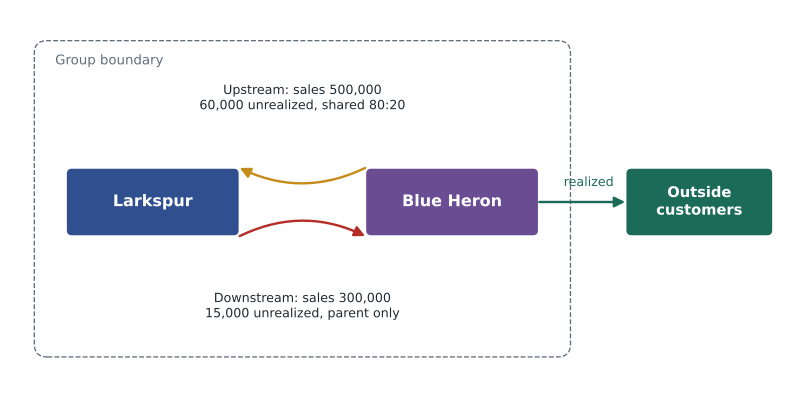
In 2026 Blue Heron sold control panels to Larkspur for $500,000. Blue Heron's gross margin on these sales is 30 percent. At year end, 40 percent of the panels remain in Larkspur's inventory. Larkspur sold Blue Heron sensor modules for $300,000 at a gross margin of 25 percent, and 20 percent remain in Blue Heron's inventory. Compute the unrealized profit and the consolidation entries.
Show solution
- Eliminate all intercompany sales: debit revenue $800,000; credit cost of sales $800,000.
- Upstream unrealized profit (Blue Heron as seller): $500,000 × 40% × 30% = $60,000.
- Downstream unrealized profit (Larkspur as seller): $300,000 × 20% × 25% = $15,000.
- Eliminate unrealized profit: debit cost of sales $75,000; credit inventory $75,000.
- Consolidated inventory falls by $75,000 to the original cost to the group.
Answer: Unrealized profit of $75,000: $60,000 upstream and $15,000 downstream.
Upstream versus downstream
The direction of the sale determines who bears the unrealized profit. In a downstream sale, the parent is the seller, so the unrealized profit is in the parent's profit and is deducted entirely from profit attributable to the parent's owners. In an upstream sale, the subsidiary is the seller, so the unrealized profit is in the subsidiary's profit, and it is shared between the parent and NCI in proportion to their interests. NCI's share of profit is therefore based on the subsidiary's profit adjusted for upstream unrealized profits, as well as for amortization of the acquisition differential.
ASC 810-10-45 requires full elimination of intercompany profits and losses and allows the elimination to be allocated between the parent and the noncontrolling interest. Proportional allocation of upstream profit, as shown here, is the usual practice. For income taxes, ASC 740 still defers the seller's tax paid on intra-entity sales of inventory until the goods are sold outside the group, recording it as a prepaid tax; since ASU 2016-16 that exception no longer applies to transfers of other assets, whose tax effects are recognized immediately.
# 2026 consolidation with intercompany sales (illustrative, taxes ignored)
P = {"Revenue": 12_000_000, "Cost of sales": 7_200_000, "Operating expenses": 2_700_000, "Interest": 200_000, "Income tax": 400_000}
S = {"Revenue": 4_000_000, "Cost of sales": 2_400_000, "Operating expenses": 680_000, "Interest": 60_000, "Income tax": 260_000}
amort = {"Cost of sales": 100_000, "Operating expenses": 100_000}
up_sales, up_margin, up_left = 500_000, 0.30, 0.40      # Blue Heron -> Larkspur
dn_sales, dn_margin, dn_left = 300_000, 0.25, 0.20      # Larkspur -> Blue Heron
up_unreal = up_sales * up_margin * up_left
dn_unreal = dn_sales * dn_margin * dn_left
cons = {k: P[k] + S[k] + amort.get(k, 0) for k in P}
cons["Revenue"] -= up_sales + dn_sales
cons["Cost of sales"] += -(up_sales + dn_sales) + up_unreal + dn_unreal
profit = cons["Revenue"] - sum(v for k, v in cons.items() if k != "Revenue")
sub_profit = S["Revenue"] - sum(v for k, v in S.items() if k != "Revenue")
nci = 0.20 * (sub_profit - sum(amort.values()) - up_unreal)     # only upstream profit affects NCI
for k, v in cons.items():
    print(f"{k:<20}{v:>12,.0f}")
print(f"{'Profit':<20}{profit:>12,.0f}")
print(f"Unrealized: upstream {up_unreal:,.0f}, downstream {dn_unreal:,.0f}")
print(f"NCI share {nci:,.0f}; owners of parent {profit - nci:,.0f}")Revenue 15,200,000 Cost of sales 8,975,000 Operating expenses 3,480,000 Interest 260,000 Income tax 660,000 Profit 1,825,000 Unrealized: upstream 60,000, downstream 15,000 NCI share 68,000; owners of parent 1,757,000
Consolidated revenue falls by the $800,000 of intercompany sales, and cost of sales falls by $800,000 less the $75,000 of unrealized profit. Consolidated profit for 2026 drops from $1,900,000 (lesson 5) to $1,825,000. NCI's share falls from $80,000 to $68,000, because it bears 20 percent of the $60,000 upstream profit, $12,000. The parent's owners bear the rest of the upstream profit ($48,000) and all of the downstream profit ($15,000), so profit attributable to owners of the parent falls from $1,820,000 to $1,757,000.
Realization in the following year
Unrealized profit at the end of one year becomes realized profit in the next, when the buyer sells the goods to outsiders, usually early in the year. On the worksheet for 2027, the opening inventory of the buyer still includes the profit, but consolidated opening retained earnings (and opening NCI, for upstream items) must exclude it. The entry debits opening retained earnings (and NCI, for its share of upstream profit) and credits cost of sales, which recognizes the deferred profit in 2027 consolidated profit.
Worked problem
Realizing 2026 profits and deferring 2027 profits
All the intercompany goods in inventory at the end of 2026 are sold to outsiders in 2027. At the end of 2027, unrealized profit is $40,000 on upstream sales and $10,000 on downstream sales. Before intercompany items, 2027 consolidated profit is $2,250,000 and NCI's share is $110,000 (lesson 5). Compute the adjusted figures.
Show solution
- Realized in 2027 from opening inventory: $60,000 upstream + $15,000 downstream = $75,000 added to profit.
- Deferred at the end of 2027: $40,000 + $10,000 = $50,000 deducted.
- Consolidated profit: $2,250,000 + $75,000 − $50,000 = $2,275,000.
- NCI share: $110,000 + 20% × ($60,000 − $40,000) = $114,000.
- Owners of the parent: $2,275,000 − $114,000 = $2,161,000.
Answer: Profit $2,275,000; NCI $114,000; owners of the parent $2,161,000.
Over the two years, the total profit is the same as it would have been with no deferral; the elimination only moves profit to the period in which the goods were sold outside the group. NCI carried forward also changes: at the end of 2026 it is $990,000 − $12,000 = $978,000, and at the end of 2027 it is $978,000 + $114,000 − $50,000 dividends = $1,042,000, which is lower than lesson 5's $1,050,000 by NCI's $8,000 share of the upstream profit still unrealized at the end of 2027.
| Effect | Downstream sale | Upstream sale |
|---|---|---|
| Seller | Parent | Subsidiary |
| Unrealized profit eliminated | In full | In full |
| Reduces profit attributable to the parent | 100 percent | Parent's percentage |
| Reduces NCI's share of profit | No | NCI's percentage |
| Opening-year worksheet adjustment | Opening retained earnings | Opening retained earnings and opening NCI |
Intercompany losses, transfer prices and taxes
Sometimes goods are transferred at less than the seller's cost. The unrealized loss is eliminated in the same way, unless the transfer price reflects a genuine decline in value. If the goods are worth less than cost to the group, the loss is evidence of impairment and is recognized: the group writes inventory down to net realizable value regardless of which entity holds it.
Transfer prices also matter for tax. Section 482 of the Internal Revenue Code lets the IRS reallocate income among related parties to reflect arm's-length prices, and penalties can apply. For financial reporting, ASC 740 defers the seller's current tax on intercompany inventory profit as a prepaid tax until the goods are sold outside the group, unlike IFRS, which recognizes deferred tax at the buyer's rate. When Larkspur later acquires its Canadian subsidiary, cross-border transfer pricing becomes a significant risk area.
Other intercompany items
Intercompany services such as management fees, rent and royalties are eliminated in full, with no profit deferral, because the service is consumed immediately. Intercompany loans and the related interest are eliminated. Intercompany dividends are eliminated, as lesson 5 showed. If intercompany profit is capitalized, for example when a parent builds equipment for a subsidiary or charges construction fees that the subsidiary capitalizes, the profit is unrealized until the asset is depreciated or sold, as lesson 7 shows for depreciable assets.
Worked problem
A capitalized intercompany fee
In 2026 Larkspur's engineering group charges Blue Heron $50,000 for designing a new production line, which Blue Heron capitalizes as part of the equipment's cost. Larkspur's cost of providing the design was $35,000. The line starts operating on 1 January 2027 with a 5-year life. What is the effect in 2026 and 2027?
Show solution
- 2026: eliminate the $50,000 fee revenue and the $50,000 capitalized cost, and restore Larkspur's $35,000 costs to the asset; consolidated equipment is $15,000 lower and profit is $15,000 lower.
- 2027: consolidated depreciation is based on $15,000 less cost, so depreciation falls by $15,000 ÷ 5 = $3,000, realizing $3,000 of the deferred profit.
- The remaining $12,000 is realized at $3,000 a year to 2031.
- As a downstream transaction, all of the effect falls on the parent's owners.
Answer: Profit falls $15,000 in 2026 and rises $3,000 a year from 2027 to 2031.
Common mistakes
MistakeEliminating only the parent's percentage of intercompany sales.
InsteadEliminate 100 percent of intragroup revenues, expenses and balances.
MistakeCharging all upstream unrealized profit to the parent's owners.
InsteadShare upstream unrealized profit between the parent and NCI in proportion to ownership.
MistakeEliminating the whole intercompany sale amount from inventory.
InsteadOnly the unrealized profit in goods still held is removed from inventory.
MistakeForgetting to realize last year's deferred profit.
InsteadDebit opening retained earnings (and NCI for upstream) and credit cost of sales in the following year.
MistakeEliminating an intercompany loss that reflects a real decline in value.
InsteadRecognize the impairment; the group writes inventory down to net realizable value.
Summary and key terms
- All intragroup revenues, expenses, balances and dividends are eliminated in full.
- Unrealized profit in inventory held by a group member at year end is removed from inventory and profit.
- Upstream unrealized profit is shared with NCI; downstream unrealized profit is borne by the parent.
- Deferred profit is realized in the period the goods are sold outside the group.
- Intercompany losses are eliminated unless they show a genuine impairment.
- ASC 740 defers the seller's tax on intra-entity inventory transfers as a prepaid tax.
- Capitalized intercompany fees are realized as the asset is depreciated.
- Section 482
- The Internal Revenue Code provision allowing the IRS to reallocate income among related parties to arm's-length amounts.
- Intercompany transaction
- A transaction between entities in the same group.
- Unrealized profit
- Profit on intercompany sales of goods still held within the group at the reporting date.
- Realized profit
- Intercompany profit that becomes group profit when goods are sold to outside parties or assets are consumed.
- Transfer price
- The price at which goods or services are exchanged between group entities.
- Upstream sale
- A sale from a subsidiary to its parent.
- Downstream sale
- A sale from a parent to its subsidiary.
- Single-entity principle
- The idea that a group is reported as one entity, so intragroup transactions are eliminated.
Practice problems
Work each problem on paper first, then reveal the answer to check.
A subsidiary sells goods to its parent for $200,000 at a 25 percent margin; half remain unsold. Unrealized profit?
Show answer
$25,000.
The parent owns 75 percent. How much of that profit reduces NCI's share?
Show answer
$6,250.
The parent sells goods to its 75 percent subsidiary for $200,000 at a 25 percent margin; half remain. Effect on NCI?
Show answer
None; downstream profit is borne by the parent.
Rerun the intercompany program with 60 percent of upstream goods unsold. Consolidated profit and NCI share?
Show answer
Profit $1,795,000; NCI $62,000.
In the following year all those goods are sold outside. What happens to the deferred profit?
Show answer
It is realized and added to consolidated profit, through a debit to opening retained earnings (and NCI for upstream) and credit to cost of sales.
A parent charges a 90 percent subsidiary a $40,000 consulting fee expensed by the subsidiary. Effect on consolidated profit?
Show answer
None; both sides are eliminated.
Goods costing the seller $100,000 are transferred for $80,000 because their market value has fallen to $80,000. Eliminate the loss?
Show answer
No; it reflects impairment and is recognized.
Why does eliminating intercompany sales not change profit by itself?
Show answer
Revenue and cost of sales fall by the same amount.
How does ASC 740 treat the seller's tax on intra-entity inventory profit?
Show answer
It is deferred as a prepaid tax until the goods are sold outside the group.
A downstream capitalized fee creates $20,000 of unrealized profit on a 4-year asset. Annual realization?
Show answer
$5,000.
Lesson quiz · 5 questions
Score 60% or more to complete this lesson.
Create a free account to save your progress, take quizzes and earn a certificate.