
ACCT-311 · Lesson 12 of 12 · 30 min
Partnerships, trusts and segment reporting
The course has concentrated on corporations and their investments, but many businesses are organized as partnerships, especially in professional services, and trusts hold assets for beneficiaries in estates, pension plans and investment vehicles. This final lesson covers the accounting that is distinctive to partnerships (formation, sharing profit, changes in partners and liquidation), introduces trusts, and then returns to the Larkspur group to see how segment reporting tells users what a consolidated group is made of. It ends by drawing the course together.
Partnerships
A partnership is an association of two or more persons to carry on as co-owners a business for profit, governed by state partnership statutes (most states have adopted a version of the Revised Uniform Partnership Act) and the partnership agreement. In a general partnership each partner is personally liable for the partnership's debts; in a limited partnership, limited partners' liability is restricted to their investment; and limited liability partnerships and limited liability companies shield owners from many claims. A partnership is not a taxable entity for federal income tax purposes: it files an information return (Form 1065) and gives each partner a Schedule K-1 showing their share of income. Partnerships may use US GAAP or other bases, and the distinctive accounting is in the partners' capital accounts.
Each partner has a capital account, credited with contributions and their share of profit and debited with withdrawals (drawings) and their share of losses. Non-cash contributions are recorded at their fair value at the date of contribution, because the partners have bargained over that value; a partner who contributes land worth $300,000 that cost $120,000 is credited with $300,000. Liabilities assumed by the partnership reduce the contributing partner's credit.
Sharing profit
The partnership agreement sets how profit and losses are shared. Without an agreement, partnership law generally divides them equally. Agreements often recognize differences in what partners contribute: salary allowances for partners who work more, interest on capital for those who invest more, and a residual ratio for whatever remains. Salary allowances and interest are not expenses of the partnership; they are steps in dividing profit, and they apply even if profit is too small to cover them, in which case the shortfall is shared in the residual ratio.
Worked problem
Moraine Advisory
Ada, Ben and Cleo are partners in Moraine Advisory, an invented consulting firm. The agreement gives Ada a salary allowance of $60,000 and Ben $40,000, 5 percent interest on opening capital (Ada $200,000, Ben $150,000, Cleo $250,000), and divides the remainder 40:30:30. Divide profit of $180,000 and then of $100,000.
Show solution
- Salaries total $100,000 and interest $30,000 (10,000; 7,500; 12,500), so $130,000 is allocated before the residual.
- Profit $180,000: residual $50,000, shared 20,000; 15,000; 15,000. Ada 90,000; Ben 62,500; Cleo 27,500.
- Profit $100,000: residual −$30,000, shared −12,000; −9,000; −9,000. Ada 58,000; Ben 38,500; Cleo 3,500.
- The allowances are applied in full in both cases; the shortfall in the second case reduces each partner's share.
Answer: Ada 90,000, Ben 62,500, Cleo 27,500; then 58,000, 38,500 and 3,500.
# Dividing partnership profit: salaries, interest on capital, then a residual ratio (illustrative)
partners = {"Ada": {"capital": 200_000, "salary": 60_000, "ratio": 0.40},
            "Ben": {"capital": 150_000, "salary": 40_000, "ratio": 0.30},
            "Cleo": {"capital": 250_000, "salary": 0, "ratio": 0.30}}
rate = 0.05                                   # interest on opening capital
def divide(profit):
    out = {}
    fixed = sum(p["salary"] + rate * p["capital"] for p in partners.values())
    residual = profit - fixed                 # may be negative: shared in the ratio anyway
    for name, p in partners.items():
        out[name] = round(p["salary"] + rate * p["capital"] + residual * p["ratio"])
    return residual, out
for profit in (180_000, 100_000):
    residual, out = divide(profit)
print(f"Profit {profit:>9,}: residual {residual:>9,.0f} " + " ".join(f"{n} {v:,}" for n, v in out.items()))Profit 180,000: residual 50,000 Ada 90,000 Ben 62,500 Cleo 27,500 Profit 100,000: residual -30,000 Ada 58,000 Ben 38,500 Cleo 3,500
Admitting and withdrawing partners
A new partner can join in two ways. Buying an interest from an existing partner is a private transaction between them: the partnership simply transfers capital from the seller's account to the buyer's, whatever price is paid. Investing in the partnership increases its assets and total capital. When the new partner pays more than the book value of the interest received, the excess is usually treated as a bonus to the existing partners, credited to their capital in the residual ratio. Some partnerships instead record goodwill implied by the price, but because internally generated goodwill is not recognized under general-purpose accounting standards, the bonus method is more common.
Worked problem
Admitting Dev
Moraine's partners' capital totals $600,000 when Dev invests $200,000 cash for a 20 percent interest in capital and profit. Record the admission by the bonus method and show what the goodwill method would record.
Show solution
- New total capital: 600,000 + 200,000 = 800,000. Dev's 20 percent: 160,000.
- Bonus to existing partners: 200,000 − 160,000 = 40,000, shared 40:30:30: Ada 16,000; Ben 12,000; Cleo 12,000.
- Entry: Dr Cash 200,000; Cr Dev, capital 160,000; Cr Ada, Ben and Cleo, capital 40,000.
- Goodwill method: implied value 200,000 ÷ 0.20 = 1,000,000; goodwill 1,000,000 − 800,000 = 200,000 credited to existing partners 80,000; 60,000; 60,000; Dev's capital 200,000.
Answer: Bonus method: Dev 160,000 and a 40,000 bonus to the existing partners.
When a partner retires, the partnership pays out the capital balance, usually after revaluing assets to fair value so the retiring partner shares in unrecognized gains. Paying more than the capital balance is a bonus to the retiring partner, charged to the remaining partners in their ratio; paying less is a bonus to the remaining partners.
Liquidation
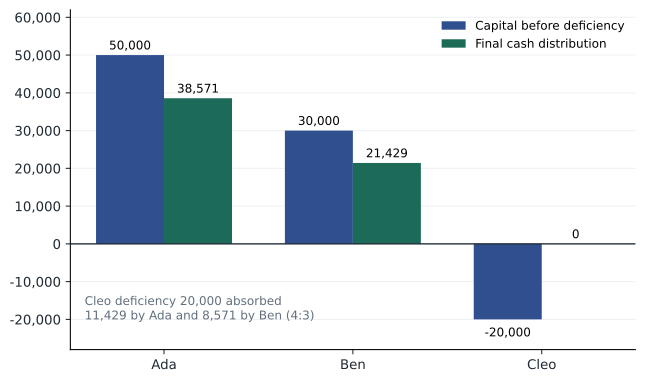
When a partnership ends, it sells its assets (realization), pays creditors, shares gains and losses on realization in the profit ratio, and distributes remaining cash according to the partners' capital balances, not their profit ratio. If a partner's capital becomes negative, that partner must contribute cash to cover the deficiency; if they cannot, the deficiency is absorbed by the other partners in their relative profit ratio. Because the order and amounts of realization are uncertain, partnerships distributing cash in installments prepare a safe payments schedule that assumes all unsold assets are worthless and no deficient partner will pay, so no partner is paid cash that might later have to be returned.
# Liquidation: a partner with a capital deficiency who cannot pay (illustrative)
capital = {"Ada": 50_000, "Ben": 30_000, "Cleo": -20_000}   # after realizing assets and paying creditors
ratio = {"Ada": 0.40, "Ben": 0.30, "Cleo": 0.30}
deficit = {n: -c for n, c in capital.items() if c < 0}
solvent = [n for n in capital if capital[n] > 0]
for d, amt in deficit.items():
    share = sum(ratio[n] for n in solvent)
    for n in solvent:
        capital[n] -= amt * ratio[n] / share  # absorbed in the solvent partners' relative ratio
    capital[d] = 0
cash = sum(v for v in capital.values())
for n, v in capital.items():
    print(f"{n:<5} final cash distribution {v:>10,.0f}")
print(f"Cash available {cash:,.0f}")Ada final cash distribution 38,571 Ben final cash distribution 21,429 Cleo final cash distribution 0 Cash available 60,000
In the program, Cleo's $20,000 deficiency is shared by Ada and Ben in their relative ratio of 40:30, so Ada absorbs $11,429 and Ben $8,571, leaving Ada $38,571 and Ben $21,429 of the $60,000 cash. If Cleo later pays, Ada and Ben recover their shares. Creditors are paid before partners, and personal creditors of a partner have prior claim on that partner's personal assets in many jurisdictions.
Trusts
A trust is a relationship in which a trustee holds property for the benefit of beneficiaries under terms set by the grantor. Accountants meet trusts in estates, family trusts, pension plans and investment funds. A fiduciary accounts to beneficiaries, often distinguishing principal (corpus) from income because the beneficiaries entitled to each may differ; the trust instrument and state law, often based on the Uniform Principal and Income Act or its successor, the Uniform Fiduciary Income and Principal Act, govern that division. Trusts and estates file Form 1041 and are generally taxed on income not distributed to beneficiaries. Real estate investment trusts that meet tax requirements, including distributing at least 90 percent of taxable income, avoid entity-level tax, and their reporting follows US GAAP and SEC rules like other registrants.
Whether a trust is consolidated by someone else is a control question from lesson 9: a sponsor that directs a trust's relevant activities and is exposed to its variable returns may have to consolidate it, as Larkspur did with its receivables trust.
Segment reporting
A consolidated statement adds together businesses with very different prospects. ASC 280 requires public entities to disclose information about their operating segments using the management approach: segments are the components whose operating results are regularly reviewed by the chief operating decision maker (CODM) to allocate resources and assess performance, and the amounts disclosed are those the CODM uses, reconciled to the consolidated totals. Segments may be aggregated if they have similar economic characteristics. A segment is reportable if its revenue (external and intersegment), its absolute profit or loss, or its assets are 10 percent or more of the combined amounts; if reportable segments' external revenue is less than 75 percent of total consolidated revenue, more segments must be reported. ASU 2023-07 added annual and interim disclosure of significant segment expenses regularly provided to the CODM and the CODM's title, and ASU 2024-03 will require disaggregation of certain income statement expense captions for annual periods beginning after 15 December 2026.
Worked problem
Larkspur's segments
By 2027 Larkspur's CODM, its chief executive, reviews five operating segments: Sensors, Controls (Blue Heron), Optics (Osprey), Service contracts and Software. Using the figures in the program below, which segments are reportable?
Show solution
- Combined revenue including intersegment sales is $22.1 million, so the revenue threshold is $2.21 million: Sensors, Controls and Optics pass.
- Combined profit of profitable segments is $3.42 million, exceeding combined losses of $0.25 million, so the profit threshold is $342,000: Service ($140,000) and Software (a $250,000 loss) fail.
- Combined assets are $27.3 million, so the asset threshold is $2.73 million: Service and Software fail.
- Reportable segments' external revenue is $19.6 million, 92.9 percent of $21.1 million, so the 75 percent test is met; Service and Software are combined as all other segments.
Answer: Sensors, Controls and Optics are reportable.
# Which operating segments are reportable? The 10% and 75% tests (illustrative, $ thousands)
seg = {"Sensors":  (12_000, 300, 1_900, 16_000),     # external revenue, intersegment revenue, profit, assets
       "Controls": (3_500,  500,   860,  5_800),
       "Optics":   (4_100,    0,   520,  4_000),
       "Service":  (900,      0,   140,    600),
       "Software": (600,    200,  -250,    900)}
rev = sum(e + i for e, i, _, _ in seg.values())
prof = max(sum(p for _, _, p, _ in seg.values() if p > 0), -sum(p for _, _, p, _ in seg.values() if p < 0))
assets = sum(a for *_, a in seg.values())
reportable = []
for name, (e, i, p, a) in seg.items():
    tests = [(e + i) >= 0.1 * rev, abs(p) >= 0.1 * prof, a >= 0.1 * assets]
    if any(tests): reportable.append(name)
    print(f"{name:<9} revenue {(e + i) / rev:5.1%}  profit {abs(p) / prof:5.1%}  assets {a / assets:5.1%}  reportable={any(tests)}")
ext = sum(seg[n][0] for n in reportable) / sum(e for e, *_ in seg.values())
print(f"External revenue of reportable segments: {ext:.1%} (must be at least 75%)")Sensors revenue 55.7% profit 55.6% assets 58.6% reportable=True Controls revenue 18.1% profit 25.1% assets 21.2% reportable=True Optics revenue 18.6% profit 15.2% assets 14.7% reportable=True Service revenue 4.1% profit 4.1% assets 2.2% reportable=False Software revenue 3.6% profit 7.3% assets 3.3% reportable=False External revenue of reportable segments: 92.9% (must be at least 75%)
Entity-wide disclosures apply even to an entity with a single segment: revenue by product and service, revenue and non-current assets by geographic area (domestic and all foreign countries, with material individual countries shown separately), and reliance on major customers, being any customer providing 10 percent or more of revenue, with the segment concerned but not the customer's name.
Bringing the course together
| Investee | Relationship | US GAAP treatment | Lesson |
|---|---|---|---|
| Listed share portfolio | Passive | Fair value through net income (ASC 321) | 1 |
| Cedar Point (30 percent, then 70) | Significant influence, then control | Equity method, then step acquisition | 2, 8 |
| Northgate | Corporate joint venture | Equity method | 2 |
| Blue Heron (80 percent) | Control | Consolidation with NCI | 3–8 |
| Receivables trust | VIE | Consolidation | 9 |
| Osprey Instruments | Foreign subsidiary | Translation, then consolidation | 10–11 |
| Moraine Advisory | Outside the group | Partnership accounting | 12 |
The common thread is that the accounting follows the economic relationship: passive investments are measured at fair value, significant influence leads to the equity method, a controlling financial interest leads to consolidation regardless of legal form, and foreign entities are translated or remeasured in a way that reflects how their cash flows affect the parent. Judgments about influence, control and functional currency drive everything else, which is why they receive extensive disclosure. ACCT-470 applies these judgments to complex cases, and ACCT-412 covers public sector and not-for-profit organizations, which have their own standards on controlled and related entities.
Common mistakes
MistakeTreating partner salary allowances as expenses of the partnership.
InsteadThey are steps in dividing profit and are applied even when profit is insufficient.
MistakeRecording a purchase of an interest from an existing partner at the price paid.
InsteadThe partnership only transfers the seller's capital balance; the price is private.
MistakeDistributing liquidation cash in the profit ratio.
InsteadCash is distributed according to final capital balances after sharing gains, losses and deficiencies.
MistakeDefining segments by legal entity or by what outsiders expect.
InsteadSegments follow the internal reports the CODM uses.
MistakeIgnoring intersegment revenue in the 10 percent revenue test.
InsteadThe revenue test uses external plus intersegment revenue; the 75 percent test uses external revenue only.
Summary and key terms
- Partners' capital accounts record contributions at fair value, shares of profit and drawings.
- Profit is shared under the agreement: salary allowances and interest, then a residual ratio, even if this creates a residual loss.
- New partners may buy an interest privately or invest; bonuses go to existing or new partners in the residual ratio.
- Liquidation distributes cash by capital balances; deficiencies are absorbed by solvent partners in their relative ratio.
- Trusts separate principal and income for beneficiaries; qualifying REITs avoid entity-level tax.
- ASC 280 uses the management approach with 10 percent and 75 percent tests and expanded expense disclosure.
- Influence, control and functional currency judgments determine the accounting throughout the course.
- Grantor
- The person who creates a trust and transfers property to it.
- Partnership
- Persons carrying on a business in common with a view to profit.
- Capital account
- A partner's equity, increased by contributions and profit and reduced by drawings and losses.
- Bonus method
- Recording admission or retirement by reallocating capital rather than recognizing goodwill.
- Capital deficiency
- A negative capital balance that the partner must make good.
- Safe payments schedule
- An installment distribution plan assuming unsold assets are worthless.
- Chief operating decision maker
- The function that allocates resources to and assesses the performance of segments.
- Operating segment
- A component whose results the CODM reviews regularly and for which discrete information is available.
Practice problems
Work each problem on paper first, then reveal the answer to check.
Rerun the profit-sharing program for profit of $250,000. Ada's share?
Show answer
$118,000.
In the same rerun, Cleo's share?
Show answer
$48,500.
A partner contributes equipment that cost $90,000 with fair value $70,000. Capital credit?
Show answer
$70,000.
Dev pays Ada $150,000 for half of her $200,000 capital. Entry?
Show answer
Dr Ada, capital 100,000; Cr Dev, capital 100,000.
Moraine's capital is $600,000; Eve invests $120,000 for a 20 percent interest. Bonus?
Show answer
A bonus of $24,000 to Eve: 20 percent of $720,000 is $144,000.
Rerun the liquidation program with Cleo's capital at −$35,000. Ada's final cash?
Show answer
About $30,000 (50,000 − 20,000).
Why prepare a safe payments schedule?
Show answer
So no partner receives cash that may later have to be returned.
Rerun the segment program with Service external revenue of 2,400. Is Service reportable?
Show answer
Yes; its revenue is about 10.2 percent of the new combined revenue.
A customer provides 12 percent of revenue. What must be disclosed?
Show answer
That fact, the amount and the segment, but not the customer's name.
Which ASU added significant segment expense disclosure?
Show answer
ASU 2023-07.
Lesson quiz · 5 questions
Score 60% or more to complete this lesson.
Create a free account to save your progress, take quizzes and earn a certificate.