
ACCT-311 · Lesson 10 of 12 · 28 min
Foreign currency transactions and hedging
Larkspur buys components from suppliers in Canada, pays some of them in Canadian dollars and sells some products to Canadian customers. Each of these transactions exposes it to changes in exchange rates between the date it agrees a price and the date cash changes hands. This lesson covers how such transactions are recorded under ASC 830-20, how transaction gains and losses on receivables and payables are reported, and how forward contracts and hedge accounting under ASC 815 can reduce the volatility those differences create. The next lesson takes up the related but distinct problem of translating the financial statements of a whole foreign entity.
Functional currency comes first
ASC 830 requires each entity to identify its functional currency, the currency of the primary economic environment in which it operates, normally the environment in which it primarily generates and expends cash. The indicators include the currency of its cash flows, whether sales prices respond to local or worldwide markets, where its sales market is, the currency of its expenses, the currency of its financing and the extent of intercompany transactions with the parent. A transaction is a foreign currency transaction when it is denominated in a currency other than the entity's functional currency. Larkspur's functional currency is the US dollar, so a purchase invoiced in Canadian dollars is a foreign currency transaction. The reporting currency can differ from the functional currency; that is the subject of the next lesson.
Recording transactions
A foreign currency transaction is recorded initially at the spot exchange rate on the date of the transaction; an average rate may be used if it approximates the results. At each balance sheet date, monetary assets and liabilities denominated in a foreign currency, such as cash, receivables, payables and loans, are remeasured at the current rate. Nonmonetary items measured at historical cost, such as inventory, equipment and prepayments, stay at the historical rate. The resulting transaction gains and losses are generally included in net income for the period in which the exchange rate changes, with exceptions for certain hedges and intercompany balances of a long-term investment nature, which are covered in the next lesson.
Because the gain or loss arises every time rates move, a payable that crosses a year end produces two transaction gains or losses: one from the transaction date to the balance sheet date and another from the balance sheet date to settlement. The cost of the inventory or equipment acquired is fixed at the transaction-date rate; later rate changes affect earnings, not the asset.
Worked problem
A US dollar payable
On 1 November 2026 Larkspur buys inventory from a Canadian supplier for CAD 500,000, payable on 31 January 2027. Spot rates (USD per CAD, illustrative): 1 November 0.735; 31 December 0.72; 31 January 0.725. Record the transaction and the transaction gains and losses.
Show solution
- 1 November: Dr Inventory 367,500; Cr Accounts payable 367,500 (500,000 × 0.735).
- 31 December: the payable is remeasured to 360,000 (500,000 × 0.72). Dr Accounts payable 7,500; Cr Transaction gain 7,500.
- 31 January: the payable would be 362,500 (500,000 × 0.725). Dr Accounts payable 360,000; Dr Transaction loss 2,500; Cr Cash 362,500.
- The inventory stays at 367,500. The net gain of 5,000 over the two years reflects the weaker Canadian dollar at settlement.
Answer: 2026 gain 7,500; 2027 loss 2,500; inventory 367,500.
Forward contracts as economic hedges
A treasurer who does not want to bear the risk of a stronger Canadian dollar can enter into a forward contract, an agreement to buy CAD 500,000 on 31 January at a rate fixed today. Under ASC 815 the forward is a derivative measured at fair value with changes in earnings. Because the payable is also remeasured through earnings, the change in the forward offsets most of the change in the payable without any special hedge accounting. This natural offset is why entities rarely designate hedges of recognized monetary items: the accounting already matches.
# A foreign currency payable, with and without a forward contract (illustrative rates)
amount = 500_000                       # CAD owed to the supplier
spot = {"1 Nov 2026": 0.735, "31 Dec 2026": 0.72, "31 Jan 2027": 0.725}   # USD per CAD
forward_rate = 0.738                    # contracted on 1 Nov for delivery 31 Jan
forward_31_dec = 0.722                  # forward rate for 31 Jan delivery, quoted on 31 Dec
payable = {d: round(amount * r) for d, r in spot.items()}
dates = list(spot)
fx_2026 = payable[dates[0]] - payable[dates[1]]          # gain (+) or loss (-) on the payable
fx_2027 = payable[dates[1]] - payable[dates[2]]
fwd_dec = round((forward_31_dec - forward_rate) * amount)    # fair value, ignoring discounting
fwd_jan = round((spot[dates[2]] - forward_rate) * amount)
print(f"Payable in USD: " + ", ".join(f"{d} {v:,}" for d, v in payable.items()))
print(f"Exchange gain (loss) on payable: 2026 {fx_2026:,}; 2027 {fx_2027:,}")
print(f"Forward gain (loss):             2026 {fwd_dec:,}; 2027 {fwd_jan - fwd_dec:,}")
print(f"Net effect on profit:            2026 {fx_2026 + fwd_dec:,}; 2027 {fx_2027 + fwd_jan - fwd_dec:,}")
print(f"Total USD cost of settling: {payable[dates[2]] - fwd_jan:,} = {amount:,} x {forward_rate}")Payable in USD: 1 Nov 2026 367,500, 31 Dec 2026 360,000, 31 Jan 2027 362,500 Exchange gain (loss) on payable: 2026 7,500; 2027 -2,500 Forward gain (loss): 2026 -8,000; 2027 1,500 Net effect on profit: 2026 -500; 2027 -1,000 Total USD cost of settling: 369,000 = 500,000 x 0.738
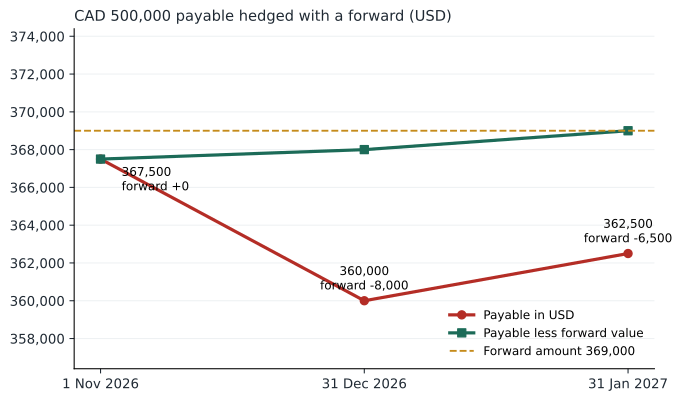
The program shows the payable and a forward contracted on 1 November at 0.738 for 31 January delivery. In 2026 the forward loses 8,000, offsetting the 7,500 gain on the payable; in 2027 it gains 1,500 against the 2,500 loss. The net effect, a 500 loss and then a 1,000 loss, is the difference between the spot and forward rates (the forward points), and the total cost of settlement is locked at 369,000, the forward rate times CAD 500,000. Fair values here ignore discounting and credit risk, which a real valuation would include.
Hedge accounting
When the hedged item is not yet recognized, such as a forecasted purchase or a firm commitment, or is measured differently from the derivative, the gains and losses fall in different periods. Hedge accounting is an optional set of rules that fixes this mismatch. ASC 815 recognizes three types of hedge. In a fair value hedge, of a recognized asset or liability or an unrecognized firm commitment, the hedged item is adjusted for changes in fair value attributable to the hedged risk through earnings, offsetting the derivative. In a cash flow hedge, of a forecasted transaction or variable cash flows, the change in the derivative's fair value included in the effectiveness assessment goes to other comprehensive income and accumulates in AOCI until the hedged transaction affects earnings. A hedge of a net investment in a foreign operation, covered in the next lesson, records gains and losses in the cumulative translation adjustment.
To qualify, ASC 815 requires formal documentation at inception, including how effectiveness will be assessed, and an expectation that the hedge will be highly effective, generally interpreted as offsetting 80 to 125 percent of changes in the hedged item. After ASU 2017-12, an initial quantitative test is often required, but later assessments may be qualitative, and the entire change in the fair value of the hedging instrument included in the assessment is recorded in the same income statement line as the hedged item; ineffectiveness is no longer measured and reported separately. Private companies have simplified options, including the simplified hedge accounting approach for certain interest rate swaps and later documentation deadlines.
Worked problem
Hedging a forecast purchase
On 1 October 2026 Larkspur forecasts, as probable, a purchase of CAD 1,000,000 of inventory on 31 March 2027, and enters into a forward to buy CAD 1,000,000 on that date at 0.74 (illustrative). On 31 December the forward rate for 31 March is 0.725; on 31 March the spot rate is 0.715. The hedge is designated as a cash flow hedge and is fully effective.
Show solution
- 31 December 2026: the forward is a liability of 15,000 ((0.725 − 0.74) × 1,000,000). Dr OCI 15,000; Cr Forward contract 15,000. Earnings are unaffected.
- 31 March 2027: the forward is a liability of 25,000; a further 10,000 goes to OCI. Settle: pay 25,000 net.
- Purchase inventory at spot: 715,000. ASC 815 does not permit a basis adjustment: inventory is 715,000 and the 25,000 stays in AOCI.
- As the inventory is sold, the 25,000 is reclassified from AOCI to cost of sales, so total cost of sales reflects 740,000, the hedged rate.
Answer: Inventory 715,000; 25,000 reclassified from AOCI to cost of sales on sale.
# Cash flow hedge of a forecast CAD purchase of inventory (illustrative rates)
amount = 1_000_000                    # forecast purchase on 31 Mar 2027, in CAD
forward_rate = 0.74                   # forward contracted 1 Oct 2026
forward_31_dec = 0.725                 # forward rate for 31 Mar delivery, quoted 31 Dec 2026
spot_31_mar = 0.715
fv_dec = round((forward_31_dec - forward_rate) * amount)
fv_mar = round((spot_31_mar - forward_rate) * amount)
purchase = round(spot_31_mar * amount)
print(f"Hedge reserve (OCI) at 31 Dec 2026: {fv_dec:,}")
print(f"Change in OCI to 31 Mar 2027:      {fv_mar - fv_dec:,}; cumulative {fv_mar:,}")
print(f"Inventory purchased at spot:       {purchase:,}")
print(f"ASC 815: inventory stays at {purchase:,}; AOCI of {fv_mar:,} is reclassified to cost of sales")
print(f"as the inventory is sold, so cost of sales reflects {purchase - fv_mar:,} in total.")Hedge reserve (OCI) at 31 Dec 2026: -15,000 Change in OCI to 31 Mar 2027: -10,000; cumulative -25,000 Inventory purchased at spot: 715,000 ASC 815: inventory stays at 715,000; AOCI of -25,000 is reclassified to cost of sales as the inventory is sold, so cost of sales reflects 740,000 in total.
The program reproduces the example. Without hedge accounting, the 15,000 loss on the forward would hit 2026 earnings while the inventory purchase it protects occurs in 2027, a mismatch that makes earnings volatile for reasons unrelated to performance. Hedge accounting defers the loss in AOCI and releases it when the hedged purchase affects earnings.
| Hedge type | Hedged item | Derivative gain or loss | Hedged item |
|---|---|---|---|
| Fair value | Recognized asset, liability or firm commitment | Profit or loss | Remeasured for hedged risk through profit or loss |
| Cash flow | Forecast transaction or variable cash flows | OCI (effective portion), then to profit or loss or basis adjustment | Not remeasured |
| Net investment | Net assets of a foreign operation | OCI with translation differences | Translated as usual |
| None (economic hedge) | Recognized monetary item | Profit or loss | Retranslated through profit or loss |
Disclosures and the SEC
SEC registrants disclose their exposure to market risk, including foreign currency risk, in a quantitative and qualitative section of Form 10-K (Regulation S-K Item 305), often using sensitivity analysis of the effect of a hypothetical 10 percent change in exchange rates. ASC 815 also requires tabular disclosure of the fair values of derivatives and the location and amounts of gains and losses in the income statement and OCI, and the objectives and strategies behind hedging activity.
Under IFRS, by contrast, a cash flow hedge of a forecast purchase of a non-financial item requires a basis adjustment to the asset's initial cost, and IFRS 9 has no bright-line effectiveness test. These differences matter when comparing a US filer with a foreign private issuer that reports under IFRS.
Choosing a strategy
Not every exposure needs hedging. A company with offsetting receivables and payables in the same currency has a natural hedge; one that can price its sales in its own currency may avoid exposure entirely. Forward contracts lock in a rate but give up the benefit of favorable moves; options cost a premium but preserve upside. Hedge accounting brings documentation and testing costs, so smaller companies often accept some volatility in reported results rather than designate hedges. Whatever the choice, the accounting should report the economics transparently, and users should be able to see how much of reported profit came from exchange movements.
Common mistakes
MistakeRemeasuring inventory bought in Canadian dollars at the current rate.
InsteadNon-monetary items at historical cost stay at the transaction-date rate; only monetary items are retranslated.
MistakeAdjusting the cost of the asset for later exchange differences on the payable.
InsteadExchange differences after the transaction date go to profit or loss; the asset cost is fixed.
MistakeDesignating a hedge of a payable to get matching.
InsteadThe payable and forward already both go through profit or loss; hedge accounting adds nothing.
MistakeAdding the AOCI balance to inventory cost when a hedged purchase occurs.
InsteadASC 815 keeps it in AOCI until the inventory affects earnings; IFRS would basis-adjust.
MistakeAssuming no effectiveness assessment is needed after ASU 2017-12.
InsteadAn expectation of high effectiveness must still be documented and assessed.
Summary and key terms
- Identify the functional currency first; transactions in other currencies are foreign currency transactions.
- Record transactions at the spot rate; retranslate monetary items at the closing rate; leave historical-cost non-monetary items at the transaction rate.
- Transaction gains and losses on monetary items go to net income.
- A forward contract on a recognized payable gives a natural offset without hedge accounting.
- ASC 815 hedge accounting has fair value, cash flow and net investment hedges, with a highly effective threshold.
- ASC 815 keeps cash flow hedge amounts in AOCI until the hedged item affects earnings.
- SEC registrants disclose market risk sensitivity under Regulation S-K Item 305.
- Transaction gain or loss
- The effect of an exchange rate change on a foreign currency denominated balance.
- Highly effective
- The ASC 815 threshold for hedge accounting, generally 80 to 125 percent offset.
- Functional currency
- The currency of the primary economic environment in which an entity operates.
- Foreign currency transaction
- A transaction denominated in a currency other than the functional currency.
- Monetary item
- A right to receive or obligation to pay a fixed or determinable number of currency units.
- Forward contract
- An agreement to exchange currencies at a fixed rate on a future date.
- Fair value hedge
- A hedge of exposure to changes in the fair value of a recognized item or firm commitment.
- Cash flow hedge
- A hedge of exposure to variability in cash flows from a forecast transaction or variable-rate item.
- Forward points
- The difference between forward and spot rates, reflecting interest rate differences.
Practice problems
Work each problem on paper first, then reveal the answer to check.
ca
Show answer
us
Is a prepayment for equipment a monetary item?
Show answer
No; it is non-monetary and stays at the transaction-date rate.
Rerun the payable program with a 31 January spot rate of 0.70. Total transaction gain or loss over both years?
Show answer
Gain of 17,500 (7,500 then 10,000).
In that rerun, what is the total cost of settling with the forward?
Show answer
Still 369,000; the forward locks the rate.
Why is hedge accounting usually unnecessary for a forward hedging a recognized payable?
Show answer
Both the payable and the derivative already go through profit or loss.
Name the three types of hedge.
Show answer
Fair value, cash flow and net investment.
Rerun the cash flow hedge program with a 31 March spot rate of 0.76. Cumulative AOCI before reclassification?
Show answer
A gain of 20,000; total cost of sales still reflects 740,000.
Does ASC 815 still require hedges to be highly effective?
Show answer
Yes; generally 80 to 125 percent offset.
Where do SEC registrants disclose foreign currency risk sensitivity?
Show answer
In the quantitative and qualitative market risk section of Form 10-K.
What is a natural hedge?
Show answer
Offsetting receivables and payables, or revenues and costs, in the same currency.
Lesson quiz · 5 questions
Score 60% or more to complete this lesson.
Create a free account to save your progress, take quizzes and earn a certificate.