
ACCT-311 · Lesson 1 of 12 · 27 min
Intercorporate investments: an overview
Companies rarely stand alone. A US manufacturer may own a few shares of a supplier, a third of a technology start-up, half of a joint venture with a competitor and all of a distribution company in Canada. Each of these holdings raises the same question for the accountant: how should the investor's financial statements show an investment in another entity? The answer depends on how much influence the investor has over the investee, and it ranges from carrying a few shares at fair value to combining the investee's assets, liabilities, revenues and expenses line by line with the investor's own. This course, Advanced Financial Accounting, is about that range. It builds on ACCT-211 and ACCT-212, which covered individual assets, liabilities and equity, and moves to groups of entities, foreign operations and other complex reporting situations.
Throughout the course we follow one invented group. Larkspur Holdings Inc., a Denver maker of industrial sensors with a December year end, reports under US GAAP as an SEC registrant. In 2026 it holds a small portfolio of listed shares, buys 30 percent of an analytics company, forms a joint venture and acquires 80 percent of a controls manufacturer, Blue Heron Controls. Later it acquires a Canadian subsidiary, Osprey Instruments Ltd., whose functional currency is the Canadian dollar. Where IFRS, used by Canadian and many other foreign companies, differs in a way that matters, we say so. All company names and figures are invented and illustrative.
Why companies invest in other companies
Intercorporate investments serve different purposes. Some are passive: a company with surplus cash buys shares of listed companies to earn dividends and price gains until it needs the money. Others are strategic. An investor may buy enough shares to win a seat on a supplier's board and secure a reliable source of components, or it may form a joint venture to share the cost and risk of entering a new market. At the far end, an investor buys control of another company to expand capacity, acquire technology, enter a new region or remove a competitor. The purpose often predicts the accounting, but the standards look at the substance of the relationship, not management's intention alone.
Ownership can be direct or indirect. A parent may own a subsidiary that in turn owns another company, creating a chain of control. Ownership may be held through common shares, through other instruments such as options and convertible debt that could become shares, or through contracts that give one party the power to direct another entity's activities without owning shares at all. The accounting framework must handle all of these.
The spectrum of influence
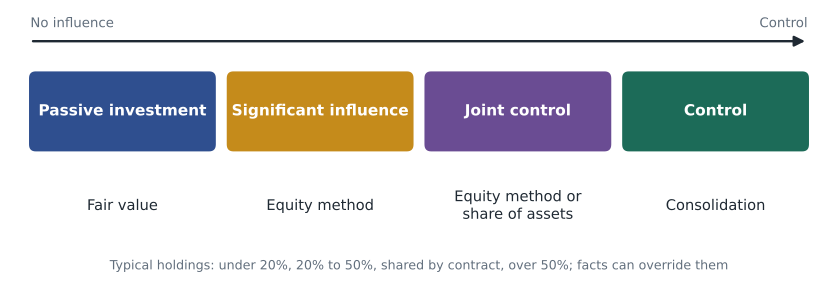
The standards sort investments into four broad categories according to the investor's ability to affect the investee's decisions. Passive investments give the investor no significant influence. Investments in associates give significant influence: the power to participate in, but not control, the investee's financial and operating policy decisions. Joint arrangements involve joint control, where decisions about the relevant activities require the unanimous consent of the parties sharing control. Subsidiaries are controlled: the investor has power over the investee, exposure or rights to variable returns, and the ability to use its power to affect those returns.
| Relationship | Typical ownership | Key concept | Accounting under US GAAP |
|---|---|---|---|
| Passive investment | Under 20 percent | No significant influence | Fair value through net income (ASC 321); debt securities by category (ASC 320) |
| Equity method investee | 20 to 50 percent | Significant influence | Equity method (ASC 323) |
| Joint venture | Shared | Joint control | Equity method (ASC 323); proportionate consolidation only in limited industries |
| Variable interest entity | Any | Controlling financial interest through variable interests | Consolidated by the primary beneficiary (ASC 810) |
| Subsidiary | Over 50 percent of voting shares | Controlling financial interest | Consolidation (ASC 810) |
The percentages are presumptions, not rules. Owning 20 percent or more of the voting power is presumed to give significant influence unless it can be clearly shown otherwise, and owning less than 20 percent is presumed not to, unless influence can be clearly shown. Evidence of significant influence includes representation on the board, participation in policy-making, material transactions between the investor and investee, interchange of managerial personnel and provision of essential technical information. An investor with 15 percent and two of nine board seats may have significant influence; an investor with 25 percent whose investee is controlled by a hostile majority shareholder that ignores it may not.
Passive investments
Under ASC 321, equity securities without significant influence are measured at fair value through net income. There is no option to present changes in OCI. For equity securities without a readily determinable fair value, an entity may elect a measurement alternative: cost, less impairment, adjusted for observable price changes in orderly transactions for identical or similar securities of the same issuer. Investments in debt securities follow ASC 320: held-to-maturity at amortized cost, available-for-sale at fair value with changes in OCI that are recycled to net income on sale, or trading at fair value through net income. Credit losses on held-to-maturity securities follow the current expected credit loss model in ASC 326.
IFRS 9, by contrast, allows an irrevocable election to present fair value changes on non-trading equity investments in OCI without recycling. A US company comparing its results with a European or Canadian competitor needs to check whether that election has kept equity price swings out of the competitor's profit.
Worked problem
Passive investment in listed shares
On 3 February 2026 Larkspur buys 10,000 shares of a listed supplier at $42 a share. At 31 December 2026 the share price is $47, and Larkspur received dividends of $1.20 a share during the year. Show the effect on 2026 net income under ASC 321 and, for comparison, under IFRS 9 with the OCI election.
Show solution
- Cost: 10,000 × $42 = $420,000. Fair value at year end: 10,000 × $47 = $470,000.
- Dividend income: 10,000 × $1.20 = $12,000, recognized in profit in all cases.
- ASC 321: net income includes the $50,000 gain plus $12,000 dividends, $62,000 in total.
- IFRS 9 with the OCI election: profit includes only the $12,000 dividends; the $50,000 gain goes to OCI.
Answer: Net income of $62,000 under ASC 321; an IFRS reporter using the OCI election would show $12,000.
Significant influence and the equity method in brief
When an investor has significant influence, fair value no longer tells the whole story, and the cost method would let the investor manipulate income by influencing the timing of dividends. The equity method, covered in lesson 2, recognizes the investor's share of the investee's profit or loss as it is earned. The investment starts at cost, increases by the investor's share of profit, decreases by its share of losses and by dividends received, and is adjusted for the amortization of any excess of cost over the investor's share of the carrying amounts, and for unrealized profits on transactions between the two. The equity method is sometimes called one-line consolidation, because it produces the same profit attributable to the investor as consolidation would, but presents it in a single line.
Control and consolidation in brief
Control triggers consolidation. Under ASC 810, a reporting entity consolidates another entity in which it has a controlling financial interest. There are two models. Under the voting interest model, a controlling financial interest is usually ownership of a majority of the voting shares, although contractual rights held by others can overcome that presumption. Under the variable interest entity (VIE) model, covered in lesson 9, an entity that lacks sufficient equity at risk or whose equity holders lack the usual characteristics of a controlling interest is consolidated by its primary beneficiary: the party with both the power to direct the activities that most significantly affect the entity's economic performance and the obligation to absorb losses or the right to receive benefits that could be significant. Consolidated financial statements present the parent and its subsidiaries as a single economic entity, with intercompany balances eliminated and the portion not owned by the parent shown as noncontrolling interest within equity.
Canadian practice shows how much the framework matters. Canadian public companies use IFRS 10, whose single control model applies to all entities and emphasizes power over the relevant activities. Canadian private enterprises applying ASPE may choose not to consolidate subsidiaries at all, accounting for them by the equity or cost method instead. US private companies have a few alternatives of their own, notably an option not to apply VIE guidance to certain common-control leasing and other arrangements, discussed in lesson 9.
Business combinations
A business combination is a transaction or event in which an acquirer obtains control of one or more businesses. It can happen by buying shares, which creates a parent–subsidiary relationship, or by buying net assets directly, in which case the acquirer records the assets and liabilities in its own books and there is no subsidiary to consolidate. Both are accounted for using the acquisition method, covered in lesson 3: identify the acquirer, determine the acquisition date, recognize and measure the identifiable assets acquired, liabilities assumed and any non-controlling interest, and recognize goodwill or a gain on a bargain purchase.
# Classifying Larkspur's investments by influence (illustrative assessments)
holdings = [
    ("Listed supplier shares", 0.02, "no board seat", "passive"),
    ("Cedar Point Analytics", 0.30, "2 of 7 board seats", "significant influence"),
    ("Northgate JV", 0.50, "unanimous consent on budgets", "joint control"),
    ("Blue Heron Controls", 0.80, "majority of board", "control"),
    ("Data partner", 0.15, "1 board seat, key technology rights", "significant influence"),
]
method = {"passive": "fair value", "significant influence": "equity method",
          "joint control": "equity method (joint venture)", "control": "consolidate"}
print(f"{'Investee':<26}{'Owned':>7}  {'Evidence':<38}{'Method'}")
for name, pct, evidence, rel in holdings:
print(f"{name:<26}{pct:>7.0%} {evidence:<38}{method[rel]}")Investee Owned Evidence Method Listed supplier shares 2% no board seat fair value Cedar Point Analytics 30% 2 of 7 board seats equity method Northgate JV 50% unanimous consent on budgets equity method (joint venture) Blue Heron Controls 80% majority of board consolidate Data partner 15% 1 board seat, key technology rights equity method
The last row of the program's output makes the point about presumptions: a 15 percent holding is accounted for by the equity method because the board seat and the technology rights give Larkspur significant influence. The ownership percentage is the starting point for judgment, not the end of it.
Why consolidation matters to users
Imagine Larkspur reported its 80 percent interest in Blue Heron as a single investment line. Its balance sheet would hide Blue Heron's debt, its inventory, its plant and its customer receivables, and its income statement would hide Blue Heron's revenue and expenses. A lender assessing Larkspur's leverage, or an investor estimating its growth, would see only a fraction of the resources the group controls. Consolidation shows the full scale of the economic entity that management directs, while the NCI line shows how much of the subsidiary's net assets belongs to outside shareholders. Separate financial statements of the parent alone, prepared for legal or tax purposes, can still be issued, but they are not a substitute for consolidated statements under IFRS or US GAAP.
Consolidation also has limits. Creditors of a subsidiary generally have claims only against that subsidiary, not against the parent, unless the parent has guaranteed the debt. Dividends from subsidiaries may be restricted by local law, loan covenants or foreign exchange controls. Consolidated figures can therefore overstate the cash the parent can actually reach, which is why segment disclosures (lesson 12) and disclosures about restrictions on subsidiaries matter.
Disclosure
US GAAP disclosures for these relationships are spread across several topics: ASC 323 for equity method investments, including summarized financial information for significant investees; ASC 810 for consolidation and VIEs, including the significant judgments in identifying a primary beneficiary; ASC 805 for business combinations; and SEC Regulation S-X, which can require separate financial statements of significant equity method investees and acquired businesses (Rules 3-05, 3-09 and 4-08(g)). Public companies must also disclose parent-only condensed financial information in certain cases when subsidiaries' net assets are restricted.
Looking ahead
The rest of the course follows the spectrum from left to right. Lesson 2 covers the equity method and joint arrangements. Lessons 3 to 9 cover business combinations and consolidation: the acquisition method, consolidation at and after acquisition, intercompany transactions, changes in ownership and control through contracts and structured entities. Lessons 10 and 11 deal with foreign currency, and lesson 12 covers partnerships, segment reporting and a capstone consolidation of the whole group. Not-for-profit and public sector reporting are covered separately in ACCT-412.
Common mistakes
MistakeTreating 20 percent ownership as an automatic line between methods.
InsteadThe 20 percent threshold is a rebuttable presumption; look at board representation, transactions and other evidence of influence.
MistakeRecording fair value changes on equity securities in OCI.
InsteadASC 321 requires fair value changes on equity securities to go through net income.
MistakeAssuming a parent needs a majority of shares to have control.
InsteadA controlling financial interest can arise through variable interests even with little or no equity ownership.
MistakeThinking consolidation means the parent owns the subsidiary's assets outright.
InsteadConsolidation reports the economic entity the parent controls; outside owners' share is shown as non-controlling interest, and the subsidiary's creditors usually have claims only against the subsidiary.
MistakeIgnoring the reporting framework when comparing groups.
InsteadIFRS has a single control model and an FVOCI election for equity investments; US GAAP does not.
Summary and key terms
- The accounting for an intercorporate investment depends on the investor's influence over the investee.
- Passive equity investments are measured at fair value through net income; there is no OCI option.
- Significant influence, presumed at 20 percent or more of voting power, leads to the equity method.
- Joint ventures are generally equity-accounted.
- A controlling financial interest under the voting interest or VIE model leads to consolidation.
- Consolidated statements present the parent and subsidiaries as one economic entity, with non-controlling interest in equity.
- Framework differences, such as the IFRS FVOCI election and single control model, affect comparisons with foreign competitors.
- Measurement alternative
- The ASC 321 option to carry equity securities without readily determinable fair values at cost less impairment, adjusted for observable price changes.
- Primary beneficiary
- The party that consolidates a variable interest entity because it has power and significant economic exposure.
- Intercorporate investment
- A holding of shares or other interests in another entity.
- Significant influence
- The power to participate in, but not control or jointly control, an investee's financial and operating policy decisions.
- Joint control
- The contractually agreed sharing of control, where decisions about relevant activities require unanimous consent of the parties sharing control.
- Control
- Power over an investee, with exposure or rights to variable returns and the ability to use the power to affect those returns.
- Subsidiary
- An entity controlled by another entity, its parent.
- Consolidated financial statements
- Statements presenting a parent and its subsidiaries as a single economic entity.
- Non-controlling interest
- The equity in a subsidiary not attributable, directly or indirectly, to the parent.
- Business combination
- A transaction or event in which an acquirer obtains control of one or more businesses.
Practice problems
Work each problem on paper first, then reveal the answer to check.
An investor owns 18 percent, appoints two of seven directors and supplies key technology. Method?
Show answer
Probably the equity method; significant influence is evident despite owning under 20 percent.
An investor owns 35 percent, but the 65 percent holder ignores it and it has no board seat. Method?
Show answer
The presumption of significant influence may be rebutted; fair value accounting may apply.
Shares bought for $80,000 are worth $95,000 at year end, with $3,000 of dividends. Net income under ASC 321?
Show answer
$18,000: a $15,000 gain plus $3,000 of dividends.
Would an IFRS reporter with the FVOCI election show the same figure?
Show answer
No; it would show $3,000 in profit and the $15,000 gain in OCI.
Name three indicators of significant influence.
Show answer
Board representation, participation in policy-making, material transactions, interchange of managers, essential technical information (any three).
What three elements make up control under IFRS 10?
Show answer
Power over the investee, exposure or rights to variable returns, and the ability to use power to affect those returns.
Why is the equity method called one-line consolidation?
Show answer
It produces the same profit attributable to the investor as consolidation but shows it in one line.
Why might consolidated cash overstate what a parent can use?
Show answer
Subsidiary cash may be restricted by local law, covenants or exchange controls, and subsidiary creditors have first claim.
Must a Canadian private enterprise using ASPE consolidate a wholly owned subsidiary?
Show answer
No; it may choose consolidation, the equity method or the cost method as a policy applied to all subsidiaries.
Rerun the classification program after changing the data partner to 15 percent with no board seat and no license. What changes?
Show answer
Its relationship becomes passive and the method becomes fair value.
Lesson quiz · 5 questions
Score 60% or more to complete this lesson.
Create a free account to save your progress, take quizzes and earn a certificate.