
ACCT-311 · Lesson 5 of 12 · 30 min
Consolidation after acquisition: the acquisition differential and NCI
A year has passed. In 2026 Blue Heron earned profit of $600,000 and paid dividends of $200,000, of which Larkspur received $160,000. Larkspur's own profit, before any income from Blue Heron, was $1,500,000, and it paid dividends of $600,000 to its shareholders. Larkspur must now prepare consolidated statements for 2026. This lesson shows how the acquisition differential is amortized, how consolidated profit is divided between the parent's owners and NCI, and how consolidated retained earnings and NCI are carried forward. Intercompany sales are ignored until lesson 6.
How the parent accounts for the investment in its own books
Consolidation starts from the separate statements of each entity, so the method the parent uses for its investment in its own records matters for the worksheet, even though it does not change the consolidated result. Many parents use the cost method in their own books, recognizing only dividends from the subsidiary as income. Others use the equity method, so that the parent's own profit already equals consolidated profit attributable to the parent. The worksheet eliminations differ, but the consolidated statements are identical.
US GAAP does not provide for general-purpose parent-only financial statements in place of consolidated statements, but SEC registrants with significant restrictions on subsidiary net assets present condensed parent-only information (Schedule I), in which investments in subsidiaries are usually carried on the equity method. In this course Larkspur uses the cost method in its own ledger, so its separate income includes only dividends from Blue Heron.
Amortizing the acquisition differential
In Larkspur's books nothing records the fair value increments. On consolidation, however, the group's assets include Blue Heron's inventory, equipment and patent at their acquisition-date fair values, and those higher values must be expensed as the assets are used. The inventory increment is expensed when the inventory is sold, usually in the first year. The equipment and patent increments are depreciated and amortized over their remaining useful lives. Goodwill is not amortized but is tested for impairment.
Worked problem
Amortization for 2026
Using the lesson 3 allocation: inventory $100,000, sold in 2026; equipment $400,000 over 10 years; patent $300,000 over 5 years. Compute the 2026 amortization of the acquisition differential.
Show solution
- Inventory: $100,000, all in 2026, added to cost of sales.
- Equipment: $400,000 ÷ 10 = $40,000 depreciation.
- Patent: $300,000 ÷ 5 = $60,000 amortization.
- Total 2026: $200,000. In 2027 it falls to $100,000, because the inventory increment is fully expensed.
Answer: Amortization of $200,000 in 2026 and $100,000 a year afterwards until the patent is fully amortized.
# Acquisition differential amortization schedule (fair value NCI), with 2027 goodwill impairment
items = {"Inventory": (100_000, 1), "Equipment": (400_000, 10), "Patent": (300_000, 5)}
goodwill = {2026: 0, 2027: 50_000}
bal = {k: v for k, (v, _) in items.items()}
gw = 1_350_000
print(f"{'Year':>4} {'Inventory':>10} {'Equipment':>10} {'Patent':>9} {'Goodwill impairment':>20} {'Total':>9}")
for yr in (2026, 2027, 2028):
    row = {}
    for k, (v, life) in items.items():
        a = min(v / life, bal[k]); bal[k] -= a; row[k] = a
    gi = goodwill.get(yr, 0); gw -= gi
    print(f"{yr:>4} {row['Inventory']:>10,.0f} {row['Equipment']:>10,.0f} {row['Patent']:>9,.0f} {gi:>20,.0f} {sum(row.values()) + gi:>9,.0f}")
print("Unamortized at end of 2028:", {k: round(v) for k, v in bal.items()}, "goodwill", f"{gw:,.0f}")Year Inventory Equipment Patent Goodwill impairment Total
2026 100,000 40,000 60,000 0 200,000
2027 0 40,000 60,000 50,000 150,000
2028 0 40,000 60,000 0 100,000
Unamortized at end of 2028: {'Inventory': 0, 'Equipment': 280000, 'Patent': 120000} goodwill 1,300,000The schedule also records a goodwill impairment of $50,000 in 2027, when an annual test shows that Blue Heron's market has softened. Because NCI was measured at fair value, the impairment relates to goodwill attributable to both the parent and NCI.
Under ASC 350-20-35-57A, a goodwill impairment loss for a reporting unit with a less-than-wholly-owned subsidiary is attributed to the parent and the noncontrolling interest on a rational basis. Larkspur attributes it in proportion to ownership, 80:20; allocating in proportion to each party's share of goodwill, also seen in practice, would attribute slightly more to the parent.
Consolidated profit and its attribution
Consolidated profit equals the parent's own profit, excluding its income from the subsidiary, plus the subsidiary's profit, less amortization of the acquisition differential and any goodwill impairment. The parent's dividend income from the subsidiary is eliminated, because a dividend inside the group is just cash moving from one pocket to another. Consolidated profit is then attributed to NCI and to the owners of the parent.
Worked problem
Attributing 2026 profit
Compute 2026 consolidated profit and its attribution, and the parent's share.
Show solution
- Larkspur's profit excluding dividend income from Blue Heron: $1,500,000.
- Blue Heron's profit adjusted for amortization: $600,000 − $200,000 = $400,000.
- Consolidated profit: $1,500,000 + $400,000 = $1,900,000.
- NCI share: 20% × $400,000 = $80,000.
- Owners of Larkspur: $1,900,000 − $80,000 = $1,820,000, which equals $1,500,000 + 80% × $400,000.
Answer: Consolidated profit $1,900,000: NCI $80,000 and owners of the parent $1,820,000.
# Consolidated income statement for 2026 and the NCI and retained earnings roll-forward (illustrative)
P = {"Revenue": 12_000_000, "Cost of sales": 7_200_000, "Operating expenses": 2_700_000,
     "Interest": 200_000, "Income tax": 400_000, "Dividend income": 160_000}
S = {"Revenue": 4_000_000, "Cost of sales": 2_400_000, "Operating expenses": 680_000,
     "Interest": 60_000, "Income tax": 260_000}
amort = {"Cost of sales": 100_000, "Operating expenses": 40_000 + 60_000}   # inventory; equipment and patent
cons = {k: P.get(k, 0) + S.get(k, 0) + amort.get(k, 0) for k in S}
profit = cons["Revenue"] - sum(v for k, v in cons.items() if k != "Revenue")
sub_profit = S["Revenue"] - sum(v for k, v in S.items() if k != "Revenue")
sub_adjusted = sub_profit - sum(amort.values())
nci_share = 0.20 * sub_adjusted
for k, v in cons.items():
    print(f"{k:<22}{v:>12,.0f}")
print(f"{'Profit':<22}{profit:>12,.0f}")
print(f"{'  to NCI':<22}{nci_share:>12,.0f}")
print(f"{'  to owners of parent':<22}{profit - nci_share:>12,.0f}")
nci = 950_000 + nci_share - 0.20 * 200_000
re = 5_000_000 + (profit - nci_share) - 600_000
print(f"NCI, 31 Dec 2026: {nci:,.0f} Consolidated retained earnings: {re:,.0f}")Revenue 16,000,000 Cost of sales 9,700,000 Operating expenses 3,480,000 Interest 260,000 Income tax 660,000 Profit 1,900,000 to NCI 80,000 to owners of parent 1,820,000 NCI, 31 Dec 2026: 990,000 Consolidated retained earnings: 6,220,000
The consolidated income statement combines revenues and expenses line by line, adds the $100,000 inventory increment to cost of sales and the $100,000 of extra depreciation and amortization to operating expenses, and excludes the $160,000 dividend income. The program confirms consolidated profit of $1,900,000, with $80,000 attributed to NCI.
Non-controlling interest at the end of the year
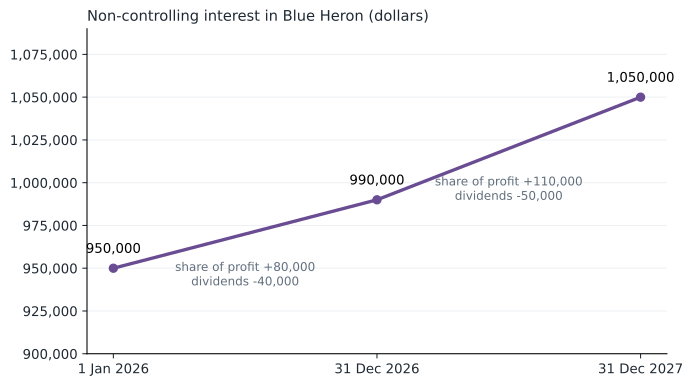
NCI at the end of each year equals NCI at the start, plus its share of the subsidiary's adjusted profit (and of OCI), less its share of dividends declared by the subsidiary. Dividends paid by the subsidiary to outside shareholders reduce NCI, because they distribute part of the outside owners' interest. Dividends paid to the parent are eliminated.
Worked problem
NCI roll-forward
Compute NCI at 31 December 2026 and 31 December 2027. In 2027 Blue Heron earns $700,000 and pays dividends of $250,000; amortization is $100,000 and goodwill is impaired by $50,000.
Show solution
- 31 December 2026: $950,000 + $80,000 − 20% × $200,000 = $990,000.
- 2027 adjusted profit: $700,000 − $100,000 − $50,000 = $550,000; NCI share 20% × $550,000 = $110,000.
- 31 December 2027: $990,000 + $110,000 − 20% × $250,000 = $1,050,000.
- Check: 20% × (Blue Heron's carrying amount $3,850,000 + unamortized increments $500,000) = $870,000, plus NCI goodwill $190,000 less its $10,000 share of impairment, is $1,050,000.
Answer: NCI $990,000 at the end of 2026 and $1,050,000 at the end of 2027.
Consolidated retained earnings
Consolidated retained earnings start with the parent's retained earnings at acquisition, add each year's profit attributable to owners of the parent and deduct the parent's dividends. Dividends paid by the subsidiary do not affect consolidated retained earnings: the parent's share is eliminated and the NCI share reduces NCI.
Worked problem
Consolidated retained earnings at the end of 2026
Larkspur's retained earnings at acquisition were $5,000,000. Compute consolidated retained earnings at 31 December 2026, and prove the figure from Larkspur's own cost-method retained earnings.
Show solution
- Roll-forward: $5,000,000 + $1,820,000 − $600,000 = $6,220,000.
- Larkspur's own retained earnings (cost method): $5,000,000 + $1,660,000 − $600,000 = $6,060,000.
- Add Larkspur's share of Blue Heron's retained earnings since acquisition: 80% × ($2,400,000 − $2,000,000) = $320,000.
- Deduct Larkspur's share of cumulative amortization: 80% × $200,000 = $160,000.
- Proof: $6,060,000 + $320,000 − $160,000 = $6,220,000.
Answer: Consolidated retained earnings $6,220,000.
The proof explains the worksheet entries in later years. In a cost-method worksheet for 2027, the opening consolidated retained earnings must be built from Larkspur's opening retained earnings plus its share of Blue Heron's retained earnings since acquisition, less its share of cumulative amortization to the start of the year. This adjustment is sometimes called converting the parent's opening retained earnings from the cost method to the equity method.
The worksheet in subsequent years
In each later year the worksheet repeats the acquisition-date eliminations, because the separate ledgers never record them, and adds entries for the current year. A common sequence is: (1) eliminate the parent's dividend income against the subsidiary's dividends; (2) eliminate the investment against the subsidiary's opening equity and set up opening NCI and the opening unamortized acquisition differential; (3) amortize the acquisition differential for prior years against opening retained earnings and NCI, and for the current year against the expense lines; (4) recognize NCI's share of current profit and dividends. Under the equity method in the parent's books, the first entries instead eliminate the parent's equity income and the investment balance, and the opening retained earnings need no conversion.
Other comprehensive income and presentation
If the subsidiary has OCI items, such as remeasurements of defined benefit plans or foreign currency translation differences (lesson 11), they are combined in consolidated OCI and attributed to the parent and NCI in the same way as profit. Total comprehensive income attributable to NCI is shown even if it results in a deficit balance; losses are allocated to NCI in proportion to its interest, even if NCI becomes negative.
The consolidated statement of changes in equity, or the equity note, shows a separate column for noncontrolling interest. Net income attributable to the noncontrolling interest is shown on the face of the income statement, and earnings per share is based on net income attributable to the parent.
| Item | 2026 | 2027 |
|---|---|---|
| Parent's profit excluding income from subsidiary | $1,500,000 | $1,700,000 |
| Subsidiary profit | $600,000 | $700,000 |
| Acquisition-differential amortization | ($200,000) | ($100,000) |
| Goodwill impairment | — | ($50,000) |
| Consolidated profit | $1,900,000 | $2,250,000 |
| Attributable to NCI | $80,000 | $110,000 |
| Attributable to owners of the parent | $1,820,000 | $2,140,000 |
| NCI at year end | $990,000 | $1,050,000 |
Common mistakes
MistakeIncluding the parent's dividend income from the subsidiary in consolidated profit.
InsteadEliminate it; it is an intragroup transfer.
MistakeForgetting the inventory fair value increment in the first year.
InsteadAdd it to consolidated cost of sales when the inventory is sold.
MistakeComputing NCI's share on the subsidiary's reported profit.
InsteadUse profit adjusted for acquisition-differential amortization and impairment attributable to NCI.
MistakeDeducting the subsidiary's dividends from consolidated retained earnings.
InsteadOnly the parent's dividends reduce consolidated retained earnings; the NCI share of subsidiary dividends reduces NCI.
MistakeAssuming a cost-method parent must switch to the equity method before consolidating.
InsteadEither method works; the worksheet converts opening retained earnings as needed.
Summary and key terms
- The parent may use the cost or equity method in its own books; consolidated results are the same.
- Fair value increments are expensed as the related assets are used; goodwill is tested for impairment.
- Consolidated profit equals the parent's own profit plus the subsidiary's profit, less amortization and impairment, with intragroup dividends eliminated.
- NCI's share is based on the subsidiary's adjusted profit.
- NCI rolls forward with its share of adjusted profit and OCI, less dividends to outside shareholders.
- Consolidated retained earnings roll forward with profit attributable to the parent, less the parent's dividends.
- Goodwill impairment is attributed to the parent and NCI on a rational basis.
- Parent-only financial information
- Condensed statements of a registrant parent required by the SEC when subsidiary net assets are restricted.
- Cost method (parent's books)
- Carrying a subsidiary at cost in the parent's ledger, recognizing only dividends as income.
- Equity method (parent's books)
- Carrying a subsidiary in the parent's ledger at cost adjusted for its share of adjusted profit and dividends.
- Amortization of the acquisition differential
- The expensing of fair value increments over the related assets' lives on consolidation.
- Profit attributable to NCI
- The outside owners' share of the subsidiary's adjusted profit.
- Consolidated retained earnings
- The parent's retained earnings plus its share of the subsidiary's adjusted post-acquisition earnings.
- Unamortized acquisition differential
- The portion of fair value increments not yet expensed at a given date.
Practice problems
Work each problem on paper first, then reveal the answer to check.
Subsidiary profit $300,000; amortization $50,000; parent owns 70 percent. NCI share of profit?
Show answer
$75,000.
Parent's own profit $900,000 excluding dividends of $56,000 from the subsidiary. Consolidated profit?
Show answer
$1,150,000.
Opening NCI $400,000; NCI share of profit $75,000; subsidiary dividends $80,000. Closing NCI?
Show answer
$451,000.
Rerun the income statement program with Blue Heron's operating expenses at $780,000. Consolidated profit and NCI share?
Show answer
$1,800,000 and $60,000.
Why is the inventory increment expensed in the first year?
Show answer
The acquired inventory is sold in that year, so its higher cost flows to cost of sales.
Parent's cost-method retained earnings $4,000,000; subsidiary retained earnings rose $500,000 since acquisition; cumulative amortization $150,000; parent owns 90 percent. Consolidated retained earnings?
Show answer
$4,315,000.
A $60,000 goodwill impairment with NCI at fair value and 75 percent ownership. Split under an ownership basis?
Show answer
Parent $45,000; NCI $15,000.
Do the subsidiary's dividends reduce consolidated retained earnings?
Show answer
No; the parent's share is eliminated and NCI's share reduces NCI.
Rerun the schedule assuming the patent life is 3 years. Total amortization in 2027?
Show answer
$140,000.
What happens to NCI if the subsidiary makes large losses?
Show answer
NCI absorbs its share and can become negative.
Lesson quiz · 5 questions
Score 60% or more to complete this lesson.
Create a free account to save your progress, take quizzes and earn a certificate.