
ACCT-211 · Lesson 6 of 12 · 29 min
Cash and receivables
Cash and receivables are the most liquid assets and, for Northlake, two of the largest: sensor stations are often sold on credit to municipalities and farms, and some customers pay over years. ACCT-101 covered bank reconciliations, internal control over cash and the basic allowance method for doubtful accounts. This lesson moves to intermediate questions: what counts as cash and how restricted cash is reported; how receivables are measured when there are discounts and long payment terms; how credit losses are estimated under the expected credit loss models; how notes receivable are carried at amortized cost using the effective interest method; and when selling receivables to a factor removes them from the balance sheet.
Cash, cash equivalents and restricted cash
Cash includes coins, currency, bank deposits available on demand and negotiable instruments such as checks received but not yet deposited. Cash equivalents, defined in lesson 3, are short-term, highly liquid investments with original maturities of about three months or less. Items that are not cash include postdated checks from customers (receivables), IOUs from employees (receivables), postage stamps (prepaid expenses) and travel advances (prepaid expenses or receivables). Cash in foreign currencies is translated at the closing exchange rate.
Restricted cash, such as deposits held in escrow or cash set aside under a loan agreement, is presented separately on the balance sheet if material and classified as current or non-current depending on when the restriction lapses. Since ASU 2016-18, restricted cash is included with cash and cash equivalents in the cash flow statement totals, with a reconciliation to the balance sheet captions. Compensating balances that are legally restricted are presented as restricted cash; others are disclosed. Bank overdrafts are current liabilities, not negative cash.
Recognizing and measuring receivables
Trade receivables arise from selling goods and services on credit; other receivables include loans to employees, interest and dividends receivable, tax refunds and amounts due from related parties. A trade receivable without a significant financing component is initially measured at the transaction price (lesson 4). Trade discounts, reductions from list price offered to classes of customers, are simply deducted: the receivable and revenue are recorded at the net price. Cash (sales) discounts for early payment, such as 2/10, net 30, are variable consideration: the entity estimates the discounts customers will take and records revenue net of them, adjusting the estimate as customers pay.
Worked problem
Cash discounts as variable consideration
Northlake sells parts to distributors for $50,000 on terms 2/10, net 30. From experience, 70 percent of distributors pay within 10 days. How are revenue and the receivable recorded?
Show solution
- Expected discount = 50,000 × 70% × 2% = $700.
- Record a receivable of $50,000, revenue of $49,300 and a liability (or contra-receivable) for expected discounts of $700.
- When distributors owing $35,000 pay within 10 days, they remit $34,300; the $700 allowance is used.
- If more or fewer customers take the discount than expected, revenue is adjusted.
Answer: Revenue $49,300, net of expected discounts; the $700 difference sits in an allowance until settled.
A receivable due beyond twelve months that contains a significant financing component is measured at the present value of the cash flows, using the market rate for the customer's credit, as in the farm cooperative example in lesson 5. After initial recognition, trade and loan receivables held to collect are measured at amortized cost under ASC 310 and ASC 326, less an allowance for credit losses.
Expected credit losses
ASC 326, Financial Instruments – Credit Losses, introduced the current expected credit loss (CECL) model, effective for large public companies in 2020 and for all other entities in 2023. An allowance for credit losses is recognized from the start for financial assets measured at amortized cost, including trade receivables, loans and held-to-maturity securities, equal to the lifetime expected credit losses based on historical experience, current conditions and reasonable and supportable forecasts, reverting to historical loss information beyond the forecast horizon. Unlike IFRS 9, CECL has no stages: lifetime losses apply to every asset from day one. For trade receivables, an aging schedule or loss-rate method adjusted for current conditions is common. ASU 2025-05, issued in July 2025, added a practical expedient allowing all entities to assume that conditions at the balance sheet date do not change over the remaining life of current trade receivables and contract assets, which simplifies forecasting for short-term balances.
IFRS 9, used by most non-US companies, has a three-stage general approach: stage 1 assets carry 12-month expected losses and stages 2 and 3 carry lifetime losses, with a simplified lifetime approach for trade receivables. For short-term trade receivables the two models usually give similar allowances; for long-term loans, CECL usually produces a larger allowance at origination because it recognizes lifetime losses immediately.
# Provision matrix for trade receivables (illustrative loss rates)
ageing = {               # bucket: (balance, historical loss rate)
    "Current":        (6_200_000, 0.004),
    "1-30 days":      (1_500_000, 0.015),
    "31-60 days":     (  600_000, 0.050),
    "61-90 days":     (  250_000, 0.120),
    "Over 90 days":   (  150_000, 0.400),
}
forward_adjustment = 1.15    # forecasts point to a weaker farm economy
total_bal = total_allow = 0
for bucket, (bal, rate) in ageing.items():
    allow = bal * rate * forward_adjustment
    total_bal += bal; total_allow += allow
    print(f"{bucket:<13} {bal:>10,}  rate {rate*forward_adjustment:6.2%}  allowance {allow:>9,.0f}")
print(f"Total receivables {total_bal:,}; required allowance {total_allow:,.0f}")
existing = 120_000
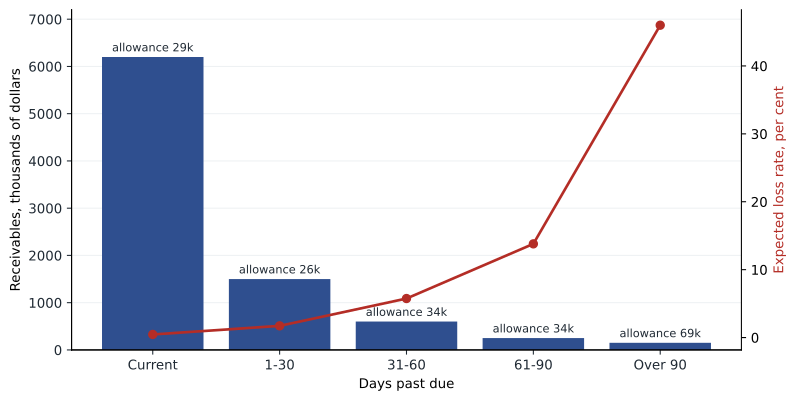
print(f"Existing allowance {existing:,}; credit loss expense this period {total_allow - existing:,.0f}")Current 6,200,000 rate 0.46% allowance 28,520 1-30 days 1,500,000 rate 1.72% allowance 25,875 31-60 days 600,000 rate 5.75% allowance 34,500 61-90 days 250,000 rate 13.80% allowance 34,500 Over 90 days 150,000 rate 46.00% allowance 69,000 Total receivables 8,700,000; required allowance 192,395 Existing allowance 120,000; credit loss expense this period 72,395
The provision matrix applies historical loss rates by age, increased by 15 percent because forecasts point to a weaker farm economy. Northlake needs an allowance of about $192,000 against $8.7 million of receivables; with $120,000 already in the allowance, it records credit loss expense of about $72,000. The forward-looking adjustment is the step that distinguishes the expected loss models from the older practice of relying only on history.
Write-offs, recoveries and presentation
When an account is determined to be uncollectible, it is written off against the allowance: debit the allowance, credit the receivable. The write-off does not change net receivables or expense, because the loss was already provided for. If a written-off account is later collected, the write-off is reversed (debit receivable, credit allowance) and the cash collection recorded. Credit loss (impairment) expense is presented as a separate line or disclosed; US GAAP requires disclosure of the allowance roll-forward and, for public companies under ASU 2022-02, gross write-offs by year of origination for loans. Notes disclose the allowance movements, the aging of receivables, concentrations of credit risk and the methods and assumptions used.
Notes receivable and the effective interest method
A note receivable is a written promise to pay a specified amount, often with interest, at a future date. Northlake accepts notes from municipalities and farm cooperatives that cannot pay for networks immediately. If the stated interest rate equals the market rate for the customer's credit, the note is recorded at face value. If the stated rate is below market, or the note carries no interest at all, it is recorded at the present value of its cash flows discounted at the market rate, and the discount is recognized as interest income over the term using the effective interest method: interest income each period equals the carrying amount at the start of the period times the market (effective) rate; the difference between that and the cash interest received increases the carrying amount.
# Note receivable at amortized cost: effective interest method
face, stated, market, years = 300_000, 0.02, 0.06, 3
cash_interest = face * stated
pv = sum(cash_interest / (1 + market) ** t for t in range(1, years + 1)) + face / (1 + market) ** years
print(f"Initial carrying amount (present value): {pv:,.0f}  discount {face - pv:,.0f}")
carrying = pv
print(f"{'Year':<5}{'Cash':>10}{'Interest income':>17}{'Amortization':>14}{'Carrying':>12}")
for y in range(1, years + 1):
    income = carrying * market
    amort = income - cash_interest
    carrying += amort
print(f"{y:<5}{cash_interest:>10,.0f}{income:>17,.0f}{amort:>14,.0f}{carrying:>12,.0f}")Initial carrying amount (present value): 267,924 discount 32,076 Year Cash Interest income Amortization Carrying 1 6,000 16,075 10,075 277,999 2 6,000 16,680 10,680 288,679 3 6,000 17,321 11,321 300,000
Northlake sells a network to a town for a $300,000 three-year note at 2 percent when the town's market borrowing rate is 6 percent. The note is worth $267,924 at inception, so revenue is $267,924, not $300,000; the $32,076 discount is interest that Northlake earns over three years. Interest income rises each year (about $16,075, $16,680 and $17,321) because it is computed on a growing carrying amount, which reaches $300,000 at maturity.
Worked problem
Zero-interest note
Northlake receives a $100,000 note due in 2 years with no stated interest in exchange for equipment whose cash price is unknown. The customer's market rate is 5 percent. Record the note and the interest.
Show solution
- Present value = 100,000 ÷ 1.05² = $90,703. Record the receivable at $90,703 and revenue of $90,703.
- Year 1 interest income = 90,703 × 5% = $4,535; carrying amount $95,238.
- Year 2 interest income = 95,238 × 5% = $4,762; carrying amount $100,000, collected at maturity.
Answer: Total interest income of $9,297 over two years equals the discount; revenue is the present value, $90,703.
Transfers of receivables
Companies can turn receivables into cash before customers pay by selling them to a factor or securitizing them, or by borrowing against them. The accounting question is whether the receivables are derecognized (removed from the balance sheet, with any gain or loss recognized) or remain on the balance sheet with a liability for the cash received (a secured borrowing). Selling receivables without recourse, where the factor bears the credit risk, usually qualifies as a sale. Selling with recourse, where the seller must compensate the factor for uncollectible accounts, often does not.
Under ASC 860, a transfer of financial assets is a sale only if the transferor surrenders control, which requires all of: the assets are legally isolated from the transferor, even in bankruptcy; the transferee can pledge or exchange the assets; and the transferor does not maintain effective control, for example through an agreement to repurchase them. Recourse does not by itself prevent sale accounting under US GAAP, but the transferor records a recourse liability at fair value. If the conditions are not met, the transfer is a secured borrowing. IFRS 9 uses a different test focused first on whether substantially all risks and rewards have been transferred, so a transfer with full recourse that is a sale under US GAAP may not be derecognized under IFRS.
Worked problem
Factoring without recourse
Northlake factors $400,000 of receivables without recourse. The factor charges a 3 percent fee and holds back 5 percent to cover returns and disputes. Record the sale.
Show solution
- Cash received = 400,000 − 3% fee (12,000) − 5% holdback (20,000) = $368,000.
- Record a receivable from the factor for the $20,000 holdback.
- Loss on sale of receivables = the $12,000 fee.
- Derecognize the $400,000 of receivables.
Answer: Debit cash 368,000, due from factor 20,000 and loss on sale 12,000; credit receivables 400,000.
Analyzing receivables
Receivables turnover (net credit sales ÷ average net receivables) and days sales outstanding (365 ÷ turnover, or average receivables ÷ sales × 365) show how quickly customers pay. A rising DSO can signal weaker customers, looser credit terms or aggressive revenue recognition: receivables that grow much faster than sales are a warning sign analysts watch for. For Northlake, with sales of $61 million and average receivables of $8.1 million, turnover is about 7.5 and DSO about 48 days. Its stated terms are net 30 for most customers and longer for municipalities, so 48 days is plausible but worth monitoring as the farm economy weakens.
Common mistakes
MistakeRecording revenue at the gross price when customers usually take early-payment discounts.
InsteadTreat expected discounts as variable consideration and record revenue net of them.
MistakeWaiting for a loss event before providing for credit losses under CECL.
InsteadCECL requires lifetime expected losses from day one, using current conditions and forecasts.
MistakeRecording credit loss expense when an account is written off.
InsteadThe write-off uses the allowance; expense was recognized when the allowance was established.
MistakeRecording a below-market-rate note at face value.
InsteadRecord it at the present value of its cash flows at the market rate and amortize the discount as interest income.
MistakeTreating every factoring arrangement as a sale.
InsteadApply the derecognition tests; transfers that fail them are secured borrowings.
Summary and key terms
- Restricted cash is reported separately and classified by when the restriction lapses.
- Trade discounts are deducted at the outset; cash discounts are variable consideration.
- CECL requires lifetime expected credit losses on amortized-cost assets from initial recognition.
- ASU 2025-05 offers a practical expedient for forecasting losses on current trade receivables.
- Write-offs reduce the receivable and the allowance, not expense; recoveries reverse the write-off.
- Notes receivable are carried at amortized cost with interest income at the effective (market) rate.
- Transfers of receivables are derecognized only if they meet the framework's tests; otherwise they are secured borrowings.
- CECL
- The current expected credit loss model of ASC 326, recognizing lifetime expected losses from day one.
- Restricted cash
- Cash that is not available for general use because of legal or contractual restrictions.
- Compensating balance
- A minimum deposit a bank requires as part of a borrowing arrangement.
- Trade discount
- A reduction from list price offered to certain customers, recorded as a lower price.
- Cash discount
- A reduction offered for early payment, treated as variable consideration.
- Expected credit loss
- The probability-weighted estimate of credit losses over a specified horizon.
- Provision matrix
- A table of loss rates by aging category used to estimate the allowance for trade receivables.
- Amortized cost
- Initial amount adjusted for principal repayments and cumulative effective-interest amortization, less the loss allowance.
- Effective interest method
- A method that recognizes interest at a constant rate on the carrying amount.
- Factoring
- Selling receivables to a third party, the factor, for cash.
- Secured borrowing
- A transfer of receivables that does not qualify for derecognition, recorded as a liability.
Practice problems
Work each problem on paper first, then reveal the answer to check.
Is a postdated customer check cash?
Show answer
No; it is a receivable until it can be deposited.
Sales of $20,000 on 1/10, net 30; 60 percent expected to take the discount. Revenue?
Show answer
20,000 − 20,000 × 60% × 1% = $19,880.
Receivables of $500,000 with an expected loss rate of 2 percent; existing allowance $6,000. Expense?
Show answer
Required allowance $10,000; expense $4,000.
A $3,000 account is written off. Effect on net receivables and expense?
Show answer
None on either; both the receivable and the allowance fall by $3,000.
A written-off $3,000 account is collected. Entries?
Show answer
Reinstate: debit receivable, credit allowance; then debit cash, credit receivable.
Present value of a $50,000 note due in one year with no interest at a 4 percent market rate?
Show answer
$48,077.
Rerun the note program with a stated rate of 6 percent. What happens?
Show answer
The note is recorded at face value, $300,000, and there is no discount to amortize.
Factor $200,000 without recourse at a 4 percent fee, no holdback. Loss and cash?
Show answer
Cash $192,000; loss $8,000.
Under ASC 860, name the three conditions for sale accounting.
Show answer
Legal isolation; transferee can pledge or exchange; no effective control retained by the transferor.
Sales $12 million, average receivables $1.5 million. DSO?
Show answer
Turnover 8; DSO about 46 days.
Lesson quiz · 5 questions
Score 60% or more to complete this lesson.
Create a free account to save your progress, take quizzes and earn a certificate.