
ACCT-211 · Lesson 1 of 12 · 29 min
The reporting environment: US GAAP, the Codification and the conceptual framework
ACCT-101 taught the accounting cycle: how transactions become journal entries, how entries become a trial balance and how a trial balance becomes four financial statements. Intermediate accounting asks harder questions. When exactly has revenue been earned on a contract that bundles equipment, installation and three years of monitoring? At what amount should a receivable sit on the balance sheet when some customers will not pay? When does a cost become an asset rather than an expense, and when must an asset be written down? Answering those questions requires the standards themselves. In the United States that means generally accepted accounting principles (US GAAP), organized in the FASB Accounting Standards Codification, with extra reporting rules from the Securities and Exchange Commission (SEC) for public companies. This course works through the asset side of the balance sheet under US GAAP and notes where International Financial Reporting Standards (IFRS), used in most other countries, differ. ACCT-212 continues with liabilities, leases, income taxes, pensions and equity. Nothing in this course is professional advice; real reporting decisions belong with qualified accountants applying the full standards.
Throughout the course one invented company provides the numbers. Northlake Instruments makes precision weather and air-quality sensors for municipalities, airports and farms. It sells sensor stations, installs them, and sells multi-year monitoring subscriptions that stream data to a dashboard. It also holds inventory of parts and finished stations, owns a factory and a fleet of service vans, capitalizes some development costs and once bought a smaller competitor. Every lesson uses Northlake to show how a standard turns a business event into numbers on the statements. All Northlake figures are illustrative.
Why financial reporting needs standards
Financial statements are prepared by management but used mainly by outsiders: investors deciding whether to buy or sell shares, lenders deciding whether to lend and on what terms, suppliers deciding whether to extend credit, and employees, regulators and the public. Outsiders cannot demand custom reports, and they cannot inspect the books themselves. Standards solve that problem by fixing the rules in advance, so statements prepared by different companies, in different years, can be compared and relied on. Without standards, each management team would be tempted to choose the methods that flatter its own results, and every set of statements would need to be reverse-engineered before it could be used.
Standards also reduce the cost of capital. When investors trust the numbers, they demand a smaller premium for uncertainty, and companies can raise money more cheaply. That is why stock exchanges and securities regulators require audited statements prepared under a recognized framework, and why lenders write covenants in terms of ratios computed from those statements. Accounting choices therefore have real consequences: a change in how revenue is recognized can move a covenant ratio, an executive bonus or a share price, which is exactly why the standards are detailed and why auditors check them.
Who sets the rules in the United States
In the United States, the Financial Accounting Standards Board (FASB), a private, independent body overseen by the Financial Accounting Foundation, sets US GAAP for public and private companies and not-for-profit organizations. Since 2009 all authoritative US GAAP has been organized in the FASB Accounting Standards Codification (ASC), which arranges guidance by topic: Topic 606 for revenue, Topic 326 for credit losses, Topic 330 for inventory, Topic 360 for property, plant and equipment, Topic 350 for intangibles and goodwill, Topic 820 for fair value, and so on. The FASB amends the Codification by issuing Accounting Standards Updates (ASUs), numbered by year, such as ASU 2024-03. The SEC has legal authority over the financial reporting of public companies; it recognizes the FASB as the standard setter but adds its own rules (Regulation S-X for financial statement form and content, Regulation S-K for other disclosures) and staff guidance. State and local governments follow standards set by the Governmental Accounting Standards Board (GASB).
Private companies follow the same US GAAP, but the Private Company Council (PCC) works with the FASB to provide simpler alternatives where the cost of full compliance outweighs the benefit to private-company users. Examples include amortizing goodwill over up to ten years instead of testing it annually for impairment, and simpler accounting for certain derivatives and leases. Foreign private issuers listed in the United States may file statements prepared under IFRS as issued by the IASB without reconciling to US GAAP, which is why US analysts also need a working knowledge of IFRS. This course concentrates on US GAAP and notes IFRS differences where they matter.
| Feature | US GAAP | IFRS (for comparison) |
|---|---|---|
| Required for | All US public companies; private companies (with PCC alternatives) | Most other countries; foreign private issuers in the US |
| Set by | FASB (SEC oversight for public companies) | IASB |
| Organization | Codification by topic (ASC) | Numbered standards (IAS, IFRS) |
| Revaluation of property, plant and equipment | Not permitted | Permitted (revaluation model) |
| Development costs | Expensed (ASC 730), with software exceptions | Capitalized when criteria are met (IAS 38) |
| Impairment of long-lived assets | Two-step test; no reversals | One-step test; reversals allowed (not goodwill) |
| Inventory cost formulas | FIFO, weighted average and LIFO | FIFO and weighted average; LIFO prohibited |
| Credit losses on receivables | Current expected credit loss model (ASC 326) | Expected credit loss model (IFRS 9) |
The conceptual framework
Standards cannot anticipate every transaction, so the FASB publishes Concepts Statements that set out the objective of financial reporting and the concepts underlying the standards. Concepts Statement No. 8, the Conceptual Framework for Financial Reporting, has been built in chapters: the objective and qualitative characteristics (2010, amended 2018), notes to financial statements, elements, recognition and derecognition, presentation and measurement, with the later chapters added between 2021 and 2024. Concepts Statements are not authoritative GAAP; they guide the FASB when it writes standards. Preparers facing a transaction the Codification does not address look first to analogous guidance within the Codification, and only then to non-authoritative sources such as the Concepts Statements and IFRS.
The framework begins with the objective. General-purpose financial reports exist to provide financial information about the reporting entity that is useful to existing and potential investors, lenders and other creditors in making decisions about providing resources to the entity. Those users need to assess the amount, timing and uncertainty of future cash flows, and management's stewardship of the entity's resources. Everything else follows from this decision-usefulness objective: which items are recognized, how they are measured and what is disclosed.
Qualitative characteristics
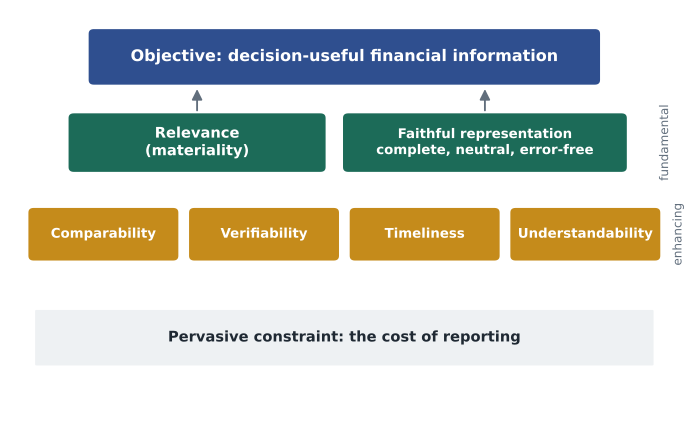
Information is useful if it is relevant and faithfully represents what it purports to represent. These are the two fundamental qualitative characteristics. Relevant information can make a difference to decisions because it has predictive value, confirmatory value or both. Materiality is an entity-specific aspect of relevance: information is material if omitting, misstating or obscuring it could reasonably be expected to influence users' decisions. There is no universal percentage threshold, although auditors often start from rules of thumb such as five percent of pre-tax income, then adjust for qualitative factors such as whether a misstatement turns a loss into a profit or breaches a covenant.
Faithful representation means the information is complete (it includes everything needed to understand the item), neutral (it is not slanted to produce a desired result) and free from error (not perfectly accurate, but with no errors in the description or the process used). Neutrality is supported by prudence, the exercise of caution when making judgments under uncertainty, which the 2018 IASB framework reintroduced. Prudence does not permit deliberately understating assets or overstating liabilities; it means not overstating assets or income and not understating liabilities or expenses.
Four enhancing characteristics make relevant, faithfully represented information more useful: comparability (users can identify similarities and differences between entities and over time, helped by consistent methods), verifiability (different knowledgeable observers could reach consensus that the depiction is faithful), timeliness (information arrives in time to influence decisions) and understandability (information is classified and presented clearly for users who have a reasonable knowledge of business and review it diligently). The pervasive constraint is cost: the benefits of reporting information should justify the costs of providing and using it. Cost is the reason ASPE and the PCC alternatives exist.
Elements, recognition and measurement
The FASB's Concepts Statement 8, Chapter 4 (2021), defines an asset as a present right of an entity to an economic benefit, and a liability as a present obligation of an entity to transfer an economic benefit. Equity is the residual. Revenues and gains, expenses and losses are defined as inflows, outflows and other changes in assets and liabilities from the entity's activities. The IASB's 2018 definitions are very similar: an asset is a present economic resource controlled by the entity as a result of past events. Both definitions center on rights and control, which is why the asset chapters of this course keep asking: does the company control a right that can produce benefits?
Meeting a definition is necessary but not sufficient for recognition. An item is recognized (included in the statements) when doing so provides relevant information and a faithful representation, considering uncertainty about existence, a low probability of benefits and the degree of measurement uncertainty. Measurement then assigns an amount. The frameworks describe two broad families of measurement basis. Historical cost measures an asset at the cost incurred to acquire it, adjusted for consumption (depreciation) and impairment; amortized cost for receivables is a form of historical cost. Current value measures include fair value (the price that would be received to sell an asset in an orderly transaction between market participants), value in use for assets (the present value of cash flows from using and disposing of the asset) and current cost. Lesson 2 examines fair value in detail.
Worked problem
Is it an asset?
Northlake (a) signs a contract to buy a machine next year for $400,000; (b) pays a $50,000 non-refundable deposit on that machine; (c) employs a team of skilled engineers; (d) holds a three-year exclusive license to a patented sensor coating. Which are assets?
Show solution
- (a) A signed purchase commitment, with no payment and no delivery, is an executory contract: neither party has performed. It is generally not recognized (although a loss on an onerous commitment may be).
- (b) The deposit is a present right (to receive the machine or the deposit's benefit) arising from a past event (the payment). It is an asset: a prepayment or deposit on equipment.
- (c) The engineers create value, but Northlake does not control them as a resource that can be recognized; they can leave. The workforce is not recognized as an asset.
- (d) The license is a present right, controlled through the contract, with the potential to produce benefits. It is an intangible asset, measured at cost.
Answer: Only (b) and (d) are recognized as assets; (a) is disclosed if material, and (c) is not recognized.
Underlying assumptions and the accounting policies note
Two assumptions run through the statements. The going concern assumption says the entity will continue operating for the foreseeable future, at least twelve months from the reporting date; if management intends to liquidate or has no realistic alternative, the statements are prepared on another basis, and material uncertainties about going concern must be disclosed. The accrual basis, covered in ACCT-101, records the effects of transactions when they occur rather than when cash moves. Monetary unit and periodicity assumptions (stable currency, artificial periods such as quarters and years) are also implicit.
Because standards allow choices and require estimates, the notes must disclose significant accounting policies and the judgments and estimates that most affect the amounts; public companies also discuss critical accounting estimates in Management's Discussion and Analysis. Under ASC 250, a change in accounting principle is made only if required by a new standard or justified as preferable, and is generally applied retrospectively. A change in estimate, such as a revised useful life, is applied prospectively. An error in previously issued statements is corrected by restating them. These distinctions matter throughout the course: switching from LIFO to FIFO is a change in principle; revising the expected life of a van is a change in estimate.
# Materiality screen: a common starting point, not a rule (illustrative)
pretax_income = 4_200_000
revenue = 61_000_000
total_assets = 48_500_000

benchmarks = {
    "5% of pre-tax income": 0.05 * pretax_income,
    "0.5% of revenue": 0.005 * revenue,
    "1% of total assets": 0.01 * total_assets,
}
for name, amount in benchmarks.items():
    print(f"{name:<22} {amount:>12,.0f}")

misstatement = 180_000
lowest = min(benchmarks.values())
print(f"Misstatement {misstatement:,} vs lowest benchmark {lowest:,.0f}:",
      "below" if misstatement < lowest else "at or above")
# Qualitative factors can still make a small amount material:
covenant_min_income = 4_100_000
print("Would correcting it breach the income covenant?",
pretax_income - misstatement < covenant_min_income)5% of pre-tax income 210,000 0.5% of revenue 305,000 1% of total assets 485,000 Misstatement 180,000 vs lowest benchmark 210,000: below Would correcting it breach the income covenant? True
The output shows why materiality is judgment, not arithmetic. The $180,000 misstatement is below every quantitative benchmark, yet correcting it would push Northlake's pre-tax income below a loan covenant minimum. That qualitative factor makes it material: a lender would certainly want to know.
International context and convergence
During the 2000s the FASB and IASB worked to converge their standards, and several major projects ended in substantially converged standards, most notably revenue (ASC 606 and IFRS 15, both issued in 2014) and, to a lesser extent, leases. Full convergence was abandoned, and the boards now work separately while monitoring each other. Important differences remain, including LIFO (permitted under US GAAP, prohibited under IFRS), revaluation of property (IFRS only), impairment testing, development costs and credit loss models. The IASB's IFRS 18, effective for annual periods beginning on or after 1 January 2027, changes income statement presentation under IFRS; the FASB took a different route with ASU 2024-03, which requires disaggregated expense disclosure in the notes (both are covered in lesson 2).
Ethics and the reporting chain
Reliable reporting depends on people as much as rules. Management prepares the statements and is responsible for internal control; the board's audit committee oversees reporting and the auditor; the external auditor, registered with the Public Company Accounting Oversight Board (PCAOB) for public companies, expresses an opinion on whether the statements present fairly in accordance with US GAAP. The Sarbanes-Oxley Act requires chief executive and chief financial officers of public companies to certify the filings (sections 302 and 906) and management to assess internal control over financial reporting (section 404), with auditor attestation for larger filers. CPAs are bound by the AICPA Code of Professional Conduct and state board rules. Lesson 12 returns to earnings management and US cases where the reporting chain failed; BUS-310 covers Enron and WorldCom.
Common mistakes
MistakeTreating Concepts Statements as authoritative GAAP.
InsteadConcepts Statements guide the FASB; the Codification is the sole source of authoritative GAAP for non-governmental entities.
MistakeApplying a fixed percentage as the definition of materiality.
InsteadUse quantitative benchmarks only as a starting point and consider qualitative factors such as covenants, trends and fraud.
MistakeEquating prudence with deliberately understating assets.
InsteadPrudence means caution under uncertainty; deliberate understatement breaches neutrality and faithful representation.
MistakeRecording a signed but unperformed purchase contract as an asset and liability.
InsteadExecutory contracts are generally not recognized until one party performs; disclose material commitments.
MistakeApplying a change in useful life retrospectively.
InsteadChanges in estimates are applied prospectively; only policy changes and error corrections are applied retrospectively.
Summary and key terms
- In the US, the FASB sets US GAAP in the Codification; the SEC adds rules for public companies and the PCC offers private-company alternatives.
- The objective of financial reporting is to provide information useful to investors, lenders and other creditors in making resource-allocation decisions.
- Relevance and faithful representation are the fundamental qualitative characteristics; comparability, verifiability, timeliness and understandability enhance them.
- Materiality is entity-specific and a matter of judgment; quantitative benchmarks are a starting point only.
- Assets are present rights or economic resources controlled by the entity as a result of past events; recognition also requires relevant, faithfully representative information.
- Measurement bases include historical cost and current values such as fair value and value in use.
- Policy changes and error corrections are retrospective; estimate changes are prospective.
- Codification (ASC)
- The single source of authoritative US GAAP, organized by topic.
- Accounting Standards Update (ASU)
- A document issued by the FASB that amends the Codification.
- Private Company Council (PCC)
- A body that works with the FASB on simpler alternatives for private companies.
- Conceptual framework
- A statement of the objective and concepts that underlie financial reporting standards.
- Relevance
- The capacity of information to make a difference to decisions through predictive or confirmatory value.
- Faithful representation
- Depiction that is complete, neutral and free from error.
- Materiality
- The quality of information whose omission or misstatement could reasonably influence users' decisions.
- Prudence
- Caution in making judgments under uncertainty, without deliberate bias.
- Going concern
- The assumption that the entity will continue operating for the foreseeable future.
- Change in estimate
- A revision of an estimate based on new information, applied prospectively.
Practice problems
Work each problem on paper first, then reveal the answer to check.
Where does a US accountant find authoritative GAAP for revenue?
Show answer
ASC Topic 606 in the FASB Codification.
Give an example of a PCC alternative.
Show answer
Amortizing goodwill over up to ten years instead of annual impairment testing.
Name the two fundamental qualitative characteristics.
Show answer
Relevance and faithful representation.
Is an engineering team an asset? Explain.
Show answer
No; the entity does not control the employees as a recognizable resource.
A $90,000 error is 2 percent of pre-tax income but turns a small profit into a loss. Is it material?
Show answer
Probably yes: qualitative factors such as changing a profit to a loss make it material.
Northlake extends a van's useful life from 5 to 7 years. Retrospective or prospective?
Show answer
Prospective: it is a change in estimate.
What does the going concern assumption require management to assess?
Show answer
Whether the entity can continue operating for at least twelve months, and to disclose material uncertainties.
Define fair value.
Show answer
The price that would be received to sell an asset or paid to transfer a liability in an orderly transaction between market participants at the measurement date.
Why do standards reduce the cost of capital?
Show answer
Investors trust comparable, audited numbers and demand a smaller risk premium.
Rerun the materiality program with a covenant minimum of 3,900,000. Is the misstatement still material on that ground?
Show answer
No; 4,200,000 − 180,000 = 4,020,000, which is above 3,900,000, so the covenant test is not breached.
Lesson quiz · 5 questions
Score 60% or more to complete this lesson.
Create a free account to save your progress, take quizzes and earn a certificate.