
ACCT-211 · Lesson 11 of 12 · 29 min
Impairment of long-lived assets
Depreciation spreads an asset's cost over its life on the assumption that the asset will earn at least that much. Sometimes that assumption fails: a technology becomes obsolete, a market collapses, a regulation bans a product, a plant sits idle. When the carrying amount of an asset is more than the entity can recover from it, the asset is impaired and must be written down. This lesson explains when to test for impairment, how the frameworks measure it and why they can give different answers for the same asset: the IFRS one-step test against recoverable amount, and the two-step test used by US GAAP and, for private enterprises in Canada, by ASPE. It also covers cash-generating units and asset groups, how losses are allocated and when they can be reversed. Goodwill impairment is introduced here and completed in lesson 12.
When to test
ASC 360-10 requires long-lived assets held and used (including PP&E and finite-lived intangibles) to be tested for recoverability whenever events or changes in circumstances indicate that the carrying amount may not be recoverable. Triggering events include a significant decrease in market price, a significant adverse change in how the asset is used or in its physical condition, adverse legal or business climate changes, costs significantly above budget to build it, current-period operating or cash flow losses with a history or forecast of continuing losses, and an expectation that the asset is more likely than not to be sold or disposed of significantly before the end of its useful life. Goodwill and indefinite-lived intangibles are tested at least annually under ASC 350 (lesson 12).
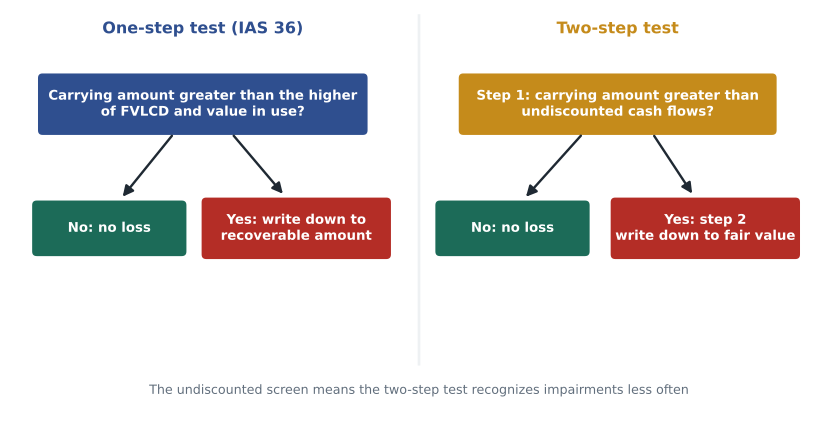
IFRS's IAS 36 is broader: entities must assess at every reporting date whether any indicator exists, and the test itself is different, as shown below.
The US GAAP model: recoverability, then fair value
Under ASC 360, impairment of an asset (or asset group) held and used is a two-step process. Step 1, the recoverability test: compare the carrying amount with the sum of the undiscounted future cash flows expected from the use and eventual disposition of the asset. If the undiscounted cash flows equal or exceed the carrying amount, the asset is recoverable and no loss is recognized, even if its fair value is lower. Step 2, measurement: if the carrying amount is not recoverable, recognize an impairment loss equal to the excess of carrying amount over fair value (measured under ASC 820). The written-down amount becomes the new cost basis and is depreciated over the remaining useful life.
IFRS's IAS 36 uses a single step: an asset is impaired whenever its carrying amount exceeds its recoverable amount, the higher of fair value less costs of disposal and value in use (the present value of expected cash flows at a pre-tax discount rate). Because there is no undiscounted recoverability screen, IFRS recognizes impairments earlier and more often than US GAAP for the same facts.
# Same asset, two impairment models (illustrative)
carrying = 1_800_000
annual_cash_flow, years, disposal_value = 330_000, 6, 100_000
rate = 0.10
fair_value, costs_of_disposal = 1_350_000, 50_000

undiscounted = annual_cash_flow * years + disposal_value
viu = sum(annual_cash_flow / (1 + rate) ** t for t in range(1, years + 1)) + disposal_value / (1 + rate) ** years
fvlcd = fair_value - costs_of_disposal
recoverable = max(viu, fvlcd)

print(f"Undiscounted cash flows {undiscounted:,.0f}; value in use {viu:,.0f}; FVLCD {fvlcd:,.0f}")
ifrs_loss = max(0, carrying - recoverable)
print(f"One-step test (IFRS): recoverable {recoverable:,.0f}; impairment {ifrs_loss:,.0f}")
two_step_loss = 0 if undiscounted >= carrying else carrying - fair_value
print(f"Two-step test: recoverable on undiscounted basis? {undiscounted >= carrying}; impairment {two_step_loss:,.0f}")Undiscounted cash flows 2,080,000; value in use 1,493,683; FVLCD 1,300,000 One-step test (IFRS): recoverable 1,493,683; impairment 306,317 Two-step test: recoverable on undiscounted basis? True; impairment 0
Northlake's marine-sensor production line has a carrying amount of $1.8 million. Its undiscounted cash flows ($2.08 million) exceed the carrying amount, so under the two-step test it passes the recoverability screen and no loss is recognized. Under IAS 36 the recoverable amount is the higher of value in use ($1,493,683) and FVLCD ($1,300,000), and the line is written down by about $306,300. The same facts produce an impairment under one framework and none under the other. If cash flows fell further so that the undiscounted total dropped below $1.8 million, the two-step test would measure the loss against fair value ($1,350,000), giving $450,000.
Asset groups
Most assets do not generate cash flows independently: a calibration machine contributes to the output of a whole production line. ASC 360 therefore tests long-lived assets at the level of the asset group, the lowest level for which identifiable cash flows are largely independent of the cash flows of other assets and liabilities. If the asset group fails the recoverability test, the impairment loss (carrying amount of the group less its fair value) is allocated to the long-lived assets of the group pro rata on the basis of their carrying amounts, but no individual asset is reduced below its own fair value if that is determinable without undue cost. Goodwill is not included in ASC 360 asset groups unless the group is a reporting unit; it is tested separately under ASC 350. IFRS uses cash-generating units, with goodwill allocated to them and absorbing losses first.
Worked problem
Allocating an asset group impairment
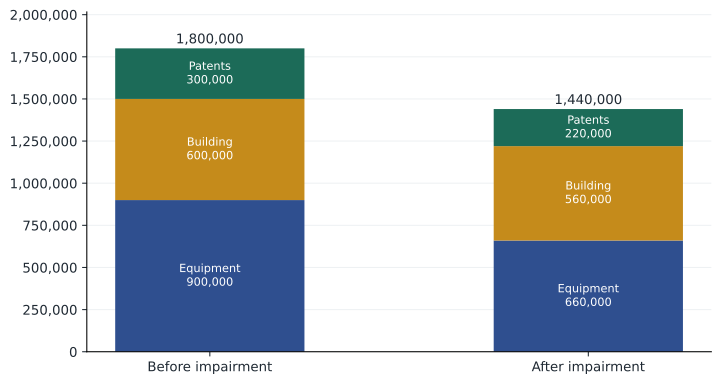
Northlake's marine-sensor asset group has equipment $900,000, building $600,000 and patents $300,000 (total $1,800,000). It fails the recoverability test, and its fair value is $1,440,000. The building's own fair value is $560,000. Allocate the $360,000 impairment.
Show solution
- Pro rata on carrying amounts (total 1,800,000): equipment 360,000 × 900/1,800 = 180,000; building 120,000; patents 60,000.
- Building limit: 600,000 − 120,000 = 480,000 would be below its fair value of 560,000. Reduce the building only by $40,000; reallocate the $80,000 excess to equipment and patents (900:300): equipment +60,000, patents +20,000.
- Final losses: equipment 240,000; building 40,000; patents 80,000. Total $360,000.
Answer: The loss is spread pro rata, but no asset falls below its own fair value.
Reversals
US GAAP prohibits reversal of impairment losses on long-lived assets held and used and on goodwill: the written-down carrying amount becomes the new cost basis. (Losses on assets held for sale may be reversed up to the cumulative losses previously recognized while held for sale.) IFRS, by contrast, requires reversal of impairment losses on assets other than goodwill when recoverable amount increases, limited to the depreciated amount that would have been carried without the impairment.
Worked problem
Reversal ceiling
For comparison, an IFRS reporter's equipment (cost $1,000,000, 10-year life, no residual) is impaired at the end of year 3: carrying amount $700,000, written down to $490,000 with 7 years remaining. At the end of year 5 its recoverable amount rises to $520,000. How much would the IFRS reporter reverse, and how much would a US GAAP reporter reverse?
Show solution
- Depreciation after impairment = 490,000 ÷ 7 = $70,000 a year; carrying amount at end of year 5 = 490,000 − 140,000 = $350,000.
- Carrying amount without the impairment at end of year 5 = 1,000,000 − 500,000 = $500,000 (the ceiling).
- Recoverable amount $520,000 exceeds the ceiling, so the reversal is limited to 500,000 − 350,000 = $150,000.
- The IFRS reporter reverses $150,000; a US GAAP reporter reverses nothing and continues depreciating $70,000 a year.
Answer: IFRS: $150,000 reversal. US GAAP: none.
Goodwill and indefinite-life intangibles: a first look
Under ASC 350, goodwill is assigned to reporting units (operating segments or one level below) and tested at least annually, and between tests if a triggering event occurs. An entity may first assess qualitative factors to decide whether it is more likely than not that a reporting unit's fair value is below its carrying amount; if so, or if it skips the qualitative step, it compares fair value with carrying amount and recognizes an impairment equal to the excess, limited to the goodwill allocated (ASU 2017-04 eliminated the old step of computing implied goodwill). Private companies may elect to amortize goodwill over up to ten years and test only on triggering events. Lesson 12 completes the treatment of goodwill and other intangibles.
Estimating cash flows and discount rates
Whichever framework applies, the quality of an impairment test depends on the cash flow forecast. Forecasts should be based on the most recent budgets approved by management, cover the asset or unit in its current condition, include cash flows from continuing use and from eventual disposal, and exclude financing costs and income taxes (because the discount rate already reflects the cost of capital and, under IAS 36, is pre-tax). Growth beyond the detailed budget period should be steady or declining and should not exceed the long-term average growth rate for the products, industries or country in which the entity operates, unless a higher rate can be justified. Overly optimistic forecasts are the most common weakness auditors and regulators find in impairment tests.
Worked problem
Building a value-in-use discount rate
Northlake estimates a post-tax weighted average cost of capital of 8 percent for its marine-sensor business, with a 25 percent tax rate. It needs a pre-tax rate for an IAS 36 value-in-use calculation. A quick approximation divides the post-tax rate by (1 minus the tax rate). What rate results, and why is it only an approximation?
Show solution
- Approximate pre-tax rate = 8% ÷ (1 − 0.25) = 10.7 percent.
- The approximation ignores the timing of tax cash flows, such as tax depreciation that differs from book depreciation, so IAS 36 practice is to solve iteratively for the pre-tax rate that gives the same value as discounting post-tax cash flows at the post-tax rate.
- Northlake rounds to 10 percent for the marine-sensor line after that iteration, which is the rate used in this lesson's program.
- Under US GAAP, the fair value measurement in step 2 uses market participant assumptions, so the discount rate reflects what a market participant would require rather than the entity's own cost of capital.
Answer: A pre-tax rate of about 10 percent; the precise rate comes from iteration, not the simple gross-up.
Disclosure and judgment
Impairment testing is one of the areas of accounting that depends most on judgment. Cash flow forecasts, growth rates, discount rates and the definition of CGUs or asset groups all affect the result, and management has incentives to avoid write-downs (which hit profit) or, occasionally, to take large write-downs in a bad year to make future results look better (a 'big bath'). Standards respond with disclosure: the events that led to the impairment, the amount, the recoverable amount or fair value and how it was measured, the key assumptions, and, under IFRS, sensitivity analysis when a reasonably possible change in a key assumption would cause an impairment. Auditors treat impairment as a key audit matter or critical audit matter in many audit reports.
Common mistakes
MistakeTesting PP&E for impairment only when the annual audit is near.
InsteadTest whenever events or changes in circumstances indicate the carrying amount may not be recoverable.
MistakeUsing undiscounted cash flows to measure an impairment loss.
InsteadUndiscounted cash flows are only the recoverability screen in the two-step test; the loss is measured against fair value (or recoverable amount under IFRS).
MistakeAllocating a CGU impairment to assets pro rata before reducing goodwill.
InsteadUnder IAS 36, goodwill absorbs the loss first, then other assets pro rata, subject to individual floors.
MistakeReversing an impairment on equipment held and used when its fair value recovers.
InsteadUS GAAP prohibits reversals on long-lived assets held and used.
MistakeIncluding planned future restructurings in value in use.
InsteadValue in use reflects the asset in its current condition; uncommitted restructurings and improvements are excluded.
Summary and key terms
- ASC 360 tests long-lived assets when triggering events occur; goodwill is tested annually under ASC 350.
- US GAAP step 1: undiscounted cash flows versus carrying amount; step 2: loss = carrying amount − fair value.
- IFRS uses a one-step test against recoverable amount, so it recognizes impairments more often.
- Value in use discounts expected cash flows from the asset in its current condition at a pre-tax market-based rate.
- Losses are measured for asset groups and allocated pro rata to long-lived assets, not below individual fair values.
- US GAAP prohibits reversals for assets held and used; IFRS requires them except for goodwill.
- Impairment depends heavily on judgment and is heavily disclosed.
- Asset group
- The lowest level of assets with identifiable cash flows largely independent of other assets.
- Reporting unit
- An operating segment or one level below, to which goodwill is assigned for testing.
- Impairment loss
- The amount by which an asset's carrying amount exceeds its recoverable amount (IFRS) or fair value after failing recoverability (two-step models).
- Recoverable amount
- Under IAS 36, the higher of fair value less costs of disposal and value in use.
- Value in use
- The present value of future cash flows expected from an asset or CGU in its current condition.
- Fair value less costs of disposal
- Fair value minus incremental costs directly attributable to disposal.
- Recoverability test
- A comparison of carrying amount with undiscounted future cash flows (ASPE and US GAAP).
- Indicator of impairment
- An internal or external sign that an asset may be impaired.
- Big bath
- Taking unusually large write-downs in a bad period to improve later reported results.
- Reversal of impairment
- An increase in carrying amount when recoverable amount recovers, limited to the no-impairment amount (IFRS, not goodwill).
Practice problems
Work each problem on paper first, then reveal the answer to check.
Name three external indicators of impairment.
Show answer
Falling market value; adverse technological, market, economic or legal changes; rising interest rates; net assets exceeding market capitalization.
Carrying amount $500,000; FVLCD $420,000; value in use $460,000. IFRS impairment?
Show answer
Recoverable amount $460,000; loss $40,000.
Same asset: undiscounted cash flows $560,000, fair value $430,000. Two-step impairment?
Show answer
None: it passes the recoverability test.
If undiscounted cash flows were $480,000 in the previous question?
Show answer
It fails step 1; loss = 500,000 − 430,000 = $70,000.
Why is value in use discounted at a pre-tax rate?
Show answer
Because the cash flows are pre-tax, the rate must be consistent with them.
A CGU with goodwill $50,000 and other assets $450,000 has a recoverable amount of $420,000. How much goodwill remains?
Show answer
None: the $80,000 loss eliminates goodwill and reduces other assets by $30,000.
Can an impairment of goodwill be reversed under IFRS?
Show answer
No.
Under US GAAP, can an impairment of equipment held and used be reversed?
Show answer
No.
What is a big bath, and why does it concern users?
Show answer
Excessive write-downs in a bad year to flatter future results; it distorts trends.
Rerun the impairment program with annual cash flows of $280,000. What happens under each model?
Show answer
Undiscounted 1,780,000 < 1,800,000, so the two-step test measures a $450,000 loss; under IFRS VIU falls to about $1,276,000, recoverable amount is FVLCD $1,300,000, loss $500,000.
Lesson quiz · 5 questions
Score 60% or more to complete this lesson.
Create a free account to save your progress, take quizzes and earn a certificate.