
ACCT-211 · Lesson 10 of 12 · 29 min
Depreciation, disposals and derecognition
Once an item of property, plant and equipment is recognized at cost, US GAAP requires it to be carried at cost less accumulated depreciation and any impairment; upward revaluation is not permitted. This lesson covers depreciation methods and estimates, component depreciation, changes in estimates, the IFRS revaluation model (so that US students can read IFRS financial statements), depletion of natural resources, and derecognition when assets are sold, retired, destroyed or classified as held for sale. Lesson 11 covers impairment.
Depreciation concepts
Depreciation is the systematic allocation of the depreciable amount of an asset over its useful life. It is an allocation of cost, not a valuation: a building may rise in market value while it is being depreciated. The depreciable amount is cost (or revalued amount) less residual value, the estimated amount the entity would obtain today from disposal if the asset were already of the age and condition expected at the end of its useful life. Useful life is the period over which the asset is expected to be available for use by the entity, or the number of production units expected; it reflects expected usage, physical wear, technical or commercial obsolescence and legal limits, and may be shorter than the asset's economic life if the entity disposes of assets early. Land usually has an unlimited life and is not depreciated; land improvements such as paving and fences are.
Depreciation begins when the asset is available for use, that is, in the location and condition necessary for it to operate as management intends, even if it is not yet used, and ceases at the earlier of derecognition and classification as held for sale. Under US GAAP, estimates are reviewed when events or changes in circumstances indicate they may have changed; there is no explicit annual review requirement, although companies review regularly in practice. Changes are changes in accounting estimates, applied prospectively.
Depreciation methods
The method should reflect the pattern in which the asset's future economic benefits are expected to be consumed. The straight-line method allocates an equal amount each period: (cost − residual value) ÷ useful life. Diminishing-balance methods apply a constant rate to the declining carrying amount, giving higher charges early; double-declining balance uses twice the straight-line rate and ignores residual value in the calculation, but stops when the carrying amount reaches residual value. The units-of-production method allocates cost per unit of output or usage, suited to assets whose wear depends on use, such as vans (kilometers) or machines (hours). Sum-of-the-years'-digits, another accelerated method, is still seen in US practice: each year's charge is the depreciable amount times the remaining life divided by the sum of the years' digits. Whatever method is chosen is applied consistently unless the expected pattern of consumption changes.
# Depreciation schedules for a service van (illustrative)
cost, residual, life = 72_000, 8_000, 5
km_total = 250_000
km_by_year = [60_000, 55_000, 50_000, 45_000, 40_000]

sl = [(cost - residual) / life] * life

ddb, carrying, rate = [], cost, 2 / life
for y in range(life):
    charge = min(carrying * rate, carrying - residual)
    if y == life - 1:
        charge = carrying - residual         # bring to residual in the final year
    ddb.append(charge); carrying -= charge

per_km = (cost - residual) / km_total
uop = [km * per_km for km in km_by_year]

print(f"{'Year':<5}{'Straight-line':>15}{'Double-declining':>18}{'Units of production':>21}")
for y in range(life):
    print(f"{y + 1:<5}{sl[y]:>15,.0f}{ddb[y]:>18,.0f}{uop[y]:>21,.0f}")
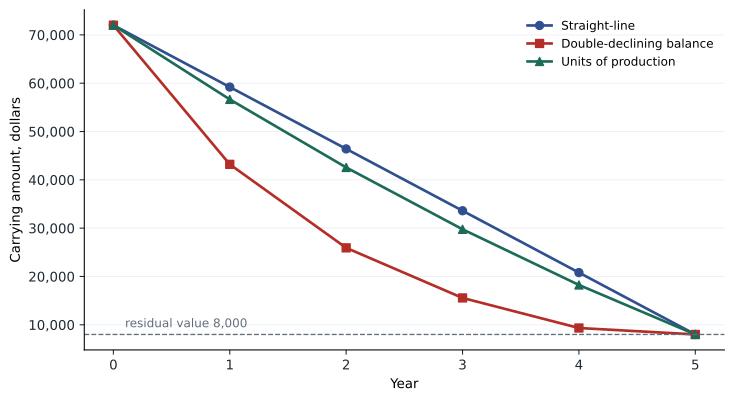
print(f"{'Total':<5}{sum(sl):>15,.0f}{sum(ddb):>18,.0f}{sum(uop):>21,.0f}")Year Straight-line Double-declining Units of production 1 12,800 28,800 15,360 2 12,800 17,280 14,080 3 12,800 10,368 12,800 4 12,800 6,221 11,520 5 12,800 1,331 10,240 Total 64,000 64,000 64,000
Every method depreciates the same $64,000 over the van's life; they differ only in timing. Double-declining balance charges $28,800 in year 1, more than twice the straight-line $12,800, and very little in the final years, when the carrying amount is already close to residual value. Units of production follows the kilometers driven. Which method is right depends on how the van's benefits are actually consumed: if wear depends on distance, units of production is the most faithful.
Partial periods and changes in estimates
Assets bought or sold during the year are depreciated for the fraction of the year they were available. Some companies simplify by policy, taking a half-year in the year of acquisition and disposal, or a full month for assets acquired in the first half of a month. US tax depreciation uses MACRS, with prescribed recovery periods and conventions, plus bonus depreciation and Section 179 expensing; book depreciation follows GAAP, and the difference creates deferred tax (ACCT-212). When an estimate changes, the remaining carrying amount (less the new residual value) is depreciated over the revised remaining life; past depreciation is not restated.
Worked problem
Change in useful life and residual value
Northlake bought a calibration machine on 1 January 2023 for $486,500, with an 8-year life and $30,500 residual value, depreciated straight-line. On 1 January 2026 it revises the total life to 10 years and the residual value to $20,000. Compute 2026 depreciation.
Show solution
- Original annual depreciation = (486,500 − 30,500) ÷ 8 = $57,000.
- Accumulated depreciation at 31 December 2025 (3 years) = $171,000; carrying amount = $315,500.
- Remaining life at 1 January 2026 = 10 − 3 = 7 years.
- 2026 depreciation = (315,500 − 20,000) ÷ 7 = $42,214.
Answer: Depreciation falls to about $42,214 a year from 2026; prior years are not restated.
Worked problem
Component depreciation
Northlake's new factory costs $9,000,000: structure $6,000,000 (40-year life), roof $900,000 (20 years), heating and ventilation $1,500,000 (15 years) and fit-out $600,000 (10 years). No residual values. Compute annual depreciation by components (as IFRS requires and US GAAP permits) and compare with a single 40-year life.
Show solution
- Structure 6,000,000 ÷ 40 = $150,000; roof 900,000 ÷ 20 = $45,000; heating and ventilation 1,500,000 ÷ 15 = $100,000; fit-out 600,000 ÷ 10 = $60,000.
- Total component depreciation = $355,000 a year.
- Single-asset depreciation = 9,000,000 ÷ 40 = $225,000 a year.
- When the roof is replaced in year 20, its cost is fully depreciated and the new roof is capitalized as a new component.
Answer: Componentization gives $355,000 a year, more faithful to how the parts wear out, versus $225,000 as a single asset.
The IFRS revaluation model (for comparison)
IFRS reporters may choose the revaluation model for an entire class of PP&E, carrying it at fair value at the revaluation date less subsequent depreciation and impairment, with revaluations regular enough to stay close to fair value. US GAAP prohibits this: PP&E is carried at historical cost less depreciation and impairment, and write-ups are not allowed. Understanding the IFRS model helps when comparing a US company with a European, Canadian or Australian competitor that revalues its real estate.
A revaluation increase is recognized in other comprehensive income and accumulated in equity as a revaluation surplus, except to the extent it reverses a previous revaluation decrease of the same asset recognized in profit or loss, in which case that part is recognized in profit or loss. A revaluation decrease is recognized in profit or loss, except to the extent there is a revaluation surplus for the same asset, in which case it first reduces the surplus through OCI. The revaluation surplus is never recycled to profit or loss. It may be transferred directly to retained earnings as the asset is used (the difference between depreciation on the revalued amount and on original cost) or when the asset is derecognized.
# Revaluation model with the elimination method (IFRS, illustrative)
cost, life_years = 5_000_000, 25           # head-office building, no residual value
years_used = 5
acc_dep = cost / life_years * years_used
carrying = cost - acc_dep
fair_value = 5_400_000
surplus = fair_value - carrying
print(f"Carrying amount before revaluation {carrying:,.0f}; fair value {fair_value:,}")
print(f"Eliminate accumulated depreciation {acc_dep:,.0f}; revaluation surplus (OCI) {surplus:,.0f}")
new_dep = fair_value / (life_years - years_used)
old_dep = cost / life_years
print(f"Depreciation after revaluation {new_dep:,.0f} vs on cost {old_dep:,.0f}")
print(f"Annual transfer from surplus to retained earnings: {new_dep - old_dep:,.0f}")
# Two years later fair value drops
carrying2 = fair_value - 2 * new_dep
remaining_surplus = surplus - 2 * (new_dep - old_dep)
fv2 = 4_300_000
drop = carrying2 - fv2
to_oci = min(drop, remaining_surplus)
print(f"Later decrease {drop:,.0f}: {to_oci:,.0f} against surplus in OCI, {drop - to_oci:,.0f} in profit or loss")Carrying amount before revaluation 4,000,000; fair value 5,400,000 Eliminate accumulated depreciation 1,000,000; revaluation surplus (OCI) 1,400,000 Depreciation after revaluation 270,000 vs on cost 200,000 Annual transfer from surplus to retained earnings: 70,000 Later decrease 560,000: 560,000 against surplus in OCI, 0 in profit or loss
An IFRS reporter revaluing Northlake's head-office building after five years eliminates $1,000,000 of accumulated depreciation and credits a $1,400,000 revaluation surplus to OCI. Depreciation rises from $200,000 to $270,000 a year, and $70,000 a year may be transferred from the surplus to retained earnings. Two years later, when fair value falls to $4,300,000, the carrying amount is $4,860,000, so the decrease is $560,000. The remaining surplus is still $1,260,000 after two annual transfers, so the whole decrease is charged against the surplus through OCI and none of it reaches profit or loss, as the program confirms. Revaluation makes the balance sheet more current at the cost of more volatility, more estimation and lower reported profit through higher depreciation.
Depletion of natural resources
Natural resources such as mineral deposits, oil and gas reserves and timber are depleted, usually by the units-of-production method: depletion per unit = (cost − residual value) ÷ estimated recoverable units. Cost includes acquisition, exploration and evaluation costs that are capitalized under the entity's policy, development costs and estimated restoration obligations. US GAAP allows oil and gas producers to choose the successful efforts or full cost method, which treat dry holes very differently. Because reserve estimates change, depletion rates are revised prospectively. Depletion is first charged to inventory (the extracted resource) and becomes cost of sales when sold.
Derecognition
An item of PP&E is derecognized on disposal or when no future economic benefits are expected from its use or disposal. The gain or loss is the difference between the net disposal proceeds and the carrying amount, recognized in profit or loss when the item is derecognized; gains are not classified as revenue. Depreciation is recorded up to the date of disposal before the gain or loss is computed. Assets retired from use but not yet disposed of continue to be depreciated (or are reclassified as held for sale if the criteria are met).
Worked problem
Sale of equipment during the year
On 30 September 2026 Northlake sells test equipment that cost $240,000 on 1 January 2021, with a 10-year life, $20,000 residual value and straight-line depreciation, for $95,000. Record the sale.
Show solution
- Annual depreciation = (240,000 − 20,000) ÷ 10 = $22,000.
- Depreciation for 2026 to 30 September = 22,000 × 9 ÷ 12 = $16,500; record it first.
- Accumulated depreciation = 5 × 22,000 + 16,500 = $126,500; carrying amount = $113,500.
- Loss on disposal = 113,500 − 95,000 = $18,500.
Answer: Debit cash 95,000, accumulated depreciation 126,500 and loss 18,500; credit equipment 240,000.
When an asset is destroyed or lost and insurance compensation is receivable, the derecognition of the asset and the recognition of the compensation are separate events: the asset is written off (a loss), and compensation is recognized in profit or loss when it becomes receivable (virtually certain under IFRS, or probable under the US gain contingency and loss recovery guidance, with gains in excess of losses deferred until realized). Replacement assets are recorded at their own cost.
Under ASC 360-10, a long-lived asset (or disposal group) is classified as held for sale when management commits to a plan to sell, the asset is available for immediate sale, an active program to locate a buyer has begun, the sale is probable and expected within one year, it is marketed at a reasonable price and significant changes to the plan are unlikely. It is measured at the lower of carrying amount and fair value less costs to sell, presented separately and no longer depreciated.
Common mistakes
MistakeTreating depreciation as a process of valuing the asset at market value.
InsteadDepreciation allocates cost (or revalued amount) over useful life; it is not a valuation.
MistakeContinuing to depreciate land.
InsteadLand usually has an unlimited life and is not depreciated; land improvements are.
MistakeRestating prior years when a useful life is revised.
InsteadApply the change prospectively over the remaining life.
MistakeRevaluing PP&E upward under US GAAP.
InsteadUS GAAP prohibits upward revaluation; only IFRS permits the revaluation model.
MistakeForgetting to record depreciation to the date of disposal.
InsteadUpdate depreciation before computing the gain or loss.
Summary and key terms
- Depreciation allocates the depreciable amount (cost less residual value) over useful life, starting when the asset is available for use.
- Methods include straight-line, diminishing balance and units of production; the method should match the consumption of benefits.
- Changes in useful life, residual value or method are changes in estimates applied prospectively.
- US GAAP permits component depreciation and reviews estimates when circumstances change.
- US GAAP prohibits revaluation; IFRS reporters may revalue a whole class with surplus in OCI.
- Natural resources are depleted by units of production, with revisions applied prospectively.
- On derecognition, the gain or loss is net proceeds less carrying amount; held-for-sale assets stop being depreciated.
- Sum-of-the-years'-digits
- An accelerated method allocating the depreciable amount by remaining life over the sum of the years' digits.
- Depreciable amount
- Cost (or revalued amount) less residual value.
- Residual value
- The estimated amount the entity would obtain from disposal of the asset at the end of its useful life, less disposal costs.
- Useful life
- The period over which an asset is expected to be available for use, or the units expected to be obtained.
- Straight-line method
- Depreciation in equal amounts over useful life.
- Double-declining balance
- An accelerated method applying twice the straight-line rate to the carrying amount.
- Units-of-production method
- Depreciation in proportion to actual output or usage.
- Revaluation surplus
- The equity reserve built up from upward revaluations recognized in OCI (IFRS).
- Depletion
- The allocation of the cost of natural resources as they are extracted.
- Derecognition
- Removal of an asset from the statement of financial position.
- Held for sale
- Classification of an asset whose carrying amount will be recovered principally through sale, measured at the lower of carrying amount and fair value less costs to sell.
Practice problems
Work each problem on paper first, then reveal the answer to check.
Cost $50,000; residual $5,000; life 5 years. Straight-line annual depreciation?
Show answer
$9,000.
Same asset, double-declining balance year 1 and year 2?
Show answer
Year 1 $20,000; year 2 $12,000.
A machine costing $100,000 with no residual value will produce 50,000 units; 8,000 made this year. Depreciation?
Show answer
$16,000.
Carrying amount $60,000 after 4 years; revised remaining life 5 years, residual $10,000. New annual depreciation?
Show answer
$10,000.
An asset bought on 1 April with annual straight-line depreciation of $12,000. First-year depreciation (December year end)?
Show answer
$9,000.
Could a US company record the same $0.5 million revaluation?
Show answer
No; US GAAP prohibits upward revaluation of PP&E.
A mine costs $12 million with 4 million metric tons recoverable; 500,000 metric tons extracted. Depletion?
Show answer
$1,500,000.
Equipment with a carrying amount of $40,000 is sold for $46,000. Gain or loss?
Show answer
Gain of $6,000.
Is an asset held for sale depreciated?
Show answer
No.
Rerun the depreciation program with a residual value of $12,000. What is straight-line depreciation?
Show answer
$12,000 a year.
Lesson quiz · 5 questions
Score 60% or more to complete this lesson.
Create a free account to save your progress, take quizzes and earn a certificate.