
ACCT-211 · Lesson 12 of 12 · 27 min
Intangible assets, goodwill and capstone: an integrated asset-reporting case
Much of a modern company's value lies in things it cannot touch: patents, software, customer relationships, brands, licenses and the know-how of its people. Accounting recognizes only some of these. This final lesson explains which intangible assets are recognized and how they are measured and amortized, why research and development is treated so differently across frameworks, how goodwill arises in a business combination and how it is tested, and how two special IFRS categories, investment property and biological assets, are measured. It then looks at earnings management involving assets and closes with a capstone case that pulls together the year-end asset reporting of Northlake Instruments.
What an intangible asset is
ASC 350 covers intangible assets other than goodwill, defining them as assets (not financial assets) that lack physical substance. In a business combination, ASC 805 recognizes intangible assets separately from goodwill if they arise from contractual or other legal rights or are separable, the same identifiability test as IFRS. The entity must control the asset and expect future benefits from it. An assembled workforce is never recognized separately; its value is part of goodwill.
Intangibles acquired separately are recognized at cost, including the purchase price and directly attributable costs such as legal fees. Intangibles acquired in a business combination are recognized at fair value at the acquisition date, separately from goodwill, if they are identifiable, even if the acquiree never recognized them: customer lists, order backlogs, trade names, technology and non-compete agreements are common examples. Internally generated goodwill, brands, mastheads, publishing titles and customer lists are never recognized, because their cost cannot be distinguished from the cost of developing the business as a whole.
Research and development
ASC 730 requires research and development costs to be expensed as incurred, with limited exceptions: R&D acquired in a business combination is capitalized at fair value as an indefinite-lived intangible until the project is completed or abandoned; materials and equipment with alternative future uses are capitalized and depreciated. Software has special rules. Costs of software to be sold, leased or marketed (ASC 985-20) are expensed until technological feasibility is established and capitalized from then until general release, which in practice often means little is capitalized. Internal-use software (ASC 350-40) has historically followed a stage model: preliminary project costs expensed, application development costs capitalized and post-implementation costs expensed. ASU 2025-06, effective for annual periods beginning after 15 December 2027 with early adoption permitted, removes the project stages: capitalization starts when management has authorized and committed to funding the project and it is probable that the project will be completed and the software used as intended, which cannot be met while significant development uncertainty remains (such as novel, unproven features). IFRS, by contrast, capitalizes all development that meets IAS 38's six criteria.
# Development costs: expensed vs capitalized (illustrative, thousands)
quarters = [("Q1 research", 400, False), ("Q2 research", 350, False),
            ("Q3 development, criteria not yet met", 300, False),
            ("Q4 development, all criteria met", 500, True),
            ("Next year development to launch", 700, True)]
expensed = capitalized = 0
for name, cost, meets in quarters:
    if meets: capitalized += cost
    else: expensed += cost
    print(f"{name:<40} {cost:>4}  {'capitalize' if meets else 'expense'}")
print(f"Total expensed {expensed:,}; capitalized {capitalized:,}")
life_years = 4
print(f"Amortization from launch: {capitalized / life_years:,.0f} a year for {life_years} years")
print(f"If all costs were expensed (US GAAP pattern): expense {expensed + capitalized:,} before launch")Q1 research 400 expense Q2 research 350 expense Q3 development, criteria not yet met 300 expense Q4 development, all criteria met 500 capitalize Next year development to launch 700 capitalize Total expensed 1,050; capitalized 1,200 Amortization from launch: 300 a year for 4 years If all costs were expensed (US GAAP pattern): expense 2,250 before launch
Northlake's new particulate sensor cost $2.25 million to bring to launch. Under US GAAP all of it is expensed as R&D as incurred (unless some qualifies as software development under the specific rules). An IFRS reporter would capitalize the $1.2 million of development incurred after all six IAS 38 criteria were met and amortize it over four years from launch, so its reported profit before launch would be $1.2 million higher and its assets larger. Analysts adjust for this difference when comparing technology companies across frameworks.
Useful life, amortization and revaluation
Intangibles with finite useful lives are amortized on a systematic basis reflecting the pattern of consumption (straight-line if the pattern cannot be determined reliably), usually with a residual value of zero, from when the asset is available for use. Useful life considers legal and contractual limits, renewal rights if renewal is expected without significant cost, technical obsolescence and competition. Intangibles with indefinite useful lives, where there is no foreseeable limit to the period over which they are expected to generate cash flows (some broadcast licenses or trademarks), are not amortized but are tested for impairment annually and whenever there is an indication, and the indefinite-life assessment is reviewed each period. US GAAP does not permit revaluation of intangibles.
Worked problem
Amortizing an acquired patent
On 1 July 2025 Northlake buys a patent on a sensor coating for $360,000 plus $24,000 of legal fees. The patent has 12 years of legal life remaining, but Northlake expects better coatings to make it obsolete in 8 years. On 1 January 2027 a successful legal defense costs $30,000 and does not extend the life. Compute amortization for 2025, 2026 and 2027.
Show solution
- Cost = 360,000 + 24,000 = $384,000; useful life 8 years (the shorter of economic and legal life). Annual amortization $48,000.
- 2025 (half year): $24,000. 2026: $48,000. Carrying amount at 31 December 2026 = $312,000.
- Legal defense costs: US practice often capitalizes the cost of successfully defending a patent and amortizes it over the remaining life; IFRS generally expenses it.
- If capitalized, 2027 amortization = (312,000 + 30,000) ÷ 6.5 = $52,615.
Answer: Amortization of $24,000 and $48,000, then $52,615 in 2027 if defense costs are capitalized.
Goodwill
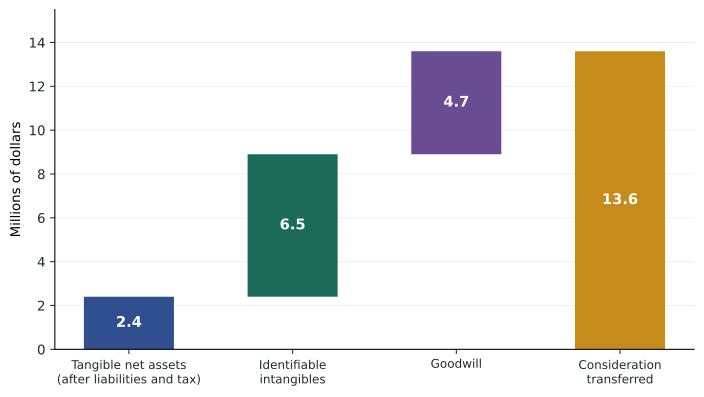
Goodwill arises only in a business combination. It is measured at the acquisition date as the excess of (a) the consideration transferred, measured at fair value, plus the amount of any non-controlling interest in the acquiree, plus the fair value of any previously held interest, over (b) the net of the acquisition-date fair values of the identifiable assets acquired and liabilities assumed. It represents future economic benefits from assets that are not individually identified and separately recognized: synergies, an assembled workforce, going-concern value. If (b) exceeds (a), the acquirer reassesses its measurements and, if the excess remains, recognizes a bargain purchase gain in profit or loss. Consolidation and the measurement of non-controlling interests are covered in ACCT-311.
# Goodwill on Northlake's acquisition of AeroTrace (illustrative, thousands)
consideration = {"Cash": 9_000, "Northlake shares issued (fair value)": 4_000,
                 "Contingent consideration (fair value)": 600}
identifiable = {"Receivables": 1_100, "Inventory": 1_400, "Equipment": 2_300,
                "Customer relationships": 2_600, "Developed technology": 3_200,
                "Trade name": 700, "Payables and accruals": -1_500,
                "Deferred tax liability on fair value uplifts": -900}
paid = sum(consideration.values())
net_assets = sum(identifiable.values())
goodwill = paid - net_assets
print(f"Consideration transferred {paid:,}")
print(f"Fair value of identifiable net assets {net_assets:,}")
print(f"Goodwill {goodwill:,}" if goodwill >= 0 else f"Bargain purchase gain {-goodwill:,}")
intang = identifiable["Customer relationships"] + identifiable["Developed technology"] + identifiable["Trade name"]
print(f"Identifiable intangibles recognized separately: {intang:,}")Consideration transferred 13,600 Fair value of identifiable net assets 8,900 Goodwill 4,700 Identifiable intangibles recognized separately: 6,500
Northlake paid $13.6 million for AeroTrace, a smaller maker of aviation sensors, including contingent consideration measured at fair value. AeroTrace's identifiable net assets at fair value are $8.9 million, including $6.5 million of intangibles AeroTrace never recognized itself: customer relationships, developed technology and a trade name. Goodwill is $4.7 million. Recognizing the identifiable intangibles separately matters, because most of them are amortized while goodwill is not.
Under US GAAP, public companies do not amortize goodwill. It is assigned to reporting units and tested at least annually (lesson 11): after an optional qualitative assessment, the fair value of the reporting unit is compared with its carrying amount, and any excess of carrying amount is an impairment loss, limited to the goodwill assigned (ASU 2017-04). Private companies and not-for-profit entities may elect the PCC alternative to amortize goodwill straight-line over ten years or less and test for impairment only on triggering events, at the entity or reporting unit level. Goodwill impairments are never reversed.
Investment property and biological assets
IFRS has two categories with fair value options that US GAAP lacks. Under IAS 40, investment property (land or buildings held to earn rentals or for capital appreciation) may be measured at fair value with changes in profit or loss and no depreciation; under US GAAP real estate held for investment is carried at cost less depreciation (except by certain investment companies). Under IAS 41, biological assets (livestock, fish farms, timber) are measured at fair value less costs to sell with changes in profit or loss; US GAAP (ASC 905, Agriculture) generally uses historical cost for growing crops and animals, with limited exceptions. US analysts comparing a US agricultural or real estate company with an IFRS peer must adjust for these measurement differences.
Earnings management and assets
Many accounting scandals have involved assets: capitalizing costs that should be expensed, delaying write-downs, building reserves in good years and releasing them in bad ones ('cookie-jar' reserves), stuffing distribution channels at quarter end (lesson 5) and inflating the existence or value of assets. Red flags include receivables or inventory growing much faster than sales, operating cash flow persistently below profit, large or frequent changes in estimates, unusual year-end transactions and auditor changes. In the United States, WorldCom's 2002 fraud centered on capitalizing billions of dollars of line costs (ordinary operating expenses) as PP&E, which overstated assets and profit; it remains the textbook example of improper capitalization. The SEC regularly brings enforcement actions involving premature revenue recognition, improper capitalization and delayed impairments. BUS-310 discusses Enron, WorldCom and the Sarbanes-Oxley reforms. The defense is the same in every framework: neutral judgments, robust internal control, an independent audit committee and auditor, and full disclosure.
Capstone: Northlake's year-end asset reporting
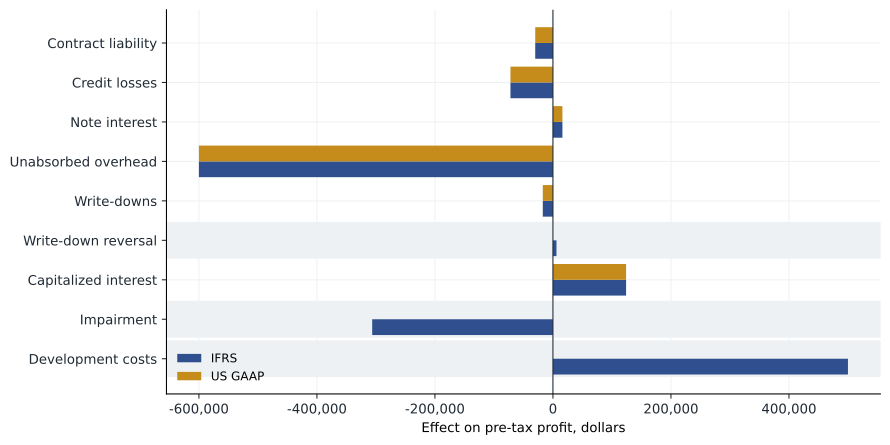
The capstone brings the course together. At 31 December 2026 Northlake's controller must finalize the asset side of the statements. The facts, all illustrative, draw on every lesson: the airport contract (lesson 4), the distributor rebate and loyalty points (lesson 5), the provision matrix and the town's note (lesson 6), inventory cut-off, overhead and write-downs (lessons 7 and 8), the wind-tunnel facility and calibration machine (lesson 9), the revalued head office and van disposals (lesson 10), the marine-sensor impairment (lesson 11) and the AeroTrace intangibles (this lesson). The program below summarizes the adjustments and their effect on pre-tax profit under US GAAP, with the IFRS outcome shown where it differs.
# Capstone: effect of year-end asset adjustments on pre-tax profit (illustrative, $)
adjustments = [
    # (lesson, item, IFRS effect, US GAAP effect)
    (4, "Airport contract: monitoring deferred to contract liability", -30_000, -30_000),
    (6, "Credit loss expense from provision matrix", -72_000, -72_000),
    (6, "Interest income on the town's discounted note", 16_075, 16_075),
    (7, "Unabsorbed fixed overhead expensed (slow year)", -600_000, -600_000),
    (8, "Inventory write-downs (Model S and damaged meters)", -17_200, -17_200),
    (8, "Reversal of prior Model S write-down after new buyer", 6_000, 0),
    (9, "Interest capitalized on wind-tunnel facility", 124_000, 124_000),
    (11, "Marine-sensor line impairment", -306_317, 0),
    (12, "Development costs capitalized after criteria met", 500_000, 0),
]
ifrs = sum(a[2] for a in adjustments); us = sum(a[3] for a in adjustments)
for lesson, item, i_eff, u_eff in adjustments:
    print(f"L{lesson:<3}{item:<56}{i_eff:>10,}{u_eff:>10,}")
print(f"{'Net effect on pre-tax profit':<60}{ifrs:>10,}{us:>10,}")
print(f"Difference between frameworks: {ifrs - us:,}")L4 Airport contract: monitoring deferred to contract liability -30,000 -30,000 L6 Credit loss expense from provision matrix -72,000 -72,000 L6 Interest income on the town's discounted note 16,075 16,075 L7 Unabsorbed fixed overhead expensed (slow year) -600,000 -600,000 L8 Inventory write-downs (Model S and damaged meters) -17,200 -17,200 L8 Reversal of prior Model S write-down after new buyer 6,000 0 L9 Interest capitalized on wind-tunnel facility 124,000 124,000 L11 Marine-sensor line impairment -306,317 0 L12 Development costs capitalized after criteria met 500,000 0 Net effect on pre-tax profit -379,442 -579,125 Difference between frameworks: 199,683
Under US GAAP, the year-end adjustments reduce Northlake's pre-tax profit by $579,125. An IFRS reporter with identical facts would show −$379,442, a difference of $199,683 from three items this course has highlighted: the IFRS reversal of an inventory write-down (prohibited under US GAAP), the IFRS one-step impairment test (which catches the marine-sensor line that passes the US recoverability screen) and capitalized development costs (IFRS capitalizes; US GAAP expenses R&D). A US analyst comparing Northlake with a European or Canadian competitor must reconcile exactly these items.
| Asset area | Key question at year end | Where covered |
|---|---|---|
| Revenue and contract balances | Has control transferred? How much is deferred? | Lessons 4–5 |
| Receivables | What lifetime losses are expected? Are discounted notes at amortized cost? | Lesson 6 |
| Inventory | Correct cut-off? Overhead at normal capacity? Any NRV write-downs or reversals? | Lessons 7–8 |
| Property, plant and equipment | Correct capitalization, interest, components, depreciation and disposals? | Lessons 9–10 |
| Impairment | Any indicators? Do assets pass the applicable test? | Lesson 11 |
| Intangibles and goodwill | Development criteria met? Acquired intangibles separated from goodwill? Annual goodwill test? | Lesson 12 |
| Presentation and disclosure | Correct classification, fair value levels, cash flow categories and events after the reporting period? | Lessons 1–3 |
ACCT-212 continues with the other side of the balance sheet: current and long-term liabilities, provisions and contingencies, leases, income taxes (including the deferred taxes created by many of the differences in this course), pensions and shareholders' equity.
Common mistakes
MistakeCapitalizing internally generated brands or customer lists.
InsteadThese are never recognized; only acquired brands and customer relationships are recognized.
MistakeCapitalizing internal R&D costs under US GAAP because the product succeeded.
InsteadASC 730 requires R&D to be expensed as incurred, except specific software and acquired R&D rules.
MistakeAmortizing goodwill in a public company's IFRS or US GAAP statements.
InsteadPublic companies test goodwill for impairment and do not amortize it (US private companies may elect amortization).
MistakeLumping identifiable intangibles acquired in a business combination into goodwill.
InsteadRecognize identifiable intangibles separately at fair value; goodwill is the residual.
MistakeAmortizing an indefinite-life intangible over 40 years.
InsteadIndefinite-life intangibles are not amortized; test them annually and review the indefinite-life assessment.
Summary and key terms
- An intangible asset is identifiable (separable or contractual-legal), controlled and expected to produce future benefits.
- Acquired intangibles are recognized at cost or, in a business combination, at fair value; internally generated brands and goodwill are not recognized.
- R&D is expensed under ASC 730; software has special capitalization rules, updated by ASU 2025-06.
- Finite-life intangibles are amortized; indefinite-life intangibles and goodwill are tested for impairment instead.
- Goodwill is the excess of consideration (plus non-controlling interest) over the fair value of identifiable net assets.
- US GAAP uses cost for investment real estate and generally for agriculture; IFRS uses fair value options.
- Asset-related earnings management includes improper capitalization, delayed write-downs and cookie-jar reserves.
- Intangible asset
- An identifiable non-monetary asset without physical substance.
- Identifiability
- The quality of being separable or arising from contractual or other legal rights.
- Research
- Original, planned investigation to gain new scientific or technical knowledge.
- Development
- Application of research to a plan or design for new or substantially improved products or processes.
- Indefinite useful life
- No foreseeable limit to the period over which an asset is expected to generate cash flows.
- Goodwill
- The excess of consideration and non-controlling interest over the fair value of identifiable net assets acquired.
- Bargain purchase
- A business combination in which the fair value of net assets exceeds the consideration, producing a gain.
- Investment property
- Land or buildings held to earn rentals or for capital appreciation.
- Biological asset
- A living animal or plant.
- Cookie-jar reserve
- An overstated liability or allowance built in good periods and released to boost later profits.
Practice problems
Work each problem on paper first, then reveal the answer to check.
Is a customer list acquired in a business combination recognized?
Show answer
Yes, separately from goodwill, at fair value.
Is an internally developed brand recognized?
Show answer
No.
Under ASU 2025-06, when does capitalization of internal-use software begin?
Show answer
When funding is authorized and committed and completion is probable, with no significant development uncertainty.
A license costing $90,000 runs 6 years with no expected renewal. Annual amortization?
Show answer
$15,000.
Consideration $5 million; identifiable net assets at fair value $4.2 million. Goodwill?
Show answer
$800,000.
Consideration $3 million; identifiable net assets $3.4 million after reassessment. Result?
Show answer
A bargain purchase gain of $400,000.
Is goodwill impairment ever reversed?
Show answer
No.
How would a US GAAP reporter carry a rental building?
Show answer
At cost less depreciation and impairment.
Give two warning signs of asset-related earnings management.
Show answer
Receivables or inventory growing faster than sales; CFO persistently below profit; frequent estimate changes; unusual year-end transactions.
In the capstone program, what happens to the framework difference if the marine-sensor line also fails the US recoverability test (US loss $450,000)?
Show answer
US effect becomes −$1,029,125; the difference becomes IFRS higher by $649,683.
Lesson quiz · 5 questions
Score 60% or more to complete this lesson.
Create a free account to save your progress, take quizzes and earn a certificate.