
ACCT-211 · Lesson 4 of 12 · 30 min
Revenue recognition I: the five-step model
Revenue is usually the largest number in the income statement and the one most often misstated. Until 2018 US GAAP had more than a hundred pieces of revenue guidance, many of them specific to industries such as software, real estate and construction. The FASB and IASB replaced them with a single converged model: ASC 606, Revenue from Contracts with Customers, and IFRS 15, which share the same core principle and five steps. US public companies adopted ASC 606 in 2018 and private companies in 2019. The two standards remain substantially the same, with a few differences in detail, such as collectibility thresholds, shipping and handling elections and license renewals. This lesson covers the five steps; lesson 5 covers special issues such as variable consideration, financing components, principal-versus-agent, licenses, warranties and loyalty points.
The core principle is that an entity recognizes revenue to depict the transfer of promised goods or services to customers in an amount that reflects the consideration to which it expects to be entitled in exchange. Revenue follows control: when the customer obtains control of what was promised, the entity has performed and recognizes revenue. Cash timing does not decide it. A customer that pays upfront creates a contract liability; a customer that receives goods before paying creates a receivable or, if the right to payment depends on something other than time, a contract asset.
The five steps
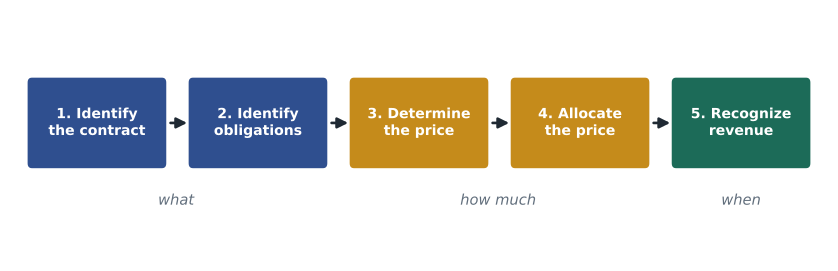
| Step | Question it answers | Key judgments |
|---|---|---|
| 1. Identify the contract | Is there an enforceable agreement with a customer? | Approval, rights, payment terms, commercial substance, probable collection; combining contracts |
| 2. Identify performance obligations | What distinct promises has the entity made? | Is each good or service capable of being distinct and distinct in the context of the contract? |
| 3. Determine the transaction price | How much does the entity expect to be entitled to? | Variable consideration, financing components, non-cash consideration, amounts payable to the customer |
| 4. Allocate the price | How much belongs to each obligation? | Standalone selling prices, observed or estimated; allocating discounts |
| 5. Recognize revenue when (or as) each obligation is satisfied | When does control transfer? | Over time or at a point in time; measuring progress |
Step 1: identify the contract
A contract is an agreement between two or more parties that creates enforceable rights and obligations. It can be written, oral or implied by customary business practice. The model applies only when all five criteria are met: the parties have approved the contract and are committed to perform; each party's rights regarding the goods or services can be identified; the payment terms can be identified; the contract has commercial substance (it is expected to change the risk, timing or amount of the entity's future cash flows); and it is probable that the entity will collect the consideration to which it will be entitled. If the criteria are not met, cash received is recorded as a liability until the criteria are met or the contract is complete and the cash non-refundable.
Probable has a slightly different meaning under the two frameworks: under US GAAP it means likely to occur, while under IFRS it means more likely than not, a lower threshold. A contract with a customer of doubtful credit could therefore fail step 1 under US GAAP but pass under IFRS. Contracts entered into at or near the same time with the same customer are combined if they are negotiated as a package, if the price of one depends on the other, or if the goods or services form a single performance obligation.
Contract modifications, changes in scope or price approved by both parties, are common in practice. A modification that adds distinct goods or services at their standalone selling prices is treated as a separate contract. Otherwise, if the remaining goods or services are distinct from those already transferred, the modification is accounted for prospectively, as if the old contract ended and a new one began; if they are not distinct (for example, a change to a partly built asset), the modification is treated as part of the existing contract with a cumulative catch-up adjustment to revenue.
Step 2: identify performance obligations
A performance obligation is a promise to transfer a good or service (or a bundle) that is distinct, or a series of distinct goods or services that are substantially the same and transferred in the same pattern, such as a monthly monitoring service. A good or service is distinct if two criteria are both met. First, it is capable of being distinct: the customer can benefit from it on its own or with readily available resources. Second, it is distinct in the context of the contract: the promise is separately identifiable from other promises. It is not separately identifiable if the entity provides a significant integration service combining the items into a combined output, if one item significantly modifies or customizes another, or if the items are highly interdependent.
Worked problem
Identifying Northlake's performance obligations
Northlake signs a contract with a regional airport for one weather sensor station, installation and three years of data monitoring, for a single price of $120,000 paid on signing. Other qualified installers could install the station, and the station works with other monitoring services. Identify the performance obligations.
Show solution
- Station: the airport could benefit from it with installation bought elsewhere, and Northlake is not integrating it into a customized combined output. Distinct.
- Installation: standard work that others can perform; it does not significantly modify the station. Distinct.
- Monitoring: a series of distinct monthly services, substantially the same and transferred over time. One performance obligation (a series).
- If, instead, the installation involved significant customization that only Northlake could perform and that integrated the station into the airport's systems, station and installation would be one combined performance obligation.
Answer: Three performance obligations: the station, installation and the three-year monitoring service.
Some promises are not performance obligations. Administrative tasks to set up a contract, such as creating a customer account, do not transfer a service. Immaterial promises in the context of the contract may be ignored under US GAAP as a policy election; IFRS has no explicit election but applies materiality generally. Shipping and handling after the customer obtains control can be treated as a fulfillment cost rather than a separate obligation under a US GAAP election; IFRS requires an assessment.
Step 3: determine the transaction price
The transaction price is the consideration the entity expects to be entitled to in exchange for transferring the promised goods or services, excluding amounts collected for third parties such as sales taxes. It may include fixed amounts, variable amounts such as bonuses, discounts, rebates or penalties, the effect of a significant financing component, non-cash consideration at fair value and reductions for consideration payable to the customer (such as slotting fees paid to a retailer). In the Northlake airport contract, the price is fixed at $120,000; lesson 5 deals with variable and financing elements. State and local sales taxes collected are excluded from revenue; US GAAP allows an election to present all such taxes on a net basis.
Step 4: allocate the transaction price
The price is allocated to each performance obligation in proportion to its standalone selling price (SSP), the price at which the entity would sell the good or service separately to a similar customer. The best evidence is an observable price when the entity sells the item separately. If no observable price exists, the entity estimates it using an adjusted market assessment approach (what the market would pay, perhaps based on competitors' prices), an expected cost plus a margin approach, or, only in limited circumstances where prices are highly variable or uncertain, a residual approach (total price minus the observable SSPs of the other items). A discount for buying the bundle is allocated proportionally to all obligations unless there is observable evidence that it relates to only some of them.
# Allocate a bundled price by relative standalone selling price (illustrative)
contract_price = 120_000
ssp = {"Sensor station": 90_000, "Installation": 10_000, "Monitoring (3 years)": 36_000}
total_ssp = sum(ssp.values())
print(f"Sum of standalone prices {total_ssp:,}; bundle discount {total_ssp - contract_price:,}")
alloc = {}
for item, price in ssp.items():
    alloc[item] = round(contract_price * price / total_ssp)
    print(f"{item:<22} SSP {price:>7,}  allocated {alloc[item]:>7,}")
# fix rounding so the allocation sums exactly to the contract price
diff = contract_price - sum(alloc.values())
alloc["Sensor station"] += diff
print("Check total:", f"{sum(alloc.values()):,}")
monthly = alloc["Monitoring (3 years)"] / 36
print(f"Monitoring revenue per month: {monthly:,.2f}")Sum of standalone prices 136,000; bundle discount 16,000 Sensor station SSP 90,000 allocated 79,412 Installation SSP 10,000 allocated 8,824 Monitoring (3 years) SSP 36,000 allocated 31,765 Check total: 120,000 Monitoring revenue per month: 882.36
The bundle is sold at a $16,000 discount on the sum of standalone selling prices, and the discount is spread proportionally. The station is allocated $79,411 (after a $1 rounding adjustment), installation $8,824 and monitoring $31,765, recognized at about $882 a month. Had Northlake regularly sold monitoring at a steep discount when bundled, with evidence that the whole discount related to monitoring, it would allocate the discount there instead.
Step 5: recognize revenue when or as obligations are satisfied
A performance obligation is satisfied over time if any one of three criteria is met: the customer simultaneously receives and consumes the benefits as the entity performs (as with monitoring or cleaning services); the entity's performance creates or enhances an asset the customer controls as it is created (as with construction on the customer's land); or the entity's performance does not create an asset with an alternative use to the entity and the entity has an enforceable right to payment for performance completed to date (as with highly customized equipment built to a customer's specification with progress payments). Otherwise the obligation is satisfied at a point in time.
For point-in-time obligations, the entity looks at indicators of the transfer of control: a present right to payment, legal title, physical possession, the transfer of the significant risks and rewards of ownership, and customer acceptance. No single indicator decides the matter. For over-time obligations, revenue is recognized by measuring progress toward complete satisfaction, using an output method (units delivered, milestones reached, surveys of work performed) or an input method (costs incurred, labor hours, machine hours relative to the total expected). The cost-to-cost input method is common for construction and is covered in CON-320; costs that do not reflect progress, such as wasted materials or uninstalled goods bought from third parties, are excluded from the measure.
Worked problem
Recognizing the airport contract
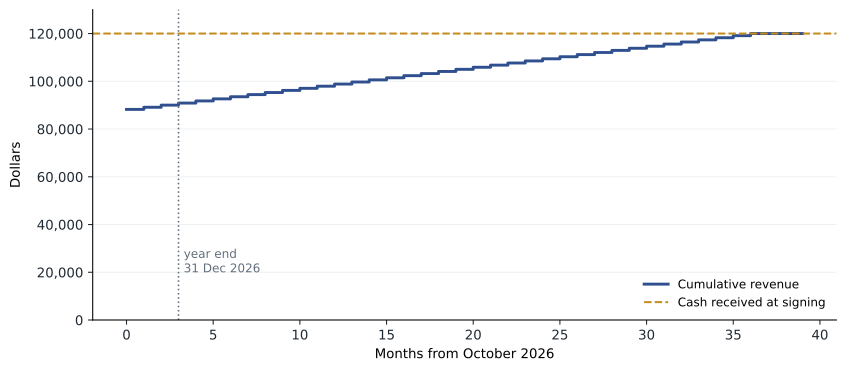
Northlake delivers the station on 1 October 2026 (the airport takes title and possession and accepts it), completes installation on 31 October, and monitoring runs from 1 November 2026 for 36 months. The year ends 31 December. How much revenue is recognized in 2026, and what is the contract balance?
Show solution
- Station: point in time, 1 October, when control transfers: $79,411.
- Installation: a short service; treated as satisfied when completed on 31 October (or over October): $8,824.
- Monitoring: over time, 2 of 36 months: 31,765 × 2 ÷ 36 = $1,765.
- Total 2026 revenue = 79,411 + 8,824 + 1,765 = $90,000.
- Cash received $120,000; revenue $90,000. The difference, $30,000, is a contract liability: $10,588 current (the next 12 months of monitoring) and $19,412 non-current.
Answer: Recognize $90,000 of revenue in 2026 and a contract liability of $30,000 for monitoring still to be provided.
Contract balances, costs and disclosure
When either party has performed, the entity presents a contract asset, a receivable or a contract liability. A receivable is an unconditional right to consideration (only the passage of time is required). A contract asset is a right to consideration that is conditional on something other than time, such as completing another obligation. A contract liability is an obligation to transfer goods or services for which consideration has been received or is due. Costs to obtain a contract that would not have been incurred otherwise, such as sales commissions, are capitalized if expected to be recovered and amortized as the related goods or services transfer; a practical expedient allows expensing them if the amortization period is one year or less. Costs to fulfill a contract that are not covered by another standard (such as inventory) are capitalized if they relate directly to the contract, generate resources used to satisfy future obligations and are expected to be recovered.
Disclosures are extensive: revenue disaggregated into categories that show how economic factors affect it (by product line, geography, timing of transfer), contract balances and changes in them, the remaining performance obligations and when they are expected to be recognized, and the significant judgments made. The aim is to let users see not just how much revenue was recognized but how much is already contracted and when it will flow.
IFRS 15 differences in brief
IFRS 15 and ASC 606 differ in a few details. The collectibility threshold in step 1 is lower under IFRS (more likely than not). US GAAP allows elections that IFRS does not have explicitly: to ignore immaterial promised goods or services, to treat shipping and handling after control transfers as a fulfillment cost, and to present sales taxes net. Guidance on licenses of intellectual property differs on renewals and on how to classify certain licenses. Interim disclosure requirements differ. For most contracts, the timing and amount of revenue are the same under both.
Common mistakes
MistakeRecognizing revenue when cash is received.
InsteadRecognize revenue when control of the good or service transfers; upfront cash is a contract liability.
MistakeTreating every item in a bundle as distinct.
InsteadAn item is distinct only if it is capable of being distinct and separately identifiable in the context of the contract.
MistakeAllocating a bundle discount entirely to the item with the highest margin.
InsteadAllocate discounts proportionally unless observable evidence shows they relate to specific obligations.
MistakeUsing the residual approach whenever a standalone price is not observable.
InsteadUse adjusted market assessment or expected cost plus margin first; the residual approach is limited to highly variable or uncertain prices.
MistakeMeasuring progress on an over-time obligation with costs of wasted materials included.
InsteadExclude costs that do not reflect progress toward satisfying the obligation.
Summary and key terms
- Revenue is recognized when (or as) control of promised goods or services transfers, at the amount the entity expects to be entitled to.
- A contract must meet five criteria, including probable collection, before the model applies.
- Performance obligations are distinct goods or services or a series of substantially the same services.
- The transaction price excludes amounts collected for third parties, such as sales taxes.
- The price is allocated in proportion to standalone selling prices, with discounts spread proportionally unless evidence points elsewhere.
- An obligation is satisfied over time if one of three criteria is met; otherwise at a point in time when control transfers.
- ASC 606 and IFRS 15 are substantially converged, with differences in collectibility and certain elections.
- Performance obligation
- A promise to transfer a distinct good or service, or a series of substantially the same distinct goods or services.
- Transaction price
- The consideration an entity expects to be entitled to for transferring promised goods or services.
- Standalone selling price
- The price at which an entity would sell a promised good or service separately.
- Control
- The ability to direct the use of, and obtain substantially all the remaining benefits from, an asset.
- Contract asset
- A right to consideration conditional on something other than the passage of time.
- Contract liability
- An obligation to transfer goods or services for which consideration has been received or is due.
- Contract modification
- A change in the scope or price of a contract approved by the parties.
- Output method
- Measuring progress by results achieved, such as units delivered or milestones.
- Input method
- Measuring progress by efforts expended, such as costs or hours, relative to the total expected.
- Incremental costs of obtaining a contract
- Costs, such as commissions, that would not have been incurred if the contract had not been obtained.
Practice problems
Work each problem on paper first, then reveal the answer to check.
State the core principle of IFRS 15 and ASC 606.
Show answer
Recognize revenue to depict the transfer of promised goods or services in an amount reflecting the consideration expected.
List the five criteria for a contract to exist under the model.
Show answer
Approval and commitment; identifiable rights; identifiable payment terms; commercial substance; probable collection.
A gym sells a 12-month membership for $600 paid upfront. Revenue in month 1?
Show answer
$50; the remaining $550 is a contract liability.
Northlake sells a station ($90,000 SSP) and monitoring ($36,000 SSP) for $110,000. Allocate.
Show answer
Station 110,000 × 90/126 = $78,571; monitoring $31,429.
When is installation not distinct from the equipment?
Show answer
When it significantly customizes or integrates the equipment into a combined output.
Name the three criteria for satisfaction over time.
Show answer
Customer simultaneously receives and consumes benefits; customer controls the asset as it is created; no alternative use plus enforceable right to payment.
Give two indicators of transfer of control at a point in time.
Show answer
Legal title, physical possession, right to payment, risks and rewards, customer acceptance.
Distinguish a receivable from a contract asset.
Show answer
A receivable is unconditional except for time; a contract asset depends on further performance.
A salesperson earns a $3,000 commission on a 3-year contract. How is it treated?
Show answer
Capitalize as a cost to obtain a contract and amortize over the 3 years (the one-year expedient does not apply).
Modify the Python program for a contract price of $126,000. What is monthly monitoring revenue?
Show answer
$1,000 (36,000 ÷ 36), since no discount remains.
Lesson quiz · 5 questions
Score 60% or more to complete this lesson.
Create a free account to save your progress, take quizzes and earn a certificate.